
Krittika Nakshatra Pada 2: Pending Karma and Predictions from Karma Vipaka Samhita By Vinayak Bhatt
Karma Vipaka
Krittika Nakshatra Pada 2 gives a very different karmic lesson from Krittika Pada 1 because the central person in this story is not lacking knowledge, culture or spiritual training. Indra Sharma is described as a learned Brahmin who studies and teaches the Vedas and the six Vedangas, which means that he already knows the rules connected with Dharma, ritual and proper conduct, yet when an opportunity for substantial material benefit appears through the funeral rites of a king, the attraction of wealth becomes stronger than the discipline expected from his own path. The real issue of Krittika Nakshatra Pada 2 is therefore not ignorance but the moment when a knowledgeable person begins making exceptions for himself because money, status or material comfort have entered the picture.
Krittika Pada 2 occupies 0°00′ to 3°20′ Taurus and falls in Capricorn Navamsha. Krittika is ruled by the Sun and its Devata is Agni, Taurus is ruled by Venus, while Capricorn is ruled by Saturn, giving us a very meaningful combination of Sun, Venus and Saturn. The Sun asks whether a person lives according to principle, Venus brings value, money, comfort and the attraction of material enjoyment, while Saturn represents duty, boundaries, responsibility and the consequences of violating an established order. Agni stands behind all three as the power which tests purity.
The deeper question of this pada therefore becomes very practical: when knowledge, responsibility and financial opportunity come together, does the native remain faithful to Dharma or begin changing the rules because the reward is attractive?
The Karma Vipaka Story of Krittika Pada 2
Lord Shiva tells Parvati that in Kanyakubja Desha there lived a Brahmin named Indra Sharma, whose wife was Rudramati. The text describes Rudramati as quarrelsome and difficult in temperament, but it does not say that she caused Indra Sharma’s karmic mistake, so her character should not be turned into the central explanation of the story. Indra Sharma himself was learned in the Vedas and the six Vedangas—Shiksha, Kalpa, Nirukta, Jyotisha, Chandas and Vyakarana—which means the narrative deliberately places a man of knowledge at the centre rather than somebody who simply did not know what was expected from him.
At that time a Kshatriya king died, and Indra Sharma was invited to participate in the final rites. He ate the ritual meal and accepted substantial donations connected with the obsequies, including a complete bed, elephant and other valuable articles. The translation says that he brought these donations home and enjoyed them for many years, while another commentary explains why this particular event is treated as karmically serious in the text: a Brahmin deeply established in Veda and Vedanga study was traditionally expected to maintain a particular ritual discipline, while specific Brahmins handled Preta Karma or death rites, and Indra Sharma crossed this boundary because of greed and the attraction of the gifts.
This historical ritual rule should not be converted into the modern statement that priests should never be paid for funeral rites, because that is not what the source is teaching. The important point is that Indra Sharma accepted material benefit from an activity which his own discipline told him not to undertake, and therefore his learning did not protect him once greed began deciding which rules mattered.
After many years Indra Sharma died and entered Yamaloka, where the text describes severe suffering for one Yuga. The different translations vary slightly regarding the intermediate births, describing forms such as an elephant, another wild animal and an insect, but they agree that he eventually returned to human birth under the influence of his remaining karma. In that later human birth the text gives disturbance in progeny and health, saying in its old son-centred language that he had no son or had daughters, while in another formulation the wife’s children did not survive and she suffered from different diseases.
The real karmic thread is therefore clear: knowledge and sacred responsibility were exchanged for material benefit, and the resulting karma later disturbed continuity, family happiness and health.
What Is the Pending Karma of Krittika Pada 2?
The pending karma of Krittika Pada 2 is not simply “accepting donation.” Dana is itself an important part of Dharma, and the same Karma Vipaka Samhita repeatedly recommends donation as a remedy, so accepting or giving wealth cannot by itself be the problem. The deeper issue is accepting a benefit which comes only because one has stepped outside the ethical boundary of one’s own role.
This distinction makes Krittika Pada 2 extremely relevant today.
A doctor possesses specialised knowledge, but may recommend an unnecessary procedure because it produces more income. A financial adviser may know that a product is unsuitable for the client but recommend it because the commission is attractive. A teacher may use spiritual or intellectual authority mainly to extract money from frightened students. A lawyer may stretch a dispute because prolonged litigation benefits the professional. An astrologer may knowingly exaggerate fear because an expensive remedy can then be sold. A public official may use authority to receive a benefit which technically becomes available only because of the office they hold.
The professions are different, but the karmic structure is the same. The person knows better. That is what makes the Karma heavier.
The main sutra of Krittika Pada 2 can therefore be expressed as: When knowledge gives you authority, do not allow financial benefit to decide how you use that authority.
This is much more useful than reading the story as a rule about one ancient funeral ritual.
Krittika Pada 2: Taurus Rashi and Capricorn Navamsha
Krittika Pada 2 is the first pada of Krittika to move completely into Taurus, and this changes the expression of the Nakshatra considerably. Krittika still carries Agni and the Sun, so discrimination, purification, standards and the power to separate right from wrong remain strong, but Taurus brings Venus and therefore wealth, comfort, possessions, food, stability and the desire to preserve material security. The Navamsha falls in Capricorn, where Saturn introduces duty, hierarchy, role, social order, consequences and the necessity of following rules even when they are inconvenient.
This makes the Indra Sharma’s story especially suitable for the pada. Sun represents the learned person’s principle, Venus represents the attractive gifts, and Saturn represents the professional or Dharmic boundary which should not be crossed merely because the material reward is tempting.
A well-functioning Krittika Pada 2 can therefore produce somebody who is extremely responsible with money and authority, because Taurus understands value while Capricorn understands accountability. Such a person may become an excellent administrator, adviser, trustee, teacher, financial manager, ritual specialist, judge, institutional head or professional who handles valuable resources while maintaining clear rules.
But the lower expression can become rigidly respectable on the outside while quietly making exceptions whenever the personal benefit is large enough.
The person may sincerely believe:
- “I deserve this.”
- “I have studied for years.”
- “Everybody does it.”
- “There is nothing technically illegal.”
- “They offered it themselves.”
- “I am only taking what is available.”
And this is exactly where Krittika’s fire has to test motive rather than merely outward correctness.
The Strong Prediction: Money Can Test the Native’s Professional Integrity
When Moon, Lagna, Atmakaraka or another important planet occupies Krittika Nakshatra Pada 2, especially when the 2nd, 6th, 9th, 10th or 11th houses become connected, one strong predictive theme is that money can repeatedly test the native’s relationship with duty and professional integrity.
I may tell such a client: “You can become very good at your work and people may trust your knowledge, but one of your major karmic examinations comes when your expertise gives you access to financial benefit. The safest path for you is to keep your professional rules clearer than average, because a short-term gain obtained through a compromised decision can become much more expensive later.”
In another chart the prediction may become: “You may be offered money, position, gifts or advantages because of your knowledge or authority. The important question is not whether the offer is attractive but whether accepting it changes the way you perform your responsibility.”
If Saturn is afflicted, the person may dislike restrictions and look for ways around them. If Venus is afflicted, luxury, comfort or financial need can become stronger than principle. If the Sun is afflicted, ego and entitlement may create the thought that normal rules should not apply to them. When Jupiter protects the combination, knowledge and conscience can correct the decision before the karmic line is crossed.
The same pattern can operate in reverse, where the native repeatedly encounters professionals who misuse knowledge for money, pays for services which were not truly necessary, or becomes disappointed by teachers and advisers whose wisdom becomes secondary to commercial interest. The horoscope tells us which side of the pattern is active.
Knowledge Creates Greater Responsibility
The most important part of Indra Sharma’s story is that he was Veda- and Vedanga-knowing. Karma Vipaka could easily have described an ignorant or untrained person making the same mistake, but it does not. It specifically gives knowledge first and transgression second.
This suggests a very powerful Jyotish principle: The more a person knows, the less easily they can hide behind ignorance.
- A beginner can make a mistake because they genuinely do not understand.
- A teacher cannot use the same excuse repeatedly.
- A young professional may not know the ethical rule.
- A senior professional is expected to know it.
- A student may misinterpret a Shastra.
- A Guru carries a different responsibility when teaching it to hundreds of people.
This makes Krittika Pada 2 particularly important in charts of people whose livelihood comes from knowledge, advice, spiritual work, medicine, law, finance, education, administration or positions where other people rely upon their judgement.
Krittika is the knife of discrimination. The native must use that knife first upon their own motives.
Before judging others, they have to ask: “Would I make the same decision if there were no money in it for me?”
For Krittika Pada 2, that question can reveal the truth very quickly.
Sacred Work and the Problem of Commercialisation
There is another subtle lesson in the story because the controversial wealth comes through death rites, a sacred and emotionally sensitive situation. Somebody has died, the family is performing its duty, and Indra Sharma enters a ritual space where grief, Dharma and material offerings meet.
This gives us a wider modern principle: the more vulnerable the person receiving our professional service, the more carefully money should be handled.
- A grieving family can be sold things they do not really need.
- A sick person can be frightened into paying for unnecessary treatment.
- A frightened astrology client can be sold an expensive remedy.
- A desperate parent can be persuaded to spend beyond their means.
- A person facing death, divorce, debt or illness does not negotiate from the same psychological position as somebody casually purchasing a luxury product.
Therefore, Krittika Pada 2 has to be particularly careful when making money from situations where the other person’s fear or vulnerability is high. Earning through service is not the problem. Exploiting vulnerability is. This distinction is important.
Material Comfort Is Not the Enemy
Because Krittika Pada 2 falls in Taurus, we should not turn the story into an argument against wealth. Taurus seeks material security naturally, and there is nothing inherently wrong with comfort, property, good food, jewellery, wealth or a stable life. The source itself repeatedly gives prosperity as the fruit of good karma in other chapters. The problem begins when comfort becomes important enough to rewrite one’s principles.
This makes Krittika Pada 2 a very practical placement for understanding Dhana versus Dharma.
Dhana is useful. Dharma determines how Dhana should be acquired. When Dharma produces Dhana, prosperity can be stable. When Dhana repeatedly overrules Dharma, the external gain may come quickly while some other area begins paying the hidden cost.
This is why Taurus and Capricorn work so well together at the higher level. Taurus builds resources; Capricorn builds structure around those resources. The mature Krittika Pada 2 native does not reject money but creates clean rules around money.
Why Progeny Becomes the Field of Karmic Result
The Karma Vipaka chapter connects Indra Sharma’s unresolved karma with disturbed progeny. The older wording says that the person may have daughters rather than sons, or that male children may not survive, while the wife may suffer from different diseases. These statements belong to the historical son-centred framework of the text, and the birth of daughters should never be interpreted as a negative result in modern Jyotish. The meaningful karmic point is disturbance of continuity and anxiety concerning progeny, not the sex of the child.
Literal child loss or infertility should never be predicted from Krittika Pada 2 alone. The 5th house, fifth lord, Jupiter, Putrakaraka, Saptamsha and relevant Dashas must repeat the indication before the classical result is applied literally.
Where the 5th house is strong, the symbolism may appear through another form of continuity. A teacher may acquire great knowledge but fail to create worthy students. A professional may gain considerable status but have nobody capable of carrying the institution forward. A family enterprise may accumulate wealth but struggle with succession. An author may possess knowledge but not transmit it properly. A person may obtain material success yet worry constantly about who will continue what they have built.
This gives a deeper sutra: If knowledge is used mainly for personal gain rather than transmission and service, continuity of knowledge itself may become disturbed.
This is an interpretive extension of the source rather than a literal statement made in the chapter, but it fits both the 5th-house symbolism and the life of a learned Brahmin who compromised his own discipline.
The Wife and Household Atmosphere
Rudramati is described as quarrelsome, but the Karma Vipaka chapter does not say that her behaviour caused Indra Sharma to accept the funeral donations. Therefore, it would be incorrect to turn the story into “bad wife caused bad karma.”
The more useful interpretation is that even a learned person does not make decisions in isolation. The atmosphere of the household can either strengthen discipline or slowly weaken it.
A spouse may encourage simplicity or constantly demand more status and luxury.
A spouse may say: “This money is not right for us.” or “Everyone else is taking it, why shouldn’t you?”
A partner may help the native remain close to Dharma or make material comparison the centre of family life.
Therefore, when Venus, the 7th lord, Saturn and the financial houses strongly connect with Krittika Pada 2, spouse and household expectations may influence the native’s decisions about wealth and professional boundaries. This does not remove individual responsibility. Indra Sharma’s decision remained his own. But family culture can make the right decision easier or harder.
Krittika Pada 2 and Health
The source connects the later karmic result with different diseases affecting the wife or the couple, but it does not give a single precise modern diagnosis. One translation and commentary associates the Nakshatra with possible cuts, wounds, inflammatory or heat-related problems, throat and neck concerns, intestinal disturbance and bilious indigestion, while clearly stating that these indications have to be synchronised with the planet, house and affliction.
For practical Jyotish, Taurus makes throat, neck, food and bodily comfort more relevant, while Capricorn Navamsha brings Saturn and therefore chronicity, obstruction or conditions which become troublesome through neglect or long duration. But these are Jyotish inferences, not diagnoses given directly in the Krittika Pada 2 Karma Vipaka story.
Any health statement should therefore be confirmed through Lagna, Lagnesha, Sun, Venus, Saturn, the 6th and 8th houses and relevant Vargas.
The stronger source-based prediction remains that unresolved karma may manifest through family health and continuity rather than through loss of wealth itself.
This is an important point because the original mistake brought material gain. The later result does not necessarily remove money. Karma can return through a completely different area.
The Higher Side of Krittika Pada 2
The higher expression of Krittika Pada 2 is one of clean professional integrity. Such a native can become somebody who knows the rules, understands the value of money and still refuses to sell their judgement. This can produce excellent teachers, administrators, trustees, auditors, judges, doctors, ritual specialists, advisers, financial professionals and institutional leaders because Taurus gives practical value, Capricorn gives discipline, Sun gives authority and Krittika gives the ability to separate what is right from what is merely attractive.
At the lower level the person says: “I know the rule, but this case is different because I benefit.”
At the higher level: “Because I know the rule, I have even greater responsibility to follow it.”
That is the transformation of Krittika Pada 2.
- Agni does not destroy wealth.
- Agni purifies the way wealth is acquired.
- Sun does not reject authority.
- Sun makes authority transparent.
- Saturn does not reject success.
- Saturn makes success accountable.
- Venus does not reject enjoyment.
- Venus asks whether enjoyment has been obtained through a fair exchange.
When these principles work together, this pada can produce a person whose reputation becomes valuable precisely because people know that their judgement cannot easily be purchased.
Traditional Remedies and Their Logic
The Karma Vipaka Samhita gives a clear Prayaschitta for Krittika Nakshatra Pada 2. The text prescribes one lakh repetitions of the Gayatri Mantra and one lakh repetitions of the Tryambaka or Mahamrityunjaya Mantra, followed by Homa using one-tenth of the Japa count. It further instructs the native to dedicate one-sixth of household wealth or income to Punya Karma, donate ten differently coloured or different types of cows to qualified Veda-knowing Brahmins and feed one hundred Brahmins. The text concludes that through this Prayaschitta the couple may obtain progeny, disease may be relieved and the previous karmic fault purified.
These formal ritual procedures should be undertaken through a competent traditional practitioner, especially where large Japa counts, Homa and Go-Dana are involved.
But the inner logic is more important for understanding the Karma Vipaka technique. The original mistake arose because valuable gifts were taken under a compromised condition. The remedy requires wealth to be given. The original decision was driven by personal benefit. The remedy directs a substantial portion of personal resources towards Punya. The original story involves a Brahmin whose learning was overridden by greed. The remedy returns him to Gayatri, Vedic Mantra, Homa and feeding of Veda-knowing Brahmins. In other words, the person is not merely paying away sin. They are being returned to the Dharma they abandoned.
This gives us a powerful remedial principle: When karma is created by abandoning one’s proper Dharma for material benefit, the remedy restores both charity and disciplined practice.
Why Donating One-Sixth of Wealth Is Important
The instruction to donate one-sixth of wealth deserves attention because the source does not prescribe only mantra. It asks the person to part with a meaningful portion of the very thing which became the temptation. If greed entered through material gain, a purely verbal remedy would leave the attachment untouched. Dana forces the person to reverse the movement.
Earlier: “I received because I wanted more.”
Now: “I release what I could have kept.”
This is why Dana can be psychologically powerful. The point is not to become poor. It is to break the idea that every resource which can legally or socially be obtained must therefore be retained.
For a modern practitioner, the deeper lesson is to cultivate clean giving and transparent money practices rather than merely performing charity after unethical gain.
A Practical Remedy for Modern Life
The most practical modern remedy for Krittika Nakshatra Pada 2 is to create non-negotiable ethical rules around professional income before temptation appears. If the native is a doctor, decide beforehand which financial relationships can compromise medical judgement. If an astrologer, never create fear merely to sell remedies. If a teacher or Guru, distinguish genuine Dakshina from pressure placed upon a vulnerable student. If working in finance, disclose commissions and conflicts of interest. If holding public or organisational authority, do not accept a gift which changes how a decision is made.
One useful test is extremely simple: “Would I still recommend this action if I earned nothing from it?”
If the answer changes because of the money, Krittika’s Agni has found exactly what needs purification.
A second practical remedy is to separate professional fee from exploitation. The text should not be read as saying spiritual, medical or educational work must always be free. Work has value and people require livelihood. The problem is not fair payment; the problem is using authority, grief, fear or dependency to obtain more than is Dharmically justified.
Regular charity, support of education, feeding worthy people, transparent payment of taxes and dues, and giving a meaningful part of income towards genuine service can all support the deeper direction of the classical remedy, although they should not be presented as replacements for the exact formal Prayaschitta.
How to Confirm Krittika Pada 2 in a Horoscope
For Krittika Pada 2, begin with the Sun, Venus and Saturn. Sun rules Krittika and shows principle, authority and the integrity of the native’s judgement. Venus rules Taurus and shows money, comfort, value and what becomes tempting. Saturn rules the Capricorn Navamsha and tells us whether duty, professional discipline and boundaries are respected even when there is a cost.
The 2nd house shows wealth, values and accumulated resources; the 5th house becomes important because the source gives progeny disturbance; the 6th house can show service, professional obligation and disputes; the 8th house may become important where death-related work, other people’s resources or hidden consequences are involved; the 9th house and Jupiter show Dharma, scripture, Guru and ethical judgement; the 10th house shows profession, authority and the role through which the native serves society; while the 11th house shows gains and the temptation to maximise benefit.
A strong connection between the 9th, 10th and 11th houses can be especially important. The question then becomes whether gains arise because the native performs Dharma properly, or whether professional authority is being adjusted in order to increase gains.
Dasha tells us when the pattern becomes active. A Sun period may test authority and integrity, a Venus period can bring money and comfort strongly into decisions, while a Saturn period can force accountability for earlier professional choices. Jupiter periods can bring teachers, Dharma, students or ethical correction, while 5th-lord periods may activate the progeny or continuity side of the story.
- If the Sun occupies Krittika Pada 2, reputation and proper use of authority become central. If the Moon occupies it, family security may strongly influence financial decisions.
- If Mars occupies it, action can become quick and uncompromising.
- If Mercury occupies it, contracts, advice, teaching and commercial intelligence become important.
- If Jupiter occupies it, the person may become a teacher or adviser whose ethical responsibility is unusually high.
- If Venus occupies the pada, the attraction of money, beauty, luxury and comfort becomes much stronger and therefore requires clean values.
- If Saturn occupies it, questions of duty, professional ethics and institutional rules can become a major life theme.
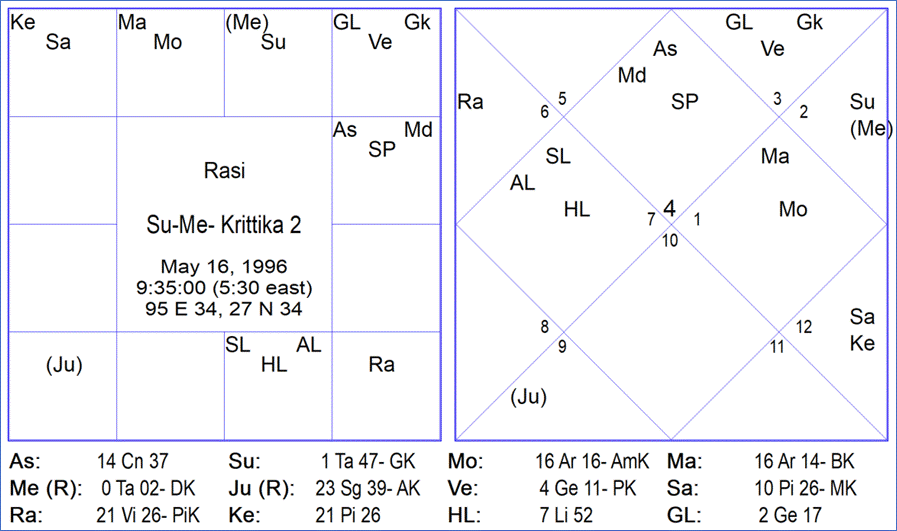
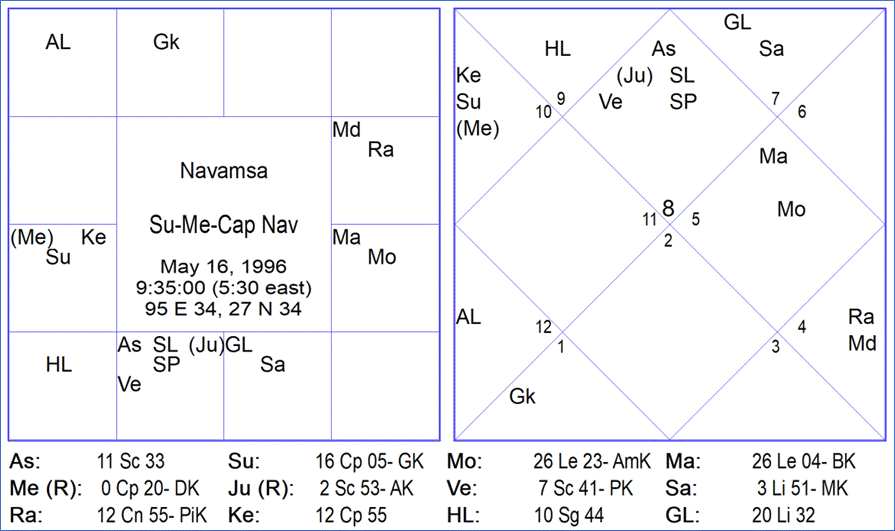
The basic rule remains the same as with every Karma Vipaka pada: do not force the literal story from one Nakshatra placement. The Pada provides the karmic pattern; the complete horoscope shows whether the pattern manifests through profession, religion, money, children, health, reputation or another field.
The Real Teaching of Krittika Nakshatra Pada 2
Krittika Nakshatra Pada 2 gives a very uncomfortable but important teaching: knowledge does not automatically make a person Dharmic.
Indra Sharma knew the Vedas. He knew the Vedangas, possessed the very knowledge which should have helped him understand his responsibility. Yet when a valuable opportunity arrived, knowledge became secondary to gain. This makes the story far more relevant than a simple warning against greed. The deepest danger is not the person who openly says: “I do not care about Dharma.” That person at least knows where they stand. The greater danger is the knowledgeable person who learns to use intelligence to explain why their own exception is reasonable. That is why Krittika is important.
- Krittika cuts excuses.
- Agni burns rationalisation.
- Sun demands integrity.
- Taurus asks what we truly value.
- Capricorn asks whether our conduct can survive accountability.
And Saturn eventually asks: “Did you perform the duty attached to your position, or did you use the position mainly for what it could give you?”
- At the lower level, Krittika Pada 2 uses knowledge to justify desire.
- At the middle level, life repeatedly places money and duty together until the difference becomes clear.
- At the higher level, the native becomes somebody whose knowledge cannot easily be corrupted by personal gain.
This is why one of the strongest predictive sutras for Krittika Nakshatra Pada 2 is: “When Krittika Pada 2 is strongly activated, examine where the native’s knowledge, profession or authority gives access to money. The karmic test begins when financial benefit can influence a decision which should have been made only from Dharma.”
And the shorter form is: “Knowing the rule creates a greater responsibility to live by it.”
That is the deeper meaning of Krittika Nakshatra Pada 2, pending karma and predictions from Karma Vipaka Samhita.
Join our Karma Vipak Course By Vinayak Bhatt





![Bhrigu Nandi Nadi Course for Beginners [Hindi]](https://vedicgrace.com/wp-content/uploads/2025/12/Bhrigu-Nandi-Nadi-for-Beginners-Hindi-Recorded-VG-300x214.png)
![Science of Remedies in Vedic Astrology [English]](https://vedicgrace.com/wp-content/uploads/2025/12/Science-of-Remedies-in-Vedic-Astrology-VG-300x214.png)


![Vedic Astrology Course by Vinayak Bhatt [English]](https://vedicgrace.com/wp-content/uploads/2026/01/Vedic-Astrology-by-Vinayak-Bhatt-English-VG-300x214.png)


Leave a Comment
Comments are closed for this post.
Be the first to comment on this blog!