
Sarva Pitru Amavasya and Anna Daan – Honouring Ancestors by Vinayak Bhatt
Spirituality & Vedic Astrology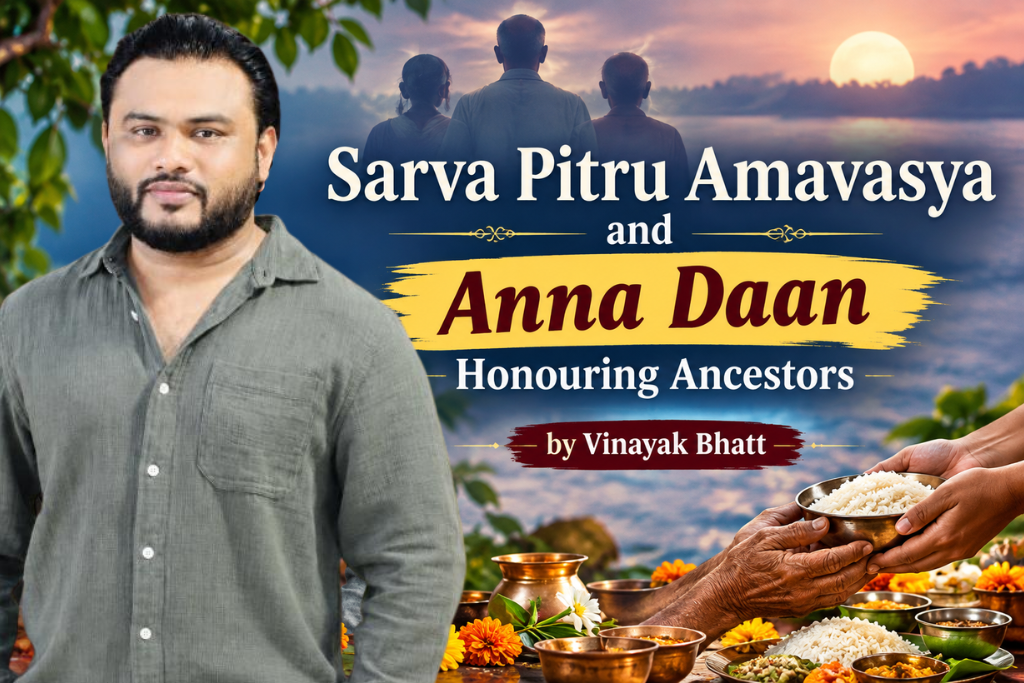
This year Sarva Pitru Amavasya falls on Saturday, 10 October 2026. It brings Pitru Paksha to its final Amavasya, and for many families it becomes the day of Shraddha, Tarpana and remembrance of ancestors whose individual Tithi may not have been observed separately. But there is one question I feel we should ask beyond ritual: why does food occupy such an important position whenever our Shastras speak about Pitris?
Taittiriya Upanishad gives a remarkable instruction: “अन्नं बहु कुर्वीत । तद्व्रतम् ।” — produce food in abundance; let that be the vow. Food is not treated merely as something we consume. It is connected with continuity, nourishment, progeny and the support of life itself. Now think about Pitru Paksha. What have our ancestors actually done for us at the most basic level? They carried life forward until it reached us. Perhaps offering food in their memory is therefore not random symbolism. Life received from the past is being converted into nourishment for another life in the present.
Mahabharata goes even further. In Anushasana Parva, Bhishma tells Yudhishthira that food is the basis of strength and life-breath, and praises Anna-dāna very highly. Then comes a statement which I find extraordinary: a gift of food even to a Chandala or a dog is not lost. The same passage says that one who satisfies Pitris, Devas, Rishis, Brahmanas and guests through food acquires great merit, and it beautifully describes the Pitris as expecting offerings from their descendants.
Notice what this does to our modern debate. Some people say, “Food should only be given to Brahmanas during Pitru rituals.” Others say, “Forget Shraddha, simply feed poor people.” Shastra is more nuanced than both slogans.
Formal Shraddha has its own ritual structure. Manusmriti says that Pitru-yajna may involve food, water, milk, roots or fruits and specifically speaks of feeding a Brahmana in honour of the Pitris. Mahabharata also gives detailed rules about the persons invited to a Shraddha and insists that Shraddha should not become merely an occasion for feeding one’s own friends and relatives. So if somebody belongs to a tradition in which proper Shraddha is prescribed, general food donation should not casually be declared an exact substitute for every ritual obligation.
But Anna-dāna itself is much wider.
Mahabharata does not restrict the merit of feeding the hungry only to the formal Shraddha table. It praises feeding travellers, mendicants, guests and people asking for food. That means we should distinguish two things carefully: Shraddha-bhojana is part of a specific Pitru ritual; Anna-dāna is the wider Dharma of nourishing life. On Sarva Pitru Amavasya, the two can beautifully support each other rather than compete.
For me, this changes the meaning of food donation.
Suppose your grandfather struggled his whole life so that his children would never remain hungry. On his Shraddha, you feed fifty people in his name. Suddenly memory becomes action.
Suppose your mother or grandmother spent her life feeding everybody before eating herself. In her memory, another family receives food. Her Samskara is continuing through you.
Now Pitru remembrance is not only looking backwards.
It is allowing something good received from the lineage to continue moving forward.
This is where Jyotish becomes interesting. Parashara identifies Surya with Atma and Chandra with Manas. On Amavasya, Sun and Moon come together astronomically. But I would be very cautious about the common statement, “Amavasya means weak Moon, therefore Pitru Dosha.” That is much too simplistic.
Classical Jyotish gives a much more layered method for judging father and lineage. Phaladeepika, for example, specifically examines the 9th from Surya for matters connected with the father and says that a Bhava, its lord and its Karaka should be judged together. This itself should teach us not to diagnose “Pitru Dosha” from one Rahu placement, one Amavasya birth or one afflicted Sun.
If we want to study ancestral patterns properly, I would examine Surya, the 9th house and 9th lord, the 2nd house of family continuity, the 8th house of inheritance and what comes through others, the relevant Karakas, Dashas and most importantly the actual family history.
Because ancestral Karma does not always appear as something supernatural.
Sometimes it appears as repeated behaviour.
Three generations fighting over property.
Father and son repeatedly becoming emotionally distant.
Every generation changing its birthplace.
Women of the family repeatedly carrying responsibility alone.
Money coming strongly but never remaining.
A family repeatedly producing teachers, doctors, soldiers, priests or businessmen.
The chart may show the pattern, but family history tells us how that pattern actually manifested.
Now look at food from this angle. The 2nd house is not only money. It also concerns family, stored resources and what sustains the household. Food itself becomes part of the symbolism of continuity. If our ancestors gave us a lineage, a home, land, education, values or even simply the body through which we are alive, then Anna-dāna becomes one practical way of saying: “What came to me will not stop with me.”
This is why I find food donation on Sarva Pitru Amavasya spiritually powerful.
Not because one plate of food magically cancels every difficult planetary combination.
But because it converts remembrance into Dharma.
There is also an uncomfortable question here. We may spend thousands on an elaborate Pitru ritual and then waste enormous quantities of food at home. We may perform Tarpana for ancestors but ignore a hungry old person outside the temple. We may pray for the blessings of our family lineage while refusing to help an elderly relative who is alive.
Then perhaps we should ask what Shraddha actually means.
Shraddha without Shraddha — ritual without sincere reverence — becomes only procedure.
Mahabharata repeatedly stresses attention, reverence and purity of intention in Shraddha. It even criticises offerings given without reverence. So the inner Bhava matters.
And there is one beautiful historical image in Anushasana Parva. The story of Nimi describes grief over his deceased son leading to the offering of food to Brahmanas and rice cakes in the name of the departed. The story presents Shraddha as arising directly from remembrance, grief and the desire to do something meaningful for one who has left the visible world.
Perhaps this is the emotional heart of Pitru Paksha.
A person has gone.
You cannot feed him physically anymore.
You cannot call him.
You cannot repair every conversation left unfinished.
But you can allow his memory to produce something nourishing in the world.
This is where Anna-dāna becomes beautiful.
Someone you do not know eats because someone you loved once existed.
Think about that.
And perhaps the real Pitru remedy is not only asking, “What can my ancestors give me?”
Maybe we should also ask:
“What can I give the world because my ancestors gave me life?”
For Jyotish students, I suggest a small exercise this Sarva Pitru Amavasya. Look at your Surya, 9th house, 9th lord, 2nd house and 8th house. Then put the chart aside and write down one quality which came through your lineage that deserves to continue, and one family pattern which should stop with you.
That second part is also Pitru work.
If grandfather’s generosity continues through you, that is lineage.
If grandfather’s anger stops through you, that is also lineage.
If family wealth is preserved and used wisely, that is lineage.
If an old feud ends because you refuse to pass it to your children, perhaps that too is a kind of Tarpana.
On Sarva Pitru Amavasya, perform Shraddha and Tarpana according to your family tradition where applicable. Honour Brahmanas, elders and your Kulachara. But also consider Anna-dāna to Sadhus, needy families, elderly people, travellers or anyone genuinely requiring food. Shastra gives formal Shraddha its own rules, while also giving Anna-dāna an extraordinarily broad place in Dharma. We do not need to destroy one tradition to appreciate the other.
Now I want one serious discussion from Jyotish students.
Do you think Pitru Karma should be judged only from Surya and the 9th house, or should we also examine the 2nd house for family continuity and the 8th for inherited patterns?
And another question: what is a greater offering to our ancestors — feeding one hundred people in their name, or consciously stopping one destructive behaviour which has been travelling through the family for three generations?
Perhaps the highest answer is not one or the other.
Perhaps we should do both.
Feed someone so that the good received from the lineage continues.
And transform yourself so that the pain received from the lineage does not.
That may be one of the deepest meanings of Sarva Pitru Amavasya.
Jai Guru Dev
Vinayak Bhatt

![Bhrigu Nandi Nadi Course for Beginners [Hindi]](https://vedicgrace.com/wp-content/uploads/2025/12/Bhrigu-Nandi-Nadi-for-Beginners-Hindi-Recorded-VG-300x214.png)


![Science of Remedies in Vedic Astrology [Hindi]](https://vedicgrace.com/wp-content/uploads/2025/12/Science-of-Remedies-in-Vedic-Astrology-Hindi-VG-300x214.png)

![Shri H. N. Katwe: Secrets of Moon [Predictive Techniques Related to Moon]](https://vedicgrace.com/wp-content/uploads/2025/11/Secrets-of-Moon-Webinar-300x300.jpg)


Leave a Comment
Be the first to comment on this blog!