
What Brihat Parashara Hora Shastra Teaches Before Prediction by Vinayak Bhatt
Spirituality & Vedic Astrology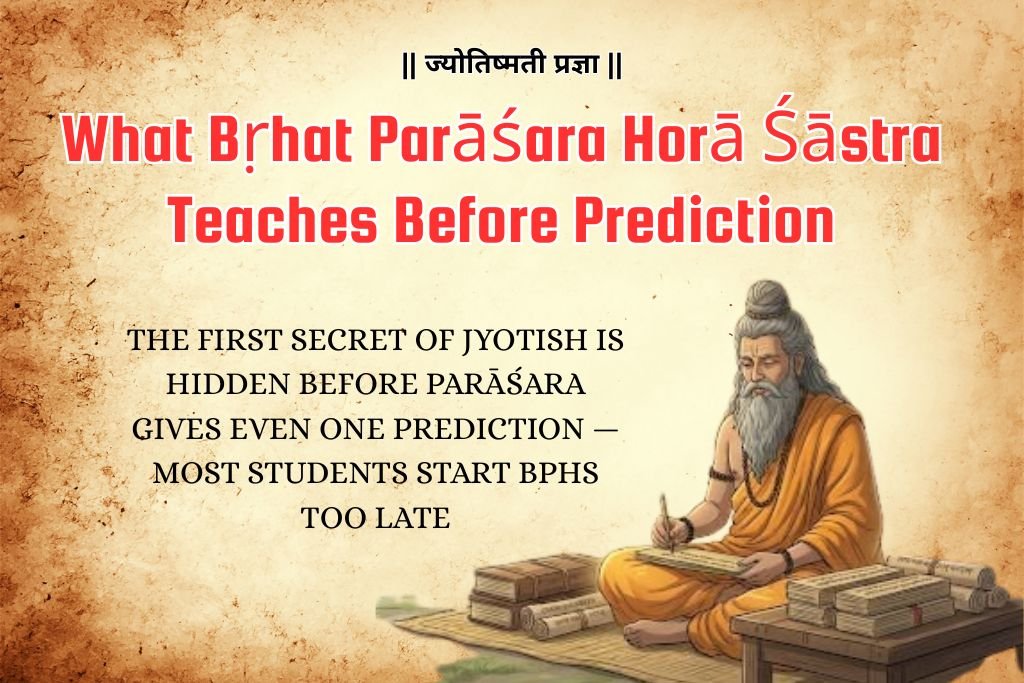
THE FIRST SECRET OF JYOTISH IS HIDDEN BEFORE PARĀŚARA GIVES EVEN ONE PREDICTION — MOST STUDENTS START BPHS TOO LATE
Whenever I return to the opening chapters of Bṛhat Parāśara Horā Śāstra, I feel that many students begin studying the book from the wrong place. We are impatient to reach Graha Dṛṣṭi, Bhāva results, Yogas, Daśās, Vargas and longevity, but Maharishi Parāśara begins somewhere completely different. Before giving even one predictive rule, the text shows us who is asking, how he is asking, why he is asking, who is qualified to answer, and for what purpose Jyotish should be used. For me, this opening conversation between Maharishi Parāśara and Maharishi Maitreya contains one of the greatest secrets of Jyotish.
The very first verse describes Parāśara as “त्रिकालज्ञं पराशरम् — trikālajñaṁ Parāśaram,” one who knows the three divisions of time, and tells us that Maitreya approaches him with folded hands after bowing respectfully. This one word Trikālajña should make every astrologer uncomfortable. Parāśara is not introduced as someone who knows 500 Yogas. He is introduced as someone who understands past, present and future as one connected movement.
This completely changed the way I started looking at prediction. A real Jyotishi should not merely say, “This will happen after three years.” He should be able to see what past pattern has produced the present condition, what is ripening now, and where the present action is taking the native next. Past is the seed, present is its visible condition, future is the direction of its Vipāka. That is Trikāla thinking.
Then Maitreya says something extraordinary. He does not immediately ask, “When will I marry?” or “Will this person become rich?” He says Jyotish is a sacred Vedāṅga consisting of Horā, Gaṇita and Saṁhitā, and then asks Parāśara: How was this creation produced? How will it dissolve? And what is the relationship between the beings living on Earth and the celestial bodies?
Please read that question again.
Before learning how Mars behaves in the 7th house, Maitreya wants to understand why a Graha in the sky should have any relationship with a human being on Earth at all.
That is the question many modern astrologers never ask.
We memorise that Saturn gives one thing, Mars another, Jupiter another, but Maitreya asks for the metaphysics behind astrology. What connects Khaga — that which is in the heavens — with Bhūsthita — the beings established on Earth?
Without understanding this, astrology easily becomes a collection of correlations.
Parāśara then gives perhaps the most important reply in the opening chapter: “साधु पृष्टं त्वया विप्र लोकानुग्रहकारिणा — sādhu pṛṣṭaṁ tvayā vipra lokānugrahakāriṇā.” In simple language: You have asked well, and your question is for the welfare of the world.
This line has stayed with me for years.
Parāśara does not praise Maitreya because his question is intellectually clever. He praises the intention behind the question.
This is the first test of Jyotish.
Why do you want this knowledge?
To impress people?
To prove another astrologer wrong?
To frighten a client with some terrible Yoga?
To become famous for “100% accurate predictions”?
Or Lokānugraha — to actually help somebody understand his life better?
The same prediction can become medicine in one astrologer’s mouth and poison in another astrologer’s mouth because the intention behind Vāk is different.
Then something even more beautiful happens. Before speaking Jyotish, Parāśara bows to Brahman, Bhāratī or Sarasvatī, and Sūrya, Grahapati, and calls Jyotish “Veda-nayana” — the eye of the Veda.
Why the eye?
Because an eye does not manufacture reality.
It reveals what is already present.
This is exactly how I understand a horoscope. The chart does not manufacture your karma. Saturn does not sit somewhere angrily deciding whom to punish on Tuesday. Jyotish gives us an eye through which patterns of Kāla, Karma and manifestation become visible.
And this is where my understanding of Karma Vipāka also enters Parāśara Jyotish. A Graha is not simply “good” or “bad.” A Graha becomes a carrier of a particular field of karmic experience. Bhāva tells us where it manifests. Rāśi describes its manner and environment. Nakṣatra takes us deeper into the script. Daśā tells us when that script becomes active. And the native’s present Puruṣārtha tells us whether an old pattern will simply repeat or begin changing.
But Parāśara places another condition before teaching anything further, and I think every astrology institute should print it on the classroom wall.
“शान्ताय गुरुभक्ताय सर्वदा सत्यवादिने । आस्तिकाय प्रदातव्यं…”
Jyotish should be given to one who is peaceful, devoted to the Guru, truthful and respectful of the sacred tradition.
Notice something surprising.
Parāśara does not first say the student must have a photographic memory.
He says Śānta — peaceful.
Why?
Because an agitated mind distorts interpretation.
If I am angry with marriage, I will see divorce everywhere.
If I am obsessed with spirituality, every Ketu becomes Mokṣa.
If I am frightened of Saturn, every Saturn becomes punishment.
If I am fascinated by affairs, suddenly every Venus-Rahu chart starts producing an extramarital relationship.
Sometimes the biggest affliction in horoscope interpretation is not in the client’s chart. It is sitting inside the astrologer’s mind.
And there is a remarkable story about Parāśara himself which makes this teaching much deeper. The Viṣṇu Purāṇa begins with the same Guru–Śiṣya pair, Maitreya and Parāśara. There we learn something extraordinary about Parāśara’s own life. His father Śakti had been killed, and when Parāśara learnt what had happened, terrible anger arose in him. He began a sacrifice intended to destroy the Rākṣasas. Many were already being consumed when his grandfather Maharishi Vasiṣṭha intervened and taught him that uncontrolled anger is unworthy of wisdom, and that beings ultimately experience the consequences connected with their own actions.
The Mahābhārata preserves the same essential episode. Parāśara remembers his father’s destruction and begins the Rākṣasa sacrifice; Pulastya and other Ṛṣis intervene and ask why innocent beings who had nothing to do with his father’s death should be destroyed. Parāśara finally abandons the sacrifice.
Now think about this as a Jyotishi.
The man later remembered as Trikālajña Parāśara first had to learn not to interpret reality through his personal anger.
What a teaching. Before he could become the teacher through whom we study the karma of others, he had to face the fire of his own reaction to karma. And in the Viṣṇu Purāṇa, after Parāśara restrains his wrath and follows Vasiṣṭha’s instruction, Pulastya blesses him with profound knowledge and the capacity to understand and transmit Purāṇic wisdom.
For me this story reveals something almost never discussed in astrology classes:
Knowledge becomes dangerous when character has not matured enough to carry it. Imagine knowing somebody’s weakness but having no compassion. Imagine seeing marital difficulty but enjoying frightening the client. Imagine finding a combination for scandal and announcing it publicly. Imagine having predictive ability while carrying jealousy, anger, ego and the need to prove yourself. Such a person may know astrology, but Parāśara’s story makes me question whether he has understood Jyotish.
This is also why I find the Parāśara–Maitreya relationship so important. In the Viṣṇu Purāṇa, Maitreya tells Parāśara that he has already been instructed by him in the Vedas, Dharma and sacred sciences before asking the deeper questions regarding creation, planets, time and dissolution.
Maitreya was not a weekend-course student asking for “advanced prediction techniques” before learning the basics. He had prepared the vessel. And even after receiving knowledge, Maitreya keeps questioning. This is another secret. A genuine Śiṣya does not collect techniques. He develops better questions.
Initially we ask, “What does Saturn in the 7th mean?”
Later we ask, “Why does Saturn signify this?”
Then: “What karmic pattern is Saturn carrying here?”
Then: “Why is this karma becoming active in this Daśā?”
Then: “What Dharma is being demanded from the native through this experience?”
And finally perhaps the question becomes:
“What is the purpose of knowing this at all?”
That last question takes us back to Parāśara’s answer: Lokānugraha.
For the benefit of people.
There is another very interesting layer to Maitreya which Jyotish students may not know. The Mahābhārata later presents Maharishi Maitreya approaching Dhṛtarāṣṭra and Duryodhana and advising peace with the Pāṇḍavas. Duryodhana dismisses his counsel contemptuously, striking his thigh and scratching the ground. Maitreya then declares that Bhīma will break that very thigh in the coming war if peace is not made. Later the Mahābhārata recalls this declaration after Duryodhana’s thigh is actually broken.
Whether we read this principally as Ṛṣi-vāk, curse or prophetic statement, there is a striking symbolic lesson.
The same Maitreya who once approached Parāśara with Pranipāta — humility later meets Duryodhana, who receives wisdom with Ahaṅkāra — contempt.
One bows before knowledge.
The other strikes his thigh before knowledge.
Look at the outcomes.
This is almost a complete Jyotish teaching without drawing one horoscope. How you receive wisdom changes what wisdom can do for you.
One more point has become very important in my own teaching. Students often think prediction is the highest achievement of Jyotish. But Parāśara’s opening suggests something greater.
Prediction is only one function of seeing. If I tell somebody, “Your difficult period begins next year,” I have shown Kāla.
If I explain why the same pattern repeatedly occurs, I have entered Karma. If I show how he should conduct himself when that period arrives, I have entered Dharma. And if through that understanding he stops repeating the same unconscious action, Jyotish has moved towards Lokānugraha.
That, to me, is the difference between an astrologer and a Jyotishi. An astrologer may tell you what will happen. A Jyotishi should slowly become capable of seeing why a particular pattern is happening, when it will ripen, what part of it must be accepted, what part can be transformed through Puruṣārtha, and what Dharma the experience is trying to awaken.
This is why the first chapter of Bṛhat Parāśara Horā Śāstra begins with creation and consciousness rather than marriage timing. Parāśara is quietly telling us:
Before you learn to predict a human life, first understand what you believe a human being actually is.
Is the native merely Lagna plus nine Grahas?
Is he merely accumulated Karma?
Is he only a victim of Daśā?
Or, as Parāśara moves into his cosmology, is there Jīvāṁśa as well as Paramātmāṁśa, with the Grahas themselves participating in a much larger cosmic order? BPHS explicitly places the Grahas within this larger metaphysical framework rather than treating them as lifeless rocks producing mechanical effects.
And here I see a subtle connection with my own study of Gaṇapati Atharvaśīrṣa. Atharvaśīrṣa keeps taking our mind from the visible form back towards Tattva. Parāśara also begins predictive Jyotish by taking Maitreya backwards towards Sṛṣṭi and Tattva.
Both traditions seem to warn us against getting trapped only at the outer level. Before Vighna, understand the Tattva behind Vighna. Before Graha-phala, understand the Tattva behind Graha.
Before prediction, understand Kāla.
Before Karma Vipāka, understand Karma.
And before speaking about somebody else’s destiny, understand the condition of the mind which is doing the speaking.
So when students ask me, “Sir, what is the secret technique of Parāśara?”
Sometimes I feel the secret technique is already written in the first eight verses, but we are searching for it in chapter eighty.
Approach knowledge with humility. Ask questions for Lokānugraha. Keep the mind Śānta. Protect Satya in speech. Honour Guru-paramparā. Understand the connection between heaven and human life. And only then begin prediction. Everything after that is technique. These are the conditions under which technique becomes Jyotish.
Now I want serious students to answer one question in the comments.
Forget Yogas and Daśās for a moment.
Why do you personally study Jyotish?
For prediction?
For earning?
For understanding karma?
For helping people?
For understanding yourself?
For spiritual enquiry?
Or because from childhood you have felt there is some invisible order behind apparently random events?
And one harder question:
Who is more important for the birth of Bṛhat Parāśara Horā Śāstra — Parāśara who knew the answers, or Maitreya who knew how to ask the right question?
Think before answering.
Because perhaps the first secret of Jyotish is not hidden in Parāśara’s answer at all.
Perhaps it is hidden in Maitreya’s question.
Jay Guru Dev
Vinayak Bhatt



Leave a Comment
Be the first to comment on this blog!