
Maha Kali in Jyotish – Understanding Kala, Karma and Destiny by Vinayak Bhatt
Astrology/ Spirituality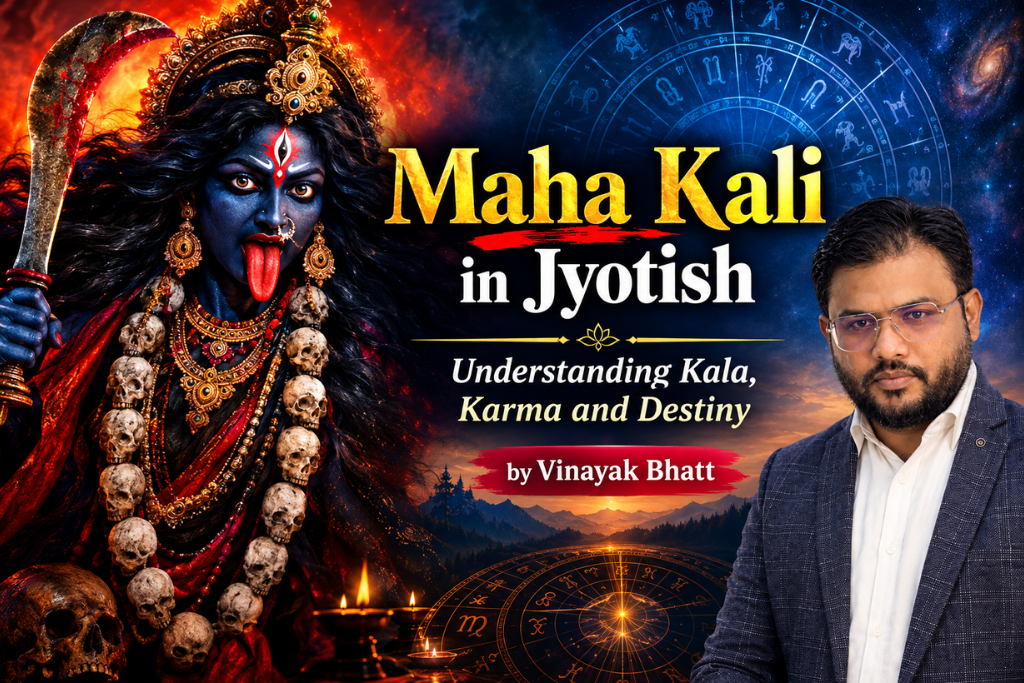
There is one question I often ask Jyotish students: why is Mahā Kālī shown wearing a garland of severed heads, holding a sword and standing in a cremation ground? Is She simply a frightening form of Devi, or is there a profound philosophy hidden in Her appearance? We happily worship Lakshmi for wealth, Saraswati for knowledge and Ganapati for removing obstacles, but when Kali appears, suddenly everybody wants protection. Perhaps this itself reveals something about our mind. We welcome the Divine when She gives us something, but become frightened when She begins taking away something to which we are attached.
The deeper I study Mahā Kālī Tattva, the more I feel that Her connection with Jyotish is not limited to Saturn, Rahu, Ketu or the 8th house. These are useful symbolic associations in certain interpretive traditions, but Kali cannot be imprisoned inside one Graha. Jyotish studies Kāla, the movement of time through which Karma becomes visible. Mahā Kālī invites us to contemplate the Divine Power before which even our most permanent identities cannot remain permanent.
The first chapter of Devi Mahatmya gives a remarkable starting point. Lord Vishnu is resting in Yoga Nidra when Madhu and Kaitabha arise. Brahma invokes the Divine Mother so that Vishnu may awaken. The Devi is described as Mahamaya, the power through which even the consciousness of knowledgeable beings can become covered.
“ज्ञानिनामपि चेतांसि देवी भगवती हि सा । बलादाकृष्य मोहाय महामाया प्रयच्छति ॥”
Devi Mahatmya, Chapter 1, Verse 55. Even the minds of knowledgeable people can be drawn into delusion by Mahamaya.
Now think about this as an astrologer. A person may know that his relationship is unhealthy, yet he cannot leave. He may know that a financial decision is dangerous, yet he continues. He may understand that his anger is destroying his career, yet the same reaction happens again. Knowledge is present, but behaviour does not change. This is exactly where the philosophical distinction between knowing something and being free from its influence becomes important.
And here is the first great difference between ordinary understanding of Kali and the deeper Mahakali Tattva. In the first Charita, the Divine Mother appears as the cosmic power of Yoga Nidra and Mahamaya. In the seventh chapter, Kali emerges from the forehead of Ambika to destroy Chanda and Munda. These two presentations belong to different episodes and theological layers of Devi Mahatmya; they should not be flattened into one simplistic story.
The seventh chapter says:
“भ्रुकुटीकुटिलात्तस्या ललाटफलकाद्द्रुतम् । काली करालवदना विनिष्क्रान्तासिपाशिनी ॥”
From the furrowed forehead of Ambika emerges Kali, carrying a sword and noose.
Why the sword? At the symbolic level, I understand it as the power of decisive severance. There are situations where adjustment is no longer enough. Something must end. Sometimes it is an unhealthy relationship, sometimes an obsession, sometimes a false identity, and sometimes the belief that our present position will last forever. Kali reminds us that destruction is not always the opposite of welfare. Sometimes the removal of an exhausted structure makes a different life possible.
Now bring Saturn into this discussion. Saturn is associated with time, ageing, responsibility, limitation and the consequences of sustained action. But Saturn and Mahakali are not interchangeable. Saturn can reveal how the individual experiences limitation within time; Mahakali Tattva directs contemplation towards the larger power through which creation, preservation and dissolution occur.
Suppose Saturn activates the 10th house and a person loses a prestigious position. A conventional prediction may correctly identify professional separation. But what happens inside the person after that event? One native rebuilds his professional life. Another becomes bitter for ten years. A third discovers that the position had become his entire identity. Same broad event, different inner responses. This distinction matters because the event may be over while attachment to the event continues producing suffering.
Kali’s sword can therefore become a powerful contemplation: what exactly must be cut — the profession, or the identification that says, “Without this profession, I am nobody”?
Now comes the most fascinating story in Devi Mahatmya: Raktabija. Every drop of his blood falling upon the earth produces another demon. Fighting him through ordinary means only multiplies the problem. Chandika therefore instructs Kali to consume the blood before it reaches the ground and creates more demons. The eighth chapter describes Kali receiving the blood of Raktabija and preventing further multiplication.
For me, this is one of the most powerful behavioural lessons hidden inside Devi Mahatmya.
Raktabija is an extraordinary image of a self-reproducing problem.
One insult produces anger. Anger produces harsh speech. Harsh speech produces another conflict. Conflict creates resentment. Resentment becomes the seed of the next argument. The original incident may have ended, but its blood has already produced fifty new demons.
Now examine Mars and Moon in a horoscope. Mars can describe force, confrontation and action, while Moon signifies the mind and emotional response. If their relationship is difficult, the astrologer may investigate whether anger and emotional reaction reinforce one another. But a responsible prediction must be supported by the whole horoscope, not merely one conjunction.
The practical question is more interesting: does the native know how to stop the multiplication of a reaction?
Because sometimes the greatest remedy is not winning the next argument. It is refusing to feed the pattern which creates the next twenty arguments.
The same symbolism becomes useful while studying Rahu. Desire produces achievement, achievement produces comparison, comparison produces another desire, and the person remains dissatisfied even after receiving what he originally wanted. The problem is no longer one object. The problem is the mechanism which continuously manufactures new objects of attachment.
That is where the Raktabija story becomes an extraordinary meditation on Karma Vipāka. If the root behaviour remains alive, one completed event can become the seed of another. This is a philosophical application of the story, not a claim that Devi Mahatmya itself gives a Rahu or Mars combination.
But Kali Tattva has another side which students often miss. Devi Mahatmya does not present Mahamaya only as the power of bondage. The same first chapter describes Her as the cause of liberation.
“सा विद्या परमा मुक्तेर्हेतुभूता सनातनी ।”
She is the eternal supreme knowledge which becomes the cause of liberation.
This creates a beautiful paradox. The same Mahashakti can appear as the power through which consciousness becomes entangled in experience and as the wisdom through which bondage ends. The important question is not simply whether Maya is good or bad. The question is whether we recognise the attachment through which experience becomes bondage.
This is where Jyotish can become much more useful. A horoscope may show a difficult relationship period, professional transition, financial pressure or separation. But the astrologer should also ask whether the native is adding new suffering through repetitive behaviour. We must distinguish the karmic event from the response which follows it.
And this is why I find the later Shakta understanding of Kali as the Supreme Devi so profound. In Devi Mahatmya’s seventh chapter She emerges from Ambika, while developed Kali-centred traditions contemplate Her as the supreme Divine Mother Herself. These are different theological viewpoints within the wider Shakta world, not necessarily competing descriptions of one identical ritual framework.
The image of Kali standing upon Shiva also requires care. It belongs prominently to later Shakta iconographic and narrative traditions; it is not the scene described in Devi Mahatmya’s account of Chanda-Munda. In contemplative interpretation, this imagery opens questions about consciousness, Shakti, activity and stillness. But we should not invent a convenient explanation and attribute it to every Tantra.
Now consider Her association with the cremation ground. A cremation ground is the one place where worldly titles lose their authority. King, businessman, professor, astrologer, millionaire — the distinctions which controlled our lives no longer carry the same meaning there. This makes Kali’s imagery deeply uncomfortable because it confronts the identities we spend our lives protecting.
And Jyotish students should recognise the connection with the 8th house. The 8th can signify longevity, vulnerability, inheritance, hidden matters and profound change. Its relationship with Kali is useful as a contemplative comparison, but it is not a universal rule that an afflicted 8th house demands Kali worship or that every Ketu placement automatically gives Kali Sadhana.
In fact, reducing Mahakali to a remedy for difficult planets misses the larger point. A person may perform elaborate worship and still continue the same dishonesty, anger, obsession and destructive behaviour. If the root remains untouched, what exactly has changed?
That is the question I want students to take from Kali Tattva.
When Saturn creates delay, what attachment does the delay expose? When Rahu creates extraordinary desire, what keeps manufacturing the next desire? When Ketu produces withdrawal, are we witnessing genuine detachment or simply avoidance? When Mars creates conflict, is courage operating or is the person feeding another Raktabija? When Moon becomes disturbed, is the suffering coming only from the event, or also from the mind repeatedly reliving it?
These are questions for observation, not automatic planetary verdicts.
And perhaps the most practical meaning of Kali’s sword is this: not every problem needs another explanation. Some patterns need to stop being fed.
The person who repeatedly lies cannot solve every Mercury problem through chanting while continuing to lie. The person who repeatedly avoids responsibility cannot expect Saturn-related patterns to improve without changing conduct. The person who continuously feeds comparison cannot solve every Rahu-related difficulty by obtaining the next desirable object.
Kali reminds us that sometimes transformation begins when we stop negotiating with the behaviour which is destroying us.
Now I want serious Jyotish students to examine one repeated pattern in their own lives. Look at Saturn, Mars, Rahu, Ketu, Moon and the relevant Bhava, but do not immediately declare one planet responsible. Identify the event, identify your response, and then identify the behaviour which keeps producing another version of the same problem.
Write your Lagna + the relevant Graha + one repeated life pattern in the comments. I am especially interested in charts where a painful ending eventually produced a completely different direction in life.
And one deeper question for our discussion: in the Raktabija episode, why was defeating the demon not enough? Why did Kali have to stop the very process through which he kept reproducing himself?
Could this be one of the most important lessons for a Jyotishi studying repeated karmic patterns?
We spend so much time predicting when a problem will end. Perhaps we should also learn to recognise why the same problem keeps returning in another form.
And finally, if Mahakali represents the power before which every temporary identity must eventually surrender, what is the real fear behind a difficult Daśā — the event itself, or the possibility that the person we believe ourselves to be may no longer survive unchanged?
Perhaps this is the deeper message of Mahā Kālī Tattva.
She is not merely the power that brings an ending. She also makes us confront what we were holding so tightly that an ending became unbearable.
Jai Guru Dev
Vinayak Bhatt

![Shri H. N. Katwe: Secrets of Moon [Predictive Techniques Related to Moon]](https://vedicgrace.com/wp-content/uploads/2025/11/Secrets-of-Moon-Webinar-300x300.jpg)
![Bhrigu Nandi Nadi Course [English]](https://vedicgrace.com/wp-content/uploads/2025/11/Bhrigu-Nandi-Nadi-Astrology-VG-English-300x214.png)
![Shri H. N. Katwe: Secrets of Sun [Predictive Techniques Related to Sun]](https://vedicgrace.com/wp-content/uploads/2025/11/Shri-H.-N.-Katwe-Secrets-of-Sun-300x214.png)


Leave a Comment
Be the first to comment on this blog!