
Ganapati Atharvashirsha and Jyotish: Understanding Karma, Grahas and the Deeper Meaning of Remedies by Vinayak Bhatt
Karma Vipaka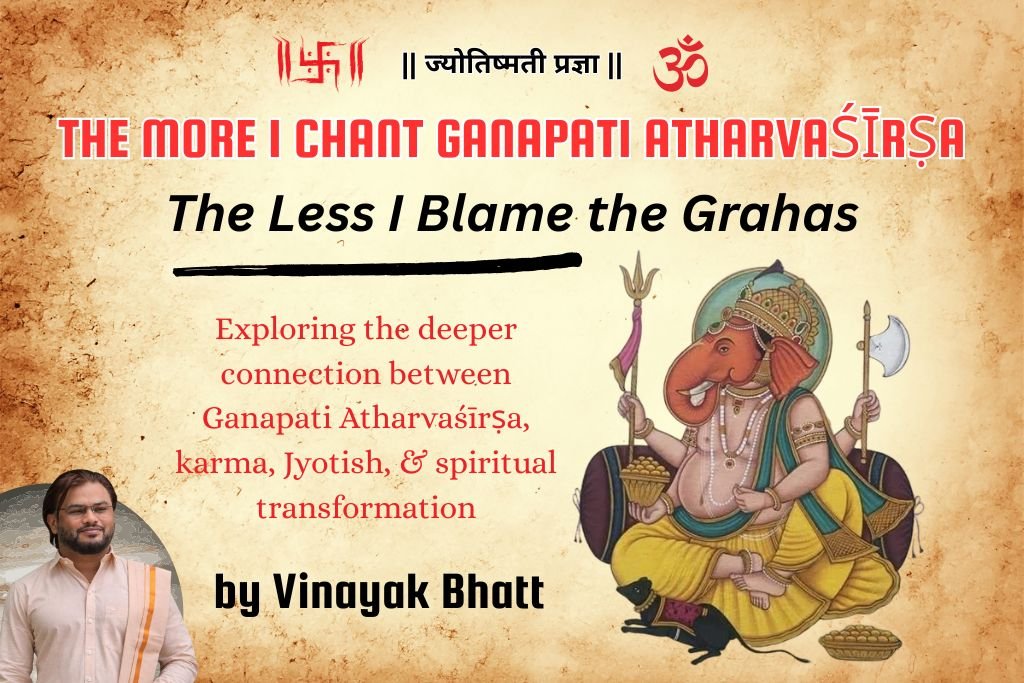
THE MORE I CHANT GANAPATI ATHARVAŚĪRṢA, THE LESS I BLAME THE GRAHAS — SOME OF MY DEEPEST EXPERIENCES WITH ATHARVAŚĪRṢA & JYOTISH
Over time, while chanting, teaching and contemplating Gaṇapati Atharvaśīrṣa, especially while working with its Vedic Svara, meaning, Phalaśruti and Abhiṣeka, one thing has slowly changed in my Jyotish: I no longer look at a difficult Graha only as something that has come to trouble the native. I first ask what that Graha is trying to make conscious. This shift looks small, but for me it has changed the way I understand remedies.
There is a line in Atharvaśīrṣa which I keep returning to: “त्वमेव प्रत्यक्षं तत्त्वमसि” — Tvam eva pratyakṣaṁ tattvam asi. Ganapati is addressed not merely as a deity who grants our wishes but as directly perceivable Tattva. Then the text says, “त्वमेव केवलं कर्ताऽसि, त्वमेव केवलं धर्ताऽसि, त्वमेव केवलं हर्ताऽसि.” You are the creator, sustainer and dissolver.
When I read a horoscope after contemplating these lines, the distinction between a “good event” and a “bad event” becomes less simplistic. Sometimes what comes into life creates something. Sometimes it preserves something. Sometimes it has come specifically to remove something which we ourselves would never willingly release.
This is very close to what Bhagavān Kṛṣṇa says in the Gītā: “गहना कर्मणो गतिः — gahanā karmaṇo gatiḥ.” The movement of karma is difficult to understand. This single statement has made me much more cautious as an astrologer. When a client is suffering, I do not like casually saying, “This is your bad karma.” We do not know karma so cheaply.
Sometimes the very event which looks like punishment is stopping a much larger mistake; sometimes a delay caused by Saturn is protection; sometimes Ketu’s separation is removing an identification which has completed its work; sometimes Jupiter’s apparent blessing creates such expansion that it becomes the beginning of another problem. Karma cannot be read like a simple debit-credit ledger.
Patañjali gave me another important key for understanding this. Yoga Sūtra 2.12 says, “क्लेशमूलः कर्माशयो दृष्टादृष्टजन्मवेदनीयः” — kleśa-mūlaḥ karmāśayo dṛṣṭādṛṣṭa-janma-vedanīyaḥ. The store of karma is rooted in the Kleśas and becomes experienced in the present or unseen births. This means that behind an event there can be karma, but behind karma there is often something even deeper — Avidyā, Asmitā, Rāga, Dveṣa or Abhiniveśa. So nowadays, when I study a troublesome Graha, one of my questions is: Which Kleśa is this Graha repeatedly exposing?
Suppose Rahu repeatedly gives disappointment. Is Rahu the whole problem, or is Rāga — endless wanting — feeding Rahu every day? Suppose Mars creates repeated conflict. Is Mars alone responsible, or has Dveṣa become the habitual reaction of the person? Suppose Saturn produces fear of failure. Is Saturn punishing the native, or is Abhiniveśa — fear, clinging and insecurity — becoming visible through Saturn? This approach has helped me move from “planet is bad” to “pattern is becoming visible.”
And this is where my study of Karma Vipāka Saṁhitā has influenced my understanding of Atharvaśīrṣa. Karma Vipāka repeatedly uses the language of “पूर्वकर्म विपाकतः — pūrva-karma-vipākataḥ,” the ripening of previous karma, and then connects particular Nakṣatra Caraṇas with karmic narratives and Prāyaścitta. I do not believe the job of the astrologer is to mechanically tell every native that the literal ancient story must have happened to him exactly as written. The mastery lies in finding the karmic principle hidden inside the story and seeing whether that principle is repeating in the horoscope and present behaviour.
Mahābhārata expresses this beautifully: “यथा धेनुसहस्रेषु वत्सो विन्दति मातरम् । एवं पूर्वकृतं कर्म कर्तारमनुगच्छति ॥” Just as a calf finds its own mother among thousands of cows, previously performed karma finds its own doer. And immediately the Mahābhārata adds another remarkable idea: just as flowers and fruits do not cross their proper season, previous karma also waits for its proper time. For a Jyotishi, that second idea is extraordinary. Karma requires Kāla for Vipāka. This is why something may remain invisible for thirty years and suddenly become the central story of life during the relevant Daśā.
Now come back to Atharvaśīrṣa. It says, “त्वं कालत्रयातीतः — tvaṁ kālatrayātītaḥ,” Ganapati is beyond the three divisions of time. This line affects me deeply as a Jyotishi because our entire profession is based upon Kāla. We calculate Daśā, Gochar, Tithi, Nakṣatra, Muhūrta, Varṣaphala and the timing of events. Yet the Devatā before whom we are sitting is described as beyond Kāla.
This has changed the way I understand a remedy. A genuine remedy cannot only mean, “Please change my coming period.” Sometimes it must mean, “Give me a level of Buddhi from where this period no longer controls my consciousness in the same way.”
Another line which became more meaningful to me through actual chanting is “त्वं मूलाधारस्थितोऽसि नित्यम् — tvaṁ mūlādhāra-sthito’si nityam.” Ganapati is eternally established in Mūlādhāra. When students hear Mūlādhāra, they immediately want to discuss Kuṇḍalinī. But my practical Jyotish experience makes me read it first as foundation. Before higher experience, check the foundation.
Before extraordinary prediction, check basic Jyotish. Before sophisticated remedies, check basic conduct. Before mystical Sādhanā, check whether the person’s life has any regularity.
Many people want Rahu-Ketu secrets while their sleep, speech, food, discipline, debts, relationships and daily routine are completely disturbed. Then what exactly are we trying to awaken?
This is why Saturn and Ganapati have become an interesting contemplation for me, even though I do not reduce Ganapati to Saturn or any single Graha. Saturn asks, “Can you repeat?” Atharvaśīrṣa chanting also asks the same question. Can you chant correctly when you are inspired? Easy. Can you maintain correctness, attention and humility after repetition has become familiar? That is where the real practice starts.
The same happens with Mercury.
Atharvaśīrṣa says, “त्वं वाङ्मयस्त्वं चिन्मयः” — You are the nature of Vāk and consciousness. In my experience of teaching chanting, the moment a person becomes careless internally, it often begins showing through Vāk — pronunciation slips, rhythm becomes mechanical, attention runs ahead of the mantra, or the tongue is chanting while the mind has already gone somewhere else.
For a Jyotishi this is fascinating because Mercury cannot be understood only as intelligence. Vāk exposes the condition of the inner instrument.
The Phalaśruti takes this connection further when it says that one who performs Ganapati Abhiṣeka with this Atharvaśīrṣa becomes Vāgmī, accomplished in speech. This is not a random reward attached to the text. Atharvaśīrṣa has already declared Ganapati as Vāṅmaya. So the Phalaśruti is internally connected to the philosophy of the mantra itself.
And during Abhiṣeka I see another symbolism. Water keeps flowing continuously over the Mūrti while the mantra must also continue without breaking. One flow is visible; another is internal. The hand performs Karma, the tongue carries Vāk, the mind holds attention, the intellect remembers meaning, and the Sankalpa gives direction. When these begin coming together, the ritual stops being an external performance and becomes a kind of **integration of the person performing it.
This is also why I have become very careful about immediately assigning Gaṇapati to one planet and saying, “Ganapati is only the remedy of Ketu,” or “Ganapati belongs to Mercury.” Atharvaśīrṣa itself says: “त्वं सूर्यस्त्वं चन्द्रमाः” and includes Brahmā, Viṣṇu, Rudra, Indra, Agni and Vāyu within Ganapati Tattva. The Devatā is larger than our convenient astrological table.
A Graha is a doorway. Devatā Tattva is much larger.
One of my strongest observations from combining Atharvaśīrṣa with Jyotish is this: many Vighnas first exist as behaviour before they become events. Saturn’s event may come later, but avoidance has already been happening for years. Mars’ major conflict may happen next year, but angry speech has already become habitual. Rahu’s scandal may come in a Daśā, but obsession was being fed every day. Ketu’s separation may become visible later, but emotional withdrawal had quietly begun much earlier.
Dharmaśāstra is very clear that karma does not arise through physical action alone. Manusmṛti discusses mental, verbal and bodily karma — mano, vāk and deha — and separately describes misconduct generated through each. So sometimes before searching the horoscope for “what happened in the previous birth,” I first ask: What karma is being manufactured today through thought, speech and behaviour?
This is perhaps the biggest lesson Atharvaśīrṣa has given me as a Jyotishi.
We keep asking Ganapati to remove Vighna, but sometimes we ourselves are producing tomorrow’s Vighna today.
– We chant for Mercury and then use Vāk carelessly.
– We perform remedies for Saturn but refuse responsibility.
– We worship for Mars and continue unnecessary arguments.
– We seek Rahu remedies but consciously feed obsession.
– We fear Karma Vipāka but repeat the exact behaviour which can create another Vipāka.
Manusmṛti makes the idea of Prāyaścitta surprisingly practical: after wrongdoing, purification includes repentance and the resolve “I shall not do this again.” This is why I increasingly feel that no remedy is complete until behaviour begins changing.
And perhaps this is the greatest difference I have personally experienced between merely reciting Ganapati Atharvaśīrṣa and actually allowing the text to enter Jyotish thinking.
Earlier the question may be: “Which Graha is creating my obstacle?”
After deeper contemplation, another question arises:
“What is this obstacle trying to show me about myself?”
And then an even deeper question:
“What inside me keeps recreating the same obstacle?”
That third question is where, for me, Gaṇapati Vidyā, Yoga, Karma Vipāka and Jyotish begin meeting each other.
Now I want to hear from students who have actually practised Ganapati Atharvaśīrṣa — not just read about it.
After regular chanting, what changed first in you?
Did your external problem disappear?
Did your speech change?
Did fear reduce?
Did decision-making become clearer?
Did relationships change?
Did you become more disciplined?
Or strangely, did the external situation remain the same but your reaction to it completely changed?
And for Jyotish students, one final research question:
Which Graha in your own horoscope do you understand differently after practising Atharvaśīrṣa?
Write your Lagna + that Graha + your actual Atharvaśīrṣa experience in the comments.
I want experiences, not textbook answers. Because somewhere between Mantra, Karma, Kāla and the Horoscope, there is a field which cannot be understood only by reading books. It has to be observed in life. 🙏
Jai Guru Dev
Vinayak Bhatt






![Science of Remedies in Vedic Astrology [English]](https://vedicgrace.com/wp-content/uploads/2025/12/Science-of-Remedies-in-Vedic-Astrology-VG-300x214.png)
![Science of Remedies in Vedic Astrology [Hindi]](https://vedicgrace.com/wp-content/uploads/2025/12/Science-of-Remedies-in-Vedic-Astrology-Hindi-VG-300x214.png)
![Shri H. N. Katwe: Secrets of Sun [Predictive Techniques Related to Sun]](https://vedicgrace.com/wp-content/uploads/2025/11/Shri-H.-N.-Katwe-Secrets-of-Sun-300x214.png)


Leave a Comment
Be the first to comment on this blog!