
Gandhari’s Curse and the Destruction of the Yadavas: Karma, Vak & Kala by Vinayk Bhatt
Karma Vipaka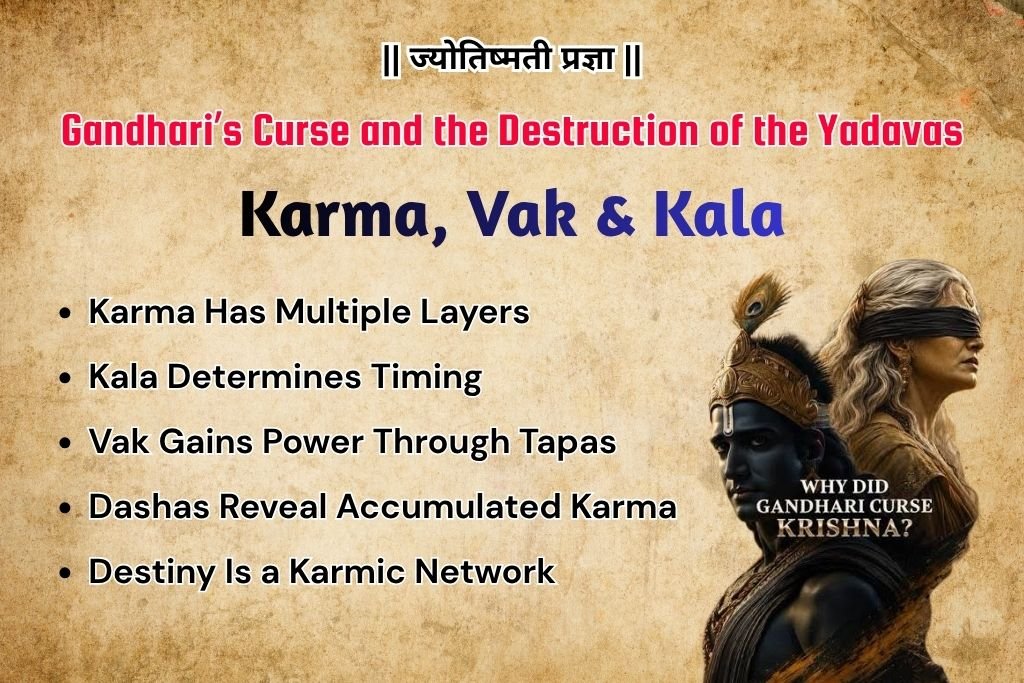
One of the most fascinating moments in Mahabharata comes after the war is over. Gandhari has lost her sons. Standing before Krishna, she holds Him responsible for allowing the destruction to happen even though He had the power to intervene. And then she does something extraordinary. She does not say, “In anger I curse you.” She invokes the spiritual merit accumulated through her life and says, in effect, that by the merit earned through serving her husband, she now curses Krishna. Thirty-six years later His own Yadava clan will destroy itself, the women of His family will weep as the Kuru women are now weeping, and Krishna Himself will meet an unusual end in the wilderness. Mahabharata’s Stri Parva preserves this directly.
This immediately creates a problem for the simple theory that “boons come from punya and curses come from paap.” Gandhari herself says that she is using her accumulated merit to give the curse. So punya and paap cannot be understood like two coloured bank accounts where good deeds produce only pleasant events and bad deeds produce only unpleasant ones. A person may acquire spiritual force through discipline, truth, sacrifice and tapas, and then the use of that force becomes another karmic question altogether. Bhagavad Gita therefore gives perhaps the best warning: “कर्मणो ह्यपि बोद्धव्यं बोद्धव्यं च विकर्मणः । अकर्मणश्च बोद्धव्यं गहना कर्मणो गतिः ॥” — the movement of Karma is difficult to understand:
But the Mahabharata gives an even greater surprise. Krishna does not become frightened by Gandhari’s words. He practically tells her: you have helped in something that I already know must happen. He says no external power can destroy the Vrishnis; they will destroy one another, and Gandhari’s curse has assisted that process.
Now stop here.
Did Gandhari’s curse create the destruction of the Yadavas?
Or did it become the NIMitta — the instrument through which an already ripening Karma received form?
This is where the story becomes pure Jyotish.
A beginner sees Saturn transit the 10th house and says, “Saturn caused the career loss.” But did Saturn really create the whole event? Or was the natal chart already carrying the promise, the Dasha already activating the Karma, the person’s own behaviour already weakening the situation, and the transit merely giving the final timing?
Mahabharata’s destruction of the Yadavas is exactly this kind of multi-layered event.
First we have Gandhari’s curse.
Later, in Mausala Parva, another curse appears. Young Yadavas mock powerful Rishis by disguising Samba as a pregnant woman and asking what “she” will give birth to. The Rishis declare that he will produce an iron club which will destroy their dynasty. The Yadavas try to destroy the club, grind it into powder and throw it into the sea, but the very material they are trying to remove eventually becomes the instrument of destruction. A remaining iron fragment finally reaches the hunter Jara.
Now the causal chain becomes far more complicated.
Gandhari’s curse.
The Rishis’ curse.
The arrogance of the Yadava youths.
The iron club.
Attempts to avoid destiny.
Intoxication.
Internal quarrel.
Kala.
And Krishna’s own acceptance that the time has arrived.
Which one caused the event?
Perhaps all of them.
This is exactly why one-event-one-planet astrology is dangerous.
A divorce is rarely caused only by Saturn.
A financial collapse is rarely only Rahu.
A serious career problem is rarely one transit.
There is usually natal promise, Dasha, transit, human behaviour, other people’s actions, social circumstances and a final trigger.
Jyotish becomes mature when we stop asking, “Which Graha did this?” and start asking, “Which layers of Karma came together so that this event could finally manifest?”
Mausala Parva becomes even more astonishing from a Jyotish point of view. As the thirty-sixth year arrives, the text describes severe omens. Planets appear to afflict Nakshatras, disturbing celestial signs appear, and Krishna specifically recalls that the astronomical atmosphere resembles the ominous period before the Bharata war. The text says He recognises that Gandhari’s words are now ready to become true.
Notice the sequence carefully.
The curse is spoken thirty-six years earlier.
It does not manifest the next morning.
Why?
Because speech may contain the seed, but Karma still waits for Kala.
This is one of the deepest Jyotish lessons in the entire story.
A Yoga may exist in the birth chart for forty years without producing its full result.
Then the relevant Dasha begins.
The transit arrives.
The environment becomes ready.
And suddenly what had remained latent becomes visible.
The curse, therefore, behaves almost like a karmic seed.
Kala decides when the seed can germinate.
This is very close to Patanjali’s language of Karma Vipaka. Yoga Sutra says that the Karmashaya, the stored residue of Karma, can fructify in seen or unseen births, and when the root remains, its Vipaka becomes experience. Karma and Vipaka are not the same moment. A deed may occur now and ripen much later.
That is why I find Gandhari’s thirty-six-year delay more interesting than the curse itself.
An astrologer should always ask: why now?
If Saturn was always in the horoscope, why did the event happen only at age 42?
If Rahu has always occupied the 7th house, why did marriage collapse only during a particular Antardasha?
The Graha is the same.
The Karma was present.
But the fruit was not ripe.
Kala is what converts possibility into experience.
Now compare the Mahabharata with the Bhagavata Purana. Bhagavata focuses much more strongly on the curse of the Brahmanas against the Yadava youths and also says Krishna Himself desired to withdraw His dynasty and allowed the curse to become the instrument. It even describes Krishna as sanctioning the event in the form of Kala.
This is a very important difference between traditions.
Mahabharata keeps Gandhari’s curse powerfully present in the background and later shows it approaching fulfilment.
Bhagavata brings the Brahmana curse and Krishna’s own divine intention strongly to the foreground.
Are these competing explanations?
Not necessarily.
Indian thought is often comfortable with layered causality.
At the human level, the Yadava youths behaved arrogantly.
At the ritual level, Rishi-Vak produced a curse.
At the karmic level, conditions were mature.
At the cosmic level, Kala had arrived.
At the theological level, Krishna Himself permitted the withdrawal of His dynasty.
Five different explanations may all describe the same event from five different levels.
This is also how Jyotish should be practised.
If a person loses a job, we can say the 10th lord is afflicted.
Correct.
We may say Saturn Dasha activated it.
Also correct.
We may say the transit triggered the event.
Correct again.
But perhaps the person had also been ignoring management warnings for six months.
That is also Karma.
Astrology should not erase human responsibility.
And human responsibility should not make us deny Kala.
This is why the idea of curse itself needs critical study. In our modern imagination, Shraap means somebody becomes angry, says something terrible and supernatural punishment automatically begins. But Mahabharata gives another picture. Gandhari specifically grounds her speech in the merit of her disciplined life. Her Vak has force because the speaker has acquired Tapas.
This raises a fascinating Jyotish question.
What makes speech powerful?
Mercury alone?
I don’t think so.
Mercury gives speech, articulation, calculation and communication. The 2nd Bhava gives Vak. But truthful speech sustained for decades has a Saturnian element of discipline, a Jupiterian element of Dharma, a solar element of integrity and a 9th-house dimension of Tapas and merit.
That is why the same sentence spoken by two people does not necessarily carry the same Shakti.
One person speaks from emotional reaction.
Another speaks after forty years of Tapas.
The words may sound similar.
The force behind them is not.
This is also why classical Jyotish contains very specific “Shapa” combinations in the context of progeny. The transmitted Brihat Parashara tradition discusses Sarpa-Shapa and other curse-related combinations while examining denial or destruction of children. For example, Rahu in the 5th with Mars’ influence is traditionally interpreted under Sarpa-Shapa.
But here also I would warn students very strongly.
Do not see Rahu-Mars in the 5th and tell a client, “A snake cursed your family in the previous birth.”
That is not responsible Jyotish.
The classical statement belongs to a specific karmic and remedial framework. First establish whether there is genuinely a problem with progeny. Then judge the strength of the 5th lord, Jupiter, Lagna, relevant Vargas and Dashas. Only then can such a traditional Shapa-Yoga be considered seriously.
Otherwise we are not reading Karma.
We are writing mythology on someone’s horoscope.
And the Gandhari story gives an even deeper challenge to the idea of punya.
If Gandhari’s Tapas produces the capacity to curse Krishna, then punya cannot simply mean “something nice will happen to me.”
Punya can produce capacity.
What we do with that capacity is another matter.
A person may earn great wealth through previous merit and then misuse it.
A person may acquire knowledge and become arrogant.
A person may acquire authority and use it cruelly.
A person may develop powerful spiritual discipline and still speak from grief.
This is perhaps why Gita says Karma, Vikarma and Akarma all require understanding.
The result alone does not tell us the entire moral nature of the action.
And then look at Krishna’s final encounter with Jara.
The popular statement that Gandhari directly cursed Krishna to die “at the hands of a hunter” is slightly more specific than the Stri Parva wording. The Mahabharata curse itself says He will meet an ignominious or unpleasant end in the wilderness; later Mausala Parva tells us that the hunter Jara mistakes Krishna for a deer and shoots Him in the heel.
- This distinction matters because it shows us how prophecy and event work.
- The earlier statement gives the broad pattern.
- Later Karma supplies the exact mechanism.
- This is also how Jyotish often behaves.
- The horoscope may clearly show separation from profession.
- But whether it comes through resignation, acquisition, retirement, conflict with management or closure of the company may require another level of timing and context.
- Prediction has layers.
- And perhaps the most amazing part of the story is this: the Yadavas destroy one another.
- The curse does not bring a foreign army.
- Their destruction comes from within.
- That is deeply symbolic.
- Sometimes Saturn does not need to bring an external enemy
- Our own habits are enough.
- Rahu does not always bring an outside fraud.
- Greed can make us deceive ourselves.
- Mars does not always create an enemy.
- Uncontrolled anger can create one.
- Mercury does not always produce somebody else’s lie.
- Our own clever rationalisation may become the problem.
- Perhaps this is why Krishna says nobody else could destroy the Vrishnis.
- They had to destroy themselves.
- This is a terrifyingly practical lesson for Jyotish.
- Some Dashas do not create new Karma.
- They expose the consequences of behaviour that has been accumulating quietly for years.
- By the time the event appears, we blame the planet.
- The planet may only be showing the bill.
- So when a difficult Dasha comes, don’t ask only, “Which remedy will stop it?”
Ask:
- What behaviour is this Dasha making impossible to continue?
- What accumulated action is ripening now?
- What warning did I ignore earlier?
- Which relationship has been weakening for years?
- Which desire has become excessive?
- What is Kala now forcing me to acknowledge?
- That is where Gandhari’s curse becomes more than mythology.
- It becomes a lesson in predictive astrology.
- Gandhari gives the Vak.
- The Yadavas create their own behavioural conditions.
- The Rishis add another curse.
- The iron club becomes the physical instrument.
- Planetary and earthly omens announce the ripening time.
- Kala opens the door.
- And Krishna says, in effect, that the event already belongs to a larger process.
- This is not one cause.
- This is a karmic network.
- Now I want Jyotish students to answer one difficult question.
- When a major event happens in a horoscope, what should receive priority: natal promise, Dasha, transit, the native’s present behaviour or accumulated Karma?
Or is a major event possible only when several of these finally meet?
And one more question: if Gandhari used her punya to deliver a curse, can we really say “curse = paap and boon = punya” so simply?
Maybe punya and paap describe the quality and residue of action, but the Shakti acquired through action can later be used in different ways.
Write your view in the comments with Jyotish logic.
Because perhaps the biggest lesson from Gandhari’s curse is not that curses come true.
The bigger lesson is that even a powerful word must wait for Karma, circumstance and Kala to meet.
And when those three finally meet, what we call “destiny” may simply be an old seed whose season has arrived.
Jai Guru Dev,
Vinayak Bhatt










Leave a Comment
Be the first to comment on this blog!