
Mrigashira Nakshatra Pada 1: Pending Karma, Trust, Entrusted Wealth and Predictions from Karma Vipaka Samhita By Vinayak Bhatt
Mrigashira Nakshatra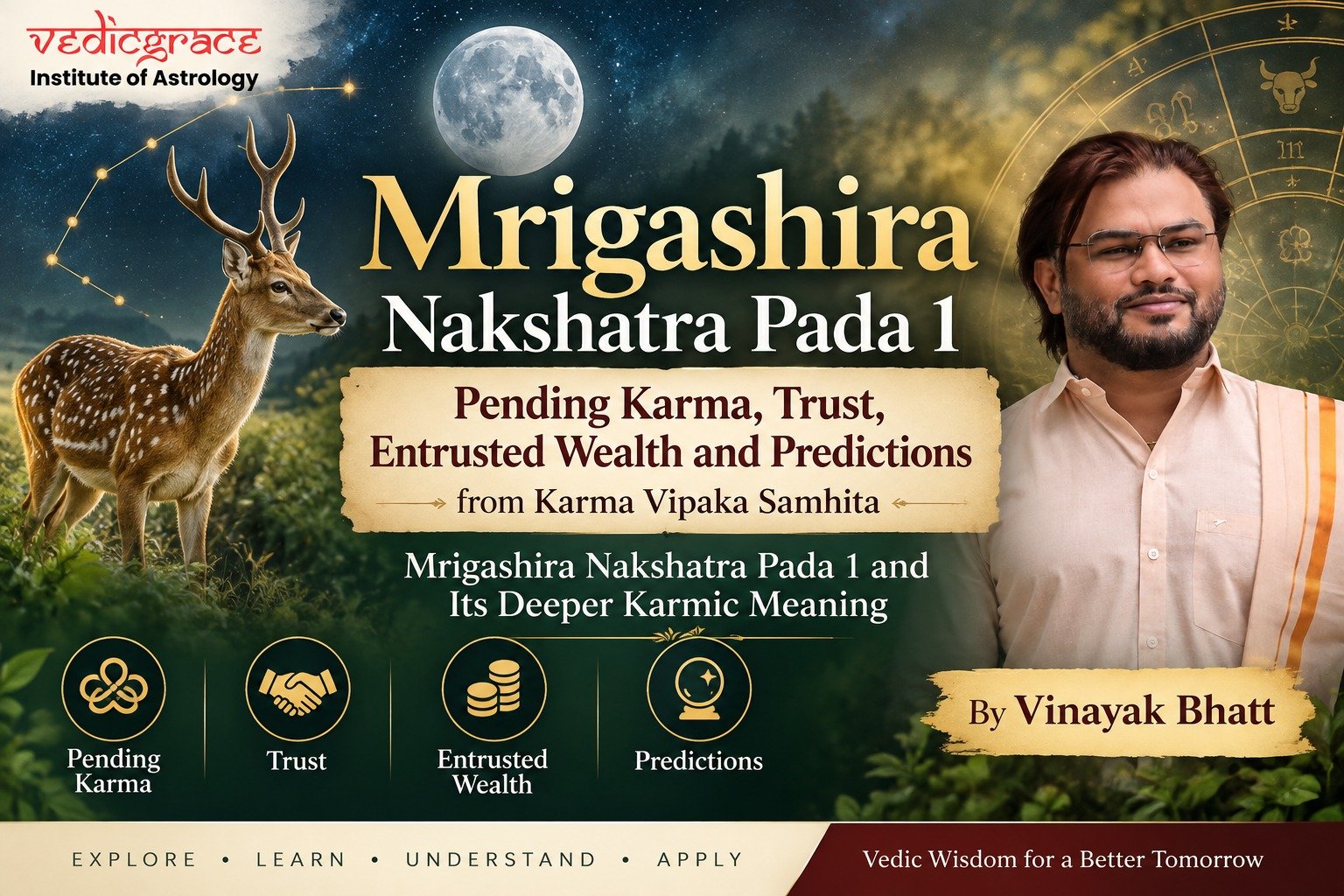
Mrigashira Nakshatra Pada 1 and Its Deeper Karmic Meaning
Mrigashira Nakshatra Pada 1 gives a very precise lesson about trust, possession and custodianship, because the central mistake described in Karma Vipaka Samhita is neither ordinary theft nor an ordinary unpaid loan. A trusted friend places a considerable quantity of gold in the house of a learned Brahmin for safekeeping. The owner later dies, and instead of preserving the gold for the rightful claimant or returning it to the deceased man’s family, the Brahmin gradually begins using the wealth with his own household. The object which originally entered his house because of trust slowly becomes treated as though it were his own possession. The karmic result is equally precise: the same person whose wealth had been retained later returns as the Brahmin’s son, becomes deeply loved by the parents and then dies in youth, after which progeny is again obstructed. The source explicitly connects the blacksmith’s rebirth as the son with the failure to return his gold.
The whole Pada can therefore be understood through one distinction: something can remain in our possession without becoming our property. This is the real moral centre of the story. The karmic problem does not begin when Veda Sharma physically receives the gold, because receiving it was part of friendship and trust; the problem begins when the meaning of that custody changes inside his mind.
In standard Jyotish, Mrigashira extends from 23°20′ Taurus to 6°40′ Gemini, and its first Pada occupies 23°20′ to 26°40′ Taurus, falling in Leo Navamsha. Mrigashira is ruled by Mars and its Devata is Soma, Taurus is ruled by Venus, while Leo Navamsha is ruled by the Sun. This gives a very interesting combination in which Mars searches and acts, Venus recognises tangible value, Taurus wants to preserve what has been acquired, Soma seeks fulfilment and nourishment, while the Sun introduces honour, conscience, reputation and the question of how one behaves when other people consider one’s character trustworthy.
The Karma Vipaka story fits this combination extremely well because Veda Sharma is not an unknown or openly immoral man. He is a learned Vedic teacher, his livelihood comes through knowledge, he possesses spiritual merit and he is devoted to Surya. Precisely because he is respectable, the blacksmith trusts him enough to leave substantial wealth in his house. His reputation therefore becomes part of the karmic test.
The Karma Vipaka Story of Mrigashira Nakshatra Pada 1
The source describes a Brahmin named Veda Sharma living in Madhyadesha. He was well versed in the Vedas and Vedangas and regularly studied or taught all four Vedas. His wife was named Sushila, and his livelihood itself came through Vedic teaching. A blacksmith or ironworker eventually became his friend and entrusted a considerable quantity of gold to Veda Sharma’s house for preservation. Some translations gives the amount as 400 tolas, while another modern day translation paraphrases the quantity at roughly four kilograms; because the modern renderings differ in how they express the old measure, the safest conclusion is simply that the amount was substantial.
After some time the blacksmith died. Veda Sharma did not restore the gold to the deceased man’s family or otherwise treat it as property still belonging to the blacksmith’s side. Instead, he gradually spent and enjoyed the wealth together with his wife. The source is therefore remarkably clear that the gold originally entered the household in good faith for safekeeping, and that the later enjoyment of it constituted the karmic fault.
After many years Veda Sharma also died. Because he was a devotee of Surya and had accumulated genuine Punya through his Vedic life, he did not immediately receive only a difficult result; the text says that he attained Surya Loka and remained there for twenty thousand years. When that Punya was exhausted, he returned to human birth, where he again possessed wealth or fortune but remained without progeny. The text then gives the central karmic reversal: because Veda Sharma had not returned the blacksmith’s gold, that same blacksmith took birth as his son. The son loved his parents deeply and behaved in a way that made him extremely dear to them, but after attaining youth he died suddenly, and the couple again remained without children.
This is a very sophisticated example of Karma Vipaka because good and difficult karma are shown giving their results separately. Veda Sharma’s Vedic learning and Surya devotion produced Surya Loka; the misuse of entrusted wealth produced a different consequence. The text therefore does not support the simplistic idea that one good deed cancels one bad deed mathematically. Different karmic streams can coexist and ripen through different areas of life.
The Real Pending Karma: Custody Is Not Ownership
The deepest pending karma of Mrigashira Pada 1 is the confusion between custody and ownership. Veda Sharma’s mistake was not that gold happened to be physically located inside his house. The mistake was that after the owner disappeared from the visible situation, Veda Sharma slowly allowed physical possession to become psychological ownership.
This is highly relevant in modern life because enormous amounts of value now move through forms of temporary custody. Client money may sit in somebody’s account. A business may hold advance payments. Jewellery may be left with relatives for safety. A trustee may control assets belonging to beneficiaries. A lawyer, accountant or financial adviser may temporarily control another person’s documents or funds. A teacher may receive unpublished research from a student. An astrologer may receive private birth data and intimate personal information. A publisher may hold an author’s manuscript. In every case, the person possesses something without necessarily owning it.
The karmic line is crossed when the mind begins saying, “It has remained with me so long that I can use it,” or “Nobody is asking for it, therefore perhaps it no longer matters.” Mrigashira Pada 1 teaches exactly the opposite principle: the absence of the owner does not change ownership.
This becomes especially important when the original owner dies, disappears or becomes too weak to demand what belongs to them. The strength of Dharma is tested most clearly when there is no immediate external pressure to behave correctly.
Why This Is More Serious Than an Ordinary Loan
The difference between this story and ordinary debt karma is important. When somebody takes a loan, both parties understand that the borrower will use the money and later repay an equivalent amount. The lender knowingly transfers temporary use of the resource.
In Veda Sharma’s story, the blacksmith did not give the gold for use. He gave it for protection.
The relationship is therefore based upon trusteeship rather than credit.
This makes the Karma Vipaka principle especially relevant to occupations and relationships involving entrusted property, deposits, escrow funds, client accounts, inheritances waiting to be distributed, institutional money, family valuables, confidential documents and intellectual property. In such situations the person’s Dharma is not primarily to create profit from the resource but to make sure that it remains protected and eventually reaches the person to whom it rightfully belongs.
For this reason, when Mrigashira Pada 1 becomes strongly connected with the 2nd, 8th or 11th houses, an astrologer should not ask only about loans. A much better question is whether the native has repeatedly been placed in situations where friends, relatives, clients or institutions trust them with something valuable.
The Blacksmith Returning as the Son: The Deepest Karmic Reversal
The most powerful part of the story is that the blacksmith himself becomes Veda Sharma’s son. The text directly gives the unpaid or unreturned gold as the reason for this rebirth connection.
The symbolic structure is extraordinary. In the previous relationship, the blacksmith placed his gold under Veda Sharma’s protection. In the later relationship, the blacksmith himself enters Veda Sharma’s protection as his child.
Earlier, something belonging to the blacksmith depended upon Veda Sharma’s honesty. Later, the blacksmith’s very life becomes part of Veda Sharma’s emotional world. The gold had been valuable, but the son becomes immeasurably more valuable emotionally.
This allows us to derive an important Jyotish principle: when we fail to protect something entrusted to us, the same karmic relationship may return through a situation where protection, care or responsibility can no longer be treated casually.
The son’s deep affection is also important. The blacksmith does not return as an obvious enemy. He returns as somebody whom Veda Sharma loves. This reminds students that Rinanubandha does not always enter through conflict. Some of the strongest karmic accounts arrive through affection, attachment and people we would never willingly lose.
That does not mean every beloved child is a former creditor or that child loss should be predicted from this Pada. The source gives one karmic model; the complete horoscope must decide whether the theme becomes literal, symbolic or highly modified.
Mrigashira, Soma and the Search for Fulfilment
The Devata of Mrigashira is Soma, and this adds a deeper psychological layer to the story. Soma represents nourishment, rasa, refreshment, satisfaction and the subtle experience of being fulfilled. Mrigashira itself is a searching Nakshatra. Its deer-like symbolism suggests something constantly sensing, looking, following and seeking the next object which promises satisfaction.
In the first Pada, which remains in Taurus, this search can become strongly connected with tangible value. The person may search for money, security, property, objects, knowledge, opportunities or something concrete which gives a feeling of stability.
At the higher level, this creates excellent research and discovery ability. The native can recognise something valuable before other people see it, follow a clue patiently and find resources, information or opportunities which have remained hidden.
At the lower level, however, the search does not stop when something is merely found. The mind may begin wanting to possess what it encounters.
This gives a very useful Mrigashira Pada 1 sutra: Finding something valuable does not create a right to possess it.
This applies to gold in the classical story, but it can also apply to information, ideas, confidential knowledge, intellectual property or opportunities discovered while working for somebody else.
Taurus and the Desire to Preserve Value
Because the first Pada remains in Taurus, the search of Mrigashira becomes more material and preservation-oriented. Taurus does not merely notice value; it wants to hold and stabilise it. This is a tremendous strength when applied correctly because such people can become excellent custodians of money, property, art, documents, land, traditions or knowledge.
But Taurus can also create attachment. Something kept in the native’s possession for a long period can gradually begin to feel psychologically “mine,” even when legally or morally it belongs elsewhere. This is exactly why the Veda Sharma story works so beautifully with the Pada. The karmic correction is not that the native should avoid valuables.
The correction is to develop a very clear internal distinction: “I protect this because it has value” is different from “I own this because I have protected it.”
A mature Taurus preserves without appropriating.
Leo Navamsha and the Responsibility Created by Reputation
The first Pada falls in Leo Navamsha, and the Sun therefore becomes a major interpretive key. This connection is unusually striking because Veda Sharma is described as a Surya devotee and later attains Surya Loka because of his Punya.
The Sun brings reputation, honour, authority, visibility and conscience. Veda Sharma’s problem could happen precisely because he was respectable. People generally do not entrust large quantities of gold to someone they consider unreliable.
This produces an important Leo Navamsha lesson: The more trustworthy your reputation becomes, the greater your responsibility towards what people place in your hands.
A well-known teacher will receive secrets and manuscripts which an unknown person never sees. A famous astrologer may receive very intimate family information. A respected financial adviser may have access to enormous assets. A Guru may receive donations simply because disciples believe in the person. A senior professional may be given authority over younger people’s careers.
- The lower Sun begins to think, “People trust me because I am important.”
- The higher Sun thinks, “Because people trust me, my standard of conduct must be higher.”
That is the real maturity of Leo Navamsha in Mrigashira Pada 1.
Knowledge Does Not Automatically Become Dharma
Veda Sharma is learned in the Vedas and Vedangas. This is not a minor detail. Karma Vipaka deliberately places the fault in the life of somebody who already knows.
Therefore, one of the strongest lessons of the story is that knowledge does not automatically transform conduct. A person may understand Dharma intellectually and still fail when money, pleasure or opportunity becomes involved.
For teachers, counsellors, astrologers and spiritual professionals, this is particularly important. Someone may be capable of giving excellent moral advice while privately failing the same test. The real examination begins not when Shastra is being explained but when personal advantage appears.
A very useful question for Mrigashira Pada 1 is: “Would I behave exactly the same way with this resource if its rightful owner were standing in front of me?”
If the answer changes only because the owner is absent, Dharma has already identified the weakness.
Friendship Karma and the 11th House
The blacksmith is specifically described as Veda Sharma’s friend, which makes the 11th house highly relevant when applying the story to a horoscope. Friendship frequently creates financial situations in which people behave less carefully because affection replaces formal procedure. Someone lends money without documentation, leaves jewellery with a friend, enters business without a written agreement or transfers funds because “we know each other.” When everything goes well, nobody notices the danger. When something goes wrong, both the money and the friendship can disappear.
This gives one of the most practical sutras of the entire Pada: Clarity protects friendship.
Written records are not an insult to trust. Clear ownership does not weaken affection. Proper accounts do not make a relationship cold or commercial. In many cases they prevent money from poisoning the relationship later.
Therefore, when the 11th house, 2nd house and 8th house connect strongly with an afflicted Mrigashira Pada 1, financial dealings with friends should remain especially transparent.
The 8th House: Other People’s Wealth
The 8th house becomes unusually important for this Pada because the central asset belongs to somebody else. The 8th house covers shared resources, inheritance, another person’s property, hidden assets and money which enters one’s life without being purely self-earned.
When the 8th lord or a planet strongly connected with the 8th occupies Mrigashira Pada 1, the person may repeatedly encounter situations involving joint money, inheritance, client funds, family jewellery, business capital, insurance, estate matters or resources entrusted by others.
A well-supported configuration can make the person exceptionally reliable in these matters. They may become a trustee, auditor, banker, financial manager, lawyer, fund administrator, executor of an estate or somebody whom the entire family trusts with important assets.
An afflicted configuration can produce the opposite side of the story, where ownership becomes unclear, informal arrangements become dangerous or another person’s money becomes mixed with one’s own.
Therefore the Pada itself should never be labelled “dishonest.” Its higher expression can actually produce exceptional integrity in custodial matters. Karma frequently develops mastery in the very field where an old weakness once existed.
The Reverse Manifestation: When the Native’s Trust Is Broken
The Karma Vipaka story places Veda Sharma in the role of the person who misuses trust, but in an actual horoscope the same karmic subject can sometimes appear through the opposite experience. The native may become the person who repeatedly entrusts valuables, money, documents or intellectual work to others and later struggles to recover them.
A friend may fail to return money. A relative may retain jewellery. A business partner may use company funds. Research shared privately may appear under somebody else’s name. A person may trust someone completely with property and later become involved in a dispute.
This reverse expression is a Jyotish inference rather than a literal result stated by the chapter, so the 2nd, 6th, 8th and 11th houses must support it before it is used predictively.
The deeper correction remains the same: Trust should remain sacred, but trust should also remain intelligent.
Mrigashira naturally asks questions. Its higher expression verifies, documents and investigates without becoming paranoid.
Intellectual Property Is a Modern Form of Entrusted Gold
One very relevant modern extension of this story concerns knowledge and intellectual property, especially because Veda Sharma himself was a teacher.
Today gold is not the only valuable thing somebody can place in another person’s hands. A rare manuscript can be valuable. Years of research can be valuable. A student’s thesis, a confidential teaching, a course structure, a private translation or an unpublished book can represent years of another person’s life. If such material is given for review, safekeeping, collaboration or private study, custody does not create authorship.
This gives Mrigashira Pada 1 enormous relevance for teachers, researchers and publishers. A person should not take another scholar’s research and quietly convert it into their own teaching. A teacher should not claim a student’s discovery as personal work. A rare manuscript shared privately should not be published merely because one possesses a copy.
The principle is exactly the same as Veda Sharma’s gold: Access is not ownership.
This becomes especially important when Mercury, Jupiter, the 5th house or 9th house connects with Mrigashira Pada 1.
The Wife and Shared Use of Entrusted Wealth
The source states that Veda Sharma and his wife Sushila enjoyed the blacksmith’s gold together. This does not justify declaring both equally responsible because the chapter does not provide enough detail for such arithmetic, but it does raise an important question about shared household benefit.
One spouse may directly make the questionable financial decision while the other knows where the money came from and enjoys the result. Marriage can therefore become the environment in which one person’s action is normalised because both people benefit from it.
This is relevant when Venus, the 7th house, 2nd house and 8th house connect with Mrigashira Pada 1. The spouse can either reinforce the lower pattern or become an important protective factor. A Dharmic spouse may be the person who says, “This is not our money; keep it separate and return it.” That one intervention can prevent a financial error from becoming a karmic relationship.
Mixed Karma and Surya Loka
The Surya Loka portion of the story should not be treated as a decorative detail because it teaches one of the most important principles in Karma Vipaka Samhita. Veda Sharma possessed genuine merit. He studied and taught Vedas, followed Surya worship and accumulated Punya. Therefore that Punya produced its own result. Only after the merit had been experienced did the unreturned gold produce another karmic consequence.
This means an astrologer should resist judging a person in totality from one difficult yoga or one Karma Vipaka story. A native can possess excellent Guru karma and difficult financial karma. They can be spiritual and still make one serious mistake with money. They may be generous in many areas yet fail one major test of trust.
Likewise, when the horoscope contains strong Raja Yogas or Dhana Yogas alongside difficult combinations involving the 5th, 8th or 11th houses, there is no contradiction. Different streams of karma can operate simultaneously.
Progeny Karma and the 5th House
The source clearly connects the unreturned gold with progeny disturbance, first showing childlessness and then the blacksmith returning as a beloved son who dies young. But this classical result should never be mechanically applied to every person with a planet in Mrigashira Pada 1.
Literal progeny judgement requires examination of the 5th house, fifth lord, Jupiter, Putrakaraka, Saptamsha and operative Dasha. Without repetition from these factors, one should not predict infertility or child loss.
The wider 5th-house meaning is especially useful here because the house also governs students, creativity, authorship and what we transmit into the future. A teacher may experience the karmic pattern through a student rather than a biological child. A researcher’s work may return through another scholar. An institution may struggle with succession. A native may find that someone they mentor eventually becomes deeply connected with family money, business or legacy.
The deeper principle is that an old account involving something entrusted to us can return through somebody whom we later have to guide, protect or nurture.
A Strong Consultation-Level Prediction
When Mrigashira Pada 1 is strongly activated and the 2nd, 5th, 8th or 11th houses repeat the source pattern, one of the most useful consultation statements is: “Your chart shows that money and trust need unusually clear boundaries. At some point you may be asked to hold, manage or protect something valuable belonging to a friend, relative, client or institution. The amount itself may not be the real karmic issue; the issue is whether ownership remains completely clear after the asset stays with you for a long period.”
If the 11th house is prominent, friendship and finance may mix. If the 8th dominates, shared assets, inheritance or another person’s resources become central. If the 5th is involved, a child, student or successor may become connected with the same financial account. If the 9th and 10th houses participate, the trust may arise because of knowledge, reputation, teaching or professional authority.
The reverse prediction is also useful when the horoscope supports it: “Do not hand over money, jewellery, documents or intellectual work merely because you trust someone personally. Maintain the relationship, but maintain records as well.”
These predictions are far more responsible and useful than telling somebody that they literally stole a blacksmith’s gold in a previous birth.
Career Potential of Mrigashira Pada 1
The same karmic pattern which creates difficulty at the lower level can produce a very strong professional ability at the higher level. Mrigashira searches, Taurus values and preserves, Leo takes responsibility, and Mars gives the capacity to act. This can make the native very capable in fields involving research, wealth management, banking, accounting, law, trusteeship, audit, insurance, estate planning, property management, fund administration, data security, archives or any role where another person’s valuable resource has to be located, protected or managed.
The person may become unusually strict about separating funds, documenting transactions and maintaining ownership records. What looks like excessive caution to other people can actually be the higher expression of the Pada.
The professional principle is simple: The lower Mrigashira finds value and wants to possess it; the higher Mrigashira finds value and knows how to protect it.
Planetary Applications of Mrigashira Nakshatra Pada 1
When the Sun occupies Mrigashira Pada 1, reputation and integrity become particularly important because the Pada itself falls in Leo Navamsha. The native may be entrusted with responsibility because of position, knowledge or public standing, and the major karmic test is not to assume that status gives special rights over resources belonging to others. At the higher level this can create a person whose reputation for honesty becomes one of their greatest assets.
When the Moon occupies this Pada, material security and emotional security can become closely linked. The person may become deeply attached to family property, valuables or resources which make them feel safe, but a well-supported Moon can make them extremely protective of assets entrusted by relatives or the family.
When Mars occupies Mrigashira Pada 1, the Nakshatra lord becomes strongly active and the searching quality becomes more forceful. Such a person can identify opportunities quickly and pursue value aggressively, but must avoid acting impulsively when ownership or another person’s property is involved.
When Mercury occupies the Pada, the karmic field often moves towards contracts, accounts, documents, commercial information, intellectual property and record-keeping. This can be excellent for audit, finance, trading or research when Mercury is strong, but an afflicted Mercury can create confusion through poor documentation or informal agreements.
When Jupiter occupies Mrigashira Pada 1, Guru, students, teaching, children and Dharma become highly relevant. A strong Jupiter can produce an exceptionally trustworthy teacher or adviser, while an afflicted Jupiter can create the contradiction of somebody who genuinely knows Dharma but rationalises questionable behaviour when valuable resources enter the picture.
When Venus occupies the Pada, money, gold, property, relationships and material value become especially important. The native may possess excellent financial sense, but if Venus is afflicted, the line between personal, marital and entrusted resources can become blurred.
When Saturn occupies Mrigashira Pada 1, responsibility for property or another person’s resources may continue for many years, especially through institutions, inheritance, family estates or long-term trusteeship. A mature Saturn can make the person exceptionally careful, patient and accountable.
When Rahu occupies the Pada, the search for valuable opportunities can become very strong, and unusual financial structures, hidden ownership, foreign assets or complicated arrangements may arise. Transparency becomes particularly important.
When Ketu occupies Mrigashira Pada 1, the native may appear detached from material possessions, but that detachment can sometimes become practical carelessness about records, ownership or responsibility. At a higher level, Ketu can turn Mrigashira’s search strongly towards hidden knowledge and research rather than physical acquisition.
These planetary possibilities are Jyotish interpretations, not statements made directly by the Karma Vipaka chapter, and they must be judged through house ownership, dignity, aspects, conjunctions and Dasha.
House Logic and Dasha Activation
The 2nd house shows personal wealth, accumulated resources and the distinction between what belongs to the native and what has entered the family treasury. The 4th house may become relevant because the classical gold was physically kept in Veda Sharma’s house, making property, storage and family possession important. The 5th house becomes central because the blacksmith returns as the son. The 8th house is one of the strongest houses for applying this story because it governs other people’s assets, shared wealth, inheritance and resources which are not exclusively self-owned. The 9th house connects with Veda, Dharma and teaching, while the 10th house shows the professional role through which the native can become trusted. The 11th house deserves special attention because the original relationship was friendship.
The strongest combinations are therefore not simply “Mrigashira Pada 1 somewhere in the chart.” The story becomes much more active when the Pada connects the 2nd and 8th houses, showing personal versus other people’s wealth; the 5th and 8th, connecting children or students with an old financial account; the 8th and 11th, connecting friends and entrusted resources; or the 9th, 10th and 8th, showing another person’s assets entering the native’s control because of knowledge or professional reputation.
Dasha tells us when the sleeping karmic pattern becomes active. A Dasha of the planet occupying Mrigashira Pada 1 may awaken the entire story through that planet’s Karakatwa. Periods of the 2nd, 5th, 8th or 11th lords can bring questions of money, children, friends and shared resources forward. Jupiter periods may activate children, students and Dharma; Venus periods can activate valuable assets and relationships; Sun periods may test reputation and integrity; while Mars periods may produce decisive action concerning property or money.
This is how Karma Vipaka should become predictive rather than merely historical.
Traditional Prayaschitta for Mrigashira Pada 1
The main available source versions agree on the central Prayaschitta. The person is instructed to perform one lakh Gayatri Mantra Japa and Durga Puja, donate ten differently coloured or different kinds of cows, and perform land donation. The text then prescribes Gaya Shraddha, with one modern day translation specifically noting that it should be performed properly and with determination even if obstacles arise, followed by sacred bathing at Prayag during the period when the Sun is in Capricorn, Makara. The classical text connects completion of these observances with destruction of the previous karmic fault, restoration of progeny and relief from disease.
These are formal traditional Prayaschitta procedures and should be carried out under competent ritual guidance rather than reconstructed casually from an English summary.
The symbolic logic, however, is very clear. Veda Sharma’s genuine spiritual strength came through Veda and Surya, and Gayatri brings him back towards the same higher field of clarity. Durga can be understood symbolically as restoring boundaries, which is especially relevant because the original karmic failure was itself a boundary failure: my property versus another person’s property, custody versus ownership, protection versus consumption. Gaya Shraddha becomes especially meaningful because the rightful owner had died before the account was settled; the death of the blacksmith removed the visible claimant but did not remove the unfinished relationship.
The most practical lesson from Gaya Shraddha is therefore equally clear: death does not make another person’s property ownerless. If somebody who has entrusted wealth dies, it should be restored properly to the rightful heirs or settled according to Dharma and law rather than silently absorbed into one’s own estate.
Practical Modern Remedy
The strongest living remedy for Mrigashira Pada 1 begins with checking whether there is anything in the present life which the native possesses but does not truly own. Old deposits should be returned, client money kept separately, family jewellery clearly accounted for, borrowed documents restored, advances treated as obligations until promised work is completed, and intellectual material credited to its true source. If somebody who entrusted property has died, rightful heirs should be identified rather than treating the person’s death as permission to keep what was left behind.
For professionals, the same remedy means creating strong systems of custodianship. Maintain records. Keep client funds separate. Put ownership in writing. Protect confidential material. Do not use another person’s research merely because it entered your possession. If people trust you, become more accountable rather than less accountable.
There is no contradiction between spiritual remedy and practical correction. In fact, the behavioural correction gives meaning to the ritual. Gayatri may purify the mind, Durga Puja may reinforce sacred boundaries and Gaya Shraddha may address the ancestral or unfinished dimension of the account, but the most convincing proof that the samskara has changed is that the person now returns what does not belong to them without being forced to do so.
The Higher Expression of Mrigashira Pada 1
The higher form of Mrigashira Pada 1 can be extremely powerful because all the same qualities remain present, but their direction changes. Mars still searches. Venus still recognises value. Taurus still preserves. Leo still gives status. Soma still seeks fulfilment. But instead of appropriating what has been found, the native becomes a guardian of value.
Such a person may become the family member everyone trusts with documents, the adviser clients trust with money, the teacher trusted with rare knowledge, the researcher who preserves old manuscripts or the trustee who protects an institution’s assets for the next generation.
The person may even become unusually strict about honesty because they intuitively understand that trust is itself more valuable than the object being entrusted.
- Gold can be replaced.
- Trust is much harder to restore.
That is the higher Soma of Mrigashira: fulfilment no longer comes merely from possessing the valuable object; fulfilment comes from becoming worthy of another person’s faith.
The Real Teaching of Mrigashira Nakshatra Pada 1
Mrigashira Nakshatra Pada 1 ultimately asks a very uncomfortable question: Who are you when the person who trusted you is no longer present to check?
The blacksmith trusted Veda Sharma. Then the blacksmith died. Nobody appears to have been standing at the door demanding the gold. The object remained inside Veda Sharma’s house. That is exactly when the karmic examination became real.
Veda Sharma possessed Vedic knowledge, Surya Bhakti, reputation and genuine Punya, yet one entrusted object revealed an area where all that knowledge had not yet become conduct. The story therefore does not condemn learning or spiritual life; it teaches that the value of learning is finally measured when nobody outside is forcing us to behave according to it.
At the lower level, Mrigashira searches for value, finds it and gradually begins to treat access as ownership. At the middle level, life creates lessons through friendship, children, money, inheritance and trust until the distinction becomes clear. At the higher level, the native becomes one of the safest people to whom wealth, knowledge, confidential information or responsibility can be entrusted.
The main predictive sutra for Mrigashira Nakshatra Pada 1 can therefore be expressed as: When Mrigashira Pada 1 is strongly activated, examine what valuable things other people place in the native’s hands because of friendship, knowledge, profession or reputation, and whether the native preserves the distinction between possession and ownership.
The shorter Karma Vipaka sutra is: “What is kept with you does not become yours.”
And the higher principle is: “When someone entrusts you with something valuable, return not only the object intact, but the trust intact.”
That is the deeper meaning of Mrigashira Nakshatra Pada 1, pending karma, custodianship and predictions from Karma Vipaka Samhita.
Regards
To know more you can join our Course Karma Vipaka


![Shri H. N. Katwe: Secrets of Moon [Predictive Techniques Related to Moon]](https://vedicgrace.com/wp-content/uploads/2025/11/Secrets-of-Moon-Webinar-300x300.jpg)
![Bhrigu Nandi Nadi Course for Beginners [Hindi]](https://vedicgrace.com/wp-content/uploads/2025/12/Bhrigu-Nandi-Nadi-for-Beginners-Hindi-Recorded-VG-300x214.png)

Leave a Comment
Be the first to comment on this blog!