
Mrigashira Nakshatra Pada 3: Pending Karma, Debt, Financial Balance and Predictions from Karma Vipaka Samhita by Vinayak Bhatt
Nakshatra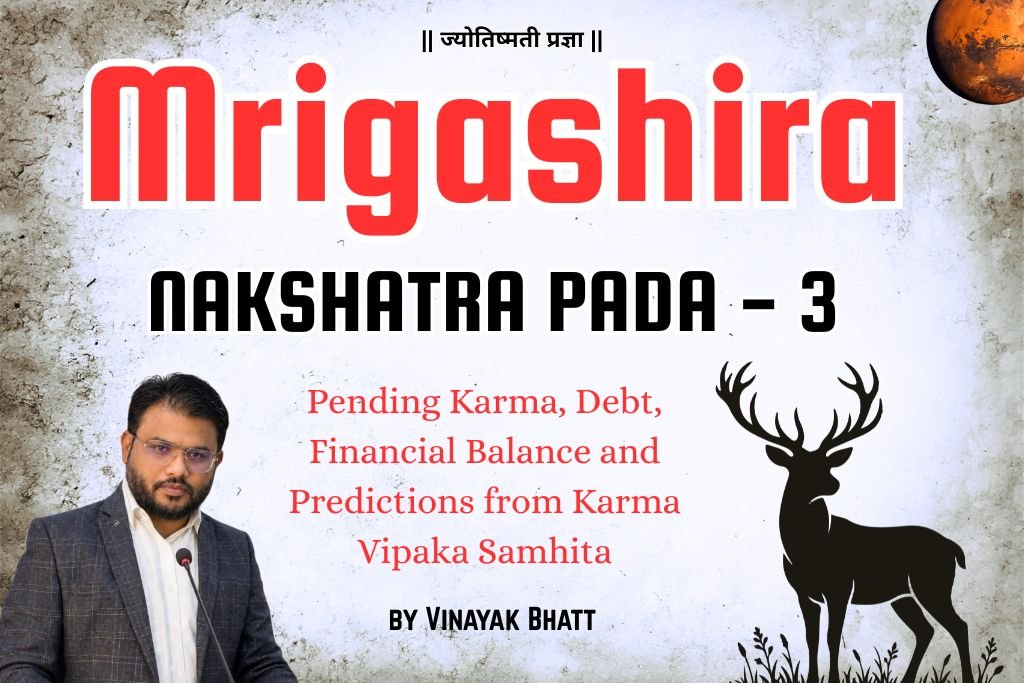
Mrigashira Nakshatra Pada 3 and Its Deeper Karmic Meaning
Mrigashira Nakshatra Pada 3 gives one of the clearest Karma Vipaka teachings regarding financial exchange, borrowing, repayment and Rina Anubandha, because the previous-life person in this story is neither a thief nor someone who originally begins life in poverty. He is a successful craftsman who earns considerable wealth through his own profession, but his circumstances change with age, his accumulated resources disappear and he eventually takes financial help to maintain his household.
The problem does not arise because he borrowed money; it arises because he consumed the borrowed money and died before the financial transaction was completed. In the later birth, the creditor does not merely return as another lender demanding repayment from outside the family. He becomes the debtor’s son and begins consuming the father’s wealth, making the unfinished monetary account into an intimate human relationship. The source directly connects this later relationship with the unpaid debt.
This makes the central subject of Mrigashira Pada 3 much deeper than a general warning against loans. Its real concern is an exchange that begins but does not reach completion. Something is received because it solves an immediate need, its value is consumed, but the responsibility attached to it remains unresolved. The Karma Vipaka narrative treats this unfinished transaction almost like a thread which continues beyond the original circumstances and eventually seeks another form through which balance can be restored.
Mrigashira Pada 3 occupies approximately 0°00′ to 3°20′ Gemini and falls in Libra Navamsha. Mrigashira is ruled by Mars, its Devata is Soma, Gemini is ruled by Mercury and Libra Navamsha is ruled by Venus. This produces a very appropriate combination for a story concerning borrowing and repayment. Mercury governs transactions, calculations, agreements, communication and commerce, while Venus governs value and Libra represents balance between two sides of an exchange.
Mars gives the impulse to act quickly when a need arises, and Soma represents nourishment, relief and the search for satisfaction. The karmic problem can therefore be understood as receiving something because it solves the difficulty of the present moment, while failing to complete the future obligation created by that solution.
The Karma Vipaka Story of Mrigashira Nakshatra Pada 3
The Karma Vipaka account places the earlier-life story in a city called Purika or Pureeka, situated on the southern bank of the Narmada River. There lived a prosperous potter named Karma Chandra, whose wife is called Devaki or Devika in different translations. Karma Chandra earned good wealth by making earthen pots, vessels and other objects from clay, so the text does not present him as somebody who lacked the capacity to earn.
He had once created material prosperity through his own skill and occupation. With advancing age, however, his financial situation deteriorated and the wealth he had accumulated gradually disappeared. He became poor and eventually borrowed one hundred gold coins from another craftsman or moneylender so that his household expenses could continue. The occupational description of the creditor varies slightly between translations, but the central fact is consistent: Karma Chandra obtained a substantial amount of gold as a loan.
Karma Chandra spent the borrowed amount. His wife died before him and he too later died without repaying the debt. Because their deaths were connected with the sacred Narmada region, the text says that they received the Punya arising from that sacred association and enjoyed a heavenly state for a long period.
When that merit was exhausted, both returned to human birth and the same woman again became his wife. This portion is important because it shows that good karma and unresolved karma can operate separately. The Narmada-related Punya produced one result, while the unpaid financial account remained incomplete and later produced another.
The person from whom Karma Chandra had borrowed the money later took birth as his son because of the old Rina relationship. Different translations describe this son as troublesome, opposing or difficult from an early age, and he repeatedly took money from the father and spent it in gambling, sensual enjoyment and other wasteful activities until the father’s accumulated wealth became depleted.
The later verses also describe disturbance of progeny and family continuity. Although the English wording differs slightly in these later portions, the common principle remains clear: the creditor became the son and the father’s wealth was consumed through the very relationship created by the old debt.
The same Karma Vipaka material elsewhere gives a broader description of a Rina-related son, stating that a creditor whose loan remained unpaid can return as the debtor’s child and consume the parent’s wealth. Mrigashira Pada 3 is therefore not an isolated moral story but a direct example of a larger Rina Anubandha principle preserved in the text.
The Real Pending Karma: The Exchange Was Left Half-Finished
The pending karma of Mrigashira Pada 3 is not borrowing itself. Borrowing can be completely legitimate and may sometimes be necessary for business, health, family or survival. Karma Chandra had reached old age and lost his financial security, so taking assistance was understandable. The problem arose because the benefit was received and consumed while the return obligation remained unfinished.
This distinction is extremely useful in practical Jyotish. The important question is not simply whether the native will take a loan, but how the native behaves after the immediate pressure has passed. On the day money is borrowed, the borrower is usually very conscious that it belongs to somebody else and has to be repaid.
The difficulty arises months or years later, after the emergency has been solved and the borrowed money has already become part of ordinary life. Repayment may be postponed, then postponed again, and eventually the lender’s reminders can themselves begin to feel irritating because they bring back a responsibility that the borrower would prefer to forget.
Mrigashira Pada 3 therefore teaches that emotional discomfort about debt does not cancel debt. The exchange remains incomplete until both sides reach a proper settlement. The deeper karmic principle is that a benefit received today can become a relationship tomorrow when the obligation attached to it is left unfinished.
Gemini Rashi and Libra Navamsha: Transaction Must Reach Balance
Gemini and Libra provide unusually clear Jyotish logic for this story. Gemini belongs to Mercury and governs commerce, agreements, calculation, documents, negotiation and movement of resources. Libra belongs to Venus and seeks equilibrium, fairness and mutual value.
Mrigashira adds the searching quality, so the native sees a problem and immediately begins looking for a solution. Mercury finds the arrangement, Mars gives the courage to act, Venus makes the resource attractive and useful, but Libra asks the final question: has the other side of the exchange also been completed?
At its higher level, this Pada can be excellent for business because Mercury understands commercial processes, Mars gives initiative and Venus understands value, price and negotiation. Such a person may know how to locate capital, identify opportunity, negotiate terms and keep a business moving during periods of financial difficulty.
At the lower level, however, the same intelligence can become very skilled at finding the next source of money while avoiding the previous obligation. Every crisis gets solved temporarily, but the balance sheet becomes increasingly full of unfinished commitments.
For this reason, the higher expression of Mrigashira Pada 3 requires clean accounts and proper closure. The person should not only be skilled at opening transactions; they should become equally skilled at closing them.
The Exactness of Karmic Repayment
One of the strongest details in the source is that the later son is described as consuming an amount corresponding to the earlier borrowing. The story therefore does not merely suggest that unpaid debt produces some vague future difficulty; it portrays karma almost as an account which seeks balance.
Whether one understands this literally through rebirth or symbolically through the philosophy of Karma Vipaka, the teaching is clear. An exchange does not cease to exist merely because the original circumstances have disappeared. Time can change the form of the relationship without necessarily changing its underlying imbalance.
This is why some financial relationships in present life can feel strangely compulsory. A particular child, family member or associate may repeatedly absorb resources, and even after one expense is finished another appears. One should never casually declare that such a person is a previous-life creditor merely because Mrigashira Pada 3 is present, but if the 2nd, 5th, 6th, 8th and 11th houses, Jupiter and the relevant Dashas repeatedly support the same pattern, Rina Anubandha can become a serious line of Jyotish investigation.
The Son Should Not Be Reduced to a “Bad Child”
From the father’s present-life perspective, the son in the classical story looks destructive because he repeatedly takes money, wastes it through gambling and sensual pleasure and gradually exhausts the family’s wealth. Karma Vipaka, however, changes the viewpoint completely because the same person had previously been the creditor whose wealth Karma Chandra consumed without repayment.
This reversal is important because Jyotish should not judge an event only from the emotional viewpoint of the present incarnation. A person who appears to be taking from us may, within the karmic philosophy of the text, be part of a relationship in which the direction of giving and taking has changed.
This should never be used to excuse addiction, theft or abuse. A parent is not required to destroy the entire family simply because an astrologer imagines that a child is a karmic creditor. Boundaries remain essential. The correct principle is that an old account should be settled without creating a new account of irresponsibility. Higher Libra seeks balance; it does not demand helplessness.
Mrigashira Pada 3 and the Pattern of Financial Leakage
A very useful modern interpretation of this Pada is wealth that repeatedly comes but does not remain. Karma Chandra had once been prosperous, yet his financial reserves disappeared in old age. In the later incarnation, wealth again existed but was gradually consumed through the debt-related son. The recurring theme is therefore not necessarily inability to earn. It is difficulty preserving financial balance across time.
This becomes especially relevant when the 2nd and 11th houses are capable of producing income while the 6th, 8th or 12th houses simultaneously create debt, obligations or leakage. Such a native may earn extremely well and still remain under financial pressure because expenses increase with income, old obligations are continually rolled forward or one family relationship consumes a disproportionate share of resources.
The more precise prediction is therefore not simply, “You will have financial problems.” It is that the ability to make money can be stronger than the ability to close financial cycles. Such a person can have income, business opportunity and even periods of prosperity, yet unfinished loans, family obligations, client advances, taxes, partnership settlements or long-term dues may keep the financial system under pressure.
The Potter’s Profession and the Question of Financial Containment
Karma Chandra is specifically described as a potter, and although the text does not explain the symbolic reason for this profession, the image gives an interesting Jyotish reflection. A potter creates a container. The entire purpose of a vessel is to hold something without allowing it to leak away. Karma Chandra could create physical containers successfully, yet the financial story of his life repeatedly shows a failure of containment: wealth accumulates and later disappears, borrowed money enters and is consumed, and wealth in the later birth again drains away through the son.
This symbolism should be treated as interpretation rather than as literal classical commentary, but it leads to a useful financial principle: earning income and creating a structure capable of retaining income are different skills. Some people are excellent producers but poor preservers. They can make money, build business and create opportunities but do not maintain reserves, retirement planning or disciplined repayment systems.
For Mrigashira Pada 3, financial maturity comes when the native learns to build a strong container around wealth rather than depending only upon the ability to earn again.
Old Age and the Need for Long-Term Financial Planning
The fact that Karma Chandra’s difficulty intensifies in old age is also significant. He was once wealthy, but by the time his earning capacity declined his resources had disappeared and borrowing became necessary. The story therefore contains an important practical lesson concerning retirement, reserves and financial planning for periods when income may reduce.
A person may spend their strongest earning years assuming that future opportunity will always remain available. Mrigashira naturally searches for the next solution, and a native may believe that another business, another client, another investment or another source of income will eventually solve the present problem. Sometimes that happens, but a life built entirely upon future possibilities can become vulnerable when age, health or circumstances reduce the ability to search and act.
The higher expression of this Pada therefore plans before desperation begins. It creates emergency reserves, separates investment capital from household expenditure and distinguishes productive borrowing from borrowing simply to maintain a lifestyle which is no longer financially sustainable.
Soma and the Difference Between Relief and Resolution
Soma, the Devata of Mrigashira, represents nourishment, satisfaction, rasa and relief. This becomes psychologically meaningful in the third Pada because borrowing often provides immediate emotional relief. A financial pressure exists, money arrives, the crisis temporarily disappears and the nervous system relaxes. Yet the obligation still exists.
This is one reason debt can become deceptive. The relief is experienced now, while repayment belongs to the future. The mind naturally values the immediate relief more strongly than the distant responsibility.
The lower Mrigashira therefore searches for relief, while the higher Mrigashira searches for resolution. Relief asks how to survive the present month. Resolution asks how the entire financial cycle will ultimately close. This distinction between temporary comfort and complete settlement is one of the most useful ways to understand Soma operating through Gemini and Libra Navamsha.
Mrigashira Pada 3 Can Be Strong for Business and Negotiation
The Karma Vipaka story should not lead students to treat this Pada as fundamentally negative for finance. In fact, Mars, Mercury and Venus can create strong commercial intelligence. The native may be naturally good at sales, brokerage, trading, consulting, negotiation, business development, marketing, finance or client-facing work because they can identify what another person needs and quickly construct an exchange around it.
The real karmic test lies in fair completion of the exchange. Contracts should be honoured, partners should receive the agreed share, commissions should remain transparent, clients should receive what was promised and refunds should not be deliberately postponed simply because delaying payment helps cash flow.
The lower Mercury asks what clever interpretation of the agreement can protect personal advantage. The higher Mercury remembers what both parties genuinely understood when the transaction began. Libra then restores fairness.
Debt Also Includes the Anxiety Created for the Creditor
Some practical renderings of this Karma Vipaka chapter emphasise not only the unpaid amount but also the distress created for the creditor. This expands the karmic meaning considerably because the effect of unpaid debt cannot always be measured only through the principal amount.
A creditor may have lent money from personal savings, postponed their own plans or trusted the borrower because of relationship. When repayment does not happen, the lender may experience family tension, loss of opportunity, anxiety or years of uncertainty. The borrower may remember only the amount owed, while the creditor remembers the entire period in which life was affected by non-payment.
For Mrigashira Pada 3, this means that delay itself can become part of the karmic account. The responsibility is not only to return value eventually but, where possible, not to make another person live unnecessarily long in uncertainty about whether their money will ever return.
Clear Agreements Protect Relationships
Because this Pada lies in Gemini, documentation and communication become especially important. Many financial conflicts do not begin with deliberate dishonesty. They begin because two people remember the original agreement differently. One thinks money was a loan, while the other thinks it was family support.
One partner expects equal profits, while another believes the larger investment gives a larger permanent share. One person expects repayment immediately, while the other assumes repayment begins only after the business becomes profitable.
When agreements remain verbal and emotional, memory eventually replaces Mercury’s clarity and Libra later has to decide what was fair.
The higher expression of Mrigashira Pada 3 therefore prefers clear documentation before conflict begins. Amount, purpose, ownership, profit share, repayment schedule and responsibilities should be understood from the beginning, especially when money moves between friends and family members. Written clarity does not indicate lack of trust; often it is precisely what protects trust from future confusion.
The Reverse Manifestation: When the Native Becomes the Creditor
Karma Vipaka patterns should not always be applied by assuming that the native repeats the exact role from the source story. In an actual chart, the theme can sometimes reverse. The native may become the person who repeatedly lends money and struggles to recover it, or may experience delayed payments from clients, friends, employers or business associates.
This reverse expression is a Jyotish inference rather than a direct statement from the chapter and requires confirmation through the 2nd, 6th, 8th and 11th houses, Mercury, Venus and the relevant Dashas. When supported, however, it can be very recognisable. The native may feel that money repeatedly becomes stuck outside their control.
The karmic lesson remains balance. Higher Libra teaches both sides of the exchange. The person learns what it means to owe, what it means to wait and why clear agreements are necessary before money changes hands.
Progeny, Children and Financial Continuity
The classical story directly connects the old creditor with the son, making progeny an important part of the karmic pattern. Yet this does not mean that a planet in Mrigashira Pada 3 automatically indicates child loss, infertility or a difficult child. Literal progeny judgement must be confirmed through the 5th house, fifth lord, Jupiter, Putrakaraka, Saptamsha and operative Dasha.
The broader symbolism is more useful because the 5th house represents continuity. A child continues the family line, a student continues knowledge, a successor continues a business and a creative work continues the native’s intellectual life. Therefore an unfinished financial past can burden future continuity in several ways.
A family business may pass to the next generation already loaded with debt, children may inherit property disputes, a founder may earn considerable wealth but fail to create financially responsible successors, or future income may continually be used to repair old obligations.
The deeper teaching is that financial disorder should not be passed forward as somebody else’s inheritance.
Children Should Not Carry the Consequences of Unplanned Financial Choices
The classical image of the creditor becoming the son also gives a useful modern extension. Parents sometimes create financial arrangements whose consequences are eventually carried by their children. Excessive borrowing for status, poorly structured business loans, undocumented family debts, unresolved property disputes or guarantees signed without understanding can all become burdens for the next generation.
This is an interpretive extension rather than a literal statement from the source, but it becomes especially relevant when the 5th lord, 8th lord and 2nd house strongly interact with Mrigashira Pada 3. The mature native should therefore ask not only whether a financial choice solves today’s problem but whether someone else will have to pay for it later.
Marriage and Shared Debt Karma
Devaki or Devika remains connected with Karma Chandra through both incarnations according to the chapter, which makes spouse and household finance important parts of the story. Debt rarely affects only the person whose name appears on the loan document. One spouse may borrow, but the entire household adjusts to the repayment. One person’s failed business can alter the other partner’s standard of living, savings and emotional security.
When Venus, the 7th house, 2nd house and 6th or 8th houses connect strongly with Mrigashira Pada 3, financial communication inside marriage deserves careful attention. Hidden debt, undisclosed credit or one partner continually rescuing another can become important relationship themes.
The higher Libra expression allows marriage itself to become a corrective force. A financially disciplined spouse may insist upon savings, transparency, repayment schedules and clear separation between household and business funds, thereby preventing the lower karmic pattern from repeating.
Health Indications Must Be Confirmed Separately
Some practical interpretations of the chapter connect the karmic pattern with health problems and difficulties concerning conception, but these should never be diagnosed from Mrigashira Pada 3 alone. Health requires analysis of Lagna, Lagnesha, Mars, Mercury, Venus, Moon, the 6th and 8th houses, relevant Vargas and Dasha. Progeny questions require the 5th house, Jupiter, Putrakaraka and Saptamsha.
The more reliable modern observation is that unresolved financial obligations can create prolonged psychological pressure, particularly when Mercury, Moon or Saturn are afflicted. The mind may remain constantly engaged in calculations, payment dates and the search for the next financial solution. This is the disturbed Mrigashira state in which the person is always searching but never reaching complete settlement.
The practical correction is financial order rather than fear.
The Higher Expression of Libra Navamsha
Libra Navamsha gives Mrigashira Pada 3 a powerful higher potential because Libra is not fundamentally about debt; it is about balance and fair exchange. A mature native can become excellent at negotiation, settlement, pricing, mediation and financial reconciliation because they understand that sustainable exchange must work for both sides.
Such a person may become unusually careful about repaying on time, reconciling accounts, documenting agreements and ensuring that partners receive the correct share. They may become good at restructuring debt, mediating financial disputes or helping others reach fair settlements.
The lower expression searches for another temporary escape from imbalance, while the higher expression searches for the settlement which actually closes the account.
Planetary Applications of Mrigashira Nakshatra Pada 3
When the Sun occupies Mrigashira Pada 3, financial matters can become connected with authority, father, status or reputation. Pride may make the native reluctant to admit financial difficulty, and this can delay necessary restructuring, while the higher expression gives dignity, transparency and a strong desire to preserve one’s name by honouring commitments.
When the Moon occupies this Pada, financial security and emotional security can become closely connected. Borrowing may arise when the native is worried about protecting family or home, and financial uncertainty can strongly disturb mental peace. A well-supported Moon can make the person very sensitive to the burden placed upon a lender and therefore more careful about repayment.
When Mars occupies Mrigashira Pada 3, financial decisions can be fast because the Nakshatra lord becomes strongly activated. The person may take loans or investment decisions quickly when an opportunity appears and only later calculate the long-term cost. At the higher level Mars gives the courage to confront debt directly instead of avoiding difficult conversations.
When Mercury occupies the Pada, the Gemini field becomes very powerful and business, contracts, accounts, negotiation and financial documentation may become central to the native’s life. A strong Mercury can create excellent transactional intelligence, while an afflicted Mercury can produce unclear agreements, repeated refinancing or disputes over what was originally promised.
When Jupiter occupies Mrigashira Pada 3, finance, advice, children, Dharma and judgement become connected. A strong Jupiter can give ethical financial intelligence and wise settlement, whereas an afflicted Jupiter may produce excessive optimism that future income will automatically solve present obligations.
When Venus occupies the Pada, the Libra Navamsha lord becomes especially important. Relationships, lifestyle, comforts and financial agreements can become intertwined. The person may spend heavily for family, spouse or lifestyle when afflicted, while the higher expression gives an excellent understanding of price, value and mutually beneficial transactions.
When Saturn occupies Mrigashira Pada 3, financial obligations can become long-lasting and may require years of disciplined repayment. The burden may feel heavy, but Saturn at its higher expression can create the patience required to close an old account systematically rather than continuously searching for shortcuts.
When Rahu occupies the Pada, the search for financial expansion can become intense, and leverage, speculation or unconventional financing may become attractive. Transparency and realistic risk assessment become particularly important when Mercury and Venus are weak.
When Ketu occupies the Pada, the native may become detached from money or leave practical arrangements unfinished because material matters do not hold consistent emotional importance. At the higher level Ketu can reduce excessive attachment and allow the native to settle an old financial account without ego or resentment.
These planetary applications are Jyotish interpretations derived from the Nakshatra, Rashi and Navamsha structure rather than literal statements from the Karma Vipaka chapter, so house lordship, dignity, conjunctions, aspects and Dasha must always be considered.
House Logic and Dasha Activation
The 2nd house shows accumulated wealth and the ability to preserve resources. The 5th house becomes important because the creditor returns as the son. The 6th house is fundamental because it governs Rina, debt, repayment, disputes and obligations. The 7th house shows agreements, partnerships and contractual exchange. The 8th house brings another person’s money, liabilities, joint resources and consequences which continue beyond the original transaction. The 11th house shows gains and inflows, while the 12th house shows expenditure and financial leakage.
A connection between the 2nd, 6th and 12th houses can create a pattern in which money comes in but continually leaves through debt and obligation. A 5th–6th connection may bring financial issues through children or students. A 7th–8th connection can make partnerships, borrowed capital or spouse-related finances important. A strong 2nd–11th combination may create excellent earning capacity, but if the 6th and 12th simultaneously afflict the pattern, the native may still retain very little.
Dasha determines when the karmic field becomes active. Mars periods can bring urgent action or financial risk because Mars rules Mrigashira. Mercury periods may activate contracts, accounts and commercial decisions because the Pada lies in Gemini. Venus periods can activate spouse, lifestyle, financial agreements and the need to restore balance because Venus rules Libra Navamsha. Periods of the 6th lord can bring debt and repayment, the 2nd lord affects savings, the 5th lord or Jupiter can activate the progeny dimension, and the 8th lord may bring old obligations, another person’s resources or postponed financial matters to the surface.
The strongest prediction emerges only when Pada, Bhava and Dasha repeat the same story.
Consultation-Level Predictions
When Mercury or Venus occupies Mrigashira Pada 3 and connects with the 2nd, 6th and 11th houses, a useful consultation statement is that the native may be capable of earning and identifying financial opportunities, but prosperity becomes unstable if one obligation is repeatedly rolled into another. The real correction is to give every financial transaction a clear closing point rather than allowing yesterday’s debt to be paid entirely from tomorrow’s expected income.
When the 5th house and Jupiter are also involved, children, education or somebody treated like a child may become an important channel of expenditure. This should lead to better financial planning rather than frightening predictions regarding progeny unless Saptamsha and the 5th house independently confirm serious difficulty.
When the horoscope shows the reverse role through the 6th, 8th and 11th houses, the native may repeatedly struggle with money stuck in the hands of clients, friends or associates. In such cases the remedy is stronger documentation, clearer credit policies and greater discrimination before lending.
When Saturn dominates the pattern, one financial responsibility can continue much longer than expected, yet the same Saturn can give the strength to clear the obligation steadily if the native abandons the search for quick escape and follows a disciplined repayment plan.
Traditional Prayaschitta for Mrigashira Nakshatra Pada 3
The classical remedial section is strongly connected with mantra, Homa, Dana and symbolic repayment. The available translations prescribe one lakh Gayatri Mantra Japa and one lakh Tryambaka or Mahamrityunjaya Mantra Japa, followed by Dashamsha Homa. A triangular and elevated Homa Kunda is described, followed by Tarpana and the appropriate purification sequence.
The text further prescribes donation of a Kapila cow, generally understood as brown or tawny, properly decorated with cloth and ornaments. Some practical renderings additionally mention metallic ornamentation of the hooves.
The most unusual and important part of the Prayaschitta is the instruction to create an image representing the old creditor, given in one translation as weighing seventeen Palas of gold, together with a silver winnowing basket of sixty Palas, and to donate these according to the prescribed procedure to a Veda-knowing Brahmin. The exact old measures and occupational wording vary between translations, so anyone intending to perform the formal remedy should return to the Sanskrit text with a competent ritual practitioner rather than depend only upon an English version.
The importance of the creditor-image should not be missed. The remedy refuses to reduce debt to an abstract number. It symbolically restores the person on the other side of the transaction. This gives a broader Karma Vipaka principle: when karma is created through an unfinished relationship, meaningful Prayaschitta often brings attention back to the forgotten human being behind the account.
Gayatri, Tryambaka and the Logic of Release
The source does not provide a detailed philosophical explanation for prescribing Gayatri and Tryambaka together, so their deeper significance should be presented as interpretive rather than as a direct textual statement. Gayatri is associated with illumination and clarity of Buddhi, which is important because financial disorder often continues through denial, confusion or rationalisation. Tryambaka is traditionally associated with healing and release from bondage, while unpaid debt itself becomes a form of Bandhana linking borrower and creditor until the matter reaches settlement.
The combination therefore has a clear internal logic: Gayatri brings the clarity to recognise what is owed, while Tryambaka supports release from the bond through proper resolution. Yet mantra should never become an excuse to avoid actual repayment. Where a living creditor exists and repayment or negotiated settlement remains possible, closing the real account is the most direct behavioural expression of the Prayaschitta.
Practical Modern Remedy
The strongest practical remedy for Mrigashira Pada 3 is to make a complete inventory of open financial accounts. Personal loans, informal family loans, vendor dues, professional fees, taxes, client advances, credit obligations and unresolved partnership amounts should be clearly separated into genuine, disputed and already-settled categories. Genuine obligations should be communicated openly and given realistic repayment schedules rather than being left in silence.
If full repayment is impossible, a transparent settlement accepted by both sides is healthier than endless avoidance. A mutually agreed restructuring, partial settlement or forgiveness closes the transaction through consent, whereas simply disappearing from the creditor keeps the relationship psychologically and financially open.
The second correction is to stop using new borrowing simply to hide old borrowing unless the restructuring genuinely reduces cost and risk. Mrigashira naturally searches for the next solution, but the next source of money is not automatically a true solution. Sometimes it merely transfers the same imbalance from one creditor to another.
Long-term reserves are equally important because the original Karma Chandra story shows prosperity giving way to financial vulnerability in old age. The native should therefore create savings and retirement structures while earning capacity is still strong rather than assuming that another opportunity will always arrive later.
The practical principle of the Pada can be stated in one continuous thought: borrow with a repayment plan, spend while remembering that the money came from somebody else’s resources, communicate before delay becomes mistrust, and close the account before temporary comfort makes the original responsibility easy to forget.
The Difference Between Mrigashira Pada 2 and Pada 3
Mrigashira Pada 2 dealt primarily with support, nourishment and the need to transform what one receives into service, skill and continuity. Its Virgo Navamsha asked whether the native remained merely dependent or gradually became useful.
Mrigashira Pada 3 moves from support into formal exchange. Its Libra Navamsha asks whether both sides of the transaction eventually return to balance. Pada 2 is therefore primarily concerned with the movement from dependency to contribution, whereas Pada 3 is concerned with the movement from obligation to settlement. Pada 2 asks what one is doing with the nourishment received from others; Pada 3 asks whether value received under a promise of return is actually returned.
This distinction makes the progression through Mrigashira very clear. The second Pada teaches the person to become useful; the third teaches the person to become fair.
The Higher Expression of Mrigashira Pada 3
The higher expression of Mrigashira Pada 3 can be exceptionally good for financial and commercial work because the native can combine Mars’s initiative, Mercury’s commercial intelligence and Venus’s understanding of value with Libra’s concern for fairness. Such a person can become a skilled negotiator, accountant, financial planner, mediator, trader, banker, consultant, broker or businessperson because they understand not only how to initiate an exchange but how to complete it without leaving resentment behind.
At the lower level, Mrigashira searches for another temporary escape whenever imbalance appears. At the higher level, it searches for the complete solution. Mercury no longer looks for clever excuses but keeps accurate accounts, Venus no longer merely consumes value but understands reciprocity, Mars no longer acts without considering future cost but confronts the obligation courageously, and Libra brings both sides back towards settlement.
This is the real evolution of Mrigashira Pada 3.
The Real Teaching of Mrigashira Nakshatra Pada 3
Mrigashira Nakshatra Pada 3 ultimately teaches that an unfinished financial account can become an unfinished human relationship. Karma Chandra had once been prosperous, but circumstances changed and he needed financial help. The loan gave immediate relief, yet the person who provided that relief remained unpaid.
The Punya associated with the sacred Narmada gave its own result and took the couple to a heavenly state, but that Punya did not erase the unfinished transaction. When the souls returned to human life, the creditor entered the debtor’s family and the old imbalance appeared through the consumption of wealth by the son.
The lesson is therefore not that debt itself is sinful. Borrowing in genuine need is not Adharma, receiving help is not Adharma and temporary financial difficulty is not a moral failure. The deeper karmic problem begins when gratitude ends before obligation ends, when temporary relief is mistaken for complete resolution and when the person who provided the resource disappears from the borrower’s awareness once the immediate crisis has passed.
Mrigashira searches, Gemini negotiates, Mars acts, Venus values and Libra balances. The lower expression repeatedly solves today’s problem by creating tomorrow’s obligation, while the higher expression develops the intelligence to see the entire transaction from beginning to end before acting.
The main predictive principle for Mrigashira Nakshatra Pada 3 is that when this Pada is strongly connected with financial houses, the astrologer should examine whether the native repeatedly enters arrangements which solve an immediate need but remain unresolved for too long, and whether children, spouse, partners, friends or clients later become channels through which the financial imbalance returns.
The deeper Karma Vipaka teaching can be condensed into one sentence: an unpaid account does not necessarily disappear merely because time has passed; unresolved exchange has a way of continuing through relationships until balance is restored. The higher principle of the Pada is therefore to receive help when genuinely needed, honour the person who provided it, preserve financial clarity while the relationship is still peaceful and complete the exchange while you still have the freedom to decide how it will be completed.












![Bhrigu Nandi Nadi Course [English]](https://vedicgrace.com/wp-content/uploads/2025/11/Bhrigu-Nandi-Nadi-Astrology-VG-English-300x214.png)



Leave a Comment
Be the first to comment on this blog!