
Mrigashira Nakshatra Pada 4: Pending Karma, Sibling Wealth, Inheritance and Predictions from Karma Vipaka Samhita By Vinayak Bhatt
Karma Vipaka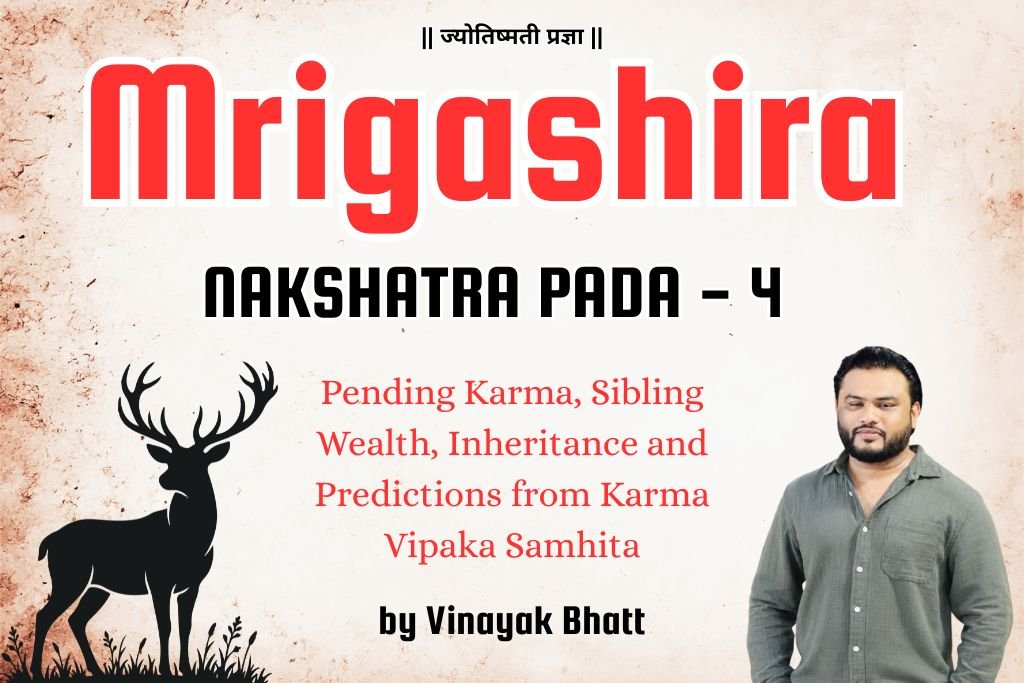
Mrigashira Nakshatra Pada 4 and Its Deeper Karmic Meaning
Mrigashira Nakshatra Pada 4 gives a powerful Karma Vipaka lesson about family wealth, the rightful share of a sibling, greed, control over accumulated resources and the consequences created when money becomes more important than the relationship through which that money is shared. The previous-life person in this story is not ignorant, poor or incapable. He is described as a learned Brahmin named Kishora Sharma who knows the Vedas, accumulates enormous wealth and yet becomes so possessive about that wealth that he refuses to give his younger brother the share that rightfully belongs to him.
The conflict becomes so severe that the younger brother dies while seeking his share; some translations describe him as dying in distress, while another explicitly says that he took his own life because of the dispute. The common point across the versions is therefore not the exact manner of death but the much stronger karmic fact that Kishora Sharma’s withholding of family wealth becomes directly connected with the destruction of his brother and later with disturbance of his own lineage.
This makes Mrigashira Pada 4 very different from Pada 3. Pada 3 concerned borrowed money which should have been repaid to a creditor, whereas Pada 4 concerns wealth already within the family which should have been divided fairly but was deliberately withheld. The issue is therefore not Rina in the narrow sense of a loan. It is the karma of refusing another person’s legitimate Adhikara, or rightful claim, because giving their portion would reduce one’s own accumulation.
Mrigashira Pada 4 extends approximately from 3°20′ to 6°40′ Gemini and falls in Scorpio Navamsha. Mrigashira is ruled by Mars, Gemini is ruled by Mercury, Scorpio Navamsha is again ruled by Mars and the Devata of Mrigashira is Soma. Mars therefore becomes doubly important in this Pada: Mars rules the Nakshatra and also the Navamsha.
This is especially meaningful because Mars is traditionally an important Karaka for brothers and sibling dynamics, while Mercury governs calculation, division, documents, negotiation and commercial exchange. The source story itself revolves around a younger brother, division of wealth, refusal of a share and an irreversible conflict, making the Mercury-Mars structure unusually relevant.
At its higher level this combination can produce somebody who is extremely capable of investigating complex financial matters, protecting family assets, handling inheritance, finding hidden value and taking strong decisions during disputes. At its lower level, calculation becomes suspicion, preservation becomes control and a disagreement about division becomes an all-or-nothing battle.
Scorpio Navamsha intensifies matters because once emotional resentment enters a financial dispute, the argument may no longer remain only about money; old grievances, perceived betrayal and questions of loyalty can become attached to the same account.
The Karma Vipaka Story of Mrigashira Nakshatra Pada 4
The source places the previous-life account approximately five Kosha south of Avanti or Ujjain, in a town called Keshava or Keshava Puri. There lived a Brahmin named Kishora Sharma, described as learned in the Vedas. The text also says that he regularly ate meals offered at annual ceremonies connected with departed ancestors. Although the exact ritual context should not be over-interpreted, this detail becomes significant when we later notice that the central sin destroys harmony within his own family line.
Kishora Sharma accumulated an enormous quantity of wealth and became extremely miserly. The source specifically says that despite possessing great resources he did not spend even a small part for Punya or religious purposes. More importantly, when family wealth had to be divided, he did not give his younger brother the legitimate share. One translation describes the amount under his control as three crores, which is better understood simply as an expression of immense wealth rather than treating the modern currency wording as a precise ancient monetary figure.
The younger brother continued seeking his share. In one translation he is described as dying while repeatedly asking for what belonged to him; another rendering states that the financial conflict became so severe that the younger brother took his own life. Since the translations differ, the responsible interpretation is that Kishora Sharma’s refusal of the legitimate family share contributed directly to an extreme and fatal crisis in his brother’s life. Even after this, Kishora Sharma did not correct the financial injustice.
After his own death, the text says that he endured severe suffering for nineteen Yugas, after which he passed through the births of a donkey and an ox before again obtaining a human body. In the later human incarnation he was born in Madhyadesha, suffered bodily disease and experienced disturbance in progeny and continuity. The old texts use language about absence of sons and the birth of daughters, but this should not be carried into modern Jyotish as though the birth of a daughter were an adverse result. The useful principle is simply that the continuity of the family line becomes a field through which the earlier destruction of a sibling relationship gives its result.
The source itself makes the cause very clear: because he became responsible for his younger brother’s suffering and death by withholding the brother’s rightful share, disease and progeny-related difficulty arose in the later birth. This is therefore not merely a story about greed. It is a story about family injustice becoming family karma.
The Real Pending Karma: Another Person’s Share Is Not Your Wealth
The central principle of Mrigashira Pada 4 is extremely precise: wealth that is physically under your control is not automatically entirely yours if another person has a legitimate share in it. This is different from the entrusted-property karma of Pada 1 and different from the loan karma of Pada 3. Here the native may genuinely own part of the asset, but the karmic problem begins when they attempt to convert joint ownership into exclusive ownership.
This can become highly relevant in inheritance, ancestral property, family business, jointly purchased assets, partnership holdings or money left by parents for several children. A person may feel that because they managed the property, cared for the parents, handled the documents or currently possess the assets, they deserve everything. Sometimes a larger share may genuinely be justified, but the decision must be reached through Dharma, agreement and proper legal or family settlement rather than by simply excluding another claimant.
The important question for Mrigashira Pada 4 is therefore not, “How much wealth can I preserve?” but “How much of what I possess actually belongs to me after every rightful claimant has been considered?”
This is the dividing line of the story.
Mars Becomes Extremely Important Because the Karma Is With a Brother
Mars has special relevance here because Mrigashira is ruled by Mars and Pada 4 enters Scorpio Navamsha, another Mars-ruled field. In traditional Jyotish, Mars is an important significator for siblings and particularly the energetic, competitive dimension of brotherhood. The classical story then specifically presents a conflict with a younger brother, making the connection especially striking.
The lower expression of Mars does not necessarily begin with hatred. It may begin with competition. One sibling believes they contributed more. Another believes they were neglected. One controlled the family business while another lived elsewhere. One remained near the parents and begins feeling morally entitled to a larger portion. Such questions may have legitimate practical dimensions, but when Mars becomes inflamed they easily change from negotiation into battle.
The conflict then stops being about fair division and becomes a question of victory: “Why should I give him anything?” Once the mind reaches this stage, Scorpio intensifies the emotional memory behind the dispute and Mercury begins producing clever arguments to justify what Mars has already decided.
The higher expression is completely different. Mars protects the family without taking another sibling’s portion. It has the courage to settle difficult matters directly rather than allowing resentment to remain hidden for years.
Gemini and Mercury: The Karma of Division, Documents and Calculation
The Pada lies in Gemini, and Mercury therefore governs the Rashi field. This is important because family-property disputes frequently revolve around documents, calculation, records, valuation, communication and interpretation of agreements. The original story may be ancient, but its structure is completely modern.
- Who owns what percentage?
- Whose name is on the document?
- Was money gifted or jointly owned?
- Did the parents give verbal instructions?
- Who paid for construction?
- Who managed the business?
- Who received earlier benefits?
- What was actually written in the Will?
These are Mercury questions.
The lower Mercury can use complexity to conceal injustice. A person may know that another sibling morally or legally has a share but exploit poor documentation, ignorance or absence to retain a larger portion. The higher Mercury does the opposite: it creates transparent calculation so that the relationship is not destroyed by ambiguity.
Therefore, when Mrigashira Pada 4 is strongly connected with family wealth, the practical rule should be to document division while relationships are still good rather than waiting until suspicion has already entered the family.
Scorpio Navamsha: When Money Becomes an Emotional Power Struggle
Scorpio Navamsha makes this Pada much more intense than an ordinary financial disagreement. Scorpio is a fixed Mars sign, and its lower expression can hold resentment for a long time. This means that a dispute which starts with money can become connected with older emotional issues: who was the favourite child, who sacrificed more for the family, who was respected, who was ignored, who controlled the parents, or who always received more recognition.
By the time inheritance actually becomes the visible subject, the argument may already contain twenty years of emotional history.
This is why a Mrigashira Pada 4 dispute can become disproportionate to the monetary amount involved. Two siblings may spend more money fighting than the property itself is worth because by that stage they are no longer defending land or cash; they are defending hurt, status, memory and perceived justice.
That is where the double Mars of this Pada becomes dangerous. The higher Scorpio does not avoid difficult truth. It brings hidden resentment into the open before legal and financial decisions are made, so that old emotional wounds are not disguised as property calculations.
The Shraddha Meal Creates an Important Irony in the Story
One subtle but important detail is that Kishora Sharma is described as regularly eating at annual rites connected with the departed ancestors, yet his own conduct damages the relationship with his living brother and ultimately his own family continuity. The source does not explicitly explain this as symbolism, so the following should be understood as interpretive commentary rather than literal textual explanation.
The contradiction is striking. He participates in rituals connected with Pitru and lineage, but fails the Dharma of lineage in ordinary life. He is connected with ceremonies remembering the dead, yet he does not properly protect the living bond with his own brother.
This creates a very important teaching: ritual cannot compensate for injustice within the family if the injustice remains uncorrected. A person may perform Shraddha perfectly, donate generously at temples and recite sacred texts, yet if they knowingly hold another sibling’s property or deny an agreed share, the practical Dharma remains unfinished.
This is one of the strongest messages of the chapter because the remedy later combines ritual purification with actual redistribution of wealth and public welfare.
Wealth Was Accumulated but Not Circulated
The text emphasises that Kishora Sharma accumulated enormous wealth but would not spend even a small part on Punya. This is not a general condemnation of saving or financial prudence. Accumulation itself is necessary for family stability, investment and future protection. The issue is extreme retention, where wealth becomes psychologically more important than relationship, duty and generosity.
Soma seeks nourishment, but nourishment becomes unhealthy when nothing circulates. The body itself works through circulation; food enters, becomes energy and is used. Money behaves similarly at the social level. It can be saved, but if every form of giving, obligation and rightful division is experienced as painful loss, accumulation has turned into fear.
The remedy given in the source directly reverses this habit because a substantial part of wealth is deliberately redirected towards Punya, public water resources, Dana and support of others. The problem was not having wealth. The problem was being unable to release wealth even when Dharma required release.
The Difference Between Saving, Greed and Withholding
This distinction is essential for students. A person who saves money carefully is not automatically greedy. A person who refuses an unfair demand from relatives is not automatically repeating this Karma Vipaka story. There are many situations where protecting one’s lawful property is completely Dharmic.
The lower pattern becomes relevant when three things occur together: another person has a genuine claim, the native knows that the claim exists, and the native still withholds the share primarily because they do not want their own wealth to reduce. That is much more specific than ordinary miserliness.
A useful consultation question is therefore: “Is there any family asset where you privately know another sibling has a rightful share but the matter has remained unresolved because releasing that share would reduce your control or financial position?”
If the answer is yes and the horoscope strongly repeats the 2nd, 3rd, 4th, 8th and Mars-Mercury themes, the story becomes much more relevant.
The Brother’s Death Shows That Financial Karma Includes Consequence, Not Only Amount
Another deep part of this story is that the karmic weight is not presented simply as “Kishora Sharma kept money.” The narrative repeatedly connects his conduct with the extreme suffering of his younger brother.
This means the karma is not only measured by the amount withheld. It also includes what the withholding did to another human being.
This principle is important in modern inheritance disputes. A financially powerful sibling may be able to delay settlement for ten years because they can afford lawyers while the weaker sibling cannot. An elderly relative may be prevented from receiving a lawful share at the very time they most need it. One sibling may remain financially trapped because another controls all documents or family accounts.
The amount of money matters, but so does the suffering caused by using control over money as leverage.
For Mrigashira Pada 4, the astrologer should therefore examine not only whether assets were divided but how the division was handled and whether somebody was deliberately pushed into helplessness.
Family Wealth Can Become a Test of Character After the Parents Are Gone
Many families remain united while parents are alive because the parents themselves function as the centre of authority. The real test sometimes comes after their death, when property, business ownership, jewellery, ancestral land or savings must be divided.
Mrigashira is a searching Nakshatra, so the mind begins searching through records, statements, memories and old promises. Gemini calculates. Scorpio suspects. Mars defends. If Dharma is weak, every discovery becomes ammunition.
The higher expression requires the opposite process. Search carefully, calculate accurately, investigate documents, but use the information to create a fair settlement rather than to build a stronger strategy for defeating one’s own sibling.
A useful predictive statement when this Pada connects strongly with the 2nd, 3rd, 4th and 8th houses is: “Family property or inheritance may require unusual clarity in your life. The real danger is not necessarily loss of wealth; it is allowing a financial division to permanently damage a sibling relationship.”
The Native May Experience the Pattern From the Opposite Side
The Karma Vipaka story places Kishora Sharma in the role of the person withholding a sibling’s share, but in an actual horoscope the native may sometimes experience the reverse pattern. They may become the sibling whose property share is delayed, denied or controlled by somebody else.
This is an interpretive Jyotish application and not a literal statement of the chapter, so it requires repetition in the horoscope. It becomes more meaningful when the 3rd lord, 2nd lord, 4th lord, 8th lord, Mars and Mercury are involved with Mrigashira Pada 4 and receive difficult influences.
The native may then spend years trying to obtain a legitimate inheritance or family-business share. A sibling may control documents, occupy the property or claim that earlier family support already counted as the native’s portion.
The higher lesson remains identical whichever side the native occupies: obtain what is rightfully yours, but do not allow the conflict to create a second cycle of hatred which becomes larger than the original property issue.
The Donkey and Ox Births: Possession Becomes Burden
After the long period of suffering described in the text, Kishora Sharma passes through donkey and ox births before again becoming human. The source does not explicitly explain the symbolism of these animal births, so the deeper meaning should remain interpretive.
Both animals traditionally carry weight and labour for others. Kishora Sharma had spent the earlier life trying to hold wealth and prevent it from leaving his control, whereas the animal imagery shifts him into forms defined by carrying burdens.
The symbolic reversal is powerful: what a person refuses to release can eventually become something they must carry.
This can be applied psychologically even without taking the animal-birth symbolism literally. People who refuse to settle family property can sometimes spend decades carrying the burden of the dispute—lawyers, hearings, arguments, broken relationships, mental stress and the constant need to defend the possession. The asset which was supposed to create security becomes the thing that consumes peace.
This is a very Scorpio-Mars lesson. Sometimes winning possession and gaining peace are not the same victory.
Progeny and the Broken Lineage
The classical text connects the earlier sibling injustice with later disturbance of progeny, but its old language about sons and daughters should not be repeated mechanically in modern Jyotish. A daughter is not a negative karmic result, and a planet in Mrigashira Pada 4 cannot by itself justify predicting childlessness, miscarriage or child loss.
For literal progeny judgement, the astrologer must examine the 5th house, fifth lord, Jupiter, Putrakaraka, Saptamsha and Dasha. The Karma Vipaka story tells us that continuity is an area to investigate; it does not establish the event independently.
The deeper symbolic logic is powerful. The native denied a horizontal family relationship—the brother. Later the vertical continuation of family, represented by progeny, becomes disturbed. The person tried to keep more of the family wealth for himself, yet the family line through which that wealth might have continued becomes unstable.
This produces a strong teaching: wealth preserved by destroying the family can ultimately lose the very purpose for which family wealth is preserved.
In charts where literal progeny difficulty is absent, the same principle can manifest through succession. A person may accumulate property but have no harmonious heir to manage it. A family business may become large but the next generation refuses to continue it. Siblings may destroy an enterprise inherited from parents because no fair structure of ownership was created.
Thus, lineage in this story should be understood more broadly as continuity of family, wealth and responsibility.
The 2nd, 3rd, 4th and 8th Houses Become Especially Important
The 2nd house shows family wealth, accumulated resources and the treasury of the family. The 3rd house is the primary house to examine for younger siblings and therefore becomes especially important because the source specifically concerns the younger brother. The 4th house becomes relevant where land, home and fixed family property are involved. The 8th house is important for inheritance, shared resources and property which passes through death or family continuity. The 6th house becomes relevant when disputes, litigation or prolonged conflict arises.
The most striking combinations for Mrigashira Pada 4 are therefore connections between the 2nd and 3rd houses, where sibling and wealth become directly linked; the 3rd and 8th, where siblings become involved in inheritance or jointly held family assets; the 3rd, 4th and Mars, where conflict may arise over property or land; and the 2nd, 6th and 8th, where family wealth becomes a field of dispute, litigation or prolonged settlement.
If Jupiter and the 5th house become involved, continuity and children can become part of the same karmic field. If Saturn joins, settlement may be delayed for years. If Rahu is strongly involved, documentation, hidden arrangements or disproportionate claims can become more complicated. If benefic Jupiter protects the pattern, even a serious dispute may eventually move towards a more Dharmic resolution.
A Strong Consultation-Level Prediction
When Mars, Mercury or the 3rd lord occupies Mrigashira Pada 4 and connects with the 2nd, 4th or 8th houses, a useful consultation statement would be: “One important family lesson in your life can involve division of property, money or responsibility between siblings. The issue may become emotionally much larger than its financial value, so everything should be documented and settled while communication is still possible rather than after resentment becomes permanent.”
If the 8th house dominates, the astrologer may say that inheritance or assets received after the death of elders require careful division and that possession of documents or control of the property should not be confused with exclusive ownership. If Saturn influences the combination, the matter may remain unresolved for a long period unless somebody consciously creates a structured settlement.
If the native is experiencing the reverse side of the story, the consultation language can be: “Your chart can show difficulty receiving your legitimate portion from a family arrangement. Fight for what is genuinely yours through proper documentation and law, but do not let the dispute consume more years of your life than the asset itself deserves.”
This keeps the prediction specific while avoiding unverifiable declarations about a literal past life.
Mrigashira Pada 4 and Family Business
The same symbolism becomes very useful in family businesses. A business founded by parents may later pass to several children, but one sibling may have worked in it full-time while another remained outside. The person running the business may gradually begin to feel that operational control means total ownership, while the absent sibling may believe that birth alone guarantees an equal economic claim.
These situations require more than astrology; they require accurate valuation, documentation and explicit agreements. Yet Mrigashira Pada 4 identifies the karmic danger very well: unspoken assumptions about entitlement eventually become emotional warfare.
The higher Mercury-Mars expression creates clear structures before crisis develops. Ownership, salary, management control, profit distribution and inheritance should be distinguished from one another. A sibling working in the business can reasonably receive compensation for work without silently absorbing another person’s ownership share.
This is an excellent modern expression of the core Karma Vipaka lesson: administration of family wealth should never be allowed to quietly become appropriation of family wealth.
Soma and the Fear of Losing Security
Soma is associated with nourishment, satisfaction and the search for emotional fulfilment. In this Pada, greed may not always arise because the person loves money for its own sake. Sometimes the deeper problem is fear of losing security.
A person may have substantial wealth yet still feel that giving another sibling their share will leave too little. The objective financial position may be comfortable, but the mind remains unsatisfied and insecure. Mrigashira continues searching for greater certainty, but no amount ever feels final.
This gives a deeper psychological understanding of the source. The opposite of greed is not reckless generosity. The real correction is the development of enoughness—the ability to recognise that another person’s rightful gain is not automatically one’s own loss.
A healthy Soma can receive nourishment and feel satisfied. An afflicted Soma keeps searching even after enough has already been obtained. This is why the source describes Kishora Sharma possessing enormous wealth while still being unable to release his brother’s share.
The Higher Scorpio Navamsha: Protecting the Family Rather Than Controlling It
Scorpio Navamsha is often understood only through secrecy, crisis or intensity, but its higher expression is tremendous loyalty and the ability to protect what is vulnerable. A mature Mrigashira Pada 4 native can become the family member who discovers hidden financial problems, protects ancestral property, resolves old disputes and ensures that every claimant is treated correctly.
- Mars then becomes the protector of siblings rather than their competitor.
- Mercury becomes the accountant who creates clarity rather than the lawyer of personal greed.
- Scorpio becomes the courage to face uncomfortable family truths rather than burying them.
Such a native can be extremely effective in estate management, legal-financial research, investigation, taxation, insurance, family-office work, auditing or any field where complex ownership and hidden value must be examined carefully. The same Pada which at the lower level can create a destructive property dispute can at the higher level create somebody exceptionally skilled at settling disputes before they destroy relationships.
Planetary Applications of Mrigashira Nakshatra Pada 4
When the Sun occupies Mrigashira Pada 4, father, authority, status and family ownership can become interconnected. The native may become the person who assumes leadership of family assets after the father or may experience a dispute over who has authority to decide the division. A strong Sun can produce principled leadership, while an afflicted Sun can make pride prevent compromise even after a fair settlement is available.
When the Moon occupies this Pada, family property and sibling relationships can become emotionally charged. The native may feel deeply attached to ancestral home, family jewellery or property because these objects carry memory rather than only monetary value. This can make division emotionally difficult even when the financial calculation is clear. A strong Moon helps the person preserve family connection while still allowing fair distribution.
When Mars occupies Mrigashira Pada 4, the Nakshatra lord and Navamsha lord become powerfully activated. Sibling competition, property disputes, land, inheritance and anger can become especially important if the relevant houses are afflicted. At the higher level the same Mars gives courage to settle difficult family issues decisively and protect weaker members of the family.
When Mercury occupies this Pada, documents, calculations, family accounts, business ownership and communication with siblings can become central. A strong Mercury is excellent for dividing assets clearly and rationally, whereas an afflicted Mercury can produce clever justification, contradictory agreements or prolonged disputes because every side has a different version of what was promised.
When Jupiter occupies Mrigashira Pada 4, family Dharma, inheritance, children and ethical judgement become closely linked. A strong Jupiter can become an important protection because the native may prefer fairness over maximum personal gain. An afflicted Jupiter can produce the dangerous belief that one’s own moral reasoning automatically justifies keeping more.
When Venus occupies the Pada, money, comforts, property and relationship become prominent. Family wealth may be substantial, but emotional attachment to lifestyle can make division difficult. At the higher level Venus understands value without confusing value with possession and can help create mutually acceptable settlements.
When Saturn occupies Mrigashira Pada 4, sibling or inheritance disputes may continue for many years, especially where old property, ancestral land or incomplete documentation is involved. Yet Saturn can also give the patience necessary to create a formal settlement and honour responsibilities over time.
When Rahu occupies the Pada, desire for control over family wealth can become unusually strong and disputes may involve hidden documents, unclear ownership, foreign property, unusual legal structures or exaggerated suspicion. Transparency becomes essential.
When Ketu occupies the Pada, the native may become detached from family wealth or may suddenly withdraw from a dispute, which can sometimes be spiritually freeing but can also create careless surrender of a legitimate claim. The complete horoscope must distinguish genuine detachment from avoidance of practical responsibility.
These planetary applications are Jyotish interpretations based upon the Nakshatra, Gemini Rashi and Scorpio Navamsha structure; they are not direct statements of the Karma Vipaka chapter and must always be modified by lordship, dignity, conjunctions, aspects and Dasha.
Health Indications Must Be Confirmed Through the Horoscope
The source directly associates later illness with the karmic consequence of causing the younger brother’s suffering and death. This should not be converted into a specific medical diagnosis from Mrigashira Pada 4 alone. Lagna, Lagnesha, Mars, Mercury, the 6th and 8th houses, relevant Vargas and Dasha must independently support any health judgement.
A safer interpretive point is that prolonged family conflict can create enormous mental and physical stress. Scorpio can hold resentment for long periods, Mars keeps the body in a state of conflict and Mercury can keep the mind repeatedly revisiting the same argument. Where the chart strongly supports it, family litigation or property conflict may become one of the conditions under which health deteriorates, but the Nakshatra itself cannot establish the disease.
Similarly, the classical progeny results must always be checked through the 5th house, Jupiter and Saptamsha rather than repeated literally.
Dasha Activation
The pattern becomes much more useful predictively when Dasha is added. A Mars Dasha or Antardasha can activate sibling conflict, property, competition and decisive settlement because Mars rules both Mrigashira and the Scorpio Navamsha. A Mercury period can bring documents, negotiations, division, registration, communication and legal-commercial details to the forefront because the Pada lies in Gemini.
Periods of the 2nd lord can activate family wealth, while the 3rd lord may bring younger siblings directly into focus. The 4th lord can activate land, houses and ancestral property, the 8th lord can bring inheritance or shared assets and the 6th lord may bring litigation or formal disputes. Jupiter or the 5th lord can activate continuity, children and succession.
The strongest prediction should only be made when Pada, Bhava, Graha and Dasha repeat the same theme. A single planet in Mrigashira Pada 4 is not enough to declare a property dispute or sibling conflict.
Traditional Prayaschitta for Mrigashira Nakshatra Pada 4
The available translations agree that the remedy begins with major Dana and Mantra, though the exact fraction of wealth differs. One translation prescribes using one-sixth of the value of the household wealth for Punya Karma and also mentions Gayatri, Jatavedase and Tryambaka Mantras, while another rendering instructs the native to spend one-eighth of savings or income on Punya. This textual difference should be preserved rather than silently choosing one figure.
The remedial instructions include repairing or creating wells, step-wells and ponds or water reservoirs, thereby turning privately retained wealth into a resource useful to the wider community. Another major instruction is to make a golden representation of the brother, given in one translation as approximately 400 grams, worship it according to the prescribed Shodashopachara procedure and then donate it. The symbolism is especially important because the remedy does not allow the injured brother to disappear from the karmic account; the very relationship that was violated becomes the centre of the Prayaschitta.
The text further gives one lakh Gayatri Japa with Dashamsha Homa, and in some translations additional Jatavedase and Tryambaka recitation is mentioned. Sacred bathing at Prayag when the Sun is in Makara, donation of a milk-giving cow, agricultural land, a horse and feeding of Brahmins are also included in one of the detailed renderings. The classical result is expressed as purification of the earlier karma, relief from disease and restoration of progeny or lineage.
These are formal traditional prescriptions, and exact quantities, Sankalpa, Mantra counts, Homa procedure and forms of Dana should be undertaken with competent ritual guidance. The translations disagree in a few numerical details, so the original Sanskrit should be checked before any literal ritual performance.
Why the Golden Image of the Brother Is the Most Important Remedy Symbol
The golden brother-image is one of the most revealing parts of the Prayaschitta because the source forces the native to acknowledge the person who was excluded from the wealth. The original wrongdoing did not merely consist of excessive accumulation; it consisted of accumulation achieved by denying a specific relationship its legitimate portion.
The remedy therefore makes that relationship visible again.
This gives a wider Karma Vipaka principle: when the sin arises by erasing another person’s claim, the remedy restores that person symbolically to the centre of the account.
For modern life the implication is obvious. If a living sibling has genuinely been denied property, the first practical correction is not to make a symbolic golden image while continuing to hold the sibling’s share. The real-world account should be settled wherever possible. Ritual can support repentance and purification, but it should not become a replacement for restitution.
Why Wells, Ponds and Public Water Appear in the Remedy
The source instructs the native to use wealth for wells, step-wells and ponds. This makes deep symbolic sense even though the text does not explicitly give the philosophical explanation. The earlier pattern is extreme retention: wealth is accumulated, withheld and prevented from reaching even the brother who has a legitimate claim.
Water represents circulation and nourishment.
A private hoard benefits one holder.
A public water source benefits people repeatedly and impersonally.
The direction of the karma therefore changes from “keep everything with me” to “create something from my wealth which continues serving people even when I am not present.”
This also fits Soma, the Devata of Mrigashira, because Soma is connected with nourishment and refreshment. At the lower level the native searches for personal security; at the higher level their resources themselves become a source of nourishment.
Practical Modern Remedy
The most important practical remedy for Mrigashira Pada 4 is to review all unresolved family ownership questions. Ancestral property, jewellery, business shares, bank deposits, documents and any asset belonging jointly to siblings should be clearly accounted for. Where an old settlement was unfair, the person should seriously consider whether restitution, renegotiation or an agreed legal settlement is possible.
The second remedy is to separate compensation from ownership. If one sibling cared for parents or managed a family business for many years, that contribution deserves recognition, but it should be calculated transparently rather than becoming an unspoken excuse to absorb everybody else’s share. Likewise, a sibling who remained outside the business should not automatically demand the value of another person’s years of unpaid labour. Higher Mercury calculates both sides honestly.
The third remedy is to allow some wealth to circulate through useful Dana or public benefit, particularly in ways connected with water, food, education or long-term community support. This reflects the direction of the classical remedy without pretending that a modern adaptation is identical to the original Prayaschitta.
The deepest behavioural correction is simple: do not make another family member beg repeatedly for something that you privately know belongs to them. The longer legitimate claims are delayed, the more the financial dispute accumulates emotional karma around itself.
The Difference Between Mrigashira Pada 3 and Pada 4
Mrigashira Pada 3 and Pada 4 both concern money, but the moral structure is very different. Pada 3, falling in Libra Navamsha, asks whether borrowed value is eventually returned and whether both sides of an agreement are brought back into balance. Pada 4, falling in Scorpio Navamsha, asks what happens when family wealth becomes a field of control and another person’s rightful share is deliberately withheld.
Pada 3 deals with a creditor. Pada 4 deals with a brother.
Pada 3 is about an unfinished contract. Pada 4 is about a damaged blood relationship.
Pada 3 says, “Complete the transaction.” Pada 4 says, “Do not destroy kinship in order to enlarge your portion.”
This is a natural progression from Libra to Scorpio. Libra tries to balance the account between two sides. Scorpio asks what happens when balance fails and the disagreement becomes emotionally irreversible.
The Higher Expression of Mrigashira Pada 4
The higher expression of Mrigashira Pada 4 can be extremely strong because the same Mars-Mercury combination which can create argument can also create courageous financial clarity. Such a person can become skilled at uncovering complicated ownership, investigating hidden assets, handling inheritance, negotiating settlements and protecting family wealth without appropriating it.
The higher native understands that wealth has to be protected from outsiders but divided fairly among insiders. They know that documentation prevents future bitterness, that clear Wills and succession plans are acts of family Dharma and that resolving a dispute early is often more valuable than winning it after twenty years.
Mars becomes courage rather than hostility, Mercury becomes clarity rather than cleverness, Scorpio becomes depth rather than suspicion and Soma becomes satisfaction rather than endless accumulation.
The person no longer asks, “How much can I keep?” but “What is genuinely mine after everybody else’s rightful share has been honoured?”
The Real Teaching of Mrigashira Nakshatra Pada 4
Mrigashira Nakshatra Pada 4 ultimately teaches that family wealth is not truly preserved when the family itself is destroyed in the process of preserving it.
- Kishora Sharma was learned.
- He understood the Vedas.
- He possessed enormous wealth.
- He participated in rituals connected with ancestors.
Yet when Dharma appeared in the simple form of his own younger brother asking for a legitimate share, learning did not become conduct. Wealth became more important than relationship, possession more important than justice and retention more important than compassion. The result in the Karma Vipaka framework was not simply financial loss; the disturbance returned through health and family continuity itself.
This is the deepest lesson of the Pada. A person may protect ancestral wealth so aggressively that there is eventually no harmonious family left to inherit it. They may win the house and lose the brother. They may control the business and destroy the lineage that built it. They may retain every rupee and spend years of life in conflict.
Mrigashira searches, Gemini calculates, Mercury divides, Mars fights and Scorpio remembers. At the lower level, these forces can turn a question of division into a lifelong war. At the higher level, exactly the same forces help the native search for the truth, calculate the rightful share, confront uncomfortable facts and settle the matter decisively.
The main predictive principle for Mrigashira Nakshatra Pada 4 is that when this Pada strongly connects with the houses of family wealth, siblings, property or inheritance, the astrologer should examine whether ownership and kinship become entangled, whether a sibling’s legitimate claim is difficult to settle, and whether the financial dispute is carrying much older emotional material than the property itself.
The deeper Karma Vipaka principle is that holding another family member’s share may increase one’s possessions while reducing the very family for whom those possessions were supposed to have meaning. The higher principle is therefore to preserve wealth with intelligence, divide it with fairness and remember that no inheritance is truly successful if the property survives but the family relationship does not.









![Science of Remedies in Vedic Astrology [English]](https://vedicgrace.com/wp-content/uploads/2025/12/Science-of-Remedies-in-Vedic-Astrology-VG-300x214.png)




Leave a Comment
Be the first to comment on this blog!