
Ashwini Nakshatra Pada 4: Pending Karma and Predictions from Karma Vipaka Samhita By Vinayak Bhatt
Karma Vipaka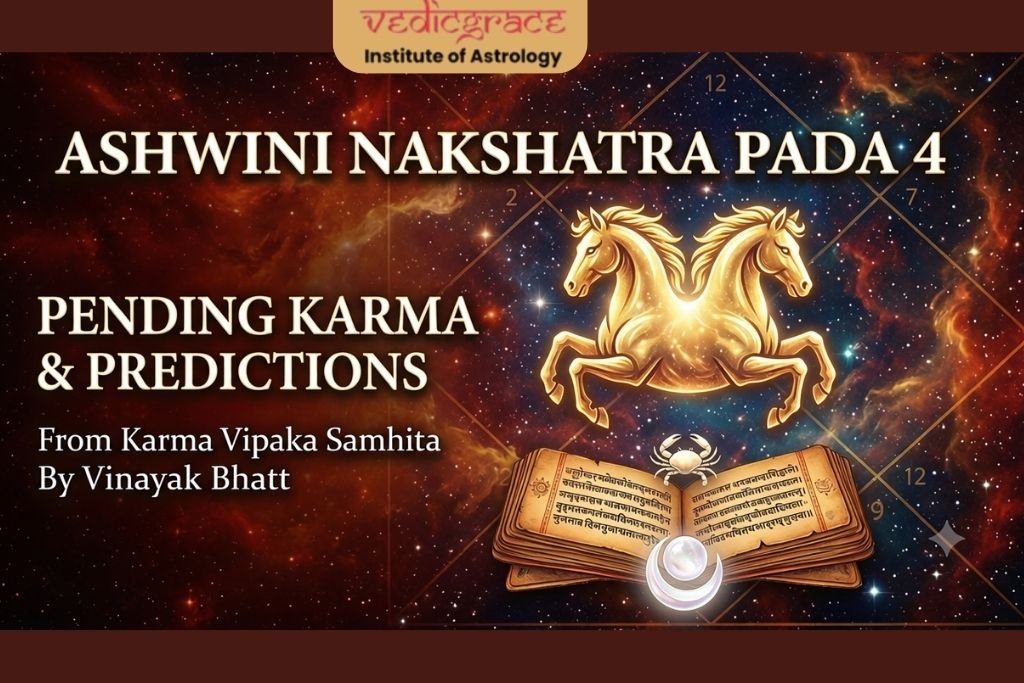
Ashwini Nakshatra Pada 4 takes us into a very different karmic field from the first three padas. Here the main story is not simply about greed, anger or a sudden dispute. It is about what happens when business, another person’s wealth, trust, spouse, family security and personal gain become mixed together.
This distinction is important because many people behave properly when everything belongs clearly to them, but their real character is tested when they are given access to something which belongs partly or completely to another person. It may be a friend’s investment, a client’s money, business stock, family property, jewellery kept in trust, commission received on somebody’s behalf, partnership income, confidential financial information or simply an asset which one has the power to control but does not truly own.
That is where the Karma Vipaka story of Ashwini Nakshatra Pada 4 becomes extremely relevant even in modern life.
Ashwini Nakshatra extends from 0°00′ to 13°20′ Aries. The fourth pada occupies 10°00′ to 13°20′ Aries and falls in Cancer Navamsha, ruled by the Moon. Therefore, when we interpret Ashwini Pada 4 through Jyotish, three Grahas become especially important: Ketu as Nakshatra lord, Mars as ruler of Aries, and Moon as ruler of the Navamsha.
This gives us an unusual combination.
- Mars says, “Act.”
- Ketu says, “There is an old unfinished samskara behind this action.”
- Moon says, “My family, security, emotional comfort and belonging are involved.”
Therefore, Ashwini Pada 4 can become more emotionally complicated than it first appears. The person may not always make an unethical financial decision because they simply want luxury. Sometimes the mind gives a much more convincing excuse: “I am doing this for my family,” “We worked hard for this,” “Nobody will suffer,” “This money is anyway under my control,” or “My spouse also agrees.”
And that is exactly where Dharma can become blurred.
The Karma Vipaka Story of Ashwini Pada 4
The short Nakshatra Phala describes the fourth pada in very severe classical language. Its broad meaning is that the native is connected with a lower social condition in the previous karmic pattern, suffers from illness, experiences difficulty connected with children, possesses a strong or well-developed body, and may suffer from what the text calls Kuṣṭha.
The commonly preserved reading is approximately:
चतुर्थचरणे देवि यदा भवति मानवः ।
तदा शूद्रं विजानीयाद् रोगवान् मृतवत्सकः ।
श्यामलः पुष्टदेहश्च कुष्ठयोगेन पीडितः ॥४॥
These words belong to the language and social structure of an older period and should not be copied mechanically into a modern consultation. The important points for Jyotish are the repeated themes of disease, bodily suffering and interruption of progeny.
There is also an apparent difference between the short phala and the detailed narrative. The short verse uses Shudra symbolism, while the detailed Ashwini Pada 4 chapter describes the earlier-life native as a Kshatriya.
We do not need to force these two layers into one literal biography.
The short Nakshatra Phala gives a compressed karmic result. The detailed chapter gives the narrative through which the karmic principle is explained.
For prediction, the repeating pattern is more useful than trying to prove that every detail belongs to one historical person.
The detailed story begins near Kosala or Ayodhya, on the northern bank of the Sarayu River, where there was a settlement called Nandan or Nandana. A Kshatriya named Lakshman lived there.
But Lakshman is not introduced as a person strongly established in Dharma. The text describes him as Dharma-Karma-Bhrashta, somebody who had fallen away from proper Dharmic conduct or who was not interested in performing his prescribed duties.
His wife was named Kalyani. She is described as beautiful and attractive, but the text also portrays her as strongly attached to sensual enjoyment and other men. She was involved in trade, particularly in valuable articles such as clothes and gold.
This is already an important clue. The karmic event does not arise in a temple. It does not arise during a war. It arises in the field of commerce.
Lakshman and Kalyani, or their household business, had continuing dealings with a Brahmin. The Brahmin was not a stranger who appeared once. The wording indicates a continuing commercial association developed through effort and over time. Eventually the Brahmin’s wealth or business stock was taken.
The available translations differ slightly on this point. One version says that Kalyani took the Brahmin’s wealth. Another explains that the native himself, after continuing business with the Brahmin for a long period, appropriated the Brahmin’s entire stock. One modern translation says thieves took the wealth, but the verses which follow specifically state that the native had previously deceived his friend.
Therefore, the safest understanding of the story is that a commercial relationship based upon trust became corrupted through the loss, appropriation or wrongful handling of the Brahmin’s wealth, and Lakshman’s household was karmically implicated in it.
The Brahmin was deeply distressed after losing his wealth and died in grief. After some time Lakshman also died. The text then describes severe post-death suffering extending for sixty thousand years, followed by birth in the body of a bull and eventually another human birth. When the native returned to human life, the earlier karmic account was still not fully closed.
The text then gives the most important result: because he had deceived his friend, his son died. The wife also suffered through barrenness or serious difficulty concerning children.
Now the whole story becomes clear.
Something belonging to another person entered the household through a violation of trust. Later, something precious belonging to that same household could not be retained. This is the core of Ashwini Pada 4.
What Is the Pending Karma of Ashwini Pada 4?
The pending karma of Ashwini Pada 4 should not be reduced to the simple sentence, “The person stole money in a previous life.”
That is too crude and not useful for prediction. The deeper karma is connected with custodianship. Something comes under your control. But control is not the same as ownership. That difference is where the soul is tested.
A person can easily become confused about this because possession creates psychological ownership. If money remains in our bank account for long enough, we begin feeling it belongs to us. If stock remains in our warehouse, we may begin thinking of it as our stock. If a friend invests money in our business, gradually we may stop remembering that part of the business value belongs to somebody else.
The Ashwini Pada 4 story asks one very precise question: When somebody else’s wealth enters your hands, do you remain its custodian, or do you slowly begin treating it as your own?
That is the pending karma.
- This can concern money, but not only money.
- A person can misuse another person’s contacts.
- A company can take a partner’s customer database.
- A teacher can claim a student’s research.
- A senior employee can take credit for the work of juniors.
- A family member can retain another sibling’s property.
- One spouse can hide joint money from the other.
- A professional can use client funds for personal purposes.
- A trader can mix client capital with his own trading capital.
- Someone can accept goods on consignment, sell them, and delay returning the owner’s money.
All of these situations have the same karmic structure. The problem is not simply wealth. The problem is wealth entrusted through relationship.
How Ashwini Pada 4 Can Manifest in Present Life
When Ashwini Pada 4 becomes important through the Moon, Lagna, Atmakaraka or another strongly placed planet, I would pay special attention to the native’s relationship with business, money belonging to other people, joint finances, partnership resources and decisions influenced by family members.
This does not mean the person will steal. The same samskara can work from either side.
- Sometimes the native is the person who receives and mismanages another person’s resources.
- Sometimes the native repeatedly becomes the person whose resources are mishandled by others.
- And sometimes the entire life lesson is about learning how to build financial structures where neither situation can happen.
This can produce a very practical personality.
Aries gives initiative and Mars gives willingness to take commercial risks. Ashwini brings speed. Cancer Navamsha adds a strong need for material and emotional security. Therefore, such a person may become very active in earning, building assets, supporting family and creating financial protection. They may also be very good at understanding what people need.
The Cancer Navamsha can make business more personal. Customers may become friends. Friends may become customers. Relatives may enter the business. Spouse may participate in commercial decisions.
And that is where the complication begins. The person may not maintain a clean boundary between personal money and business money.
- A relative may invest informally.
- A friend may give money without proper documentation.
- The spouse may ask that some money be diverted for household use.
- A business partner may say, “We will settle the accounts later.”
For many people this ends without a serious problem.
For Ashwini Pada 4, when the rest of the horoscope repeats the same pattern, these small informal arrangements can become the exact doorway through which old karma becomes active. The native should therefore be more careful than average about accounts. Not because they must distrust everybody. Because clarity itself becomes protection.
The Strong Prediction: Business Trust and Family Money Must Never Be Mixed Carelessly
One of the strongest predictions I would test in a chart containing a heavily activated Ashwini Nakshatra Pada 4 is whether the person’s major financial problems arise not from ordinary lack of money, but from situations in which somebody else’s money, business stock, family pressure and personal decisions become mixed together.
The consultation may reveal something like this:
“You can earn well, but one of your difficult financial periods can come through a person you already know rather than through a stranger. It may be a friend, partner, customer, spouse or relative. Money or assets can enter your control, and later there can be disagreement about who actually owns what.”
In another chart I may tell the client:
“Do not run partnership money casually. If a friend invests in your business, write everything down from the first day. The friendship may be excellent while the business is small, but once the money becomes substantial, the lack of written clarity can damage both the business and the friendship.”
In another case:
“One financial decision influenced by spouse or family can later create tension with a business partner. Keep household needs separate from business obligations.”
And in a chart where the karma is being experienced from the opposite side:
“You may repeatedly trust people with money and later discover that they treated access as ownership. Do not depend only on verbal promises, even when the person is close to you.”
These are much more useful predictions than telling somebody that they robbed a Brahmin in another birth. The ancient story gives the pattern. Jyotish tells us where that pattern is operating now.
Why Progeny Appears Again and Again in Karma Vipaka
Ashwini Pada 4 gives a very direct link between betrayal of a friend and loss of progeny.
The text says that because the native deceived his friend, his son died.
This may appear strange if we think only in modern legal terms. What does business dishonesty have to do with children?
But Karma Vipaka is working with a deeper idea- What we wrongly retain from another person can return through something we ourselves desperately want to retain. That is why progeny becomes such a powerful karmic symbol. A son or daughter is not simply a possession. A child represents continuation.
The 5th house represents Purva Punya. It represents what comes out of us and continues after us. So when another person’s future has been damaged through betrayal, the karmic return may appear in the native’s own experience of continuity.
This becomes even more interesting because the chapter immediately before the Ashwini Pada 4 narrative discusses different karmic relationships between parent and child. One of its principles says that wealth retained from another person can later produce a relationship in which that karmic account is settled through the child.
This tells us something extremely important. Karma Vipaka does not see children only biologically. A child can also become an instrument through which an older account is settled. For practical Jyotish, however, we should never predict child loss only from Ashwini Pada 4.
The 5th house, fifth lord, Jupiter, Putrakaraka, Saptamsha and Dasha must confirm it.
If these factors are strong, the same karmic symbolism may express itself in another form. The person’s biological children may be completely fine, but a business they want to pass to the next generation may not continue.
- A student whom they trained may leave them.
- A company may break during succession.
- A book may remain incomplete.
- A family property may not pass smoothly to heirs.
- A project built over many years may collapse just when it is ready for the next stage.
These are all forms of interruption of continuity.
That is why the word Mritavatsa should not always be read only literally.
The astrologer has to understand its principle.
Ashwini Pada 4 and Health
The short Ashwini Phala is quite strong about health. It uses words associated with illness and Kuṣṭha.
We should be careful here.
The classical term Kuṣṭha covers a much wider field in older Sanskrit medical and astrological usage than simply one modern diagnosis. Therefore, it would be wrong to tell every Ashwini Pada 4 native that they will suffer from leprosy.
The proper approach is to treat the verse as a warning that chronic or visibly troublesome bodily conditions may become important when the rest of the horoscope confirms them.
From the Jyotish side, Aries is ruled by Mars and carries heat, inflammation, injury and fast physical reactions. Ketu can make a problem strange, recurring or difficult to understand clearly. The fourth pada falls in Cancer Navamsha, making the Moon important; therefore mental peace, family tension, nourishment, emotional security and bodily sensitivity can become part of the same pattern.
This does not create a medical diagnosis by itself. But when the Lagna, Lagnesha, Moon, Mars, Ketu, 6th house and 8th house repeat the same affliction, then the classical health warning deserves greater attention.
There is another useful psychological observation. Ashwini Pada 4 can sometimes hold financial stress inside the body. A person may appear strong. The classical verse itself speaks of a well-developed or strong body. But strength of body does not necessarily mean freedom from disease. Such people may continue working through tension for a long time because responsibility towards family remains strong. They may not stop when worried about money, business or security. The body then becomes the place where unresolved pressure is expressed.
Therefore, one of the practical lessons of this pada is simple: do not wait for the body to force you to stop.
The Spouse as an Instrument of Karma
The spouse is far more important in the Ashwini Pada 4 story than a superficial reading may suggest.
- Kalyani is not sitting in the background.
- She is directly involved in business.
- She deals in clothes, ornaments or gold.
- She interacts with customers.
And in some versions she is the person directly associated with taking the Brahmin’s wealth. This gives us a powerful Jyotish rule.
In Ashwini Pada 4, the spouse can become an important participant in the native’s financial karma.
This does not mean the spouse will be bad. The karma can work positively or negatively depending upon the horoscope.
With a good Venus and strong 7th house, the spouse may become the person who forces transparency, keeps proper accounts, prevents the native from making a financially emotional decision and helps the business remain ethical.
The spouse may literally say: “This is not our money. Return it.” That single sentence can become karmic protection.
But when Venus, Moon, 7th house, 8th house and the financial houses are badly afflicted, spouse and business can become difficult to separate.
- One partner may secretly use business funds.
- The couple may hide money from a business associate.
- One spouse may pressure the other to take a financial shortcut.
- Property may be transferred into the spouse’s name to avoid another person’s legitimate claim.
- The native may justify an improper act because it benefits the family.
Or the opposite can happen: the native behaves correctly, but suffers financially because of a spouse’s poor decision. This is where Cancer Navamsha becomes meaningful. Moon naturally protects home. But protection without Dharma can become attachment. And attachment can make a person justify what they would otherwise recognise as wrong. The higher lesson is not to choose business over family.
The lesson is to protect family without damaging another person’s rightful interest.
Why One Ethical Mistake Can Become Expensive
The Ashwini Pada 4 story is especially useful for businesspeople because it shows that not every financial gain is prosperity. Money came into the household. But peace did not come with it. That is the difference between Dhana and Lakshmi.
Dhana is money. Lakshmi is wealth which carries harmony, continuity, nourishment and auspiciousness. A person can possess Dhana and still lose Lakshmi.
If profit comes through destroying trust, the bank balance may increase while some other area of life quietly starts paying the cost. This is one of the most practical ways to understand the Karma Vipaka narrative.
Many people think that if an unethical decision produced money and no legal problem occurred, they escaped the consequence. Karma Vipaka says something very different. The transaction may finish. The karma may not.
That is why Ashwini Pada 4 should be watched carefully in people who deal with client funds, investments, partnership capital, stock, jewellery, expensive goods, property, financial management, commissions, brokerage, trading accounts or family assets.
The chart may give them the ability to handle large resources. But greater access creates a greater ethical test.
The person should never think: “Because I can control it, I have the right to use it.”
Control is not ownership. That is perhaps the cleanest sutra of Ashwini Pada 4.
The Higher Side of Ashwini Pada 4
We should not read this pada only through wrongdoing. The same karmic structure can produce an exceptionally trustworthy person once the lesson has matured. Think carefully about what abilities are required in the story.
- There is business.
- There are valuable goods.
- There is another person’s wealth.
- There is commercial responsibility.
- There is family involvement.
- There is the need to distinguish one’s own property from what belongs to somebody else.
When these qualities become Dharmic, Ashwini Pada 4 can produce somebody who is excellent at custodianship. Such a person can become a trusted accountant, banker, investment manager, business owner, administrator, wealth adviser, auditor, estate manager, trader, jeweller, inventory controller, trustee or person responsible for valuable assets.
Why?
Because the soul understands, sometimes painfully, what happens when trust is violated. A mature Ashwini Pada 4 native may therefore become extremely particular about accounts.
- They may insist on documentation.
- They may refuse to mix client money with personal money.
- They may return even a small amount that does not belong to them.
- They may become uncomfortable when business partners keep unclear records.
This is not fear. It is karmic intelligence.
Cancer Navamsha can also make the person protective. Mars gives the courage to act. Ashwini gives quick response. The Moon gives care. Ketu gives the possibility of eventually separating from selfish attachment. At the lower level the combination can say: “I must protect what is mine, even if somebody else loses.”
At the higher level it says: “Because I am responsible for this resource, I will protect everybody’s rightful share.” That is a major transformation.
Traditional Remedies and the Logic Behind Them
The Ashwini Pada 4 chapter does not end with punishment. It gives Prayaschitta.
This is one of the most important features of Karma Vipaka Samhita because it shows that the purpose of identifying karma is correction, not fear. The text prescribes one lakh Gayatri Mantra Japa for purification of the previous karmic fault.
It also describes an offering involving Kushmanda or coconut together with cloth and gold, connected with the sacred waters of the Ganga. The wording varies in the translations, so this should be performed only according to a competent traditional practitioner who knows the ritual procedure. The text then describes a round Homa Kunda and Havan.
After this, a cow together with her calf, properly adorned according to traditional rules, is to be donated to a Guru or qualified Brahmin.
The concluding statement says that through the prescribed Prayaschitta, the obstruction connected with progeny is removed and the lineage continues.
The exact ritual quantities and methods belong to a traditional religious framework and should not be casually improvised. But the inner logic of these remedies is extremely clear.
- The original karma concerns taking.
- The remedy concerns giving.
The original karma concerns another person’s wealth entering one’s household. The remedy deliberately takes one’s own wealth out of the household and places it in a Dharmic direction.
The original karma damages another person’s security.
- The cow and calf represent nourishment, continuity and protection.
The original karma damages continuation.
- The remedy supports continuation.
The original act grows out of attachment.
- Gayatri brings Buddhi back towards clarity.
- Homa takes something material and consciously offers it into Agni.
This is why Prayaschitta makes sense when understood correctly. It is not a magical payment made to erase a bad deed. It is a deliberate reversal of the karmic direction.
A Practical Remedy for Modern Life
The traditional remedy should remain traditional, but the person’s daily conduct must also change.
For Ashwini Nakshatra Pada 4, one of the strongest living remedies is very simple:
Never keep money whose ownership is unclear.
- If somebody pays extra by mistake, return it.
- If partnership money is sitting in your account, record it properly.
- If a client gives funds for one purpose, do not use them temporarily for another purpose.
- If a relative’s property is in your name for convenience, do not begin treating it as your own.
- If your business holds somebody else’s stock, maintain clear inventory.
- If a friend invests money, give proper accounts even if the friend never asks for them.
- If husband and wife work together, define what belongs to the family and what belongs to the business.
- And if an old financial obligation has remained unpaid simply because the other person stopped asking, settle it.
This is where the Karma Vipaka remedy becomes alive. A person can perform one lakh Gayatri Japa and still repeat the same karma if they continue mishandling somebody else’s resources.
- Mantra should purify Buddhi.
- Purified Buddhi should change behaviour.
- Otherwise, the ritual and the life are moving in opposite directions.
There is another powerful practical correction.
- Become the person through whom somebody else’s wealth becomes safer.
- Help a family member organise finances.
- Protect a client’s capital.
- Keep transparent accounts.
- Return borrowed goods.
- Respect intellectual property.
- Give correct credit.
- Pay employees properly.
- Do not delay commissions that are legitimately due.
These actions directly reverse the old pattern. The deeper remedy is to turn misuse of custody into sacred custodianship.
How to Confirm Ashwini Pada 4 in a Horoscope
Karma Vipaka should never become an excuse for making blind predictions from one Nakshatra Pada. The Pada gives us the karmic seed. The horoscope tells us whether the seed will become a major tree, a small plant or simply remain dormant.
For Ashwini Pada 4, first study Ketu, Mars and Moon. Ketu is the Nakshatra lord and carries the unfinished karmic samskara. Mars owns Aries and tells us how the native acts when desire, competition or financial pressure arises. Moon rules the Cancer Navamsha and tells us how family, emotional security and the need for protection influence those actions.
- Then examine the 2nd house for personal wealth and family resources.
- The 7th house becomes important for spouse, contracts and business partnerships.
- The 8th house must be studied for joint wealth, another person’s assets, inheritance and resources held in common.
- The 10th house tells us whether the karma operates through profession or business responsibility.
- The 11th house becomes important for friends, associates, investors, networks and gains.
- The 5th house and Jupiter must be examined before making any literal prediction regarding children.
- The 6th house becomes relevant where debt, disputes, repayment, litigation or financial conflict is involved.
Mercury deserves special attention if the native is involved in accounts, commerce, brokerage, documentation or trading.
Venus becomes important when jewellery, clothes, luxury goods, spouse or relationship is part of the karmic field.
Then Dasha tells us when the story becomes active.
A Moon Dasha can bring family, spouse, emotional security or progeny into the matter.
A Mars Dasha can activate business decisions, conflict, property or fast action.
A Ketu Dasha may bring an old unresolved financial or relationship matter back into life, sometimes through sudden separation or discovery.
If Mercury occupies Ashwini Pada 4, the karmic test may arise through contracts, accounts, trade, documentation, communication or clients.
If Venus occupies the pada, spouse, jewellery, valuables, luxury, relationships or joint financial enjoyment may become the field.
If Jupiter occupies Ashwini Pada 4, children, teacher-student relationships, advice, wealth management or Dharma can become central.
If Saturn is involved, the financial account may remain unresolved for years and return through debt, legal responsibility, delayed settlement or long-term partnership problems.
If the Sun is involved, authority, government, father, leadership or reputation can become connected with the same issue.
This is how the ancient narrative becomes predictive Jyotish. We do not repeat the story. We identify its structure inside the horoscope.
The Real Teaching of Ashwini Pada 4
Ashwini Nakshatra Pada 4 gives a very practical lesson: A business relationship is also a field of Dharma.
Many people behave ethically in temples, rituals and religious matters, yet become completely different when money enters the room. Karma Vipaka does not separate these two lives.
- The way you handle another person’s money is Dharma.
- The way you treat your partner’s share is Dharma.
- The way you keep accounts is Dharma.
- The way you return what was entrusted to you is Dharma.
- The way husband and wife make financial decisions together is Dharma.
- The way you earn profit is as important as the amount of profit.
Lakshman was described as Dharma-Karma-Bhrashta. That detail should not be ignored. The problem was not simply that wealth disappeared. The real problem was that commercial activity had become separated from Dharma. And once Dharma leaves business, intelligence can become very clever at explaining why an improper act is acceptable.
- “I will return it later.”
- “He has enough money anyway.”
- “My family needs it more.”
- “It is only temporary.”
- “I did most of the work.”
- “Nobody will know.”
- “All businesses do this.”
These sentences are the modern form of the same karmic doorway.
- Ashwini is quick.
- Mars wants action.
- Ketu can disconnect the mind from consequences.
- Cancer Navamsha wants security for the family.
Therefore, the native must learn to insert one question before action:
Does this truly belong to me?
If the answer is no, stop. That one habit can protect the entire pada. And this gives us the final Jyotish understanding of Ashwini Nakshatra Pada 4 according to Karma Vipaka Samhita.
At the lower level, the person may confuse access with ownership. At the middle level, life repeatedly teaches difficult lessons through partnership, money and trust. At the higher level, the same person becomes somebody others can safely trust with their most valuable resources.
At the lower level, family attachment becomes an excuse for improper action. At the higher level, the person builds financial security without violating another person’s rights.
At the lower level, another person’s loss becomes one’s gain. At the higher level, one’s own ability becomes a source of protection for other people’s wealth.
This is the transformation of the pada. The soul is not being asked to reject money.
- It is being asked to handle money with Dharma.
- It is not being asked to avoid business.
- It is being asked to recognise that business creates karmic relationships.
- It is not being asked to stop protecting family.
- It is being asked never to protect one’s own family by creating suffering for another family.
- And it is not being asked merely to perform a remedy after something goes wrong.
- It is being asked to live in such a way that the old karma does not need to repeat itself.
That is when Ashwini Pada 4 moves from pending karma to conscious Dharma, and that is where Karma Vipaka Samhita becomes a serious predictive text rather than only a collection of past-life stories.
Explore the Karma Vipaka Course →

Related Articles
Ashwini Nakshatra Pada 1
Ashwini Nakshatra Pada 2
Ashwini Nakshatra Pada 3
Ashwini Nakshatra Pada 4





![Bhrigu Nandi Nadi Course [Hindi]](https://vedicgrace.com/wp-content/uploads/2025/12/Bhrigu-Nandi-Nadi-Astrology-VG-Hindi-300x214.png)

![Vedic Astrology Course by Vinayak Bhatt [English]](https://vedicgrace.com/wp-content/uploads/2026/01/Vedic-Astrology-by-Vinayak-Bhatt-English-VG-300x214.png)




Leave a Comment
Comments are closed for this post.
Be the first to comment on this blog!