
Ardra Nakshatra Pada 3: Pending Karma, Compulsion, Unclean Wealth, Broken Boundaries and Predictions from Karma Vipaka Samhita by Vinayak Bhatt
Nakshatra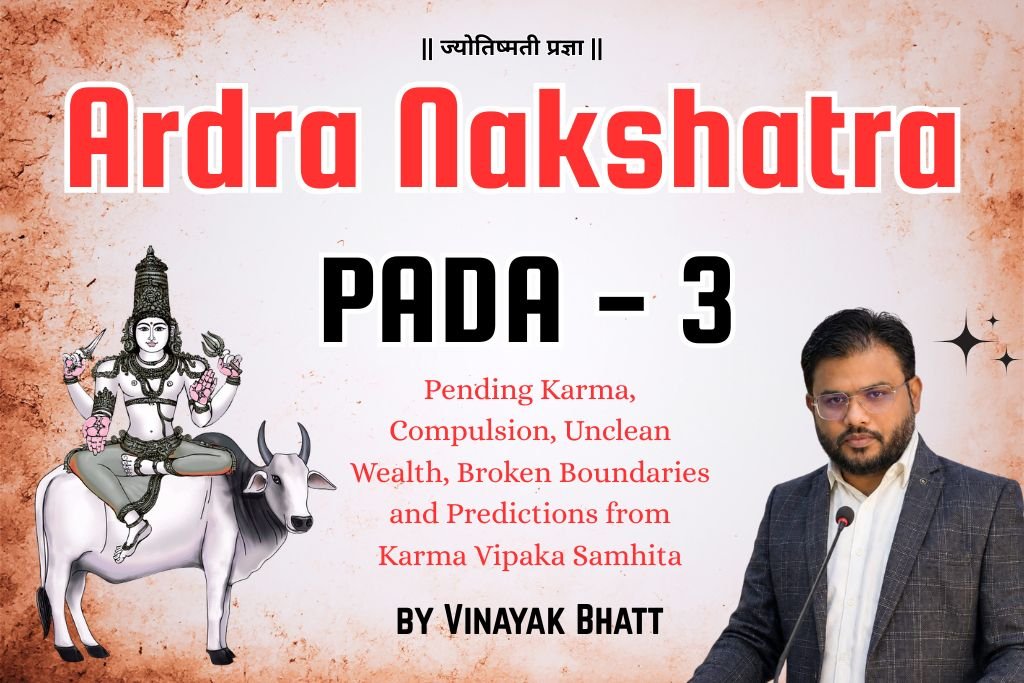
Ardra Nakshatra Pada 3 and Its Deeper Karmic Meaning
Ardra Nakshatra Pada 3 gives one of the strongest Karma Vipaka lessons about compulsion, uncontrolled appetite, money acquired through improper means, misuse of freedom and the gradual destruction of self-discipline. The previous-life person in this chapter is born into a Brahmin family, but the text deliberately contrasts his social or religious identity with his actual conduct.
He becomes deeply involved in gambling, habitual drinking, theft and relationships outside proper boundaries, and he accumulates considerable wealth through stealing while refusing to use any portion of that wealth for Dana or Punya. The story therefore does not revolve around one accidental mistake; it describes a repeated lifestyle in which desire, risk, money and pleasure gradually become stronger than conscience and restraint.
This makes Ardra Pada 3 very different from Ardra Nakshatra Pada 2. Pada 2 dealt with a person who was originally prosperous, later suffered financial decline and failed to settle a genuine debt taken during difficulty. Pada 3 is more intense because the problem lies not only in an unfinished transaction but in the source of wealth itself and the repeated pattern through which that wealth is obtained and enjoyed. The text repeatedly mentions gambling, intoxication, theft, illicit relationships and complete absence of charity, suggesting a life where immediate stimulation becomes more important than long-term consequence.
Ardra Pada 3 occupies approximately 13°20′ to 16°40′ Gemini and falls in Aquarius Navamsha. Ardra is ruled by Rahu, its Devata is Rudra, Gemini is ruled by Mercury and Aquarius Navamsha is ruled by Saturn. This combination gives a remarkably suitable Jyotish framework for the source narrative.
Mercury gives intelligence, calculation, trade, communication and the ability to understand systems; Rahu intensifies appetite, risk, experimentation, rule-breaking and fascination with what lies outside ordinary boundaries; Rudra brings disruption and the destruction of an existing order; while Saturn in the Navamsha represents consequence, social law, limitation, responsibility and the long period through which one eventually has to face what has been created.
The lower expression therefore becomes cleverness without restraint, while the higher expression turns the same intelligence into disciplined research, reform and the ability to understand complicated systems without becoming consumed by them.
The Karma Vipaka Story of Ardra Nakshatra Pada 3
The source places the earlier-life story about two Koshas from Avanti or Ujjain, in a town called Mangal, Mangala or Mangalapura. The direction from Avanti differs slightly between translations, with one rendering giving south-west and another south-east, so the safer point is simply that Mangalapura was situated close to Avanti.
There lived a Brahmin who was constantly inclined towards gambling, although other Brahmins living in the same region are described as people of good conduct. This contrast appears intentional: the problem cannot simply be blamed on the environment because the text places more disciplined people around him while showing that he repeatedly chooses another path.
The Brahmin is described as habitually drinking alcohol, stealing, pursuing other men’s wives and associating with prostitutes or courtesans according to the moral language of the old translations. He accumulated wealth through theft and did not give anything in charity or spend his resources upon Punya.
In other words, the story combines several forms of uncontrolled appetite: gambling seeks uncertain gain, theft seeks wealth without rightful exchange, intoxication weakens discrimination, sexual boundary-crossing places desire above responsibility, while total refusal of Dana turns accumulation into a one-way movement where resources continually enter but never voluntarily move outward.
Eventually he died. The text says that the messengers of Yama carried him to a terrible hell where he endured suffering for seventy thousand years. Some versions call the realm Raurava, while another rendering describes the suffering through imagery associated with Soochimukha or needle-like torment. After this period he passed through the births of a cat and a crow, and only afterwards returned to human birth in Madhyadesha.
The source does not explain why these two particular animal births occur, so it would be unwise to build predictive rules around their symbolism. What matters for this chapter is the larger sequence: a human life dominated by compulsive and exploitative behaviour is followed by a long period of difficult karmic result, then non-human births, and finally return to human life.
In the later human birth the text says that he suffered greatly and that his lineage was destroyed or progeny was obstructed. The old translation expresses this through the absence of a son, but such son-centred language must be handled prudently today. The useful principle is disturbance of continuity, not preference for one sex of child. The chapter then gives a substantial Prayaschitta involving Gayatri, Jatavedase and Tryambaka Mantras, Tulsi and Vishnu worship, offerings of food, incense and lamps and donation of land according to means.
The Real Pending Karma: Compulsion Became a Way of Life
The most important feature of Ardra Nakshatra Pada 3 is that the source does not describe one isolated act. The Brahmin is portrayed as repeatedly gambling, drinking, stealing and pursuing pleasure. This makes the karmic pattern one of habit and compulsion rather than one-time error.
There is a major difference between making a bad decision once and gradually organising life around the repeated satisfaction of an appetite. One poor financial choice can be corrected. One emotional mistake can be acknowledged. But when the mind continually seeks the same stimulation and repeatedly justifies it, the Samskara becomes much deeper because the behaviour is no longer only something the person does; it begins shaping how the person thinks.
This is where Rahu becomes extremely important. Rahu rarely says, “This is enough.” It searches for the next experience, the next advantage, the next thrill, the next secret, the next opportunity or the next possibility of getting more. Mercury then becomes dangerous when it is used only to explain why the next action is reasonable.
The real pending karma of Ardra Pada 3 can therefore be summarised as intelligence being repeatedly placed in the service of appetite rather than discrimination.
Gambling Is an Important Symbol of the Pada
The first activity mentioned prominently in the story is gambling. It should not be used to tell every Ardra Pada 3 native that they will literally gamble, but the psychological principle behind gambling is highly relevant. Gambling combines risk, uncertainty, calculation, hope, excitement and the possibility of obtaining large value without a proportionate process of production.
That combination fits Rahu and Mercury remarkably well. Mercury calculates the odds and understands patterns, while Rahu becomes fascinated by the exceptional outcome. The person does not focus upon what usually happens; the mind becomes attracted to what could happen if the unusual result arrives.
This same psychological structure can appear outside a casino. The native may repeatedly seek high-risk investments, speculative business decisions, rapid financial multiplication or opportunities which promise an unusually large result compared with the normal effort required. Again, none of these is automatically negative. Entrepreneurship itself requires risk, and intelligent speculation is different from compulsive gambling. The difference lies in whether the person can stop, calculate loss honestly and accept that a particular opportunity has failed.
The lower Ardra Pada 3 keeps chasing the next recovery.
The higher Ardra Pada 3 knows when information has become sufficient and when continued risk is only emotional compulsion disguised as strategy.
Aquarius Navamsha and the Need for Rules
Aquarius Navamsha makes Saturn one of the most important regulators of this Pada. Rahu wants to cross boundaries, while Saturn represents systems, limits, accountability and the consequences which eventually follow when rules are continually ignored. Because Rahu and Saturn have an important functional relationship in many traditional Jyotish interpretations, the third Pada becomes a field where freedom has to learn structure.
At the lower level, the person experiences rules as obstacles. Regulations feel restrictive, financial controls feel unnecessary, social expectations feel outdated and personal desire feels more intelligent than the system around it. Yet repeated disregard for structure eventually creates exactly the Saturnian experiences the native was trying to avoid: limitation, loss, legal difficulty, isolation, reputational damage or a long period of rebuilding.
At the higher level, the same native can become unusually good at understanding complex systems. Rahu explores where the system is weak, Mercury understands how it works, Aquarius sees the larger network and Saturn builds the control necessary to prevent collapse. This can create powerful ability in technology, analytics, cybersecurity, audit, risk management, investigation, compliance, forensic finance, research or any subject where one has to understand how a complicated system can be exploited and then design a better structure.
The difference between the higher and lower expression is not intelligence.
Both can be highly intelligent.
The difference is whether intelligence serves the system or only personal appetite.
Wealth Through Theft: The Source of Money Becomes More Important Than the Amount
The chapter specifically says that the Brahmin became wealthy through theft. This gives Ardra Pada 3 a strong karmic question regarding the source of wealth.
The story does not condemn wealth itself. In fact, many Karma Vipaka chapters show people possessing wealth without making wealth the problem. Here the problem is that accumulation comes through taking what belongs to somebody else without rightful exchange.
In modern life this should not be limited to literal burglary. The principle can include financial fraud, misuse of entrusted funds, commissions that are deliberately hidden from people who are entitled to know, appropriation of another person’s intellectual property, manipulation of accounts, false promises used to obtain money or using access to a system to redirect value unfairly.
The astrologer should not accuse an Ardra Pada 3 native of any such behaviour merely from Nakshatra placement. But if the Pada connects strongly with the 2nd, 6th, 8th, 10th or 11th houses, and Rahu, Mercury and Saturn are also troubled, the ethical source of income becomes an important area to examine.
A useful predictive principle is that the native may have unusual capacity to find loopholes, hidden opportunities or ways of generating money which are not obvious to others. At the higher level this becomes innovation. At the lower level it becomes exploitation.
The dividing line is whether another person’s legitimate right is being violated.
The Absence of Dana Is Not a Minor Detail
The source deliberately adds that the Brahmin never gave anything in charity or used his wealth for Punya. This detail becomes more meaningful because the money itself came through theft. Wealth moves continually inward but never voluntarily outward.
The karmic issue is therefore not merely greed but complete breakdown of circulation.
Aquarius is naturally connected with the larger collective, communities and networks. At its higher level, individual ability becomes useful to a wider group. In the source story, however, the native uses the social environment only as a field from which money and pleasure can be extracted.
The later remedy reverses this pattern through land donation, feeding, ritual offerings and worship. Wealth which once moved secretly inward is now consciously released outward. The symbolic direction changes from taking to offering and from private appetite towards something that sustains beyond the individual.
Yet charity should never be used as a substitute for restitution. If money has actually been taken from someone in present life, giving an unrelated donation elsewhere does not make that person’s loss disappear. The first ethical correction is to return or settle what is rightfully owed wherever possible; Dana creates another stream of Punya but should not be used to avoid the specific responsibility created by the original act.
Drinking and the Larger Problem of Lost Discrimination
The source includes habitual drinking among the Brahmin’s repeated activities. It would be simplistic to convert this into a universal statement that every use of alcohol creates the same Karma Vipaka. The narrative is more specific: intoxication appears as one part of a larger pattern of gambling, theft, uncontrolled sexual conduct and refusal of responsibility.
The deeper concern is therefore loss of discrimination under appetite.
Any behaviour that repeatedly reduces the person’s ability to make a conscious choice can become relevant to the symbolism of this Pada. In one native it may literally involve alcohol or another substance; in another it may be gambling, compulsive sexual behaviour, online stimulation, speculation or any activity where the person repeatedly says, “I know this is damaging me, but I still cannot stop.”
Rahu increases fascination, Mercury invents rationalisations and Saturn eventually presents the accumulated cost.
When the 6th, 8th or 12th houses are strongly involved, the astrologer should investigate compulsive patterns carefully but without moral judgement. If a genuine addiction is present, professional treatment and structured support are far more useful than telling the client that the problem is only a past-life curse.
Sexual Conduct and the Issue of Boundary Crossing
The old text uses strongly moralised language concerning other men’s wives and prostitutes. Modern interpretation requires more care. The problem should not be reduced to judging adult sexuality or treating sex workers as inherently impure. The karmic point that remains useful is crossing relationship boundaries, betrayal of agreed commitments and using another person primarily for gratification.
Rahu naturally becomes interested in what lies outside established boundaries. Mercury creates duality and multiple connections, while Ardra is willing to disturb structures which feel restrictive. None of this automatically means infidelity. It can produce unconventional relationships, intercultural unions or a refusal to follow social patterns which genuinely no longer make sense.
The lower expression appears when freedom is demanded for oneself while the emotional and practical consequences are pushed onto other people.
A useful consultation question is therefore whether desire and responsibility are being held together, or whether the native repeatedly seeks excitement while expecting others to carry the cost of that excitement.
This distinction allows the Karma Vipaka principle to remain relevant without repeating the social prejudices of an older era.
Outer Identity and Inner Conduct
One particularly important feature of the story is that the central person is a Brahmin, while his behaviour is repeatedly described as contrary to Brahminical conduct. The text is therefore making a distinction between identity and qualification.
- A sacred label does not make conduct sacred.
- Knowledge does not automatically create character.
- Social reputation does not guarantee private discipline.
This is highly relevant to Ardra Pada 3 because Rahu often creates powerful contrasts between image and hidden reality. A person may look respectable publicly but privately struggle with compulsions. Another may be highly intelligent, educated or spiritually knowledgeable and still behave very poorly with money or relationships.
The lesson should not become an attack on religious identity or traditional social categories. The universal principle is simply that a role is meaningful only when behaviour carries the responsibility of that role.
For an astrologer, teacher, doctor, banker, spiritual adviser or public figure, reputation gives access. Access creates greater opportunity for both service and misuse. The higher Ardra Pada 3 understands that the more people trust one’s status, the more carefully private conduct must be regulated.
The Long Hell Period Shows the Cost of Repeated Behaviour
The source gives seventy thousand years of severe post-death suffering before the animal births occur. Such Puranic time spans should be understood within the metaphysical framework of the text rather than converted into modern astronomical chronology. Their function is to communicate the severity and persistence of the karmic pattern.
This is consistent with the narrative because the wrongdoing is not occasional. It becomes repetitive and deeply established. One act can be corrected quickly; a lifestyle creates a much stronger Samskara.
This gives a practical psychological lesson even without entering metaphysics. The longer a compulsive behaviour is repeated, the more difficult it becomes to remove because habits create systems around themselves. The gambler develops financial arrangements supporting gambling. The person hiding money develops stories explaining discrepancies. The person maintaining secret relationships develops another network of secrecy. The problem eventually becomes larger than the original desire because the entire life has been reorganised around protecting the behaviour.
Higher Saturn breaks this cycle through routine, accountability and consequence rather than relying only upon willpower.
Cat and Crow Births Should Not Be Over-Interpreted
The source says that after the period of suffering the native passes through cat and crow births before returning to human life. It is tempting to assign elaborate symbolism to these animals, but the text itself does not explain why they were selected.
For that reason it is better not to claim that a cat necessarily represents one precise sin or that the crow represents another. Such interpretations can easily become imaginative rather than textual.
The stronger teaching lies in the overall progression. Human intelligence was used in the service of compulsion and exploitation; after experiencing the consequences, the soul returns to human life and is again given the opportunity to use intelligence differently.
Human birth therefore becomes another chance at conscious regulation.
Lineage Destruction Is the Main Present-Life Result Given by the Source
After the non-human births, the person returns to a human birth in Madhyadesha and the source states that his lineage becomes obstructed or destroyed. The old translations commonly express this as absence of a son, but this should never be used to demean daughters or to predict literal childlessness merely from a planet occupying Ardra Pada 3.
For actual progeny judgement the astrologer must examine the 5th house, fifth lord, Jupiter, Putrakaraka, Saptamsha and relevant Dasha. Without repetition from these factors, the Karma Vipaka statement should remain a thematic indication rather than a literal prediction.
The wider symbolism of lineage is much more useful. A lineage is anything meant to continue beyond the individual. Children continue a family, students continue knowledge, successors continue an institution and creative work continues a person’s intellectual contribution.
The lower Ardra Pada 3 is centred upon immediate appetite. Lineage requires the opposite quality: patience, continuity and willingness to sacrifice present gratification for something that will survive later.
This produces an important karmic contrast. A life organised only around today’s stimulation can weaken tomorrow’s continuity.
The 5th House and Gambling Form an Important Jyotish Connection
The source prominently mentions gambling, while lineage and progeny later become disturbed. In Jyotish, the 5th house is especially interesting because it governs both children and speculative intelligence. This does not prove that the text intentionally constructed the story around that astrological correspondence, but the relationship is highly useful in practical interpretation.
When the 5th house, its lord or Jupiter strongly connects with Ardra Pada 3, the same field may contain both the capacity for speculation and questions concerning children, students or legacy. A strong benefic structure can turn speculative intelligence into research, markets, mathematical modelling or strategic thinking. A heavily afflicted pattern can make risk-taking emotionally addictive.
The predictive rule should therefore not be, “This placement causes gambling.” The stronger rule is that the native’s relationship with risk has to be examined because the same intelligence that can identify exceptional opportunities can also become attracted to exceptional odds.
When children and speculation are both heavily represented in the chart, one should also examine whether risky financial decisions can affect family security.
Wealth Without Peace Can Be a Major Pattern
The earlier-life Brahmin becomes wealthy through theft, yet the story gives no indication that this wealth produces real contentment. Instead, appetite continually expands into gambling, intoxication and sexual pursuit. This is one of the most recognisable Rahu principles: acquisition does not automatically produce satisfaction.
In modern charts an Ardra Pada 3 native may sometimes have enough money and still feel compelled to take one more financial risk, pursue one more opportunity or prove themselves through another major gain. The problem is not poverty but an internal inability to define “enough.”
This is where Saturn’s role becomes extremely important. Saturn teaches sufficiency through boundaries. It asks the native to create rules before desire appears: maximum risk limits, separate accounts, scheduled savings, ethical guidelines and clear consequences if the rules are violated.
The higher Saturn does not destroy ambition.
It gives ambition a structure capable of surviving itself.
Ardra’s Storm Can Expose What Has Been Hidden
Rudra is the Devata of Ardra, and Rudra’s storm has a revealing function. What has accumulated underneath eventually becomes impossible to conceal. In a practical horoscope, a strong Ardra Pada 3 activation can therefore coincide with periods when hidden financial, relational or behavioural patterns become visible.
- A secret account may be discovered.
- A risky financial strategy may finally produce a visible loss.
- A relationship arrangement which had remained hidden may come into public knowledge.
- A private habit may become impossible to maintain alongside professional responsibilities.
This should not be read fatalistically. Exposure can itself become the beginning of purification. Rudra destroys the arrangement which allowed the old behaviour to continue unquestioned.
The higher native eventually recognises that the crisis was not merely an external punishment; it was the point at which the system could no longer support the contradiction.
Aquarius Navamsha and Social Consequence
Aquarius expands the story beyond personal morality into the field of social systems. Theft, gambling and exploitation do not affect only the individual. They alter families, businesses, institutions and networks. When one person manipulates a financial system, other people carry the cost.
This gives Ardra Pada 3 strong relevance wherever technology or networks allow a person to act at scale. A clever financial manipulation today can affect hundreds of investors rather than one neighbour. Misuse of data can affect thousands of people. A person exploiting an online system may never physically meet those who bear the loss.
Rahu and Aquarius can create distance between action and consequence.
Saturn restores the connection by showing that large systems still produce accountability.
At the higher level, the same placement can produce people who understand exactly how systems are abused and therefore become very effective in fraud detection, cyber security, regulation, compliance, forensic accounting, investigative research or institutional reform.
A Strong Career Potential Hidden Inside the Same Karma
The presence of gambling, stealing and manipulation in the source story should not lead students to label Ardra Pada 3 as inherently criminal. Nakshatra energy has both lower and higher possibilities. Rahu, Mercury and Saturn together can give powerful ability to work with information that is complex, hidden, technical or difficult for ordinary people to understand.
A mature native may excel in technology, coding, network architecture, data analysis, cyber investigation, auditing, financial markets, risk management, taxation, intelligence work, research, crisis management or restructuring. The person may instinctively notice irregularities in systems because the mind naturally searches for loopholes and patterns.
The karmic maturity lies in what is done with that knowledge. One person discovers a weakness and exploits it. Another discovers the same weakness and fixes it.
That is perhaps the clearest higher-versus-lower distinction of Ardra Pada 3.
The Source of Income Should Be Examined During Major Dashas
When Ardra Pada 3 becomes strongly activated, especially through the Dasha of the planet occupying it, the astrologer should examine not only how much money is being made but how that money is being made.
A rapid increase in income during Rahu or Mercury periods may come through innovation, technology, foreign links, trading or unusual commercial methods and can be completely legitimate. Yet if the 2nd, 6th, 8th or 12th houses are simultaneously heavily afflicted, the native needs greater caution around documentation, compliance, taxation, borrowed funds and dealings involving other people’s money.
The prediction is therefore not “Rahu money is bad.” Rahu can produce enormous worldly success. The real question is whether the financial model can survive scrutiny.
A very useful consultation sentence is: “If the income can remain completely comfortable even after every document, tax, agreement and source is openly examined, the higher side of this combination is working. If secrecy is essential to keep the money flowing, the chart is asking for much greater caution.”
House Logic for Ardra Nakshatra Pada 3
The 2nd house is important for accumulated wealth and the source from which family resources are built. The 5th house becomes significant because the source story mentions gambling as well as later disruption of progeny. The 6th house can show compulsive habits, debt, conflicts, legal consequences and the work necessary to correct them. The 7th house matters when agreements, marriage or crossing another relationship’s boundaries become part of the story.
The 8th house is especially relevant for secrecy, hidden money, other people’s resources, scandal and behaviour concealed beneath the visible life. The 10th house shows professional reputation and whether private conduct can affect public standing. The 11th house governs gains and networks, while the 12th house can show expenditure, intoxication, secret pleasure, loss and activities carried out away from ordinary scrutiny.
A 2nd–5th–11th connection can give strong speculative intelligence and the ability to make large gains, but affliction from Rahu, Saturn or the 6th and 12th lords can turn risk into compulsion. A 2nd–8th connection requires exceptional cleanliness concerning hidden or shared resources. A 7th–8th–12th pattern can make relationship secrecy or private attachments more relevant. A 10th–8th connection may create a sharp contrast between public reputation and private matters, while a strong Jupiter or well-placed Saturn can become an important corrective force.
The strongest reading should always come from repetition. Ardra Pada 3 gives the karmic theme; Bhavas and Grahas decide how literally that theme manifests.
Dasha Activation
A Rahu Dasha or Antardasha can strongly activate Ardra because Rahu rules the Nakshatra. The period may produce rapid expansion, unconventional opportunity, experimentation, foreign or technological connections and greater willingness to take risk. If Rahu is afflicted and connected with the 5th, 8th or 12th houses, the same period can also magnify compulsive behaviour or hidden complications.
A Mercury period can activate trading, communication, accounts, commercial strategies and multiple simultaneous decisions because the Pada remains in Gemini. Strong Mercury can make the period intellectually brilliant, while afflicted Mercury can encourage rationalisation and excessive cleverness.
A Saturn period is particularly important because Saturn rules the Aquarius Navamsha. It can bring accountability, legal or financial structure, delayed consequence, discipline and the need to repair what earlier Rahu-like behaviour left incomplete. Saturn periods may feel restrictive, but for Ardra Pada 3 they can become extremely constructive because the native finally develops systems that prevent repeated chaos.
Periods of the 2nd, 5th, 6th, 8th, 11th or 12th lords become especially relevant when those houses already connect with the Pada. The prediction becomes stronger only when Nakshatra, Bhava and Dasha repeat the same language.
Consultation-Level Predictions
When Rahu, Mercury or the 5th lord occupies Ardra Pada 3 and connects strongly with the 2nd and 11th houses, the native can possess excellent ability to identify unusual opportunities and make money through areas where information, timing and risk matter. The consultation should not discourage ambition, but the astrologer should advise the native to establish fixed risk limits before emotional excitement enters the decision. Such charts perform far better when rules are written during calm periods rather than invented after losses begin.
When the 8th and 10th houses connect strongly with the Pada, the native may have a major life lesson concerning the difference between private conduct and public reputation. The person may work in a confidential or investigative field, but if the planets are heavily afflicted, hidden personal matters can also threaten professional standing. The strongest protection is not merely secrecy but behaviour that can withstand eventual disclosure.
When the 6th, 8th and 12th houses dominate, the astrologer should examine compulsive or escapist patterns with particular care. The native may go through phases where one behaviour becomes difficult to regulate. The practical advice should emphasise accountability, structured support and real-world correction rather than frightening language about curses.
When Saturn is strong and well placed, the same chart can show an individual who goes through one serious period of disorder and then becomes extraordinarily disciplined afterwards. Such a native may eventually become the person who teaches others how to manage risk, recover from addiction, rebuild finances or correct systems because personal experience has shown them exactly where unregulated appetite leads.
Planetary Applications of Ardra Nakshatra Pada 3
When the Sun occupies Ardra Pada 3, personal identity, authority and reputation can become connected with the Nakshatra’s intense desire for independence. The native may dislike rules imposed by people they do not respect and may test boundaries professionally or personally. If afflicted, pride can make it difficult to admit that a risky choice has become harmful, while the higher expression uses leadership to reform systems and expose wrongdoing rather than participate in it.
When the Moon occupies this Pada, the mind itself becomes strongly affected by Rahu-Rudra themes. Curiosity, emotional intensity and changing mental stimulation can become powerful, and periods of anxiety or obsession may arise when the Moon is afflicted. At the higher level this can produce a deeply investigative mind capable of understanding psychology, technology or hidden human behaviour, but emotional self-regulation becomes essential.
When Mars occupies Ardra Pada 3, decisions can become fast, bold and highly competitive. The native may be willing to take risks that others avoid and can perform well in difficult environments, but impulsive speculation, confrontation or acting before all information is available becomes the lower possibility. Higher Mars gives courage to stop a destructive pattern decisively.
When Mercury occupies the Pada, the Gemini quality becomes especially strong and the native may possess exceptional commercial, technical or analytical ability. The mind can understand complex systems quickly, identify loopholes and communicate persuasively. When afflicted, however, the same cleverness can become self-deception or manipulation because the native can produce convincing arguments for whatever they already want to do.
When Jupiter occupies Ardra Pada 3, knowledge and ethical judgement become extremely important. A strong Jupiter can transform Rahu’s curiosity into serious research, teaching and reform and can help the native distinguish opportunity from exploitation. An afflicted Jupiter may create sophisticated justification for excessive behaviour, where philosophy and intelligence are used to defend appetite rather than regulate it.
When Venus occupies this Pada, pleasure, relationships, money and attraction can become intense. The native may be drawn towards unconventional people, unusual social environments or highly stimulating lifestyles. A strong Venus can produce creativity and sophisticated commercial sense, while affliction can blur the line between genuine enjoyment and compulsive consumption.
When Saturn occupies Ardra Pada 3, the Aquarius Navamsha lord becomes particularly important. Life may give strong lessons regarding consequence, law, delay and responsibility. The native may experience restrictions after periods of excess, but Saturn can ultimately become the greatest stabilising force by converting chaotic talent into disciplined expertise.
When Rahu occupies Ardra Pada 3, the Nakshatra lord becomes highly amplified. The person can possess extraordinary ambition, technological ability, fascination with unusual knowledge and capacity to operate outside conventional frameworks. If poorly regulated, however, appetite can become self-multiplying, making external accountability and ethical structure essential.
When Ketu occupies this Pada, the person may pass from periods of intense involvement into sudden detachment. They can become highly perceptive about hidden systems yet lose interest once the intellectual puzzle has been solved. At the higher level Ketu can sever a destructive compulsion abruptly, while at the lower level it may cause practical responsibilities to be abandoned without proper closure.
These planetary applications are Jyotish interpretations derived from Ardra, Gemini and Aquarius Navamsha, not literal statements made by the Karma Vipaka chapter, and they must always be modified by house lordship, dignity, conjunctions, aspects and Dasha.
Health Indications Must Be Handled Carefully
The source states that the native suffers greatly after returning to human birth and that the prescribed Prayaschitta is connected with relief from disease. It does not provide a reliable modern diagnosis which should automatically be attached to Ardra Pada 3.
Health assessment therefore requires Lagna, Lagnesha, Moon, Mercury, Saturn, Rahu, the 6th and 8th houses, relevant Vargas and Dasha. The chapter’s pattern of intoxication and compulsive behaviour may make lifestyle an important subject where the horoscope independently supports it, but one should never tell a client they have a specific illness merely because a planet occupies this Pada.
The broader principle is that a lifestyle built around continuous overstimulation can eventually create physical and psychological exhaustion. Ardra’s storm cannot remain permanent without cost.
Traditional Prayaschitta for Ardra Nakshatra Pada 3
The traditional remedy is centred upon three major Mantras, Homa, Tarpana, Marjana, Tulsi-Vishnu worship and land donation. The text prescribes a total of three lakh Japa, commonly understood in the available translations as one lakh each of the Gayatri Mantra, Jatavedase Mantra and Tryambakam Yajamahe or Mahamrityunjaya Mantra, followed by the appropriate Homa, Tarpana and purification procedures.
The native is then instructed to worship Tulsi as connected with Lord Vishnu, using appropriate offerings, incense and lamps. Some translations specifically describe preparing different rice dishes and offering them during the worship. Finally, land is to be donated according to the native’s capacity or wealth. The classical text associates these practices with purification of the earlier karma, relief from disease and restoration of progeny or lineage.
These are formal ritual prescriptions. Exact Mantra procedure, Sankalpa, Homa count, Tarpana, Marjana and land donation should be undertaken through competent traditional guidance rather than reconstructed casually from an English translation. The classical claims concerning progeny should also be understood within the traditional framework and not treated as guaranteed medical outcomes.
Why Three Mantras Appear in the Remedy
The source itself does not provide a long philosophical explanation of the three-Mantra combination, so the deeper meaning should be presented as interpretive rather than textual. Yet their combination fits the karmic pattern remarkably well.
Gayatri is connected with illumination of Buddhi. The earlier problem is not absence of intelligence but intelligence repeatedly losing control of appetite. Gayatri symbolically restores discrimination.
Jatavedas, a form of Agni, represents purification and transformation. The source story contains wealth generated through improper action and a life organised around consumption. Agni changes what is offered rather than merely accumulating it.
Tryambaka is traditionally associated with healing and release from bondage. Compulsion itself is a kind of Bandhana because the person gradually loses freedom to choose differently.
Taken together, the remedial movement is from confused intelligence to clear intelligence, from accumulation to offering, and from compulsion to release.
Tulsi and Vishnu After the Storm of Rudra
The instruction to worship Tulsi and Vishnu is particularly meaningful in an Ardra chapter. Rudra breaks. Vishnu preserves. Ardra describes a life in which appetite has destroyed order; the remedy then turns towards a principle of preservation, stability and sustained Dharma.
Tulsi is not merely an ornamental ritual object in this context. The worship introduces daily discipline, purity and repetition – the exact opposite of a life organised around impulsive stimulation.
The symbolic movement is therefore from Rahu’s uncontrolled appetite towards Vishnu’s preservation of order.
This is an important teaching for Jyotish students because remedial logic often attempts to cultivate the quality absent from the original karmic pattern.
Why Land Donation Is Such a Strong Corrective Symbol
The chapter concludes with donation of land according to capacity. The source does not explicitly explain why land was chosen, but the symbolism is powerful. The earlier wealth was unstable, acquired through theft and consumed through repeated pleasure. Land is the opposite kind of value: fixed, enduring, productive and connected with long-term responsibility.
Giving land converts unstable acquisition into a stable resource transferred consciously.
It also introduces a Saturnian quality because land requires boundaries, ownership and lawful transfer. What was once taken without legitimate ownership is now released through a deliberate and recognised act of ownership.
The higher principle is not that every modern person must literally give away land. The traditional prescription should be respected as such. The broader ethical lesson is to convert wealth into something stable, useful and legitimately transferred rather than secretly acquired and privately consumed.
Practical Modern Remedy
The first practical remedy for Ardra Pada 3 is to clean the source of income. Any money which is being obtained through deception, misuse of another person’s funds, unpaid entitlement or deliberate concealment should be addressed directly. Where restitution is possible, restitution takes priority over unrelated charity because the original person or institution whose value was taken should not disappear behind a general spiritual remedy.
The second correction is to place external structure around any genuine compulsion. Gambling limits, separate financial accounts, restricted access to speculative capital, accountability to another trusted person and professional support where addiction exists can all become practical Saturnian remedies. Willpower alone is often weakest at the exact moment Rahu is strongest, which is why systems matter.
Relationship boundaries should also become explicit. If the native is in a committed relationship, agreements regarding fidelity, money and privacy should be clear rather than assumed. Freedom is healthier when its terms are honest.
The final practical correction is circulation of resources through genuine Dana or service according to capacity, but this should come after immediate obligations and restitution are addressed. The point is not to purchase forgiveness. The point is to change the Samskara from taking without limit to participating responsibly in exchange.
The Difference Between Ardra Pada 2 and Pada 3
Ardra Pada 2, falling in Capricorn Navamsha, dealt mainly with financial decline, borrowing during crisis and the responsibility to repay what had been received. Its central weakness was failure to close an obligation after the emergency had passed.
Ardra Pada 3 moves into Aquarius Navamsha and changes the issue from debt to systemic excess and misuse of freedom. Here money itself may come through theft or unethical acquisition, while gambling, intoxication and sexual appetite show that the financial problem is part of a much larger pattern of self-regulation.
Pada 2 asks whether the native will honour a debt.
Pada 3 asks whether the native can regulate desire before desire takes control of the entire system of life.
- Capricorn demands responsibility after crisis.
- Aquarius asks whether individual freedom can exist without damaging the wider network.
This is the natural progression from the second to the third Pada.
The Higher Expression of Ardra Nakshatra Pada 3
The higher Ardra Pada 3 can be exceptionally powerful because the very qualities that create difficulty at the lower level become remarkable strengths when disciplined. Rahu sees what other people overlook, Mercury understands patterns and information, Aquarius understands networks and Saturn gives the patience to test a system until its weaknesses become visible.
Such a person can become excellent at research, technology, systems analysis, forensic work, fraud detection, cyber security, auditing, risk management, investigation, financial markets, crisis management or social reform. They may understand abnormal behaviour more deeply than people whose lives have always remained orderly because their mind naturally explores edges, exceptions and hidden structures.
The real maturity comes when the native stops asking, “How can I use this loophole?” and begins asking, “Why does this loophole exist, and how can I prevent it from harming people?”
That is the transformation of Rahu through Saturn.
The Real Teaching of Ardra Nakshatra Pada 3
Ardra Nakshatra Pada 3 ultimately teaches that intelligence without self-regulation can become one of the most effective servants of desire. The Brahmin of the source story is capable enough to accumulate considerable wealth, but the method of accumulation and the lifestyle surrounding it become increasingly destructive.
Gambling, intoxication, theft, sexual boundary-crossing and absence of Dana are not separate random sins in the narrative; together they describe a person whose appetites have gradually become stronger than his capacity to restrain them.
The later suffering and loss of lineage should therefore be understood not as a simplistic divine punishment but as the Karma Vipaka text’s way of illustrating the consequence of a life in which nothing is being preserved for the future. Everything is oriented towards present gain, present excitement and present gratification. Lineage, by contrast, represents what is supposed to continue beyond the present self.
Rahu wants more experience, Mercury finds the method, Rudra destroys whatever cannot contain the pressure and Saturn ultimately asks the person to live inside consequence. At the lower level, the native becomes increasingly clever at feeding appetite. At the higher level, the same native becomes exceptionally capable of identifying danger, controlling systems and transforming chaos into disciplined knowledge.
The main predictive principle for Ardra Nakshatra Pada 3 is that when this Pada strongly connects with wealth, speculation, secrecy, relationship or loss-producing houses, the astrologer should examine whether the native’s greatest strength—intelligence, adaptability and willingness to cross conventional boundaries—is being used to create innovation or merely to rationalise a behaviour which has become difficult to control.
The deeper Karma Vipaka principle is that wealth acquired without rightful exchange and pleasure pursued without responsibility may increase immediate stimulation while weakening long-term continuity. The higher principle of Ardra Pada 3 is therefore to use Rahu to investigate rather than exploit, Mercury to understand rather than rationalise, Rudra to destroy destructive habits rather than relationships and Saturn to build rules strong enough that intelligence remains a servant of Dharma rather than a servant of appetite.






![Science of Remedies in Vedic Astrology [Hindi]](https://vedicgrace.com/wp-content/uploads/2025/12/Science-of-Remedies-in-Vedic-Astrology-Hindi-VG-300x214.png)
![Science of Remedies in Vedic Astrology [English]](https://vedicgrace.com/wp-content/uploads/2025/12/Science-of-Remedies-in-Vedic-Astrology-VG-300x214.png)



Leave a Comment
Be the first to comment on this blog!