
Why This Course?
Why Rudra for Students of Jyotish?
There is a very deep connection here.
Śiva is Mahākāla.
And what does the astrologer actually study?
Kāla — Time.
Daśā is Kāla.
Transit is Kāla.
Graha maturity is Kāla.
The fructification of Karma is Kāla.
The rise and fall of circumstances happens through Kāla.
The Jyotishi attempts to understand the movement of time.
But Mahākāla stands beyond Time.
This itself makes Rudra worship deeply meaningful for a student of Jyotish.
Śiva, Chandra and Nakshatra
Mahādeva carries Chandra upon His head.
And Chandra moves through the Nakshatras.
In Jyotish, Chandra carries:
- Manas
- memory
- emotional impressions
- Saṁskāra
- perception
- past conditioning.
Therefore, for the Jyotishi, worship of Mahādeva also carries a beautiful symbolism:
Let the mind which interprets Nakshatra first become peaceful.
Because an unsettled mind can know many rules and still interpret them incorrectly.
The Third Eye of the Jyotishi
Śiva possesses the third eye.
There is a simple teaching hidden here for every astrologer.
Two eyes can see the horoscope.
But the third eye must understand the Karma behind the horoscope.
Anybody can see Saturn in the 7th house.
The Jyotishi must ask:
Why has Saturn come there?
What responsibility is Saturn creating?
What type of Karma is being matured?
What should the native learn?
What should the astrologer tell him?
And what should perhaps not be told?
That movement from merely seeing a placement to understanding its purpose is the spirit behind Jyotisha Dṛṣṭi Śuddhi.
Every Graha Is Also a Teacher
There is another reason I want Jyotish students to participate in this Saṅkalpa.
When we study Saturn, we study Karma, responsibility and consequence.
When we study Jupiter, we study knowledge, Guru and wisdom.
When we study Mercury, we study Buddhi, interpretation and speech.
When we study Moon, we study Manas and Saṁskāra.
When we study Sun, we study Ātma, authority and identity.
When we study Mars, we study action, courage and discipline.
When we study Venus, we study relationships, value, desire and restoration.
When we study Rahu and Ketu, we enter unusual, unfinished and difficult regions of Karma.
Therefore, every Graha is doing more than giving events.
Every Graha is teaching something.
So occasionally the astrologer should stop asking:
“What will this Graha give me?”
And begin asking:
“What is this Graha trying to teach me?”
The second question can completely change the study of Jyotish.
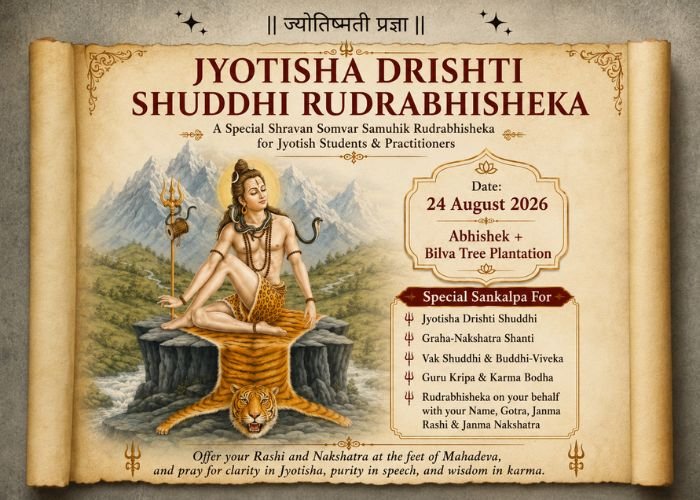
Rudrābhiṣeka + Bilva Tree Plantation
There is another important part of this event.
The donation collected through this event will be used for planting Bilva trees in Rishikesh.
The worship should not finish when the Abhiṣeka finishes.
Something from our worship should return to Prakṛti.
And what could be more connected with Mahādeva than Bilva?
The Bilva leaf is offered during Śiva worship.
But instead of only offering leaves, we also wish to support the planting of the tree which gives those leaves.
This gives a beautiful completion to the Saṅkalpa.
One offering goes to Mahādeva through Abhiṣeka.
Another offering goes back to Mother Earth through Bilva Vṛkṣa Ropaṇa.
So participation becomes connected not only with personal prayer, but also with Vṛkṣa Seva.
The Bilva trees supported through the donations collected from this event will be planted in Rishikesh.
A Different Prayer to Mahādeva
Do not participate only with the prayer:
“Mahādeva, make all my planets favourable.”
Come with another prayer:
“Mahādeva, give me the Dṛṣṭi to understand what my Grahas are trying to teach me.”
That prayer is different.
Because sometimes grace does not mean removing Saturn.
Grace may mean finally understanding Saturn.
Sometimes grace does not mean removing a difficult Nakshatra experience.
Grace may mean receiving the wisdom required to complete its Karma properly.
And sometimes the greatest remedy is not changing the horoscope.
It is changing the consciousness with which we live the horoscope.