
Ardra Nakshatra Pada 4: Pending Karma, Unpaid Debt, Punya, Financial Responsibility and Predictions from Karma Vipaka Samhita By Vinayak Bhatt
Nakshatra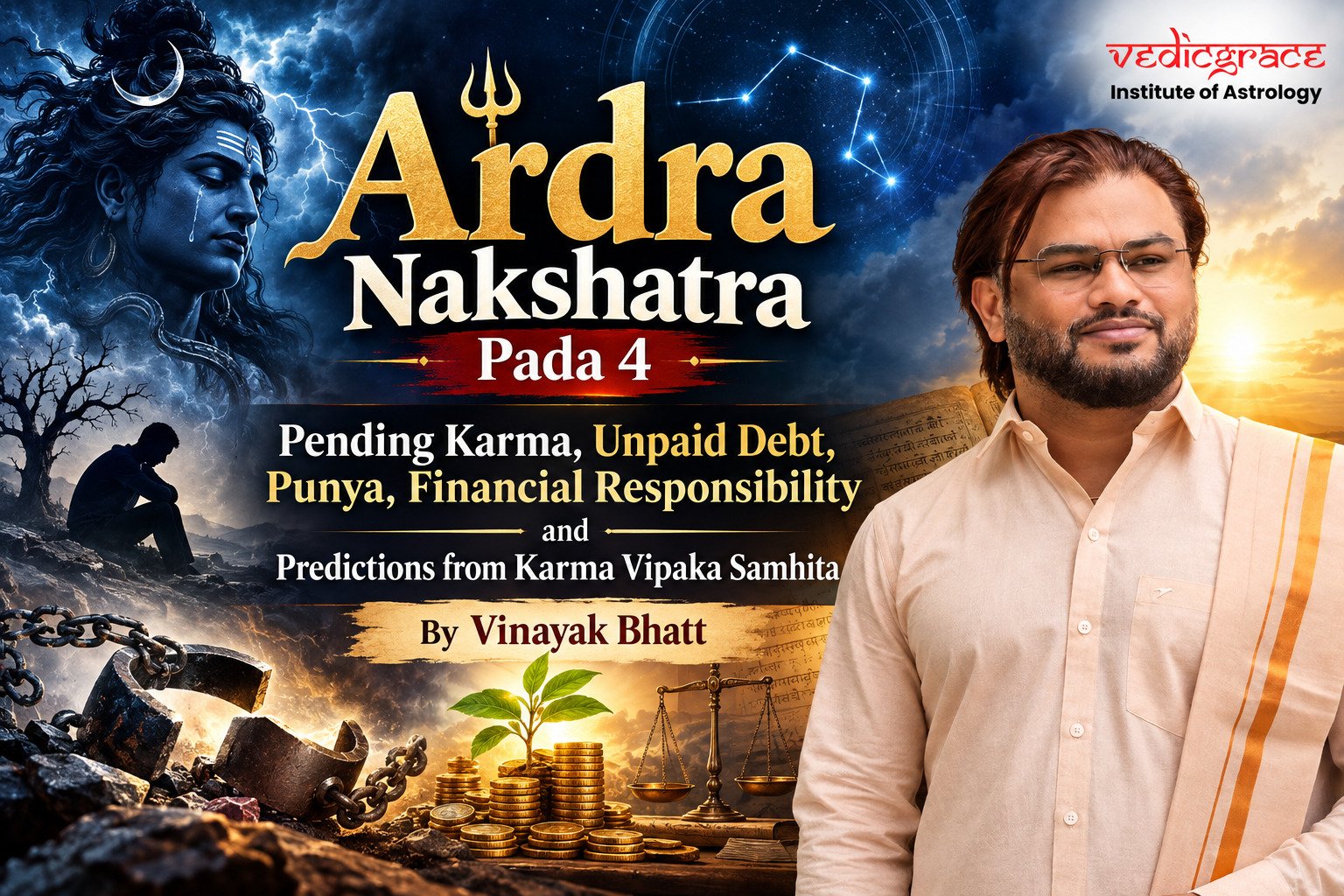
Ardra Nakshatra Pada 4 and Its Deeper Karmic Meaning
Ardra Nakshatra Pada 4 gives a particularly subtle Karma Vipaka lesson because the previous-life person is shown as wealthy, commercially active and capable of very large acts of charity, yet one specific financial obligation remains unpaid. This combination is more important than the debt alone. The person trades in many kinds of goods, participates in agriculture, handles animals, gems and clothes, and during a solar eclipse goes with his wife to the Narmada and performs an extraordinary donation of cows adorned with gold and garments. Yet later he receives money from a goldsmith and does not return it. The text then connects this unresolved debt with difficult karmic consequences and, in the later human birth, with the death of a son.
The story therefore makes an important distinction between general Punya and specific responsibility. A person may give generously to temples, sacred causes, religious institutions or society and still have one unresolved obligation towards a particular individual. The large charity does not automatically erase that person’s legitimate claim. This is perhaps the most important principle of Ardra Pada 4: a thousand acts of generosity elsewhere do not necessarily settle one debt that still belongs to a specific creditor.
Ardra Pada 4 occupies approximately 16°40′ to 20°00′ Gemini and falls in Pisces Navamsha. Ardra is ruled by Rahu, its Devata is Rudra, Gemini is ruled by Mercury and Pisces Navamsha is ruled by Jupiter. This creates a very different inner structure from Ardra Pada 3. Mercury gives trade, calculation, movement, multiple commercial interests and the ability to deal with many kinds of people and commodities. Rahu expands scale, appetite and worldly reach. Rudra brings disruption when a structure can no longer continue. Pisces Navamsha introduces Jupiter, Dharma, compassion, charity, pilgrimage, sacred rivers, faith and the desire for purification. The source story itself contains exactly these themes: large-scale commerce, financial disturbance, sacred charity and one unresolved debt surviving beside considerable Punya.
The Karma Vipaka Story of Ardra Nakshatra Pada 4
The source describes a very wealthy man living in Ujjain. The old text identifies him through traditional social terminology, but for modern interpretation his occupational life is far more useful than his caste label. He kept and traded goats and sheep and was also involved in agriculture and extensive buying and selling. The chapter expands his commercial activity further and says that he dealt in elephants, horses, gems and different kinds of garments. One translation also mentions his regular consumption of goat meat. The important picture is of a materially active trader whose livelihood is spread across several categories rather than a person dependent upon one narrow occupation.
During a solar eclipse, he went with his wife to the Narmada River and performed an immense act of Dana. The source says that he donated a thousand cows adorned with gold and clothes. The exact scale is part of the traditional narrative, but even without treating the number as a modern accounting figure, the intended point is obvious: this man was capable of significant Punya and was not fundamentally opposed to religious charity.
Later he experienced material difficulty, bodily suffering or a decline in circumstances—the wording differs slightly across translations—and he received wealth from a goldsmith or jeweller for his practical needs. What remains completely clear is that he did not return the money. After considerable time he died with that financial account unresolved. The text then says that he suffered in a hellish state for two lakh years, after which he passed through non-human births. One detailed translation lists a crow, buffalo and heron before he again obtained human birth in an auspicious family; another rendering is less precise in the sequence. The specific animal symbolism is not explained by the Samhita, so it is better not to invent elaborate meanings for each Yoni.
In the later human life, the text directly returns to the old financial account and says that because the money taken from the goldsmith had not been repaid, the native’s son died. The son reached youth and suffered a serious bodily disorder before death. One modern translation renders the condition as hemiparesis, while another more generally refers to a Vata-related affliction. Since this is an ancient Sanskrit source being translated into modern medical terminology, it is safer to preserve the broader idea of serious bodily weakness or paralytic/Vata-type suffering rather than claiming a precise modern diagnosis from the verse.
This gives the chapter its central karmic structure. The man could perform enormous charity and still leave a specific creditor unpaid. His Punya remained Punya, but his Rina remained Rina.
The Real Pending Karma: Charity Cannot Replace Restitution
Ardra Pada 4 contains one of the clearest distinctions between Dana and repayment. Both involve money leaving our hands, but karmically and ethically they are not the same action. Dana is voluntary giving. Repayment is completion of an obligation. In Dana, the receiver had no prior claim over the wealth. In repayment, the other person’s right existed before the money was returned.
This is why the thousand-cow donation is so important to the story. The source could simply have described an unpaid debt, but instead it first tells us that the person had performed an enormous religious donation. That contrast forces the student to recognise that general generosity cannot simply be used to compensate mentally for a specific unpaid account.
A person may donate large amounts publicly and still delay payment to a small vendor. They may support a religious institution yet leave an employee’s dues unresolved. They may give generously during festivals while refusing to return money borrowed from a friend. The charitable act can create its own Punya, but it does not magically transform the creditor’s money into the donor’s property.
The strongest Karma Vipaka principle of this Pada is therefore: first identify what genuinely belongs to others, then understand what is truly available for charity.
Pisces Navamsha and the Difference Between Compassion and Accountability
Pisces Navamsha introduces a very important Jupiterian dimension. Pisces can be deeply charitable, spiritual, compassionate and willing to release resources. At its higher level this is beautiful because the person understands that wealth has meaning beyond personal possession. At its lower level, however, compassion can become vague and accountability can become blurred.
A person may think, “I have helped so many people, therefore one old debt should not matter so much.” Another may believe that because they donated more elsewhere than they owed the creditor, some larger spiritual balance has already been achieved. This is precisely where the Karma Vipaka story gives a correction.
Dharma is not always a single total score where every good act is subtracted from every difficult act to produce one final number. The chapter portrays different actions as producing different consequences. The charity at Narmada has its own value. The unpaid goldsmith has another account.
The higher Jupiter therefore does not say, “I am generally a good person, so this particular obligation can be ignored.” Higher Jupiter says, “Because Dharma matters to me, I should be even more careful about the specific person whose right remains unresolved.”
This makes Ardra Pada 4 especially important for people who are generous by temperament. Generosity itself is not the problem. The lesson is to combine generosity with accurate financial accountability.
Rahu, Mercury and the Capacity for Large-Scale Commerce
The source describes an unusually wide range of commercial activity: sheep, goats, agriculture, elephants, horses, gems and garments. This is more than a simple shopkeeper’s profile. The person appears comfortable moving between different forms of merchandise and value.
This fits the Rahu-Mercury structure of Ardra very well. Mercury can deal with multiple products, buyers, sellers, prices and negotiations at the same time, while Rahu expands the range and scale. Such natives can have the capacity to work across industries, combine very different businesses or move from one commercial field into another without the psychological rigidity seen in more fixed Nakshatra patterns.
At the higher level, Ardra Pada 4 can therefore be very strong for trading, brokerage, distribution, logistics, commodities, agriculture-related business, import-export, luxury goods, textiles, financial intermediation and businesses where many categories have to be coordinated simultaneously. The exact profession must of course be supported by the 2nd, 7th, 10th and 11th houses.
The danger is that expansion can become wider than financial control. A person may have many profitable activities but poor visibility over total liabilities. Several businesses may individually appear healthy while accumulated debt, informal borrowing or cash-flow pressure remains hidden between them. Jupiter in Pisces wants expansion and faith; Mercury understands transactions; Rahu wants scale. The higher expression therefore needs a strong accounting structure so that optimism does not become financial blindness.
The Commercial Success and the Later Financial Distress Are Both Important
The person in the source begins extremely wealthy, yet later has to take money from a goldsmith. This change should not be ignored because it shows that earlier prosperity did not guarantee permanent liquidity. Someone can possess assets, livestock, merchandise, land and reputation and still face a period when ready cash becomes scarce.
This distinction between wealth and liquidity is extremely relevant in modern Jyotish. A businessperson may own property, inventory and valuable assets while struggling to meet immediate obligations. Another may appear extremely wealthy from outside but have most capital locked inside business. When sudden expenditure arrives, borrowing becomes necessary.
Ardra Pada 4 can therefore show a person who is capable of creating considerable value but occasionally experiences sharp mismatches between asset value and available cash flow. When the 2nd house is strong but the 6th, 8th or 12th houses become active, apparent prosperity can coexist with hidden financial pressure.
The lesson is not to fear wealth but to understand the difference between accumulated value, working capital, emergency reserves and money genuinely available for expenditure.
The Eclipse and the Narmada Donation: Punya Was Real
The solar eclipse and sacred Narmada setting should not be treated as decorative details. In traditional Dharma, eclipse periods are considered powerful times for Japa, Snana and Dana, and the source specifically shows the native using such a moment for enormous charity.
This tells us that the person possesses genuine religious sensitivity. He is not portrayed as somebody completely cut off from sacred action. This makes the later failure to repay even more instructive because it shows that ritual intelligence and practical financial Dharma do not always mature equally inside the same person.
A person may understand auspicious timings, perform pilgrimage and know when to give, yet still behave poorly in an ordinary financial relationship. The real maturity comes when sacred Dharma becomes daily Dharma. It is easier to perform an extraordinary act during an eclipse than to honour a small commitment every month for several years.
Ardra Pada 4 therefore asks a very practical question: Does the person’s spirituality become visible only in sacred moments, or does it also govern ordinary agreements?
Public Generosity and Private Liability
This story gives an especially useful distinction between public generosity and private liability. The native’s donation is large, visible and spiritually impressive, but the later unpaid debt belongs to a much smaller private relationship between him and the goldsmith.
This is psychologically important because public generosity gives immediate emotional satisfaction. The person feels generous, respected and spiritually uplifted. Repayment often gives no such emotional reward because it merely closes an obligation that should already have been completed.
That is precisely why repayment can be more difficult for certain temperaments than charity. Charity feels expansive and Jupiterian. Repayment feels limiting because it reduces available resources without producing a new identity as a generous person.
Higher Pisces understands both. It knows that feeding one hundred strangers can be Punya, but paying the one person whose money has been held unfairly is also Dharma.
This principle makes Ardra Pada 4 especially useful when Jupiter, Rahu and the 9th house are strong but the 6th or 8th houses carry financial affliction. The native may be genuinely generous yet surprisingly disorganised around personal liabilities.
Rudra and the Destruction of Financial Illusion
Rudra is the Devata of Ardra, and Ardra often reveals truth through a storm. Financially, this can mean that an apparently strong structure suddenly shows where its weakness was hidden. A prosperous business may experience a cash-flow crisis. A diversified trader may discover that too many operations depend upon borrowed capital. A person known for generosity may be forced to confront a creditor who has been ignored.
Rudra’s function is not merely punishment. The storm removes illusion.
The higher Ardra Pada 4 can therefore become extremely strong after one serious financial crisis because the native finally learns to distinguish wealth from liquidity, charity from repayment and optimism from actual accounting. Once this lesson is learned, the person may become much more financially mature than somebody who has never experienced a crisis.
The lower expression tries to rebuild the same unstable arrangement immediately.
The higher expression allows the storm to expose the weakness and changes the structure underneath.
Why the Goldsmith Is an Interesting Creditor
The creditor is specifically a goldsmith or jeweller, a profession connected with precious value, refinement and the transformation of raw gold into a usable or beautiful form. The source does not explicitly explain why the creditor has this occupation, so any deeper meaning must remain interpretive.
Still, the symbolism is appropriate. The native himself trades in many categories of external value, yet when his financial structure becomes weak he receives value from somebody whose work is directly connected with gold. The unresolved debt therefore concerns concentrated value, not an insignificant object.
The goldsmith also reminds us that smaller specialised professionals can become creditors to much larger traders. The borrower may have more public wealth and status than the lender while still owing the lender money.
This is important in consultation because financial power does not determine moral ownership. A large business still owes a small supplier. A wealthy person can still owe an artisan. Size does not change the legitimacy of the account.
An Unpaid Debt Can Become More Important Than a Large Donation
One of the most thought-provoking features of the source is the disproportion between the large Punya and the apparently smaller debt. The native donates a thousand cows, yet the text still traces the later family difficulty to the money not returned to the goldsmith.
This tells us that Karma Vipaka is not presenting Dharma merely in terms of monetary size. A small amount wrongly retained may create a stronger relational knot than a large amount freely given elsewhere because the smaller amount contains another person’s unfulfilled right.
This distinction is extremely useful for astrologers. The magnitude of an action is not the only thing that matters. The relationship created by the action also matters.
₹10 lakh freely donated and ₹1 lakh deliberately withheld from its rightful owner are not the same karmic category.
One is voluntary release.
The other is unfinished exchange.
The Son and the Return of the Unfinished Account
The source directly associates the unpaid goldsmith’s money with the later death of the native’s son. This is a severe classical statement and must be handled with great caution. It should never be converted into the prediction that every Ardra Pada 4 native will lose a child.
Literal progeny judgement requires examination of the 5th house, fifth lord, Jupiter, Putrakaraka, Saptamsha and relevant Dasha. Without independent affliction from these factors, the Karma Vipaka passage should be treated as a karmic theme rather than a literal event.
The deeper symbolism is nevertheless important. A specific financial obligation was left unfinished, and later the area representing continuity and what is most precious to the native becomes disturbed. The story therefore connects money with something far more valuable than money.
It is as though the text is teaching that financial obligations should not be dismissed simply because money appears less important than family. Neglected financial Dharma can itself enter family karma.
In charts where literal child difficulty is absent, the same principle can operate through students, successors, creative projects or the continuation of a business. The person may accumulate much during their own lifetime but struggle to create stable continuity after themselves.
The Youthful Illness of the Son Must Not Be Used as a Medical Shortcut
The source says that the son reached youth, developed severe bodily illness and then died. Some translations render the disorder as a Vata-related affliction, while one modern interpretation uses the term hemiparesis.
Because modern diagnostic categories cannot safely be projected backward onto an ancient Sanskrit verse without clear philological and medical support, the responsible approach is to preserve the broader indication of serious weakness, paralysis-like symptoms or Vata disturbance rather than asserting a specific neurological diagnosis.
For actual health judgement, the astrologer must assess the Lagna, Lagnesha, Moon, Sun, Mars, Saturn, Rahu, the 6th and 8th houses and relevant Vargas and Dasha. The Nakshatra story can guide investigation but cannot replace medical assessment or complete Jyotish analysis.
Ardra Pada 4 and the 5th–6th House Connection
The source gives a particularly interesting technical direction because debt and progeny are directly linked. The 6th house represents Rina, debt, disputes and obligations, while the 5th represents children, students, Purva Punya and continuity.
When Ardra Pada 4 strongly connects the 5th and 6th houses, a financial obligation may become connected with children, education or dependents. This does not have to manifest as loss. It can simply mean that children become a major financial responsibility, that debt is taken for education, or that unresolved financial pressure strongly affects family planning.
If Jupiter is simultaneously afflicted, the theme becomes stronger because Jupiter is both the Navamsha lord of Ardra Pada 4 and an important Karaka for children and Dharma. If Jupiter is strong and protective, the same pattern may instead produce wisdom about debt and responsible planning for the next generation.
A useful consultation principle is therefore to investigate whether financial decisions made today can burden the native’s future continuity.
Pisces Navamsha and the Risk of Over-Faith
Pisces is naturally connected with faith, hope and the belief that circumstances can improve. This can become a great strength during crisis because the native may refuse to become psychologically defeated even after substantial loss.
Yet in financial matters the same faith can become overconfidence. The person may believe that another deal will solve the present deficit, that money will arrive somehow or that the goodwill created through earlier generosity will protect them from financial consequence.
Higher Jupiter combines faith with wisdom.
- It hopes, but it also calculates.
- It gives, but it also accounts.
- It forgives, but it does not confuse forgiveness with financial disorder.
A mature Ardra Pada 4 therefore develops the capacity to hold spiritual trust and practical planning at the same time.
The Pada Can Produce a Natural Philanthropist
The large donation in the source should not only be read as a contrast with the debt; it also shows a genuine capacity for large-scale giving. When Jupiter is strong, the 9th house is well placed and the financial houses support prosperity, Ardra Pada 4 can produce somebody who wants wealth to serve a larger purpose.
Such a person may support education, spiritual institutions, animal welfare, water projects, pilgrimage centres, food distribution or social causes. The scale can sometimes be larger than expected because Rahu expands whatever it touches and Pisces naturally wants boundaries of personal ownership to soften.
The important correction is to make philanthropy financially clean. Donations should come from wealth that is truly the native’s after taxes, creditor rights, employee dues and partnership obligations are respected.
The higher principle is generosity after accountability, not generosity instead of accountability.
Trading Animals, Gems and Clothes: The Pada Understands Different Forms of Value
The variety of goods mentioned in the source is also worth studying. Animals, gems and clothing do not derive value in the same way. Livestock represents productive living assets, elephants and horses historically represented transport, power and prestige, gems represent concentrated luxury value, while garments represent trade, utility and social presentation.
The source therefore gives the picture of a person who understands multiple kinds of value. This supports a broader predictive idea for Ardra Pada 4: the native may not be psychologically restricted to one industry and may be capable of converting skill from one commercial field into another.
- Mercury sees exchange.
- Rahu sees opportunity outside convention.
- Jupiter sees expansion.
When supported by the horoscope, this can create an excellent entrepreneur, broker or diversified businessperson.
The risk is that diversification without consolidated financial control becomes fragmentation. The person can know the profit of every deal while remaining unclear about the total balance sheet. This is another reason why accounting discipline is central to the higher expression.
The 9th House Is More Important Here Than in Many Debt Stories
Because the narrative prominently includes solar-eclipse Dana, the Narmada and enormous religious charity, the 9th house deserves special attention in this Pada. The 9th represents Dharma, Guru, pilgrimage, Punya, blessings and the principles by which a person decides what is right.
When Ardra Pada 4 connects with the 9th and financial houses, the native may have a strong relationship between wealth and Dharma. They may earn through travel, knowledge, foreign links, religious work or large commercial networks and later use wealth for charitable causes.
If the 9th is strong but the 6th is afflicted, however, a peculiar split may occur: the person is generous and spiritually inclined but poor at managing specific financial obligations. In such cases the astrologer should not dismiss the person’s spirituality as false. The more accurate reading is that one Dharmic capacity is strong while another requires maturation.
That distinction respects the complexity shown by the source itself.
House Logic for Ardra Nakshatra Pada 4
The 2nd house shows accumulated wealth, liquidity and the resources from which both charity and repayment occur. The 5th house becomes important because progeny is the field through which the unresolved account later manifests. The 6th house is central for Rina, borrowing and repayment. The 7th house represents commercial agreements and exchange partners, while the 8th house shows another person’s money, hidden liabilities and obligations whose consequences continue beyond the immediate transaction.
The 9th house becomes especially significant because of pilgrimage, eclipse Dana and the Pisces-Jupiter dimension of Dharma. The 10th house shows occupation and large-scale commercial activity, the 11th house shows gains and networks and the 12th house shows expenditure, charitable release and financial outflow.
A 2nd–6th combination can make savings and debt strongly interact. A 5th–6th connection can bring financial obligation into the field of children or continuity. A 6th–9th connection can create the exact lesson of this chapter, where debt and Punya operate side by side. A 9th–12th connection can produce significant charitable or pilgrimage expenditure, while 2nd–10th–11th combinations may explain the considerable earning and trading capacity described in the source.
When the 6th is weak but the 9th and 11th are strong, the person may earn and give substantially yet remain surprisingly careless about liabilities. When Jupiter protects Mercury and the 6th lord, generosity and accountability can work together beautifully.
Dasha Activation
A Rahu Dasha or Antardasha can activate the Ardra pattern through expansion, unusual commerce, sudden financial change, large opportunities or unexpected liabilities. Rahu can increase both business scale and the temptation to believe that future expansion will solve present imbalance.
A Mercury period can activate contracts, buying and selling, brokerage, accounts, communication and the management of multiple business streams because the Pada lies in Gemini.
A Jupiter period becomes especially important because Jupiter rules the Pisces Navamsha and can activate philanthropy, pilgrimage, family continuity, ethical financial decisions and the need to reconcile money with Dharma.
Periods of the 2nd or 11th lords may bring prosperity and large inflows, while the 6th lord can bring loans and repayment obligations. The 5th lord or Jupiter can activate the progeny or continuity dimension, and the 8th lord can expose hidden liabilities or money belonging to other people.
The strongest prediction comes when Pada, Bhava and Dasha repeat the same pattern. Ardra Pada 4 alone is not sufficient to predict debt, child difficulty or financial collapse.
Consultation-Level Predictions
When Mercury, Rahu or Jupiter occupies Ardra Pada 4 and strongly connects with the 2nd, 10th and 11th houses, the native can have considerable commercial ability and may work successfully with multiple products, markets or revenue streams. The consultation should recognise this strength while advising that all businesses be consolidated into one clear financial picture so that rapid expansion does not hide liabilities.
When the 6th and 9th houses connect, I would say that the person may be naturally generous or spiritually inclined yet have an important karmic lesson concerning repayment, tax, loans or money owed to specific people. Their protection lies in settling the specific liability rather than assuming that general charitable activity has already balanced it.
When the 5th, 6th and Jupiter become involved, children, education, creative ventures or successors can become major channels of expenditure. This does not justify predicting child loss. It means financial responsibilities towards future continuity require careful planning, while literal progeny judgement must come independently from the 5th house and Saptamsha.
When the 8th and 12th houses dominate, the astrologer should look for hidden liabilities, informal debts, money leaving through unseen channels or excessive charitable expenditure which is not being coordinated with the native’s actual financial capacity.
Planetary Applications of Ardra Nakshatra Pada 4
When the Sun occupies Ardra Pada 4, reputation, authority and financial responsibility can become closely connected. The native may be generous because public honour and Dharma matter deeply, but should ensure that personal or business liabilities are equally clean. A strong Sun with Jupiter can produce principled leadership and philanthropy, while affliction can make status more visible than actual financial structure.
When the Moon occupies the Pada, generosity and money can become emotional subjects. The native may give freely when moved by sympathy, faith or family feeling, yet financial decisions made entirely through emotion can later create pressure. The higher Moon preserves compassion while allowing Mercury and Jupiter to decide what is sustainable.
When Mars occupies Ardra Pada 4, commercial decisions can be fast and risk-taking can increase. The native may act aggressively when cash flow becomes difficult and can either confront debt courageously or make the problem larger through impulsive decisions. Strong Jupiter helps Mars act according to a larger principle rather than immediate pressure.
When Mercury occupies this Pada, trading ability, negotiation, diversified commerce and financial intelligence can become very strong. The person may handle many transactions simultaneously and understand price differences quickly. An afflicted Mercury can create fragmented accounting or too many informal obligations, while a strong Mercury can make the native exceptional at commercial coordination.
When Jupiter occupies Ardra Pada 4, the Pisces Navamsha principle becomes especially powerful. Charity, Dharma, teaching, wealth, children and ethical questions can become closely interconnected. A strong Jupiter gives generous but principled behaviour, while an afflicted Jupiter may rationalise financial looseness by believing that good intentions are enough.
When Venus occupies the Pada, luxury goods, jewellery, garments, relationships, comfort and commercial value become important. This can support trade in beautiful or valuable products, but lifestyle and generosity should not consume money already committed to creditors or business partners.
When Saturn occupies Ardra Pada 4, liabilities may take time to clear and financial obligations can become serious teachers. Yet Saturn can make the native far more disciplined after earlier disorder, especially when long-term repayment and structured financial planning are adopted.
When Rahu occupies its own Nakshatra Pada, the desire for expansion can become very strong. The native may work across unconventional businesses, foreign networks or multiple markets and can achieve significant scale. Clear accounting and legal compliance become essential because Rahu can magnify both opportunity and financial complexity.
When Ketu occupies Ardra Pada 4, the person may alternate between material involvement and sudden detachment. They may become generous without carefully calculating consequence or abruptly abandon a financial arrangement they no longer value. At the higher level Ketu reduces greed and helps the native release wealth without attachment while still completing practical obligations.
These planetary applications are Jyotish interpretations derived from Ardra, Gemini and Pisces Navamsha, not literal statements made by the Karma Vipaka chapter, and they must always be modified through lordship, dignity, conjunctions, aspects and Dasha.
Ardra Pada 4 and the Difference Between Wealth, Liquidity and Dharma
One additional layer deserves emphasis because the source uniquely contains all three subjects. Wealth means what the native possesses. Liquidity means what can actually be used at the required moment. Dharma decides what portion of those resources rightfully belongs to somebody else or should be released for a larger purpose.
- A person can be wealthy and illiquid.
- A person can be generous yet indebted.
- A person can have substantial Punya yet poor financial organisation.
Ardra Pada 4 becomes mature when these three realities stop being confused.
The native learns to maintain adequate working capital before large donations, establish reserves before expansion, settle creditor rights before discretionary philanthropy and still preserve a genuine capacity for generosity after the accounts are clean.
This is much more sophisticated than simply telling the native either to save more or donate more.
Why Ardra Pada 4 Is Not Simply a Repetition of Ardra Pada 2
Ardra Pada 2 also contains financial decline, borrowing and an unpaid creditor, so the distinction between the two padas must be understood carefully. Pada 2 falls in Capricorn Navamsha, where Saturn makes the central lesson one of scarcity, discipline, business decline and the long responsibility of repayment. Its question is whether the person builds structure after financial crisis.
Ardra Pada 4 falls in Pisces Navamsha, and the source gives a different emphasis. Here the native is a large and diversified trader, performs extraordinary Punya during a solar eclipse and still leaves a specific creditor unpaid. The deeper question therefore becomes whether religious merit, generosity and broad good conduct are being unconsciously used to overlook one precise financial responsibility.
Capricorn says: “Face the debt with discipline.”
Pisces says: “Do not confuse generosity with settlement.”
That difference is crucial.
The Difference Between Ardra Pada 3 and Pada 4
Ardra Pada 3, falling in Aquarius Navamsha, dealt with repeated compulsion, gambling, improper acquisition of wealth and the use of intelligence in service of appetite. Its central issue was the source of the money and the regulation of desire.
Ardra Pada 4 moves into Pisces Navamsha. Here the native is not primarily described as stealing his wealth. He is a capable merchant and significant donor. The difficult karma arises because one specific debt remains unpaid despite the presence of considerable Punya.
Pada 3 therefore asks whether money itself is being acquired and used Dharmically, while Pada 4 asks whether a generally generous person is still neglecting one specific account that Dharma requires them to settle.
Aquarius demands social responsibility. Pisces demands integration between spiritual values and practical responsibility.
Traditional Prayaschitta for Ardra Nakshatra Pada 4
The traditional Prayaschitta for Ardra Pada 4 is unusually elaborate. The source prescribes one lakh Gayatri Mantra Japa, listening to or reciting the Harivamsha, and the corresponding ritual observances. It also gives forms of substantial Dana, including a chariot, horse, land or village in one rendering, as well as sesame and cow donation. The text further instructs the native to create an image representing the goldsmith or creditor, worship it through the prescribed ritual method and donate it to a qualified Brahmin. Some translations describe the image through an old measure connected with a thousand gold coins, so the exact quantity should be verified from a reliable Sanskrit edition before any literal performance.
The remedy then turns strongly towards Lord Shiva. The source describes worship of Shiva Lingas prepared from clay or cow-dung material, and one translation gives the very large ritual number of three lakh Shiva Lingas. The worship involves Panchagavya, Panchamrita, milk, Vedic Mantras and Shadanga Rudra Mantras. The classical conclusion connects this observance with relief from the bodily disorder mentioned in the chapter and with restoration of progeny.
These are formal traditional prescriptions, and the large ritual counts, old monetary measures and precise form of the creditor-image should be undertaken only after checking the Sanskrit and following competent ritual guidance. The old claims regarding disease and progeny belong to the text’s traditional framework and should not be treated as guaranteed medical outcomes.
Why the Creditor’s Image Is the Most Important Symbolic Remedy
The image of the goldsmith is arguably the deepest part of the remedial structure because it brings attention back to the exact person whose financial right was ignored. Instead of allowing the native to perform only general charity, the remedy symbolically restores the creditor to the centre of the account.
This directly corrects the problem seen in the story. Earlier, the native could give magnificently at the Narmada while one private debt remained unresolved. In the remedy, the forgotten creditor can no longer disappear behind general Punya.
This gives a very powerful Karma Vipaka principle: when the fault concerns a particular person, the remedy should not erase that person from the correction.
For modern life, this means that where the real creditor is alive and identifiable, repayment or a mutually accepted settlement should normally take priority over symbolic substitution. Ritual can accompany restitution, but ritual should not become a way of avoiding restitution.
Why Harivamsha and Shiva Worship Appear Together
The text prescribes listening to the Harivamsha and then gives extensive Shiva worship. It does not provide a detailed philosophical explanation for this combination, so the deeper interpretation must remain separate from the literal source.
Harivamsha brings the mind towards sacred lineage, Dharma and continuity, which is especially meaningful because the karmic consequence in the story appears through the son and family line. Shiva worship introduces Rudra in purified form. Ardra belongs to Rudra, but in the original life Rudra manifests as disruption and suffering; in Prayaschitta, the same Rudra principle becomes conscious worship and purification.
This is an important remedial principle: the Nakshatra’s difficult Devata principle is not necessarily rejected. It is elevated. The uncontrolled storm becomes deliberate Rudra worship.
The Three Lakh Shiva Linga Instruction and the Discipline of Repetition
The very large number of Shiva Lingas prescribed in one translation is striking. Whether the entire procedure is undertaken literally today depends upon ritual tradition, resources and competent guidance, but its structure gives an important symbolic lesson.
The original financial error may have been one decision—not returning the goldsmith’s money—but Karma Vipaka presents its consequence as extending over time and affecting lineage. The remedy therefore does not ask for one momentary emotional apology. It prescribes sustained repetition and discipline.
This teaches that some karmic corrections require continuity rather than intensity. A person may feel guilty for one day and then return to the same behaviour. Real change is demonstrated by repeated action: regular repayment, accurate accounts, disciplined saving, continued Mantra and a consistent refusal to create new unresolved liabilities.
The magnitude of the ritual therefore mirrors the depth of the Samskara.
Practical Modern Remedy
The strongest practical remedy for Ardra Pada 4 is to identify every specific unpaid obligation before increasing discretionary charity. Personal loans, informal borrowings, vendor dues, employee payments, partnership shares, taxes, professional fees and client money should be reviewed honestly. If the amount is genuinely owed, it should either be repaid or brought into a mutually agreed settlement.
The second correction is to separate philanthropy from money that has already been promised elsewhere. A donation should ideally come from resources that are truly available after essential family commitments, legal liabilities and creditor rights are respected. This makes the charitable act cleaner rather than smaller.
The third correction is better liquidity management. A person may be asset-rich but cash-poor, and therefore emergency reserves, working-capital discipline and clear separation between long-term assets and operational funds become practical expressions of the Pada’s lesson.
For a businessperson, all enterprises should ultimately feed into one consolidated understanding of total debt and total cash flow. Diversification is useful only if the native can still see the complete financial picture.
The behavioural principle of Ardra Pada 4 can therefore be stated in one connected thought: be generous, but first know which money is actually yours to give; honour sacred causes, but also honour the individual whose money helped you during difficulty; and never use broad Punya as a reason to leave one precise financial responsibility unfinished.
The Higher Expression of Ardra Nakshatra Pada 4
The higher Ardra Pada 4 can become one of the most interesting wealth-and-Dharma combinations because it combines Rahu’s scale, Mercury’s commercial intelligence and Jupiter’s capacity for generosity. Such a native can build substantial business networks, move across different sectors, understand unusual opportunities and eventually use wealth for social, educational or spiritual purposes.
The mature form is not a person who rejects money. It is someone who understands that wealth creates several layers of responsibility at once. Business must be profitable, creditors must be respected, family continuity must be protected, taxes and obligations must remain clean and surplus can then become meaningful Dana.
Rudra gives the courage to dismantle a financial structure that is no longer healthy. Mercury provides the intelligence to rebuild it. Rahu supplies ambition and scale. Jupiter ensures that success ultimately serves something larger than appetite.
At this level, the native may become not merely wealthy but a custodian of wealth, capable of combining enterprise with philanthropy without allowing either side to become financially dishonest.
The Real Teaching of Ardra Nakshatra Pada 4
Ardra Nakshatra Pada 4 ultimately teaches that Punya and Rina can exist side by side. The wealthy trader of Ujjain performs extraordinary charity at the Narmada during a solar eclipse, yet later receives money from a goldsmith and fails to return it. The charitable act remains meaningful, but it does not erase the specific relationship created by the unpaid debt. The source then carries that unresolved account through a long karmic sequence and connects it with disturbance of progeny in the later human birth.
The lesson is not to become suspicious of charity, wealth or borrowing. All three can be completely Dharmic. The problem begins when a person treats general goodness as permission to neglect specific responsibility.
Ardra searches through complexity, Gemini multiplies transactions, Rahu expands the field, Rudra destroys unstable structures and Pisces eventually asks whether worldly success has become aligned with Dharma. The lower expression gives widely while leaving one inconvenient obligation hidden. The higher expression understands that the smallest legitimate creditor deserves as much ethical clarity as the largest sacred donation.
The main predictive principle for Ardra Nakshatra Pada 4 is that when this Pada strongly connects with wealth, debt, business, Dharma or progeny houses, the astrologer should examine whether the native can generate substantial money and even display genuine generosity, yet periodically develops hidden liabilities or unfinished financial obligations that later disturb family continuity, cash flow or peace of mind.
The deeper Karma Vipaka principle is that charity creates Punya, but repayment closes Rina, and the two should not be confused.
The higher principle of Ardra Pada 4 is therefore to allow Rahu to expand opportunity, Mercury to keep the accounts clear, Rudra to destroy financially false structures and Jupiter to ensure that generosity begins only after justice has been done to the people whose legitimate claims already exist.
Regards
To know more you can join our Course Karma Vipaka





![Science of Remedies in Vedic Astrology [Hindi]](https://vedicgrace.com/wp-content/uploads/2025/12/Science-of-Remedies-in-Vedic-Astrology-Hindi-VG-300x214.png)




![Bhrigu Nandi Nadi Course [Hindi]](https://vedicgrace.com/wp-content/uploads/2025/12/Bhrigu-Nandi-Nadi-Astrology-VG-Hindi-300x214.png)
![Vedic Astrology Course by Vinayak Bhatt [English]](https://vedicgrace.com/wp-content/uploads/2026/01/Vedic-Astrology-by-Vinayak-Bhatt-English-VG-300x214.png)


Leave a Comment
Be the first to comment on this blog!