
What Aghora Ganapati Teaches Us About Karma & Grahas by Vinayak Bhatt
Karma Vipaka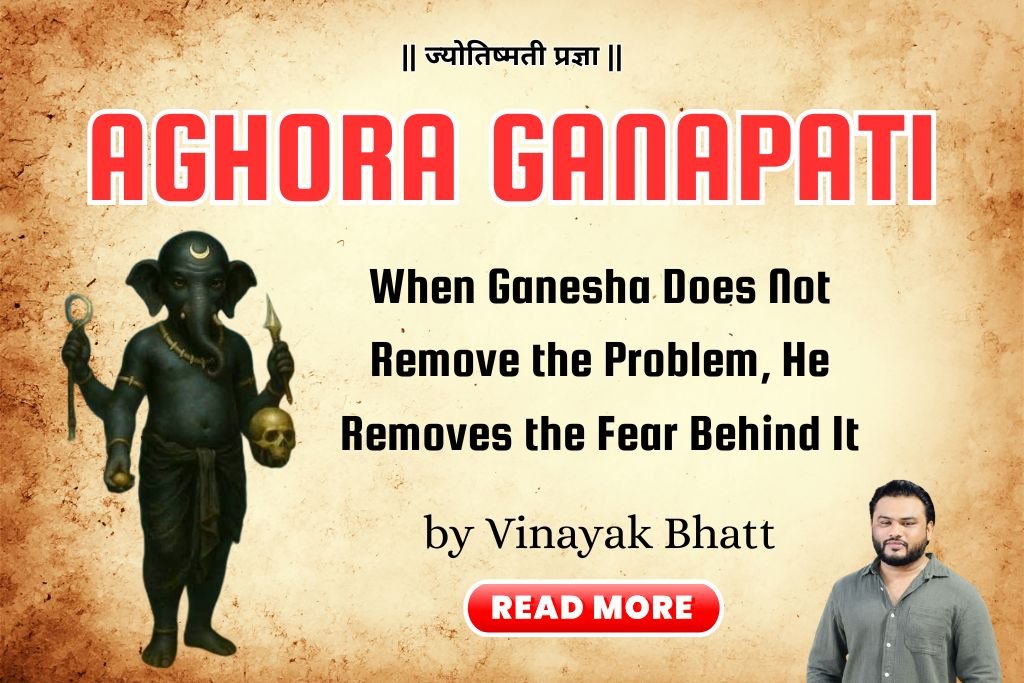
AGHORA GANAPATI – WHEN GANESHA DOES NOT REMOVE THE PROBLEM, HE REMOVES THE FEAR BEHIND IT
Most Jyotish students know Gaṇapati as Vighneśvara, the remover of obstacles. But there is a deeper question: What if the biggest vighna is not outside you? What if the obstacle is the behaviour produced by fear, attachment, memory and identification? This is where the symbolism of Aghora Ganapati becomes extremely interesting for a Jyotishi.
“Aghora” should not immediately be translated as frightening, dark or dangerous. A-ghora literally points towards that which is not terrible. And this gives us a beautiful spiritual paradox. A form may appear intense because it is confronting something which we ourselves are afraid to see. So Aghora is not necessarily about creating fear. It is about reaching that state where the thing which controlled you through fear no longer controls you.
Now apply this to Jyotish. Suppose Saturn is creating pressure. Ordinary thinking says, “Please remove Saturn’s problem.” Aghora thinking asks, “Why does pressure frighten you so much?” Suppose Mars brings conflict. Instead of only asking for the enemy to disappear, we ask, “What inside me reacts before wisdom gets a chance to speak?” Suppose Rahu creates obsession. Instead of only asking Rahu to become favourable, we ask, “Why does my mind require this object, recognition or experience so badly?” Suddenly Jyotish moves from event prediction into the anatomy of karma.
This is why Gaṇapati symbolism is far more profound than “remove obstacles before starting work.” An obstacle sometimes protects us. An obstacle sometimes redirects us. And sometimes the obstacle repeatedly comes because our method of responding to it has not changed. The same relationship pattern, same financial mistake, same anger, same fear of authority, same need for approval, same professional crisis – different people and different years, but almost the same inner story.
Now look at Ketu. Ketu can show old patterns, cutting, disconnection and areas where the ordinary worldly logic does not function smoothly. Rahu can magnify hunger. Saturn can crystallise fear and repetition. Mars can turn that pattern into immediate reaction. Moon can make it emotionally habitual. If these grahas become strongly connected in a chart, do not merely predict “difficult period.” Ask the client something more important: “What do you repeatedly do when you become afraid?”
That one question can expose half the horoscope.
A person with strong Saturnian fear may postpone everything until circumstances force action. Another person may become excessively controlling because uncertainty frightens him. A Mars-dominated person may attack before being attacked. A Rahu-dominated person may keep increasing ambition because standing still makes him uncomfortable. A Ketu pattern may simply disappear from people, work or relationships whenever emotional intensity becomes too much. The grahas are different, but underneath them may sit one hidden vighna – fear controlling behaviour.
This is where I find the idea of Aghora Ganapati extremely useful for Jyotish contemplation. Ganapati is not merely standing at the door and removing stones from our road. He is also asking, “Who placed this stone here? Why do you keep returning to the same road? And why does the same stone defeat you every time?”
And notice the elephant symbolism. An elephant does not become powerful by nervous movement. It is powerful because its movement has weight. It can remove an obstacle, but it can also simply stand before something without being disturbed by it. This itself is an excellent meditation for Saturn, Mars and Rahu dominated charts: power without panic.
There is another subtle point. Ganapati is associated with buddhi, discrimination and proper beginning. Many karmic mistakes happen because action begins before discrimination. Mars moves. Rahu desires. Moon reacts. Saturn fears. But where was buddhi before the action started? Therefore Ganapati worship, at a philosophical level, is not only “give success to my beginning.” It is also: “Please correct the intelligence from which this beginning is arising.”
Then Aghora takes this one level deeper. Can your intelligence remain clear even when the situation is unpleasant? Can you remain dharmic when somebody insults you? Can you remain balanced when money is lost? Can you avoid becoming desperate when Rahu shows something attractive? Can you remain patient when Saturn delays the result? Can you observe Ketu’s withdrawal without immediately destroying the relationship? That is where spiritual practice begins touching predictive Jyotish.
So perhaps one way of judging a difficult graha is not merely asking, “What event will this planet give?” Ask another question: “What behaviour does this planet repeatedly produce in the native when he is under pressure?” The event may change. The behaviour often repeats. And that repeated behaviour eventually becomes destiny.
This is why remedies without behavioural observation sometimes disappoint people. We perform pūjā for Saturn and continue exactly the same Saturnian fear. We worship Mars and continue fighting unnecessarily. We perform Rahu remedies and continue feeding obsession twenty-four hours a day. We worship Gaṇapati for removal of vighna but protect the psychological pattern which manufactures the vighna again.
For me, this is one of the most beautiful Jyotish meanings hidden inside Aghora Ganapati: Do not merely ask the Divine to make every frightening situation disappear. Ask for the intelligence through which the frightening situation stops ruling you.
Now I want Jyotish students to test this practically. Look at the most troublesome graha in your horoscope – especially Saturn, Mars, Rahu, Ketu or Moon – and do not tell me the event it gave. Tell me the behaviour pattern it creates in you under pressure.
Write in the comments: Lagna + your most difficult Graha + one behaviour you keep repeating because of fear, anger, attachment or withdrawal.
And here is the real research question: Which is the bigger Vighna in a horoscope – the difficult Graha, or the behaviour we have developed around that Graha?
I think the comments on this one can teach us more Jyotish than the post itself.
Jay Guru Dev
Vinayak Bhatt













Leave a Comment
Be the first to comment on this blog!