
Krittika Nakshatra Pada 4: Pending Karma, Rina Anubandha and Predictions from Karma Vipaka Samhita By Vinayak Bhatt
Nakshatra
Krittika Nakshatra Pada 4 gives one of the clearest explanations of Rina Anubandha, the karmic relationship created through unpaid obligation, because the story does not remain at the simple level of a man borrowing money and failing to return it. Karma Vipaka Samhita takes the matter much further and shows that when a financial account remains unfinished, the relationship itself may remain unfinished, so the person to whom something was owed can return through a very close relationship in another birth and recover the value in a completely different form. In this story the creditor does not return as a moneylender standing outside the house; he returns as the borrower’s own son and gradually consumes the father’s wealth from inside the family.
This makes Krittika Nakshatra Pada 4 very different from an ordinary discussion about debt. The text is showing that Rina is not merely an entry in an account book. A financial obligation can become a relationship, a relationship can become an emotional attachment, and an old unpaid amount can return in another form where repayment becomes almost impossible to avoid.
Krittika Pada 4 occupies approximately 6°40′ to 10°00′ Taurus and falls in Pisces Navamsha. Krittika is ruled by the Sun and its Devata is Agni, Taurus is ruled by Venus, while Pisces is ruled by Jupiter. From a Jyotish viewpoint this gives a very meaningful combination because Venus governs value, possessions, agreements and enjoyment, Jupiter governs Dharma, wisdom and progeny, while the Sun and Agni bring the question of purity and right conduct.
The Karma Vipaka story connects exactly these three areas: money is taken, Dharma concerning that money is left incomplete, and the account returns through progeny.
The deeper question of Krittika Nakshatra Pada 4 is therefore not simply, “Will this person have debt?”
The real question is: “Is there any unfinished exchange in which something was received but the rightful return was never completed?”
The Karma Vipaka Story of Krittika Nakshatra Pada 4
Lord Shiva tells Devi about a Brahmin belonging to the Kanyakubja lineage who lived in Mahishmati, situated on the southern bank of the Narmada River. He was described as a devoted Vaishnava, and his name is given as Yodha Sharma or Yodh Sharma in the available English translations, while his wife is called Dhaanavi or Daanvi. Although he was born into a Brahmin family, he earned through buying and selling merchandise and functioned as a trader. A prosperous Vaishya lived there, and Yodha Sharma borrowed a substantial amount of gold from him for his activities. Time passed, Yodha Sharma died, and the borrowed gold remained unpaid.
The text then adds another layer which belongs to the traditional Varna-Dharma framework of the period. It says that Yodha Sharma had moved away from the duties expected of a Brahmin and had taken up Vaishya activity, and this departure from his prescribed Dharma is also treated as part of his karmic error. After death he enters Raurava Naraka, remains in the realm of Yama for twenty thousand years, takes birth first as a bull and then as a pig, and only after exhausting those experiences returns to human birth, where he again possesses wealth and grain.
For a modern reader, this section should not be converted into the crude rule that one profession belongs permanently to one caste and another profession is sinful. That would miss the useful Jyotish principle. The stronger modern meaning is that a person must understand the Dharma, responsibility and ethical rules belonging to the role they actually accept. Yodha Sharma entered trade, borrowed capital and therefore entered a financial obligation, but he did not complete the responsibility created by that transaction. The practical fault which can be carried into modern astrology is therefore not “doing business”; it is entering an obligation and leaving the other party unpaid.
The most important part of the story comes after his return to human birth. Lord Shiva says that because of the previous Rina, the Vaishya who had lent the money was born as Yodha Sharma’s son. The son repeatedly spent his father’s wealth, and the text specifically says that the money was consumed through alcohol and association with prostitutes. When that son reached youth he died, leaving his parents in deep grief, and because of the remaining Karma Vipaka they did not obtain another son.
This is the real karmic key of Krittika Pada 4.
The unpaid creditor entered the family as the person who had a natural right to consume the father’s resources. The father could refuse an outside creditor. He could not so easily refuse his own child. That is Rina Anubandha.
Rina Anubandha: The Most Important Sutra of Krittika Pada 4
Karma Vipaka Samhita contains a separate discussion of different kinds of sons based upon previous karmic relationships, and one of those is explicitly the Rina-related son. The text explains that when a person had taken a loan and failed to repay it in an earlier birth, the creditor may return as a son; that child then repeatedly takes the father’s wealth, spends it and eventually leaves after the account has been settled.
Krittika Nakshatra Pada 4 is therefore one of the strongest padas for teaching students the principle that relationships are not always created only by love, hatred or blood; some relationships are created by accounts.
A person may ask, “Why does my son keep costing me so much money?”
Another may ask, “Why am I financially responsible for this family member even though the relationship is difficult?”
Someone may spend extraordinary amounts on a child’s education, treatment, debts, legal problems, lifestyle or repeated failures and wonder why the financial connection simply refuses to end.
Karma Vipaka gives one possible karmic model: sometimes payment is happening through relationship because direct payment was not completed earlier.
This does not mean that every financially demanding child is a previous-life creditor, nor should an astrologer make such a statement merely because one Graha occupies Krittika Pada 4. The 2nd, 5th, 6th, 8th and 11th houses, Jupiter, relevant Dasha and the Saptamsha should repeat the pattern before making a literal prediction. But when several factors agree, this pada can give a remarkably specific line of enquiry.
I would ask the client whether one child or close family member has consumed a much larger portion of family resources than others, whether money repeatedly goes towards the same person despite the native’s efforts to stop it, or whether the person’s most difficult financial chapter began not through business failure but through someone they deeply love and therefore cannot easily refuse.
That is a much stronger use of Krittika Pada 4 than simply saying “there will be debt.”
The Pending Karma of Krittika Pada 4 Is an Unfinished Exchange
The pending karma of Krittika Nakshatra Pada 4 should not be reduced to borrowing money. Borrowing itself is not wrong. Commerce cannot function without credit, and household life also requires borrowing at certain times. The problem begins when a person receives value with an understanding that it will be returned, gains the benefit from that value, and then allows the obligation to disappear from their own mind even though it has not disappeared from the other person’s account.
The karmic sequence is very precise: something is received, the benefit is enjoyed, repayment is postponed, the giver remains unpaid, death closes the legal account but does not close the karmic account, and the same relationship returns in a form where repayment becomes unavoidable.
This principle can apply far beyond formal bank loans. A person may keep money belonging to a partner. They may not pay an employee’s legitimate dues. They may borrow from a relative and behave as if family money does not need to be returned. They may retain a client’s advance without completing the promised work. They may use another person’s capital to build a business but later deny that person’s contribution. They may hold deposits, commissions, royalties, inheritance shares or partnership funds which properly belong to somebody else.
The legal form changes. The karmic principle does not.
Krittika Pada 4 therefore asks the native to be especially clear about what is mine and what has only come into my hands temporarily.
Why the Creditor Returns as a Son
The choice of the son in this story is not accidental. A child naturally receives resources from the parent. The father pays for food, shelter, education, marriage, health and countless other needs, normally without treating every expenditure as a loan. Therefore, if an old creditor has to recover value through a relationship where the previous debtor cannot keep demanding repayment, becoming the debtor’s child is symbolically perfect.
This is why the text’s teaching on Rina Anubandha is so powerful.
The creditor once said: “You owe me.”
In the next karmic arrangement the father himself says: “This is my child; I have to provide.”
The direction of obligation has reversed and the account can now settle naturally.
This gives a useful predictive sutra for Krittika Nakshatra Pada 4: When the pada strongly connects the 2nd house of accumulated wealth with the 5th house of children and the 6th house of debt, one child may become the channel through which a major financial account is exhausted.
If Jupiter is afflicted and connected with the 6th lord, the native may repeatedly spend on children because of debt, disease, litigation, education or another responsibility. If the 5th lord enters the 2nd or the 2nd lord enters the 5th with strong affliction, family savings can become closely tied to progeny. If the 8th house also participates, sudden expenses, inheritance complications or serious events involving the child can become part of the pattern.
But the source should always remain the seed and the complete horoscope should decide the manifestation.
The Strong Prediction: Your Most Expensive Debt May Not Look Like a Loan
This is one of the most useful consultation predictions from Krittika Pada 4.
If the Moon, Lagna, Atmakaraka, Jupiter, 5th lord, 2nd lord or another highly relevant Graha occupies Krittika Pada 4 and the debt-child axis repeats elsewhere, I would not merely tell the client to avoid bank loans. I would say something more specific: “One important financial account in your life may come through a person rather than through a bank. You may find yourself repeatedly paying for a child, family member, student, partner or dependent, and even when you feel the amount has become excessive, emotionally you may not be able to stop. Treat such situations carefully because your chart connects financial obligation with relationship.”
For another chart the prediction may become: “Do not leave informal loans unresolved, especially money taken from friends, relatives, partners or people who trusted you personally. An unpaid amount can remain attached to the relationship much longer than you expect.”
For a business person: “Be very careful with investor money, customer advances, unpaid vendor dues and capital borrowed privately. Your chart does not favour the attitude that an obligation disappears because the other person has stopped asking.”
For a family horoscope: “One child may require disproportionate financial support compared with the others. Before calling the child irresponsible, study whether the larger karmic pattern is actually showing an old financial account being settled through progeny.”
These predictions come directly from the structure of the Karma Vipaka story, but they become valid only when the houses and Dashas support them.
Taurus and Pisces Navamsha: Money Meets Dharma
Krittika Pada 4 lies in Taurus and falls in Pisces Navamsha. This is one of the most useful Jyotish keys for understanding why the story takes the shape that it does.
Taurus, ruled by Venus, deals with value, accumulated resources, possessions, security, food, comfort and the desire to preserve what one owns. Pisces, ruled by Jupiter, brings Dharma, faith, surrender, compassion and the larger moral account. Jupiter is also the natural Putrakaraka, the significator of children.
Notice how perfectly the story moves through these Karakatwas-
- First comes Taurus: money is borrowed.
- Then comes the moral question: should it be returned?
- Then comes Pisces/Jupiter: the unfinished financial obligation turns into a son.
This does not mean that Pisces itself signifies unpaid debt. It does not. The deeper point is that the Navamsha lord Jupiter connects the material transaction with Dharma and progeny, exactly where the karmic consequence finally appears.
Therefore, Krittika Pada 4 may produce people who are very capable of acquiring resources but who have to learn that every financial transaction also has a moral dimension. Two agreements may look identical on paper, yet karmically they are not always identical. Borrowing from a faceless financial institution is one type of transaction. Borrowing from a person who trusts you, helps you during hardship and gives resources because of relationship creates another layer.
The second creates not only Rina. It can create Anubandha, a bond and this pada is particularly sensitive to that bond.
Sun, Venus and Jupiter in the Krittika Pada 4 Story
Krittika is ruled by the Sun and presided over by Agni. The Sun asks whether the native acts according to an inner principle even when no authority is forcing them. Venus in Taurus asks what value the native places upon wealth and comfort. Jupiter through Pisces Navamsha asks whether money remains subordinate to Dharma.
When these three work well, Krittika Pada 4 can produce somebody who is excellent at handling resources because they understand that financial trust is sacred. They may borrow, invest, lend, trade and build considerable wealth but remain extremely particular about settling accounts.
When the combination becomes distorted, the person may begin thinking that possession itself creates ownership. Money comes into the account, therefore it feels like “my money.”
- A partner contributes capital, but after years pass the native begins forgetting the original contribution.
- A family member lends money without paperwork, so repayment becomes less urgent.
- A customer pays in advance, but the native uses the money elsewhere before completing the work.
The central Krittika Pada 4 correction is therefore extremely simple: Do not allow time to change the ownership of somebody else’s money in your mind.
If it was borrowed yesterday, it remains borrowed ten years later until it is returned or properly settled.
Agni and the Purification of Financial Karma
Agni, the Devata of Krittika, is important here because Agni separates, purifies and transforms. In a Yajna, something is placed into the fire and cannot be taken back in its previous form. The unresolved debt of Yodha Sharma works in the opposite manner: he received something but never completed the exchange. Therefore, the remedial structure includes Homa and extensive Dana.
The account must move again. What was retained must begin to circulate. What was consumed privately must be balanced through something useful beyond the self.
The classical remedy even asks the native to create public utility in the form of a garden or Dharamshala for travellers and wells, ponds or reservoirs.
This is a very meaningful correction.
The original karma says: “I received somebody else’s resource and kept its benefit.”
The corrective karma says: “I will use my own resource to create benefit for people from whom I may receive nothing in return.”
That is the reversal of the samskara.
Why the Dharamshala and Water Source Matter
The Prayaschitta for Krittika Nakshatra Pada 4 is unusually practical. The text does not restrict correction to mantra alone. It tells the native to create a garden or resting place beside a traveller’s path and to construct wells, ponds or other water sources. This is important because the original wrongdoing concerns an unfinished private exchange. The remedy creates a completed public offering.
- A traveller drinks water and owes you nothing.
- A stranger rests in the Dharamshala and you do not demand repayment.
A public water source continues giving after the donor has left. The karma of “I took but did not return” is replaced by “I give without asking for return.” That is far deeper than mechanical charity.
One modern commentary makes this practical by suggesting that where personally constructing a Dharamshala or well is unrealistic, the native can contribute according to capacity towards such work, including water reservoirs, borewell recharge or similar useful projects. For modern life, this is one of the most sensible ways to understand the remedy.
Krittika Pada 4 and Children
The source is strongly son-centric, as many older ritual texts are, but this should not be translated into the idea that daughters are inferior or that every Krittika Pada 4 native must experience childlessness. It should be noted that the text’s son-centric language belongs to its older social setting and should be interpreted prudently in modern practice.
The real Jyotish principle is progeny and continuity.
When the 5th house, fifth lord, Jupiter and Saptamsha support the difficult side of this pada, the native may face delayed conception, repeated worry regarding children, heavy expenditure on children, separation, a child who becomes difficult to manage, or a child through whom old financial karma becomes active.
Where these factors are strong, the literal negative result may not occur at all. The Rina pattern may instead appear through a student, business successor, nephew, employee or another person whom the native treats almost like a child.
- For a teacher, for example, one student may repeatedly require free support, money, recommendation, employment or rescue from difficulty.
- For a business owner, a younger successor may consume resources created by the previous generation.
- For a family with inherited business, the next generation may spend the capital which the elder generation accumulated.
So the 5th-house meaning should remain broad until the horoscope narrows it.
The Son Who Consumes Wealth Is Not Simply a “Bad Child”
This is perhaps the most mature part of the Karma Vipaka teaching.
From the parent’s viewpoint, the son in the story appears destructive. He spends the father’s wealth on alcohol and women and dies young. It is easy to call him the cause of suffering. But Karma Vipaka changes the observer’s viewpoint.
- The son was previously the creditor.
- The father was previously the debtor.
Now the same financial flow looks completely different.
What appears to the father as “my son wasting my money” can be read karmically as “the creditor recovering what was previously left unpaid.” This is why Jyotish cannot judge an event only from one person’s emotional viewpoint. The same event can simultaneously be loss for one person and settlement for another.
This gives Krittika Pada 4 a very useful teaching for counselling: Before asking why somebody is taking so much from you, sometimes ask what unfinished exchange may have created such a powerful obligation between the two of you.
We cannot prove a specific previous-life story, so this should not be used to blame the native or the child. Its value lies in changing the behaviour now: settle accounts correctly, remove resentment where possible, create clear boundaries and stop generating a new cycle of unpaid obligations.
How the Karmic Pattern Can Manifest Without Literal Debt
Krittika Nakshatra Pada 4 can also operate through non-financial exchange because Rina is wider than money. Somebody may have received years of support but never acknowledged it. A person may have taken another person’s labour without fair payment. A teacher may have built status using a student’s research without giving credit. A businessperson may have used a partner’s contacts and then pushed the partner aside. A family member may have taken care of elderly parents while another sibling enjoyed the property without carrying the responsibility.
The underlying formula remains: benefit received + rightful return withheld = unfinished relationship.
In another cycle the same person may find that others receive disproportionate benefit from their own time, money, work or reputation. Again, this should not create superstition.
Its practical use is straightforward-
- When you receive genuine value, complete the exchange properly.
- Pay money.
- Give credit.
- Return property.
- Honour promises.
- Acknowledge contribution.
- Settle inheritance fairly.
- Do not force another person to keep carrying an unpaid account in their mind.
Krittika Pada 4 and Business Karma
Because the original story directly involves trade, gold and credit, this pada deserves special attention in charts of business owners, traders, financiers, advisers and people who regularly work with other people’s capital.
A strong Krittika Pada 4 does not mean the native should avoid business. On the contrary, Taurus can have considerable financial capacity. But transactions must remain clean.
If Mercury, Venus and the 7th or 10th lord support the pada, business itself can be successful. If Jupiter is strong, the native can become trusted precisely because of ethical dealing. If the 2nd and 11th houses are strong, accumulation can be considerable.
The warning appears when the 6th, 8th or 12th houses heavily afflict the same configuration. Then credit may become difficult. Loans can remain unresolved. Partners may claim unpaid amounts. Clients may delay payment to the native, creating a reversal of the old pattern. The native may repeatedly recover only part of what others owe them. Or a business may earn very well while cash continuously disappears through family obligations. The chart decides which side becomes visible.
Karma Can Reverse the Role
One of the most useful ways to teach Karma Vipaka is to understand that the native does not always repeat the previous-life role exactly. A previous debtor may become a present creditor.
- Someone who once failed to pay others may now repeatedly experience delayed payments.
- A person who ignored another person’s legitimate claim may spend years fighting to recover their own dues.
- Someone who casually borrowed from relatives may now become the relative whom everyone approaches for loans.
This is not stated as an automatic rule in the Krittika chapter, but it is a reasonable Jyotish application of the karmic structure.
Therefore, when Krittika Pada 4 is heavily activated, I would examine both sides of money flow.
- Is the native always borrowing?
- Or are others always borrowing from them?
- Does money go out and never return?
- Does the native repeatedly become the guarantor?
- Does family obligation prevent financial accumulation?
- Does one client owe a large amount?
- Does a business partner consume more than their contribution?
The common factor is not simply debt. It is unfinished exchange.
Krittika Pada 4 and Health
The Krittika Pada 4 chapter concludes that the prescribed Prayaschitta removes disease, while one modern commentary reads recurring ailments and difficulty concerning childbirth as possible present-life consequences connected with the chapter. The broader Krittika material also associates the Nakshatra with possible problems involving heat, cuts, throat or neck, digestion and other Agni-related disturbances, but these indications are expressly meant to be synchronised with planetary and house affliction rather than used independently.
Therefore, the responsible prediction is not to attach one disease automatically to Krittika Pada 4. Instead, examine Lagna and Lagnesha, Sun, Venus, Jupiter, the 6th and 8th houses and the relevant Dasha.
A more subtle psychological connection is also possible. Financial debt can create chronic worry, and a long unresolved obligation can remain in the mind for years. The person may appear materially comfortable while internally carrying fear of repayment, guilt, pressure or conflict. If the Moon and Saturn also participate, the financial issue can become a long mental burden.
Again, this is a Jyotish inference, not a literal medical statement from the text.
The Higher Side of Krittika Nakshatra Pada 4
Karma Vipaka should never be studied only through punishment. Every difficult pattern contains its corrected form.
- The lower expression of Krittika Pada 4 receives value and does not complete the exchange.
- The higher expression becomes the person whose word can be trusted completely.
Such a native can become extremely disciplined with accounts, promises and commitments. They may repay loans earlier than required, refuse to mix personal and business money, maintain transparent partnerships and insist that employees, vendors and contributors receive what is due to them, and because Pisces Navamsha brings Jupiter, the higher native may gradually move beyond ordinary transaction into generosity. They understand the difference between repayment and Dana.
- Repayment means returning what belongs to somebody else.
- Dana begins only after repayment.
This distinction is crucial.
A person cannot keep ₹1 lakh belonging to someone and then donate ₹10,000 elsewhere and imagine the karmic account is purified.
- First settle Rina.
- Then perform Dana.
That may be the most practical teaching hidden inside Krittika Nakshatra Pada 4.
Traditional Remedies for Krittika Nakshatra Pada 4
The parallel source versions prescribe one lakh repetitions of the Gayatri Mantra for purification of the previous karma. They then instruct the native to establish a garden, Vatika or Dharamshala along a travellers’ route, construct wells, ponds, reservoirs or other water facilities, perform Homa according to proper procedure, donate five Pala of gold, donate cows of different colours decorated appropriately, feed one hundred Brahmins and give Dakshina or gold according to capacity. The concluding verses state that disease is removed and the line of sons and grandsons prospers.
One modern commentary, adds a useful practical clarification that donations should be made according to one’s means, that one may support an existing Dharamshala or water project rather than personally constructing one, and that traditional cow donation can be adapted symbolically where literal Go-Dana is not practical. The text also advises that formal Japa and Purashcharana procedures should be learnt correctly from a competent family Pandit or ritual practitioner.
The exact ritual should therefore not be improvised merely from an article, especially when large Japa counts, Homa and formal Dana are involved.
But the inner logic is unmistakable.
- The previous karma retained what should have been returned.
- The remedy creates giving.
- The previous transaction benefited one household.
- The remedy creates water and shelter for many households.
- The previous wealth became an unfinished personal account.
- The remedy converts wealth into Punya.
The Most Important Practical Remedy: Close Old Accounts
Before performing any elaborate ritual, the simplest living remedy for Krittika Nakshatra Pada 4 is to examine whether there is any real unpaid account in the present life.
- Money borrowed from relatives should be returned.
- Old employee dues should be cleared.
- Vendor payments should not be deliberately delayed merely because the vendor is weak.
- Client refunds should not be avoided.
- Shared property should be divided fairly.
- If a partner invested capital, the contribution should be acknowledged accurately.
- If repayment is genuinely impossible, speak openly and create a realistic settlement rather than disappearing from the obligation.
This is not a substitute for the traditional Prayaschitta. It is the behavioural correction which makes the Prayaschitta meaningful. There is little purpose in chanting one lakh Gayatri while continuing to hold somebody else’s money without justification. The mantra purifies the mind and the corrected action proves that the mind has actually changed.
A Powerful Practical Remedy for Teachers and Astrologers
For teachers, counsellors and astrologers, the principle can operate in another form.
- Do not take fees for work you know you cannot deliver.
- If a student pays for a promised course, complete the teaching.
- If research belongs to another scholar, acknowledge the source.
- If somebody gives you rare material in trust, do not claim it as your own work.
- If a client accidentally overpays, return the excess.
These may look like small matters, but Krittika Pada 4 teaches that a small unfinished account can preserve a relationship much longer than expected, and for a Jyotish teacher this is particularly important because Jupiter becomes the Navamsha lord of this pada. Knowledge, money and Dharma must remain connected properly.
How to Confirm Krittika Pada 4 in the Horoscope
Karma Vipaka gives the story, but Jyotish has to determine where the story actually manifests.
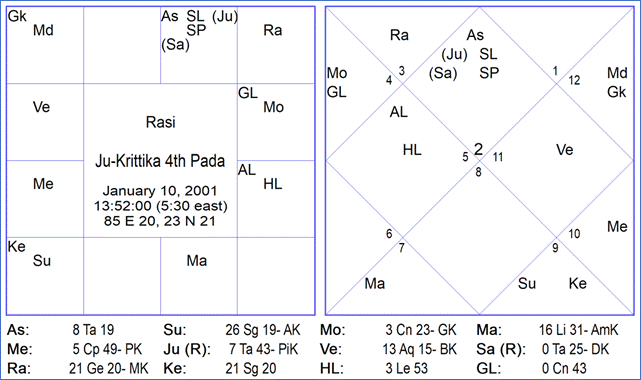
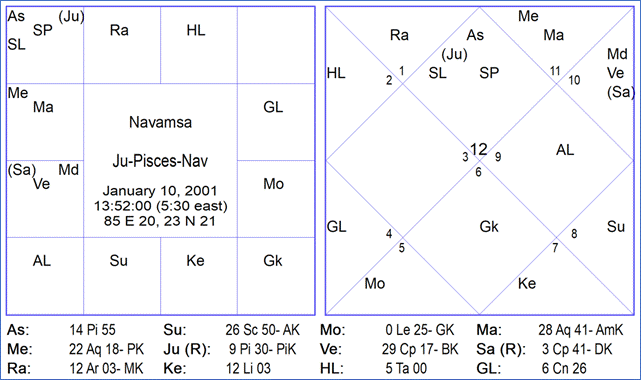
The 2nd house and its lord show accumulated family wealth and the resources which can be consumed. The 6th house is fundamental because it governs Rina, debt and obligation. The 5th house and Jupiter show children, Purva Punya and continuity, making them especially important because the creditor in the classical story returns as a son. The 7th house should be examined when loans involve trade, contracts or partners, while the 8th house becomes important for unpaid financial obligations, sudden financial consequences and inherited or shared resources. The 11th house shows large gains, fulfilment and networks, while the 12th house reveals expenditure and loss.
Sun, Venus and Jupiter become particularly important for this pada. The Sun is the Nakshatra lord, Venus owns Taurus, and Jupiter owns the Pisces Navamsha.
If the 2nd, 5th and 6th houses strongly connect with Krittika Pada 4, the financial-progeny interpretation becomes much stronger. If the 7th and 8th join the pattern, business partnership or borrowed capital can become central.
- If Jupiter is badly afflicted, the karmic account may come strongly through children or Guru-Dharma.
- If Venus is afflicted, possession, luxury or the inability to release money can become part of the issue.
- If the Sun is weak, the native may know an obligation exists but repeatedly postpone doing what is right.
- If Mercury joins, contracts, accounts, documentation and commercial dealings become important.
- Saturn can extend repayment over many years.
- Mars can create conflict over money.
- Rahu can complicate loans, unclear agreements or excessive financial appetite.
- Ketu can produce detachment from practical accounting or sudden severance from a financial relationship.
None of these should be read separately. The prediction becomes strong when several factors tell the same story.
Dasha and the Activation of Debt Karma
The Rina Anubandha shown by Krittika Pada 4 may remain quiet for years and become visible only in the Dasha connected with the relevant houses.
- A Dasha of the 6th lord can activate borrowing, repayment or disputes over money.
- A 5th-lord period can bring the account through children.
- A 2nd-lord period can make family savings the main issue. Jupiter’s period may activate children and Dharma, while Venus can activate money and consumption. The Dasha of the planet actually occupying Krittika Pada 4 can awaken the entire narrative through that planet’s Karakatwa.
Suppose Mercury occupies Krittika Pada 4 and rules the 2nd and 5th houses. The story may awaken through business accounts and a child’s expenditure.
Suppose Jupiter occupies the pada and rules the 6th. Rina and progeny can become very tightly connected.
Suppose Venus occupies it and also rules the Lagna. The native’s own attitude towards accumulation, comfort and repayment may become the main karmic test.
This is how Karma Vipaka becomes predictive rather than remaining a past-life story.
The Deepest Lesson of Krittika Pada 4
Krittika Nakshatra Pada 4 gives a lesson which is simple enough for anybody to understand but deep enough to change how we read relationships: Not every person who takes from us is necessarily taking something that was always ours.
Sometimes a relationship itself may be an account.
The son in Yodha Sharma’s later life appears to destroy his father’s wealth, but Karma Vipaka tells us that the son was once the person whose wealth the father had failed to return. Suddenly the story changes. The son is no longer merely the spender and the father is no longer merely the victim. Both are completing an old exchange.
This is why Rina Anubandha is one of the most important ideas for understanding difficult family relationships in Jyotish. It does not mean that parents should tolerate abuse, addiction or irresponsible behaviour. It means that the astrologer should avoid shallow moral judgement and look for the deeper pattern of exchange, obligation and settlement.
Krittika’s Agni finally asks for purification.
- Taurus asks, “What do you possess?”
- Pisces asks, “What is actually yours to possess?”
Venus asks about value. Jupiter asks about Dharma. The Sun asks whether you will do what is right even when nobody can force you.
And Karma Vipaka asks the most practical question of all: “Have you returned what you once received?”
The main predictive sutra for Krittika Nakshatra Pada 4 can therefore be stated in this way: When Krittika Pada 4 is strongly connected with wealth, debt and progeny factors, an unfinished financial obligation can return through a close relationship, especially through someone whom the native is emotionally compelled to support. The safest path is to keep financial accounts clean, repay what is due and never treat another person’s trust as free capital.
And the shorter Karma Vipaka sutra is: “An unpaid debt may leave the account book, but it may enter the family tree.”
That is the deeper meaning of Krittika Nakshatra Pada 4, Rina Anubandha, pending karma and predictions from Karma Vipaka Samhita.
To Join Karma Vipaka Course click here







![Shri H. N. Katwe: Secrets of Sun [Predictive Techniques Related to Sun]](https://vedicgrace.com/wp-content/uploads/2025/11/Shri-H.-N.-Katwe-Secrets-of-Sun-300x214.png)


Leave a Comment
Be the first to comment on this blog!