
Krittika Nakshatra Pada 3: Pending Karma and Predictions from Karma Vipaka Samhita By Vinayak Bhatt
Karma Vipaka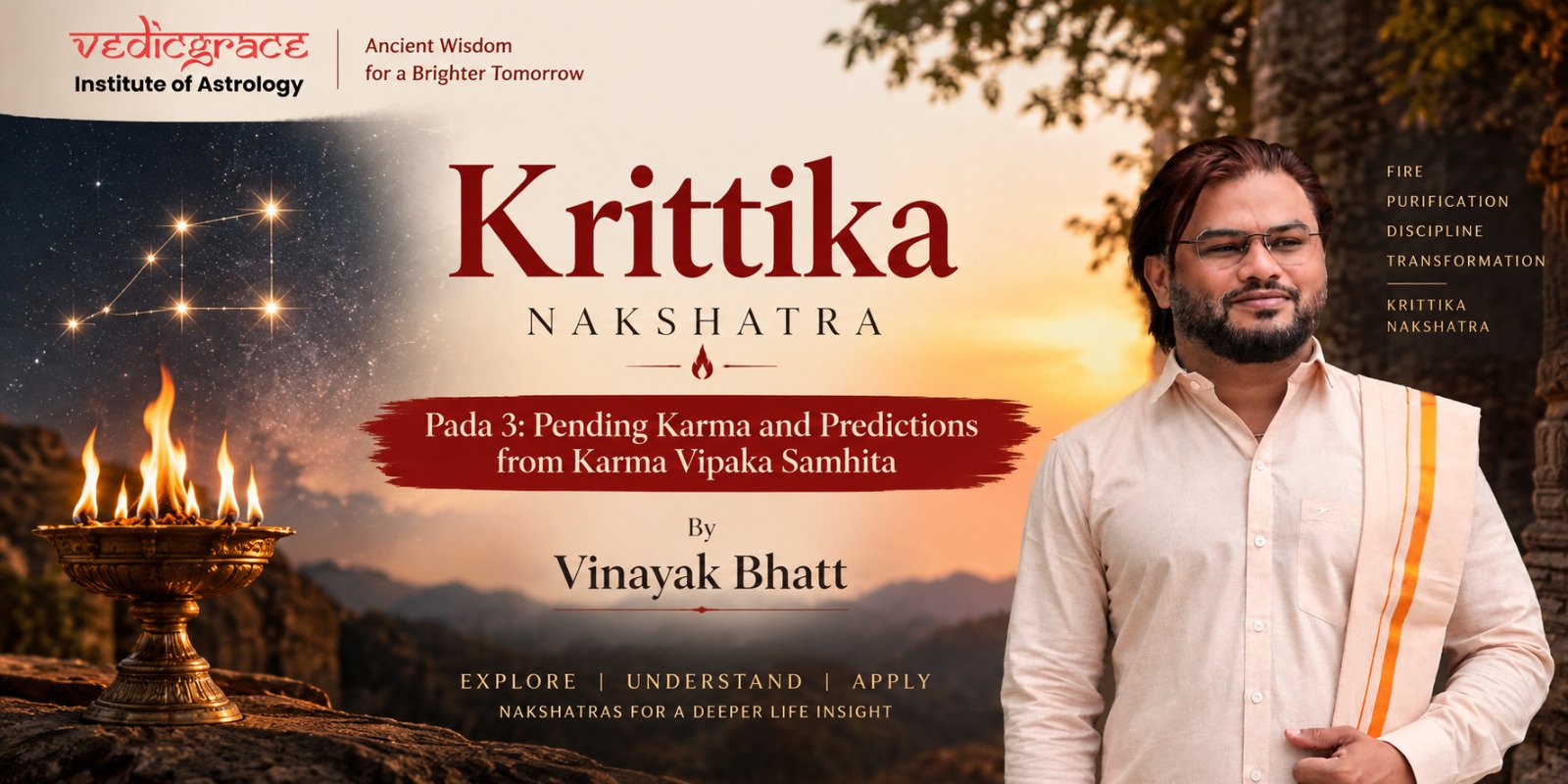
Krittika Nakshatra Pada 3 gives a particularly subtle lesson because the previous-life person does not begin as greedy, corrupt or careless. He begins as a poor Brahmin deeply engaged in Vedic recitation, and his real karmic difficulty begins only after poverty suddenly disappears. This makes the story especially relevant because poverty can test character, but prosperity can test character in a completely different way. A person may remain disciplined when there is very little choice, work sincerely when survival demands it and remain close to learning or spiritual practice because that is the only stable centre of life, yet once substantial money arrives, the same person may slowly change their routine, values, relationships and priorities without even noticing when the original path was left behind.
This is the central theme of Krittika Nakshatra Pada 3 according to Karma Vipaka Samhita. The question is not merely whether wealth will come, because in the story wealth comes in abundance; the more important question is what happens after the wealth arrives.
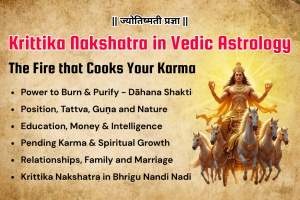
Krittika Pada 3 occupies approximately 3°20′ to 6°40′ Taurus and falls in Aquarius Navamsha. Krittika is ruled by the Sun and its Devata is Agni, Taurus is ruled by Venus, while Aquarius is ruled by Saturn in classical Jyotish. This produces a very meaningful combination: the Sun represents principle, knowledge, clarity and personal integrity; Venus brings wealth, comfort and material enjoyment; Saturn introduces duty, responsibility and the wider social order; Taurus wants to retain what has been acquired, while Aquarius asks how individual resources connect with society and the larger collective. Agni stands behind all of them as the principle which tests, purifies and transforms whatever is placed into the fire.
The Karma Vipaka story therefore gives us a powerful karmic question: when prosperity enters the life of a person who already has knowledge, does wealth support Dharma, or does wealth slowly replace Dharma?
The Karma Vipaka Story of Krittika Pada 3
Lord Shiva begins the Krittika third-pada narrative by telling Parvati about UdyotaSharma, a Brahmin of Kanyakubja lineage who lived in Suryapur. His wife is named Girija in the available material and is also described through the word Karkasha, meaning harsh or hard-spoken, because she regularly spoke to him with severity. Udyota Sharma himself was continuously engaged in Veda Patha, but despite his learning and religious discipline he lived in considerable poverty.
Then a very unusual event changes the direction of his life. During a solar eclipse, an oilman or oil merchant came there and gave Udyota Sharma an enormous donation, described in the translations as one lakh or lakhs of gold coins, and the donation was given in the middle of the Ganga River. The Brahmin accepted the wealth, returned home and began using it with his wife and family. Gradually the Vedic recitation which had shaped his earlier life was left behind, while the household began enjoying the wealth.
The text then gives the central fault very clearly. Udyota Sharma became attached to the gold and did not donate any portion of it further. One commentary specifically reads this as an important karmic point: when a Brahmin receives wealth through Dana, particularly wealth obtained without ordinary labour, it should not become purely personal consumption; some part should return towards Punya Karma, Dharma or service. He also notes that becoming wealthy should not cause the native to leave spiritual or Dharmic practice.
Udyota Sharma eventually died and suffered in a terrible hell for one Yuga, followed by births described as a crow and then a jackal before returning to human birth. The important part, however, is what happens after he becomes human again. Karma Vipaka does not say that everything from the previous life was sinful. Udyota Sharma had taught the Vedas, and because that work was Punya, he became prosperous and honoured in the later human birth. But the karmic account connected with greed and abandonment of Dharma also remained active. In that later life his wife died, then his son died, he married again, diseases troubled his body, happiness remained disturbed, and in old age the son from the later marriage could become his enemy or the wife’s children might not survive.
This gives us the real structure of Krittika Pada 3: knowledge created Punya and therefore prosperity returned, but wealth without circulation and wealth that displaced Dharma created another result which appeared through family continuity, relationship and health.
What Is the Pending Karma of Krittika Pada 3?
The pending karma of Krittika Pada 3 is not simply receiving a large donation, because receiving Dana is not condemned throughout the Karma Vipaka tradition. Nor is wealth itself treated as sinful. The deeper problem is that sudden prosperity changed the person’s relationship with both Dharma and circulation. Something which arrived through a sacred circumstance became absorbed completely into personal and family consumption, and the Vedic discipline which had previously structured the person’s life gradually disappeared.
This gives us one of the strongest sutras for this pada: When wealth enters because of your knowledge, merit, reputation or grace, do not let the wealth destroy the very source from which it came.
This is extremely relevant today. A teacher may begin with great love for teaching, then become successful and spend most of their energy selling courses rather than studying or teaching. An astrologer may begin with sincere Jyotish research and gradually become more interested in monetising fear than improving knowledge. A writer may spend years developing real scholarship, gain sudden recognition and then stop doing the difficult study which produced that recognition. A spiritual teacher may build an institution around Sadhana, but after money and status arrive the institution may remain while the Sadhana quietly disappears.
The problem in each case is not success. The problem is success disconnecting the person from the root of success. That is the karmic doorway of Krittika Pada 3.
The Solar Eclipse Is a Major Symbol in the Story
One of the most striking details in the story is that the gold arrives during a solar eclipse. This can be read simply as part of the ritual setting of the text, but from a Jyotish viewpoint it gives a remarkable symbolic layer because Krittika itself is ruled by the Sun.
This should be understood as Jyotish interpretation rather than a direct statement made by Karma Vipaka Samhita.
At the exact moment when Surya is eclipsed, gold enters Udyota Sharma’s life. In Jyotish, gold also carries a strong solar association, so outwardly the person receives something solar and brilliant, but inwardly the Surya principle of clarity, discipline and Dharma becomes obscured. Soon after, the Veda Patha is abandoned. The symbolism is very sharp. He receives the metal of the Sun while losing the light of the Sun. The outer gold increases. The inner Surya weakens.
This gives us a powerful predictive understanding of Krittika Pada 3: the native may sometimes receive an opportunity which looks unquestionably beneficial—money, recognition, status, sponsorship, patronage or rapid expansion—but the real test is whether accepting and enjoying that opportunity quietly eclipses the person’s original purpose.
This is why Krittika, ruled by Agni and Surya, must repeatedly ask not only, “What have I gained?” but also, “What became dim inside me after I gained it?”
The Oilman, Saturn and Aquarius Navamsha
Another striking feature is the identity of the donor. One translation describe him as an oilman, while one modern Shiv govind rendering uses the more general word merchant. The oilman reading is especially interesting from a Jyotish perspective because oil has a strong traditional association with Saturn, while Krittika Pada 3 falls in Saturn-ruled Aquarius Navamsha.
Again, this is interpretive decoding rather than a statement made explicitly by the source.
A Sun-ruled Nakshatra receives sudden gold during a solar eclipse from a Saturn-associated occupational figure, and the pada itself falls in Saturn’s Aquarius Navamsha. This creates an interesting Sun-Saturn tension between personal brilliance and social responsibility, between individual enjoyment and what must be returned to the collective.
Taurus says: “I have received something valuable; let me keep it.”
Aquarius asks: “What part of this value must circulate beyond me?”
Udyota Sharma accepts the wealth and keeps the benefit almost entirely inside the household. The remedial section later moves strongly in the opposite direction through Dana, Harivamsha, land, bed or cattle donation according to the version, and Homa.
This suggests that Krittika Pada 3 has to learn the Dharma of circulation.
- Wealth which comes in should not become stagnant.
- Knowledge which comes in should be taught.
- Opportunity which comes in should create opportunity for others.
- Recognition should support further work.
- A large gain should create some Punya outside the self.
The higher Aquarius Navamsha does not demand poverty; it demands responsibility beyond personal possession.
Taurus Wants to Keep, Aquarius Wants to Distribute
The combination of Taurus Rashi and Aquarius Navamsha gives us perhaps the clearest psychological key to this pada. Taurus is fixed earth and naturally seeks security, accumulation and preservation. There is nothing wrong with that; without Taurus, wealth cannot become stable. Aquarius, however, is fixed air and belongs to the larger social field, networks, communities and structures extending beyond the individual household.
Krittika Pada 3 therefore sits between two valid needs: preserve enough to create stability, but circulate enough to prevent prosperity from becoming spiritually closed.
When the balance is lost towards Taurus, the person may accumulate money, knowledge, contacts, students or influence but become increasingly possessive about them. When the Aquarius principle matures, the same person can create scholarships, institutions, research foundations, community resources, publications, teaching networks or systems through which their knowledge and wealth continue benefiting people beyond the immediate family.
This is why charity in the Krittika Pada 3 story should not be understood merely as “give money because wealth is bad.” The deeper teaching is that resources should continue moving according to Dharma.
The lower pattern says: “I suffered without money; now that I have it, I will never let it go.”
The higher pattern says: “I know what scarcity feels like; therefore my prosperity should create stability for me and usefulness for others.”
That is a much more mature expression of Taurus and Aquarius together.
How Krittika Pada 3 Can Manifest in Present Life
When the Moon, Lagna, Atmakaraka or another important Graha occupies Krittika Nakshatra Pada 3, I would examine whether the person’s major turning points occur after financial improvement rather than during hardship. The native may be extremely disciplined while struggling, but once security appears, habits can become looser, spiritual practice may reduce, learning may stop or relationships with teachers may weaken because the urgency which previously drove discipline is gone.
This is a very practical prediction because many people imagine that money solves the problem shown by poverty. Krittika Pada 3 suggests that sometimes poverty and prosperity are simply two different examinations.
- During poverty the test is endurance.
- During prosperity the test is remembrance.
Can you remember what mattered before success arrived?
The pada can also give a real ability to earn through knowledge, teaching, education, advising, scripture, specialised skill or a respected position, because the source specifically says that Udyota Sharma’s earlier work of teaching Vedas later produced prosperity and respect. This is therefore not fundamentally a “poverty pada.” In fact, the karmic story suggests a person who can move from scarcity to abundance and whose knowledge itself may become a source of material improvement.
The stronger prediction is that earning from knowledge is favourable, but abandoning knowledge after earning begins creates the problem.
The Strong Prediction: The Real Test Begins After the Breakthrough
A useful consultation-level prediction for Krittika Pada 3 can be:
“Your chart can give a major improvement through knowledge, teaching, a patron, institution, network or sudden financial opportunity, but your karmic test starts after the breakthrough. You should not stop the discipline which created your success simply because the success has already arrived.”
For a teacher or astrologer, I may say:
“Your knowledge can itself become wealth, but the moment commercial activity becomes larger than study and teaching, the same success which lifted you can begin disturbing another part of life.”
For a businessman or professional:
“A sudden inflow, investor, large client, inheritance, bonus or financial jump can change your lifestyle quickly. Keep a fixed part of the gain directed towards long-term purpose, learning, charity or institution-building rather than allowing every increase in income to become an increase in consumption.”
If Saturn strongly afflicts the pada, scarcity-consciousness may remain even after the native becomes wealthy, making it difficult to give or share. If Venus is heavily afflicted, comfort and pleasure can become more compelling after prosperity arrives. If the Sun is weak, the person may lose clarity about identity and purpose. If Jupiter is strong, wisdom may help the native preserve Dharma while still enjoying material success.
Krittika Pada 3 and the Karma of Abandoning One’s Practice
One of the most important lines in the story says that Udyota Sharma left the Veda Patha after becoming wealthy. This gives the pada a theme which extends beyond money.
- The native can have a tendency to abandon the discipline once the immediate objective has been achieved.
- A student studies intensely to pass an examination and never studies the subject seriously again.
- A person meditates regularly during a crisis and abandons meditation once life improves.
- An astrologer researches deeply while trying to establish a reputation and stops researching after becoming famous.
- A businessman personally watches every detail while the business is small but stops maintaining standards after growth.
- A person follows strict health discipline until the illness improves and then immediately returns to the old lifestyle.
The common pattern is: the practice was treated as a means to an end rather than becoming part of life.
Krittika Pada 3 has to convert temporary discipline into sustained Dharma.
This is where Saturn becomes important. Aquarius Navamsha requires structure. A practice should continue not only while motivation is high but because it has become part of the person’s order of life.
Harsh Domestic Pressure and the Search for Security
The source also describes Udyota Sharma’s wife as harsh-spoken while the family was living in poverty. We should not use this to blame the wife for his later choices, because the text does not say she caused his greed or forced him to abandon the Vedas. But the detail gives us an important picture of the psychological environment surrounding the sudden wealth.
Poverty was not merely financial. It was affecting peace inside the house. Then a huge amount of money suddenly appeared. For somebody who has lived through scarcity, the temptation to use every part of a windfall for family comfort can be very strong.
This makes the Karma Vipaka story psychologically realistic.
The person may tell himself:
- “My family suffered enough.”
- “My spouse tolerated poverty for years.”
- “Now we should enjoy.”
There is nothing wrong with improving family life.
The problem begins only when relief becomes complete abandonment of Dharma and no portion of the gain returns towards the source, community or sacred purpose.
For modern Jyotish, this means that family pressure for security can become an important part of the Krittika Pada 3 financial test, especially when the 2nd, 4th, 7th and 11th houses connect with Venus and Saturn.
The Most Important Wealth Sutra: Do Not Consume the Seed
Udyota Sharma becomes prosperous through a combination of past learning and sudden Dana, but he begins consuming the wealth rather than using it to strengthen the source of knowledge.
This gives us a useful modern financial and karmic principle: Do not consume the seed which created the fruit.
- If teaching produced income, reinvest in study, books, research and students.
- If business produced wealth, strengthen the systems and people which created the business.
- If a family asset produced income, preserve the asset rather than spending everything it generates.
- If a reputation created opportunity, continue the work which earned that reputation.
- If spiritual knowledge brought followers, deepen the Sadhana rather than only expanding the audience.
This is where Krittika’s Agni becomes important. Fire consumes, but Yajna fire also converts an offering into something which moves upward and outward. Wealth used only for consumption resembles ordinary fire; wealth placed partly into Dharma becomes Yajna.
Punya and Papa Operate at the Same Time
Krittika Pada 3 gives a particularly useful teaching about mixed karma because Udyota Sharma is not presented as somebody whose whole life becomes sinful after receiving gold. He had already created genuine Punya through teaching Vedas, and the text says that this merit later gives him prosperity and honour when he returns to human birth.
At the same time, the greed connected with the donation and the abandonment of Dharma produce their own result.
So in the later human life we see both:
- prosperity and suffering,
- honour and family difficulty,
- knowledge-based merit and disease,
- material success and disturbed happiness.
This is much closer to actual horoscope experience than the simple idea that good karma gives a completely good life while bad karma gives a completely bad one.
- A person can be wealthy because of one Punya.
- Child-related difficulty can arise from another karma.
- A good career can coexist with a difficult marriage.
- Strong spiritual merit can coexist with one unresolved financial samskara.
Jyotish separates these streams through houses, Karakas and Dashas. This is why the complete horoscope must always be read before the Karma Vipaka story is applied literally.
Family Karma: Wife, Son and the Cost of Misplaced Priority
The later-life results described in the source are strong. The wife dies, then the son dies, the native marries again, his body suffers from different diseases and he does not experience stable happiness. In old age the son connected with the second marriage may become a strong enemy, or continuity through the wife’s children remains disturbed.
These statements should not be turned into automatic predictions that every Krittika Pada 3 native will lose a spouse or child.
The deeper symbolic point is that wealth which was used almost entirely for the household did not ultimately guarantee household happiness.
That is a very important karmic irony.
Udyota Sharma abandoned his practice partly after material security entered the family, yet in the later cycle the difficult result comes through the same family field.
This gives a practical sutra: Do not sacrifice the source of Dharma in the belief that material security alone can protect the family.
- Money is necessary. But money cannot replace right conduct, knowledge, relationship, health or Punya.
- A native may work endlessly “for the family” while never being present with the family.
- Another may accumulate property for children while the relationship with the children becomes hostile.
- Someone may stop spiritual practice because business is demanding, only to discover later that business success did not produce peace.
Krittika Pada 3 teaches that family security has to include more than accumulation.
Progeny and the Karma of Continuity
The source repeatedly brings the son or the survival of children into the later karmic result, and the Prayaschitta concludes with restoration of progeny. Yet, as with the earlier padas, literal child-related predictions should only be made after examining the 5th house, fifth lord, Jupiter, Putrakaraka, Saptamsha and relevant Dashas.
If these factors are afflicted and linked with Krittika Pada 3, progeny difficulties can become more relevant. If they are strong, the same pattern may operate through knowledge lineage instead.
This is especially important here because Udyota Sharma was a Vedic teacher.
- A teacher’s real progeny is not only biological children; students also carry the teacher forward.
- A scholar’s books are continuity.
- A research tradition is continuity.
- A school is continuity.
- A spiritual lineage is continuity.
Therefore, Krittika Pada 3 can sometimes produce an interesting life problem where the person has knowledge and even receives money or fame from that knowledge, yet fails to produce serious successors because commercial activity gradually becomes stronger than transmission.
This is a Jyotish interpretation built upon the source story, not a literal statement from the text, but it fits the karmic architecture very well.
The deeper question is: Did knowledge become a product, or did it remain a living lineage?
Krittika Pada 3 and Health
The classical story gives general bodily disease in the later human incarnation rather than naming one specific modern diagnosis, and the remedial verses say that disease will be removed after Prayaschitta. Krittika’s broader symbolism involves Agni, heat, cutting and purification, while Taurus introduces throat, food and bodily comfort, and Aquarius Navamsha introduces Saturn and therefore chronicity, circulation, dryness or conditions which may develop slowly. These are general Jyotish considerations rather than explicit diagnoses from the Krittika Pada 3 chapter.
Any medical prediction must therefore be confirmed through Lagna, Lagnesha, Sun, Venus, Saturn, the 6th and 8th houses and appropriate Vargas.
The more reliable behavioural reading is that after gaining comfort the native should not abandon the routines which maintain health. The same karmic structure seen in Veda Patha can repeat through the body: discipline is followed during difficulty and dropped once improvement comes.
A person diets until weight improves and returns immediately to excess. They follow treatment until symptoms reduce and stop prematurely. They exercise while afraid and abandon it when they feel healthy. Again the lesson is continuity of discipline after the immediate problem has disappeared.
The Higher Side of Krittika Pada 3
The higher expression of Krittika Pada 3 can be extremely constructive because this pada combines knowledge, material capacity and social responsibility. Sun gives clarity and leadership, Venus gives value and resources, Saturn gives structure and Aquarius connects the individual with something larger than the household. Agni provides the ability to purify and transform.
Such a native can become a person who does not merely become wealthy through knowledge but uses prosperity to preserve and extend knowledge. They may build schools, research centres, libraries, publication projects, temples, scholarships, charitable institutions or systems through which other people receive what the native once struggled to obtain.
This is the exact opposite of the lower story. The lower Udyota Sharma receives abundance and stops the Vedic practice.
The higher Krittika Pada 3 receives abundance and uses it to make the Vedic or knowledge tradition stronger.
The lower expression hoards the windfall. The higher expression turns part of the windfall into infrastructure.
The lower expression remembers poverty only as a reason to accumulate. The higher expression remembers poverty as a reason to support others who are still struggling.
This is where Aquarius Navamsha becomes mature.
Traditional Remedies and Their Logic
The classical Prayaschitta for Krittika Pada 3 centres upon the Jatavedase mantra, with the available versions prescribing three lakh repetitions, followed by Homa with sesame and appropriate materials in a square sacred Kunda. The text then recommends listening to the Harivamsha Purana and performing substantial Dana.
The final Dana details vary somewhat between versions. The Shiv govind rendering mentions donation of land and cattle to a qualified Brahmin. One reading gives land and a complete bed, and his commentary additionally explains a form in which ghee is placed in a copper or bronze vessel, the native observes the reflection and then the object is given or disposed of according to ritual understanding. Because these are formal ritual matters and the English renderings differ, anyone wishing to perform the exact Prayaschitta should refer back to the Sanskrit text with a competent ritual practitioner.
The inner logic, however, is very clear. The original problem arose after wealth entered. The remedy causes wealth to leave through Dharma.
The original life moved away from Vedic practice.The remedy returns the native to mantra, Homa and Harivamsha.
The original gold was consumed mainly within personal life. The remedy turns resources into land, support, shelter, cattle or other forms of meaningful Dana.
In other words, the remedy restores circulation, sacred practice and social usefulness.
Why Jatavedase Is Especially Meaningful for Krittika
The use of the Jatavedase mantra is particularly meaningful because Krittika’s Devata is Agni and Jatavedas is a celebrated name of Agni. The remedial structure therefore brings the native directly back to the Devata principle of the Nakshatra.
Agni consumes, but sacred Agni does not merely destroy. It transforms.
Something offered into ordinary appetite disappears into personal consumption.
Something offered into Yajna becomes part of a sacred exchange.
This difference mirrors the entire story.
Udyota Sharma’s gold went primarily into Bhoga. The remedy converts resources into Yajna, Dana and Dharma.
So one of the deeper lessons of Krittika Pada 3 is not that enjoyment must be rejected, but that Bhoga should not consume everything.
Some portion of life must remain Yajna.
A Practical Remedy for Modern Life
The strongest modern practical remedy for Krittika Nakshatra Pada 3 is to create a fixed rule that every major financial rise must strengthen rather than weaken one’s original Dharma. Someone whose livelihood comes through knowledge should continue spending time and money on learning, research and teaching. Someone who receives an unexpected financial gain can consciously reserve a reasonable portion for charity, education, public benefit or another meaningful purpose rather than allowing the entire windfall to disappear into lifestyle expansion.
- For a teacher, this may mean funding deserving students.
- For an author, preserving archives or supporting publication of serious work.
- For a business owner, supporting employees, training or public benefit.
- For an astrologer, continuing research, offering some genuine teaching without commercial pressure, supporting preservation of Jyotish texts or helping students who have capacity but limited means.
The specific modern act is secondary.
The principle is primary: When abundance comes, do not close the circuit around yourself.
A second practical remedy is equally important: never stop the discipline which produced the good result. Keep studying after becoming a teacher. Keep practising after becoming known. Keep listening after becoming an authority. Keep learning after people begin paying for your knowledge.
That may be the most living Prayaschitta for this pada.
How to Confirm Krittika Pada 3 in a Horoscope
For practical Jyotish, begin with the Sun, Venus and Saturn. The Sun rules Krittika and shows whether clarity, purpose and Dharma remain intact. Venus rules Taurus and reveals the native’s relationship with money, comfort and accumulation. Saturn rules Aquarius Navamsha and shows whether prosperity becomes responsible, structured and socially useful or turns into fear-based hoarding and detachment from the wider community.
The 2nd house becomes important for accumulated wealth and family consumption, while the 5th house shows children, students, Purva Punya and continuity. The 9th house is especially relevant because the story begins with Vedic study and Dharma. The 10th house shows whether knowledge becomes profession, the 11th house shows large gains, donors, networks and sudden increases in income, while the 12th house becomes important because Dana, sacrifice and release of resources are central to the correction. The 6th and 8th houses should be examined if disease or major family breaks are being considered.
A strong link between the 9th and 11th houses can be particularly interesting because it can show gains through knowledge, Guru, teaching, institutions or Punya, but the chart must then reveal whether the gain strengthens the 9th-house principle or begins overwhelming it.
Dasha tells us when the karmic test becomes active.
- Sun Dasha can bring questions of purpose, reputation and authority;
- Venus Dasha can bring prosperity, comfort and material temptation;
- Saturn Dasha may force accountability and redistribution;
- Jupiter period can reactivate teaching, children or Dharma; while periods involving the 2nd, 5th, 9th or 11th lords may awaken the main structure of the Karma Vipaka story.
If the Sun occupies Krittika Pada 3, the native’s identity can become strongly tied to knowledge and recognition, and success must not eclipse principle.
If the Moon occupies it, family security can heavily influence decisions concerning wealth and Dharma.
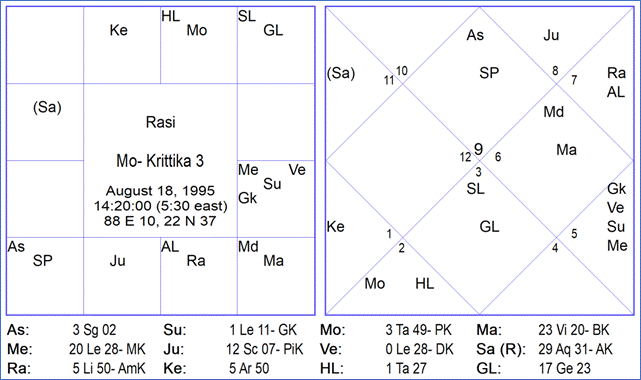
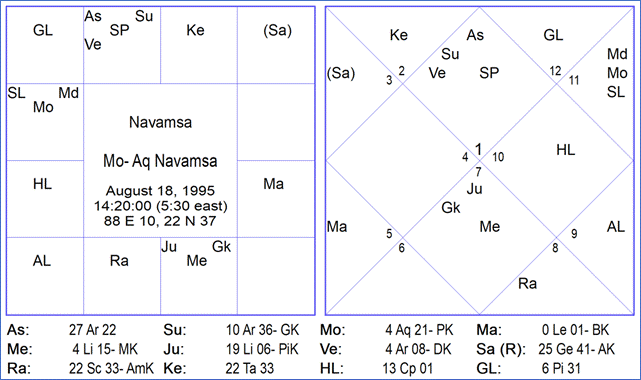
If Mars occupies the pada, financial decisions can become quick and forceful.
If Mercury occupies it, teaching, writing, business, accounts or commercialisation of knowledge can become central.
If Jupiter occupies it, Guru, teaching, students and the ethics of monetising knowledge deserve special attention.
If Venus occupies Krittika Pada 3, material comfort can become a very strong motivation, while a mature placement can create significant wealth used constructively.
If Saturn occupies it, scarcity, responsibility, social duty and the fear of losing what has been accumulated may become major karmic themes.
But the rule remains the same: the Nakshatra Pada gives the pattern, not the final verdict. The complete horoscope must show whether the story is actually manifesting through money, knowledge, family, children, health, teaching or another field.
The Real Teaching of Krittika Nakshatra Pada 3
Krittika Nakshatra Pada 3 teaches something which becomes more relevant as a person becomes successful: Do not forget the person you were before prosperity arrived.
Udyota Sharma was poor, but he had Veda Patha. Then gold arrived. The poverty disappeared. Gradually the Veda Patha disappeared too. And that is the real tragedy of the story. The gold itself was not the enemy. The problem was that the external solution to poverty also removed the internal discipline which had created Punya. This can happen in any profession.
- A person prays during difficulty and forgets prayer during success.
- A student studies while unknown and stops learning after becoming a teacher.
- A researcher works deeply before recognition and starts repeating old material after becoming famous.
- A businessman respects every rupee while poor and becomes careless after expansion.
- A teacher values every student before success and later values mainly enrolment numbers.
Krittika Pada 3 asks whether prosperity has refined the native or merely made discipline unnecessary.
- Agni gives the answer through purification.
- The Sun asks whether the original light remains visible.
- Taurus asks what has been accumulated.
- Aquarius asks what has been circulated.
- Saturn asks what responsibility came with the gain.
And the Karma Vipaka story asks one final question: “When life gave you more than you once had, what did you become capable of giving back?”
At the lower level, Krittika Pada 3 receives prosperity and leaves Dharma.
At the middle level, life repeatedly gives gains followed by family, relationship or inner disturbances until the native understands that money alone cannot preserve happiness.
At the higher level, the same person becomes a custodian of knowledge and wealth, using prosperity to preserve the very tradition, discipline or work from which the prosperity arose.
The main predictive sutra can therefore be stated as: “When Krittika Nakshatra Pada 3 is strongly activated, examine what changes after the native becomes financially secure. The karmic danger begins when success weakens the discipline, knowledge or Dharma which originally produced the success.”
And the shorter sutra is: “Do not let the fruit destroy the root.”
That is the deeper meaning of Krittika Nakshatra Pada 3, pending karma and predictions from Karma Vipaka Samhita.
Regards
To Join Karma Vipaka Course click this








Leave a Comment
Be the first to comment on this blog!