
Ashwini Nakshatra Pada 3 – Pending Karma & Karma Vipaka Predictions By Vinayak Bhatt
Karma Vipaka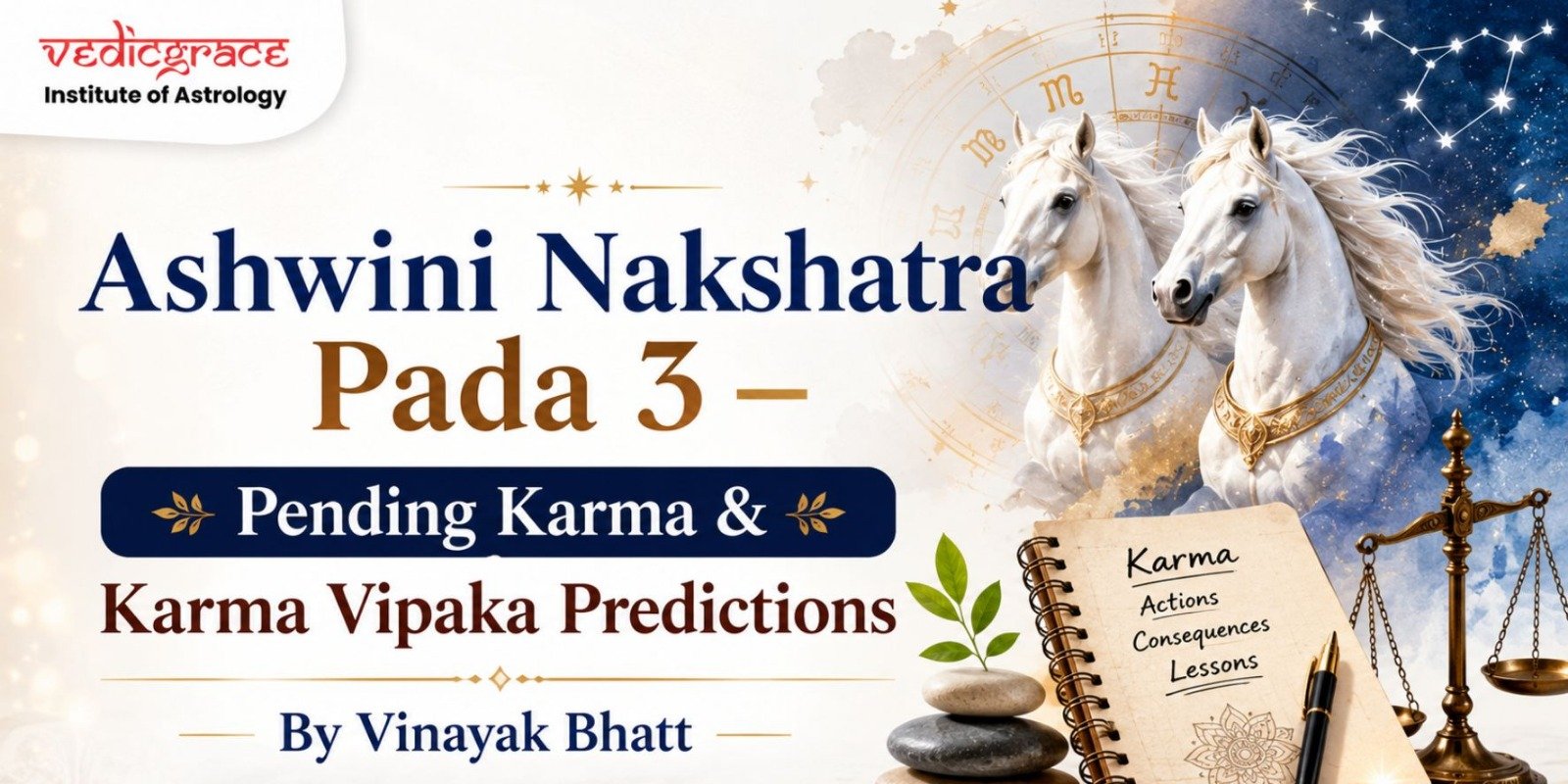
Ashwini Nakshatra Pada 3 gives us one of the most interesting lessons in Karma Vipaka because its story is not about a person who spent his entire life doing wrong. In fact, the detailed account describes a prince who performed his duties, protected his people, possessed self-control and appears to have lived largely according to Dharma, yet one violent dispute with a friend created a karmic result which remained unfinished even after many good actions had been performed.
This makes Ashwini Nakshatra Pada 3 very important for students of predictive Jyotish because it teaches something which is easily missed when karma is explained too simply. A person may carry considerable Punya from previous lives and still carry one particular unresolved karma. Good karma can give wealth, position, respect and protection, while another unfinished action can simultaneously create difficulty in one specific area of life. Karma does not always behave like an account where one good deed simply cancels one bad deed.
Ashwini Nakshatra extends from 0°00′ to 13°20′ Aries. The third pada occupies 6°40′ to 10°00′ Aries and falls in Gemini Navamsha, ruled by Mercury. Therefore, Ashwini Pada 3 brings together Ketu, Mars and Mercury. Ketu carries the old samskara, Mars rules Aries and brings action, aggression, courage and immediate reaction, while Mercury governs speech, calculation, negotiation, exchange, division, agreements, friendship and the ability to see two sides of a matter.
This combination becomes remarkably meaningful when we place it beside the Karma Vipaka story because the critical event occurs while two friends are dividing the animal they had hunted together. The problem begins with a question of share, entitlement and division, then speech and disagreement become heated, Mars enters through anger and violence, and something which could have remained a small dispute becomes irreversible.
For Ashwini Pada 3, therefore, one of the deepest karmic questions is not simply, “Can I get what belongs to me?” It is, “What happens to my judgement when I believe my rightful share is being threatened?”
That distinction gives us the key to this pada.
The Karma Vipaka Story of Ashwini Pada 3
The brief Ashwini Nakshatra Phala gives the following reading for the third charana:
तृतीयचरणे देवि वैश्यवर्णसमुद्भवः ।
रोगी कुत्सितवर्णोऽयं मृतवत्सो नपुंसकः ॥३॥
The surviving translations describe the Ashwini third-pada person through a Vaishya background and connect the pada with sickness, weakness of progeny or children who do not survive, and napuṁsakatva. Such statements belong to the social and medical language of an older text and should not be repeated mechanically as modern predictions. The important thing for a practising astrologer is to identify what is repeated when we compare this short verse with the much longer narrative given specifically for Ashwini Pada 3.
The detailed story begins with Lord Shiva telling Parvati about a beautiful place called Narayana Pura situated towards the south-east, or Agneya direction, from Ayodhya. A prince lived there. His name appears as Chola Simha in one translation and Cholaraja in another. His wife was named Prabhavati.
The text does not introduce Chola Simha as a naturally wicked man. Quite the opposite. He is described as a person who performed his duties, exercised self-restraint and gave importance to the welfare and protection of the people under his care. This detail matters because it changes the entire interpretation of the story.
Chola Simha had a Brahmin friend. Here the available versions differ slightly. One translation calls the Brahmin karma-bhrashta, suggesting that he was not properly observing his prescribed Vedic duties, while another translation describes him favourably before later calling him deceitful in the quarrel. Since the manuscripts and translations do not agree completely on this point, it would be wrong to build the entire interpretation around whether the Brahmin was morally good or bad.
What every version does preserve is much more important.
The prince and his Brahmin friend went hunting together. They killed a deer or wild animal and went deeper into the forest. When the time came to divide what they had hunted, a serious argument arose between the two men. The disagreement became intense, anger and hostility entered the situation, and the Brahmin died in the forest.
The wording of the available translations is not clear enough for us to confidently say that Chola Simha deliberately planned and murdered the Brahmin. The safer and more faithful reading is that a violent conflict over division of the share ended in the friend’s death.
This is very different from Ashwini Pada 1 and Ashwini Pada 2.
There is no carefully planned murder for gold here.
There is no long period of greed followed by deliberate appropriation of another person’s wealth.
Instead, two companions are participating in an activity together, something has to be divided between them, disagreement begins over the division, anger rises quickly and a relationship is destroyed in a moment.
That is the karmic centre of Ashwini Pada 3.
After the incident Chola Simha did not behave as though nothing had happened. The text says he became distressed and worried, returned home and performed the proper Apara Karma, the funeral rites, for his Brahmin friend. This shows remorse, responsibility and an attempt to restore Dharma after the event.
Later, after a considerable period of time, Chola Simha went to Prayag together with his wife Prabhavati on the sacred occasion of Makar Sankranti and left his ashes there. The text then gives him a very different post-death result from the darker stories seen in some other Karma Vipaka padas. He is said to have enjoyed heavenly pleasures for seven Yugas because of his accumulated merit.
When that Punya was exhausted, he returned to human birth and again received wealth and prosperity.
But one result remained unfinished.
The text says that he had no son, or alternatively that children were born but did not survive.
This is perhaps the most important philosophical point in the entire story. Chola Simha’s righteous actions were not forgotten. They gave their own result. His service to people, Dharma, repentance and Punya produced heavenly enjoyment and prosperity. But the karmic consequence connected with the death of the Brahmin friend did not simply disappear because other parts of his life were good.
Both fruits remained.
This is Karma Vipaka in its proper sense.
What Is the Pending Karma of Ashwini Pada 3?
The pending karma of Ashwini Nakshatra Pada 3 should not be reduced to “anger,” because anger is only the visible trigger. The deeper issue is what happens when relationship, competition, entitlement and division come together.
Two men were friends.
They undertook something together.
A result was produced through their joint effort.
That result had to be divided.
And the friendship could not survive the dispute over the share.
This gives us a very practical karmic sutra for Ashwini Pada 3:
A dispute over what is “mine” and what is “yours” should never be allowed to become more valuable than the relationship itself.
The Gemini Navamsha makes this even more interesting. Gemini is a dual sign. Mercury calculates, compares, negotiates, counts, distributes, discusses and decides who receives what. Mars, because the entire pada is still in Aries, does not naturally enjoy prolonged negotiation. Mars wants a clear decision and quick action.
- When Mercury is working properly, the matter can be discussed.
- When Mars takes control of Mercury, discussion becomes argument.
- And when Ketu carries an old unresolved samskara into the combination, the person can suddenly become detached from the consequences of what is being said or done.
This can create a very specific present-life pattern. The native may be generally responsible, helpful and even principled, yet one area of life repeatedly tests their fairness when credit, profit, property, authority, commission, partnership income, inheritance, business shares or recognition have to be divided.
The problem may not be greed in the ordinary sense. The person may genuinely believe, “I am only asking for what belongs to me.”
That is exactly why the karma can be difficult to see.
How Ashwini Pada 3 Can Manifest in Present Life
Ashwini Pada 3 can produce a person who thinks quickly and responds quickly. Because Mercury rules the Navamsha, the native may have good ability in communication, business, trading, management, technical work, calculation, writing, consulting, sales, media or any profession where information has to be processed rapidly. Mars gives the courage to take decisions, while Ashwini gives the instinct to move without waiting too long.
This can make the person very effective when a situation requires fast judgement.
But the same speed can create difficulty when another person disagrees.
A common Ashwini Pada 3 pattern can be that the native is perfectly comfortable while everybody is moving in the same direction, but tension develops when the final result has to be distributed. Who receives the credit? Who receives the larger percentage? Who controls the project? Whose name comes first? Who owns the client? Who gets the property? Who did more work? Who deserves recognition?
These may appear like ordinary human disagreements, but when the horoscope strongly repeats Ashwini Pada 3, they can become the doorway through which an older karmic pattern becomes active.
The story itself gives us another clue. The conflict does not happen between strangers. It happens between friends. Therefore, friendship and competition require special care.
An Ashwini Pada 3 native may form a good friendship which later becomes a business partnership. Everything may remain cordial while the venture is being built, but the relationship can become strained when money starts coming in. Another native may work happily with a sibling, cousin or colleague until property, promotion or ownership has to be divided. Someone else may help a friend professionally and later feel that the friend took too much credit.
And sometimes the native can experience the reverse side of the same karma. They may repeatedly find that people with whom they worked closely become hostile when success arrives, that somebody denies them their share, or that a person they trusted becomes competitive once money or recognition enters the relationship.
The horoscope tells us which side of the story is active. Karma Vipaka gives us the pattern.
The Strong Prediction: Be Careful When Friendship and Shares Come Together
When Moon, Lagna, Atmakaraka or another important planet occupies Ashwini Nakshatra Pada 3, and Mercury, Mars, the 3rd, 6th, 7th or 11th houses repeat the same theme, one prediction becomes particularly useful: an important relationship can be tested when something earned or created together has to be divided.
I would tell such a person that there may come a period when a friend, colleague, sibling, partner or business associate becomes involved in a matter of profit-sharing, commission, ownership, credit or responsibility, and the real danger will not necessarily be the amount involved but the speed with which a disagreement becomes personal.
In another chart, I may say that the native should avoid making financial or professional arrangements with friends purely on verbal understanding because the relationship can remain excellent until success comes, and only after money or credit appears does each person discover that they had imagined a different agreement.
If Mercury is afflicted, misunderstanding, messages, documentation, accounting or verbal commitments can become the trigger. If Mars is afflicted, the disagreement can quickly become confrontational. If Ketu strongly joins the pattern, communication may suddenly break down and one party may simply cut the other person off.
This is where the prediction becomes practical. The remedy starts before the conflict.
- Put agreements in writing.
- Define the percentage before profit arrives.
- Define ownership before the project becomes valuable.
- Decide responsibilities before expectations become emotional.
Mercury must do its work before Mars is required to fight.
That is one of the clearest Jyotish lessons hidden in the Karma Vipaka story of Ashwini Pada 3.
Why Progeny Appears Again in Karma Vipaka
The detailed Ashwini Pada 3 chapter says that after returning to human birth Chola Simha obtained prosperity, yet the continuity of children remained disturbed. One translation says that he had no son, while another reading allows the possibility that children were born but did not survive.
The brief Nakshatra-phala verse repeats this theme through the word mritavatsa, which is connected with the experience of children not surviving. Therefore, even though the brief verse and detailed story do not give the same biography, progeny disturbance is one of the points repeated across the different textual layers.
For Jyotish students, this repetition is more important than forcing every detail into one story.
Why should a conflict with a friend return through children?
The answer lies in the principle of continuity.
One life was cut short during a dispute.
A relationship which should have continued did not continue.
The native later performed funeral rites and other Dharmic actions, but something irreversible had already happened.
Therefore, the karmic result is shown through the native’s own experience of continuity.
This does not mean that every person with a planet in Ashwini Pada 3 will be childless or will lose children. Such a prediction would be irresponsible. The 5th house, fifth lord, Jupiter, Saptamsha, relevant Dashas and other supporting combinations must confirm the result before a literal progeny prediction is made.
There is also a wider meaning of progeny which should not be ignored.
A child carries something forward, but so does a student, a book, a company, an institution, a family business, an intellectual tradition or any work intended to survive after its creator.
Therefore, the Ashwini Pada 3 continuity problem may sometimes appear as a repeated difficulty maintaining partnerships long enough for the work to mature. A person may start a company with somebody and separate before it becomes successful. A research partnership may break before publication. A teacher may train somebody very well and later quarrel with the same student over credit. A family business may develop well but become divided when succession begins.
The same old pattern remains visible: something created together reaches the point where ownership or continuation must be decided, and the relationship breaks at that exact stage.
This is how Karma Vipaka becomes predictive rather than merely literal.
Ashwini Pada 3 and Health
The short Ashwini Nakshatra-phala associates the third pada with illness and also uses the term napuṁsaka, while the detailed Prāyaścitta narrative places much greater emphasis on progeny and continuity. These two levels of the text should be kept separate instead of mixing them into one frightening prediction.
From the Jyotish side, Ashwini Pada 3 remains in Aries, so Mars brings heat, inflammation, injury, impulsive physical action and the tendency to push the body quickly. Ketu can make a condition irregular or difficult to read, while Mercury adds nervous activity, mental restlessness and the tendency to keep thinking about a conflict even after the outer event has finished.
This can produce a very recognisable pattern in some charts: the argument ends, but the body continues carrying the argument.
The person may replay conversations mentally, become restless after disputes, lose sleep while calculating who was right or wrong, or remain physically tense long after the practical issue has been settled.
If the Lagna, Lagnesha, 6th house, 8th house, Mercury, Mars and Ketu repeat this pattern, stress arising through conflict can become physically significant. If the 5th, 7th and 8th houses along with Jupiter and Venus are also disturbed, then reproductive or progeny-related concerns become more relevant.
But the Nakshatra Pada alone is never enough for diagnosis.
The more useful prediction is that an Ashwini Pada 3 native should not allow unresolved conflict to remain continuously active in the mind and body. Quick confrontation may feel natural, but quick resolution is equally necessary.
The Spouse as an Instrument of Karma
Prabhavati has an interesting role in the Ashwini Pada 3 story because the text does not present her as the cause of the problem. She remains beside Chola Simha through the later phase of his life and accompanies him to Prayag.
This gives Ashwini Pada 3 a very different marriage symbolism from those Karma Vipaka stories in which husband and wife jointly participate in an unethical act.
Here the spouse can become a partner in correction.
This distinction is useful in a horoscope analysis.
When Venus or the 7th house is favourably connected with Ashwini Pada 3, the spouse may be the person who helps the native calm down after confrontation, settle disputes, withdraw from an unhealthy rivalry or return to Dharma after an impulsive decision. The spouse may encourage pilgrimage, worship, counselling, reconciliation or simply bring enough emotional distance for the native to see that winning the argument is not always worth the cost.
When the 7th house is afflicted, the same karmic field can move into marriage itself. Arguments may arise over who contributes more, who controls money, whose family receives more support, whose career deserves priority or how joint assets should be divided.
Again the word division becomes important. Gemini Navamsha wants to divide and classify.
Marriage requires two people to remain one unit even while responsibilities are divided. That itself can become an Ashwini Pada 3 lesson.
Why One Moment of Anger Can Become Expensive
Perhaps the strongest difference between Ashwini Pada 3 and the first two padas is that Chola Simha appears to have many good qualities.
- He performs his duties.
- He protects people.
- He later performs the funeral rites of his friend.
- He carries remorse.
- He goes to Prayag.
- He has enough accumulated Punya to receive heavenly enjoyment.
And he is later born with prosperity. Yet one karmic wound remains.
This teaches us a very practical truth: good character reduces many problems, but it does not give permission for one uncontrolled action.
An Ashwini Pada 3 native can therefore be respected, helpful and genuinely Dharmic, yet still have one weak point around argument, competition or perceived unfairness.
The danger is the sentence, “But I was right.”
A person may be factually right about the money.
They may be right about their percentage.
They may be right about who worked harder.
They may be right that the other person behaved badly.
And still the reaction can produce more damage than the original injustice.
This is where Mars has to learn from Mercury.
The purpose of intelligence is not merely to prove that the other person is wrong. Intelligence should also know how much a victory is going to cost.
The Higher Side of Ashwini Pada 3
The same combination that can create disputes can produce an excellent problem-solver when it matures.
- Mars gives courage to take a difficult decision.
- Mercury gives the ability to understand facts, figures, contracts and two sides of an argument.
- Ketu can eventually create detachment from ego.
- And Ashwini gives the instinct to repair something quickly.
Therefore, the higher expression of Ashwini Nakshatra Pada 3 can be a person who becomes very good at settling complicated situations before they become destructive. Such natives can perform well in negotiation, business, management, law, administration, mediation, consulting, emergency coordination, trading, surgery, technical fields or any area where a fast mind has to work under pressure.
The past-life story also begins with a ruler who takes care of people. Therefore, leadership is not foreign to this pada.
But the mature leader of Ashwini Pada 3 has to learn one specific rule: authority is strongest when it can settle a dispute without humiliating anybody.
- A weak Mars defeats an opponent.
- A mature Mars protects order.
- A weak Mercury argues over every detail.
- A mature Mercury finds the fair division.
- A restless Ketu breaks the relationship.
- A mature Ketu knows which argument is not worth continuing.
This is the higher movement of the pada.
Traditional Remedies and the Logic Behind Them
Karma Vipaka Samhita gives specific Prāyaścitta for the Ashwini third-pada pattern. The available version advises the native to create or support a well or pond, particularly in a place useful to travellers, and to listen to the Harivamsha Purana with devotion. The text also prescribes charity involving gold, clothing and cows of different colours or types, and states that these acts support the continuation of lineage and removal of affliction.
These remedies are worth understanding rather than merely copying.
The original conflict happened in the forest where two people were concerned with dividing what had been obtained. The remedy moves in the opposite direction. Instead of fighting over a limited share, the native creates a shared resource.
- A well is not meant for one person.
- A pond is not consumed privately.
Travellers, animals and people who may never know the donor can all benefit from it.
This is a beautiful reversal of the karmic pattern.
The old event says, “How much of this belongs to me?”
The corrective action says, “Let something I create belong to everybody.”
This is why the water remedy should not be treated as an unrelated ritual instruction. It is directly connected with the inner education of the soul.
The charity of gold and clothes works through the same principle because accumulated value is voluntarily released rather than fought over. Listening to Harivamsha brings the mind back towards Dharma, lineage and sacred continuity, exactly where the karmic result is said to appear.
Traditional Prāyaścitta should of course be undertaken according to one’s means and under competent guidance when formal ritual procedure is involved.
But the principle can be understood by every student.
Karma was created through action.
Correction also requires action.
A Practical Remedy for Modern Life
For a modern Ashwini Pada 3 native, one of the strongest living remedies is to become exceptionally fair whenever something has to be divided.
- If two people build a business, decide the ownership clearly.
- If relatives share property, complete the paperwork properly.
- If a team produces intellectual work, acknowledge everybody’s contribution.
- If a friend brings a client, decide the commission before receiving the payment.
- If two siblings are handling parental assets, do not allow informal assumptions to become tomorrow’s bitterness.
And when disagreement begins, do not make irreversible decisions while angry.
This practical discipline expresses the real spirit of the classical remedy because it directly corrects the behaviour shown in the story.
The instruction to create wells and ponds can also be followed in a sensible modern way by contributing towards drinking-water facilities, restoring a village pond, supporting water conservation, installing drinking-water facilities in a school or pilgrimage route, or supporting projects that provide clean water to people and animals.
Cow donation should be followed according to genuine tradition and capacity. Where direct Go-Dāna is not practical, responsible support of a well-run Gaushala can express part of the same Dharmic intention, though it should not be presented as a textual replacement for the original ritual.
Harivamsha may be read or heard with attention rather than treated as something to be played mechanically in the background.
And there is one remedy which costs nothing.
When anger says, “Finish the relationship now,” wait before acting.
For Ashwini Pada 3, that pause can itself become Prāyaścitta in daily life.
How to Confirm Ashwini Pada 3 in a Horoscope
Karma Vipaka gives us the karmic story, but the whole horoscope must tell us whether the story is operating literally, symbolically or only as an inner behavioural tendency. Even the modern commentary on Karma Vipaka warns that no single dictum should be used mechanically and that supporting Jyotish indications are required.
For Ashwini Pada 3, Mercury becomes especially important because the pada falls in Gemini Navamsha. Mars must be studied because Aries is the Rashi, while Ketu is the Nakshatra lord. These three planets tell us how thought, speech, disagreement and action are going to combine.
The 3rd house becomes important for courage, communication, companions and the way a person responds when challenged. The 6th shows disputes, competition, disagreement, debts and enemies. The 7th shows agreements, partnerships and the person standing opposite us. The 11th shows friends, gains, networks and the distribution of results coming from collective activity. The 2nd becomes relevant for speech and resources, while the 8th can show the consequences which emerge when shared resources or trust break down.
Then we come to the 5th house.
Because the classical text repeatedly brings progeny into Ashwini Pada 3, the fifth lord, Jupiter and Saptamsha must be examined carefully before saying anything literal about children. If these are strong, the classical progeny indication may operate symbolically through legacy, students, projects or succession rather than through loss of children.
Dasha tells us when the pattern becomes active.
A Mercury period can activate contracts, negotiations, accounts, documentation or questions of division. A Mars period can make the dispute sharper and quicker. A Ketu period can bring an old relationship issue back into life or produce sudden separation. The period of a planet occupying Ashwini Pada 3 can activate the same story through that planet’s Karakatwa.
If Venus occupies Ashwini Pada 3, the division may involve spouse, relationship, property, comfort or joint money. If Jupiter is there, the karmic matter may involve children, teachers, students, knowledge or moral judgement. If Mercury is there, documentation, business, speech and negotiation become especially important. Mars can make competition and anger much stronger. Saturn can prolong the dispute and turn one short disagreement into years of distance.
The prediction should always come from the complete chart.
The Pada tells us where to look.
The Real Teaching of Ashwini Pada 3
Ashwini Nakshatra Pada 3 teaches something which every astrologer should understand before speaking about past-life karma.
A person can be mostly good and still carry unfinished karma.
Chola Simha was not shown as somebody devoid of Dharma. He protected his people and performed his responsibilities. After the death of his friend, he grieved and performed the funeral rites. He accumulated enough Punya to receive heavenly results and prosperity in another birth.
But the text still says that progeny was disturbed.
So Punya did not become useless. And Papa did not become invisible. Each gave its own fruit.
This is a much more mature understanding of Karma Vipaka than saying that somebody is either a “good soul” or a “bad soul.”
Most human beings carry mixed karma. One area may prosper because something was done well. Another may repeatedly hurt because something else remains unfinished.
Ashwini Pada 3 shows this through a remarkably human situation. Two friends go out together, produce something through joint effort and then quarrel while dividing it. Anger takes over, the relationship reaches an irreversible end, and the person who survives carries the weight of that moment long afterwards.
The deepest question of this pada is therefore not whether the native is aggressive.
The deeper question is:
What happens when the native believes that somebody has taken more than their rightful share?
- If Mercury remains awake, the person negotiates.
- If Mars takes over, the person fights.
- If Ketu takes over, the person cuts the relationship.
But when all three begin serving Dharma, something else becomes possible.
- Mercury defines what is fair.
- Mars has the courage to enforce fairness without cruelty.
- Ketu gives enough detachment to walk away from ego.
- And Ashwini turns conflict into correction.
This is the real karmic movement of Ashwini Nakshatra Pada 3 according to Karma Vipaka Samhita.
The soul is not being asked to stop competing.
- It is being asked to compete without destroying friendship.
- It is not being asked to surrender its rightful share.
- It is being asked to claim that share without losing proportion.
- It is not being asked to become weak during disagreement.
- It is being asked to become strong enough that anger does not make the final decision.
And when this lesson is understood, the very same pada which once showed conflict over division can produce a person who becomes trusted precisely because they know how to divide things fairly, settle disputes intelligently and protect relationships when money, credit or ownership enter the picture.
That is when pending karma becomes conscious Dharma, and that is the real value of studying Ashwini Pada 3, Karma Vipaka Samhita and predictive Jyotish.
Explore the Karma Vipaka Course →

Jai Guru Dev
By Mr. Vinayak Bhatt



![Shri H. N. Katwe: Secrets of Moon [Predictive Techniques Related to Moon]](https://vedicgrace.com/wp-content/uploads/2025/11/Secrets-of-Moon-Webinar-300x300.jpg)



Leave a Comment
Comments are closed for this post.
Be the first to comment on this blog!