
Ashwini Nakshatra Pada 2: Pending Karma and Predictions from Karma Vipaka Samhita by Vinayak Bhatt
Karma Vipaka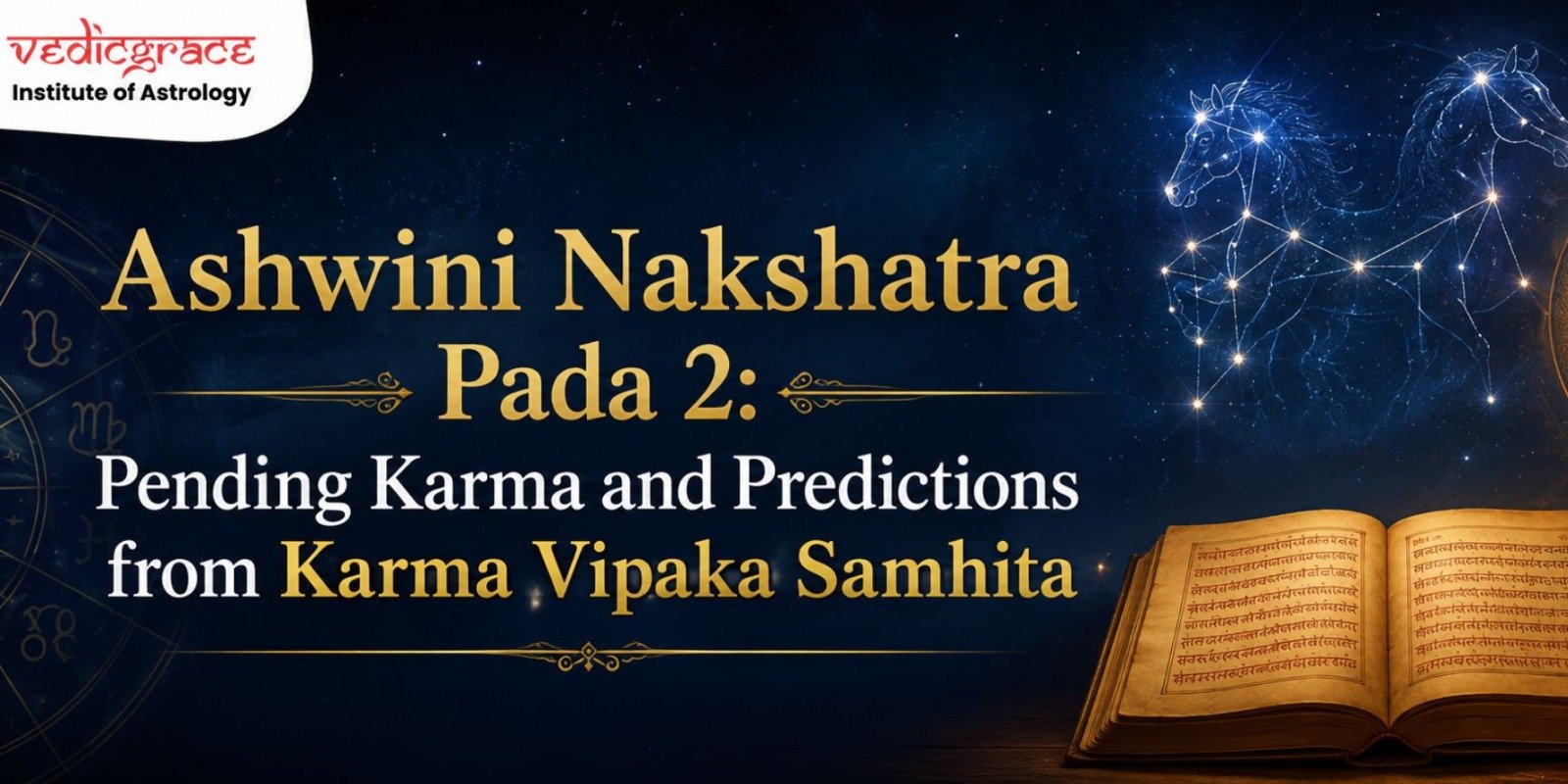
Ashwini Nakshatra Pada 2 is very different from Ashwini Pada 1, even though both fall in Aries and both carry the quick, decisive and action-oriented nature of Ashwini. The difference begins when we look at the Navamsha. Ashwini Nakshatra Pada 2 occupies 3°20′ to 6°40′ Aries and falls in Taurus Navamsha, which means that beneath the speed of Aries and Mars there is another layer ruled by Venus, connected with money, possessions, comfort, food, family security, relationships, valuables and the desire to preserve what one has acquired.
This becomes very important when Ashwini Nakshatra Pada 2 is studied through Karma Vipaka Samhita, because the classical story attached to this pada is not simply about aggression or impulsiveness. It is a story about a person who received a relative into his home, treated him well, allowed him to stay as a guest, saw the enormous wealth he possessed, later killed him and his son, concealed the bodies and appropriated the wealth. The karmic result described by the text eventually comes through family continuity, progeny, the spouse and health.
This is where the study of pending karma through Nakshatra padas becomes more meaningful than ordinary personality astrology. We are no longer asking only whether an Ashwini Pada 2 native is active, independent, attractive, practical or financially motivated. We are asking a deeper question: why does the Karma Vipaka tradition connect this particular pada with family trust, inherited wealth, the maternal side of the family, hidden actions, progeny and the consequences of taking what rightfully belonged to another person?
Ashwini is ruled by Ketu, Aries is ruled by Mars and the second pada goes into Taurus Navamsha ruled by Venus. This gives us a very interesting karmic combination. Ketu carries an old samskara, Mars acts quickly, while Venus and Taurus want possession, stability, enjoyment and material security. When these forces work through Dharma, the native can protect resources, support family members, build wealth and use material prosperity constructively. When they become distorted, the same combination can create a powerful temptation to possess something simply because it is available.
This is the doorway through which the Karma Vipaka story should be understood.
The Karma Vipaka Story of Ashwini Pada 2
The general Nakshatra-phala section of Karma Vipaka Samhita introduces Ashwini Pada 2 with the following verse:
द्वितीयचरणे देवि पुरा क्षत्री न चान्यथा ।
अयोध्यापुरतः पूर्वं पुत्रकन्याविवर्जितः ॥२॥
The verse places the previous incarnation in a Kshatriya setting towards the east of Ayodhya and connects the pada with the absence of progeny.
Another commentary gives a particularly interesting Jyotish explanation for this statement. Ashwini Pada 2 falls in Aries in the Rashi chart and Taurus in Navamsha; the twelfth sign from Taurus is Aries, and Aries is associated there with Kshatriya symbolism and the eastern direction. This is a useful example of how the old text may be decoded through both Nakshatra Pada and Navamsha rather than reading the story as an isolated statement.
Lord Shiva tells Parvati that east of Ayodhya, near the Sarayu River, there lived a Kshatriya named Shweta Varma. He lived with his wife Gunavati and his son. One day his maternal uncle, or Matula, arrived with his own son and a very large quantity of wealth and gold. Shweta Varma welcomed them, showed them respect and allowed them to stay in his house.
The maternal uncle and his son remained there for about a month. They lived as honoured guests and ate in the household. But after this period Shweta Varma killed both his maternal uncle and the uncle’s son, buried their bodies in the ground and took possession of their enormous wealth. The text describes him as having incurred a serious karmic fault, and the translation specifically connects the act with Guru Shaap, even though the victim was the maternal uncle rather than a formal spiritual Guru.
That point deserves attention.
In many modern discussions, Guru Shaap is understood only as the curse resulting from offending one’s teacher. Karma Vipaka uses the idea more broadly in this narrative. An elder relative, protector, guide or person deserving reverence can occupy a Guru-like position. Therefore, the story is not simply about murdering someone for money. The deeper offence is the destruction of someone who had entered the native’s protection and trusted the household.
Shweta Varma and his wife then consumed the wealth. Eventually both died and underwent severe consequences after death. The text describes further non-human births before returning to human birth, and when the human cycle resumes, the central result is Vamsha Chheda, interruption of lineage. The text directly links the destruction of the maternal uncle and his son with disturbance in the native’s own continuity.
The brief introductory verse describes the earlier Kshatriya incarnation as without son or daughter, while the detailed Ashwini Pada 2 in the book describes Shweta Varma as living with wife and son. These two statements should not be forcibly joined into one literal biography. Classical texts and their surviving editions often preserve different layers of teaching. The repeated message is much clearer than the biographical detail: progeny and continuity become the field through which this particular karma returns.
What Is the Pending Karma of Ashwini Pada 2?
The pending karma of Ashwini Nakshatra Pada 2 is not simply greed. Greed is present in the story, but it is only the visible surface. The deeper fault is the violation of protection, kinship and trust for the sake of material possession.
Shweta Varma was a Kshatriya. The traditional duty of a Kshatriya is protection. His guest was also his maternal uncle, an elder member of the family. The uncle entered his home with his son and wealth and therefore came under the protection of the household. Shweta Varma did exactly the opposite of what his role demanded. Instead of protecting the guest, he destroyed him. Instead of protecting the next generation, he killed the uncle’s son. Instead of protecting entrusted wealth, he appropriated it.
This gives us the real karmic sutra of Ashwini Pada 2: When the protector becomes the exploiter, the karma returns through the native’s own security, family and continuity.
That principle is much more useful than just saying that one must have committed a particular act in a previous birth.
In present life, an Ashwini Pada 2 native may repeatedly be placed in situations where they must make decisions involving family money, inheritance, joint property, gold, investments, family businesses, the resources of relatives, confidential financial information or assets temporarily placed in their control. The situation itself is not negative. In fact, such natives can become very capable managers of resources. But whenever another person’s vulnerability and the native’s personal gain come together, the old karmic examination begins.
The question becomes very simple: will you protect what has entered your hands, or will you treat access as ownership?
That is one of the strongest pending karma themes of Ashwini Pada 2.
How Ashwini Pada 2 Can Manifest in Present Life
Because this pada combines Aries with Taurus Navamsha, the person may have considerable ability to convert action into material results. Ashwini wants to act immediately, while Taurus wants something tangible to remain after the action. This can give good capacity in business, finance, administration, property, medicine, luxury industries, food, hospitality, vehicles, jewellery, design, consulting or any field where quick decisions must eventually produce stable value.
Such natives may also be very protective of family, money and possessions. They often dislike financial insecurity and may work hard to create a stable base. But this desire for security becomes the karmic testing ground when fear of loss becomes stronger than fairness.
One important present-life manifestation can arise through the maternal family. The classical story specifically chooses the maternal uncle rather than an unrelated stranger. In Jyotish, the maternal uncle is commonly connected with the 6th house, and therefore an astrologer studying Ashwini Pada 2 should pay careful attention when the 6th house, its lord, the 2nd house of family wealth, the 8th house of inherited or shared resources and the 5th house of progeny begin forming one pattern.
A native may tell you that there has always been tension over money with the mother’s relatives. Another person may become responsible for property belonging to a maternal uncle. Someone may enter a family business through the mother’s side. Another may become involved in inheritance disputes, jewellery, land or money belonging to relatives. In some charts, the native may be the person who suffers because relatives have taken what belongs to them. Karma does not always repeat with exactly the same role. Sometimes the soul learns the principle by experiencing the opposite side of the transaction.
The important point is that family and finance should not be mixed casually in this pada.
Agreements should be clear. Ownership should be documented. Inheritance matters should not be manipulated. Money held for another family member should remain separate. Informal arrangements can become the source of a much larger conflict when the horoscope repeats the Karma Vipaka pattern.
The Strong Prediction: Family Trust and Money Must Be Handled Carefully
Suppose Moon, Lagna, Atmakaraka or another important planet occupies Ashwini Nakshatra Pada 2 and the chart simultaneously connects the 2nd, 5th, 6th and 8th houses. Pay serious attention to one pattern: money belonging to family or relatives can become a karmic test.
The prediction can then become specific without becoming dramatic.
The native may be told that at some stage of life, an important situation involving a relative’s money, inheritance, property, investment or financial responsibility can arise, and the native should maintain complete transparency because even a technically legal advantage may create long-term family consequences if it damages trust.
Another variation may be that a maternal relative comes to the native for financial assistance, shelter, business help or property management, and what begins as cooperation later becomes complicated by ownership or expectations.
In another chart, the prediction may reverse itself. The native may repeatedly feel that family members have taken advantage of their generosity, used their resources or created disputes around property. In such a case, the soul is learning what the violation of trust actually feels like.
The horoscope tells us which side of the story is active.
This is why predictions from Karma Vipaka Samhita should never be made from the Nakshatra Pada alone. The Pada provides the karmic story, while the houses, grahas and Dashas show where the story has entered present life.
Why Progeny Appears Again and Again in Karma Vipaka
The central consequence given in the detailed Ashwini Pada 2 narrative is Vamsha Chheda, interruption of lineage. This is not random.
The person destroyed a maternal uncle and his son. In other words, he did not merely harm one individual; he attacked two generations of one family at the same time. One person represented the established generation and the other represented what would continue after him.
The karmic response therefore appears through continuity.
This gives a powerful rule: when the previous action destroys another person’s continuation, the present karmic result may appear through difficulty establishing one’s own continuation.
The literal manifestation can involve delayed conception, pregnancy difficulties, concern over children, loss, separation from children or anxiety surrounding progeny, but such predictions should only be made when the 5th house, fifth lord, Jupiter, relevant Vargas and Dasha support them.
The symbolic manifestation can be equally important.
The native may create something but repeatedly fail to carry it into the next generation. A family business may not find a successor. A book may remain unfinished. Students may come but not remain. Property may repeatedly change hands. A project may develop strongly and suddenly stop. The native may worry constantly about who will continue what they have built.
This is also Vamsha in a broader sense.
A lineage is not only biological. Knowledge has lineage. Institutions have lineage. Businesses have lineage. Traditions have lineage. A Guru has students. An author has books. A founder has successors.
Therefore, whenever the text says that lineage is affected, an intelligent astrologer should first ask, “What is this person trying to continue?”
That question often gives a much more accurate prediction than immediately predicting childlessness.
Ashwini Pada 2 and Health
The Ashwini Pada 2 chapter also brings the spouse and health into the karmic result. The classical translation says that the same wife becomes connected with the native again and suffers from ill health, including chronic cough and recurring fever.
This should not be used for mechanical medical prediction. It gives us a karmic theme that needs confirmation through the horoscope.
Ashwini itself belongs to the Ashwini Kumaras, the divine physicians, which means disease and healing often appear together in the symbolism of this Nakshatra. Aries brings Mars, heat, inflammation and acute events. Ketu can make conditions irregular, recurrent or difficult to understand. Taurus Navamsha adds the throat, food, nourishment and the physical maintenance of the body.
When Ashwini Pada 2 is strongly connected with the Lagna, Moon, 6th house or 8th house, recurring conditions can become part of the native’s life story, especially when the body is being pushed through excess work, irregular eating, suppressed stress or prolonged financial and family tension.
But the important word here is repetition.
The Karma Vipaka pattern is not necessarily one dramatic health event. It can be something that improves, returns, improves again and returns whenever the unresolved life pattern becomes active.
For an astrologer, this is more useful than trying to name a disease from the Nakshatra.
The Spouse as an Instrument of Karma
The wife has an unusually important role in the Ashwini Pada 2 narrative. Gunavati is part of Shweta Varma’s household when the wealth is taken, and the story later says that the same wife becomes connected with him again in another human birth.
The text does not clearly say that she planned the crime, so we should not add that to the story. What it does show is that the wealth obtained through the wrong action was consumed within the marriage, and the karmic consequence eventually became connected with both partners.
This gives us a very useful Jyotish principle.
Marriage can become the place where unfinished financial karma is shared.
In a modern horoscope, the spouse may become deeply connected with property, inheritance, family investments or disputes involving relatives. One partner’s financial decision may affect the health, security or peace of the other. Sometimes one spouse enters the marriage carrying a complicated family property issue and the other spouse becomes involved simply because marriage makes the two karmic fields overlap.
This becomes particularly important when Venus, the 7th lord, the 2nd house, the 8th house and Ketu form relationships.
And because Ashwini Pada 2 itself falls in Venus-ruled Taurus Navamsha, relationship and material security are naturally woven together more strongly here than in Ashwini Pada 1.
This is why financial transparency between husband and wife becomes one of the most practical protections for this pada.
Why One Ethical Mistake Can Become Expensive
The most striking part of the Ashwini Pada 2 story is that the crime happens inside the home.
The relative was welcomed.
He was respected.
He stayed for a considerable time.
Food was shared.
Only later was the trust destroyed.
This sequence tells us that the real danger in Ashwini Pada 2 is not always an obvious enemy. It can be the transformation of trust into opportunity.
A person may be given access to family accounts, a business password, jewellery for safekeeping, property documents, inheritance papers or responsibility for an elderly relative’s assets. Nothing is wrong at that stage. But once access becomes temptation, the karmic pattern has begun repeating.
The Taurus Navamsha makes the symbolism even clearer. Taurus likes tangible possession. It wants to secure, hold, accumulate and enjoy. This is normally a strength. But when afflicted by greed, fear or entitlement, the mind can quietly move from “I am looking after this” to “This should belong to me.”
That small internal shift is the danger.
And because Mars rules the Rashi, the final decision may then happen quickly.
Ketu shows that the pattern is old.
Venus shows what becomes desirable.
Mars executes the act.
The Higher Side of Ashwini Pada 2
Karma Vipaka should never be taught as a catalogue of punishments because every karmic story also contains the exact clue required for elevation.
If the lower form of Ashwini Pada 2 is taking resources from somebody who trusted you, the higher form is protecting the resources of those who trust you.
This can produce exceptional trustees.
It can produce a person who manages family wealth honestly, protects inheritance for children, supports an elderly relative, handles client money carefully, manages charitable funds with transparency or prevents property from being misused.
The Kshatriya symbolism also changes completely when Dharma is restored. The same person who once failed to protect can now become a strong protector.
Ashwini gives the ability to respond quickly. Mars gives courage. Taurus Navamsha gives practical management. Venus understands value. Ketu brings experience from an older karmic layer.
Once these qualities work together correctly, Ashwini Pada 2 can produce somebody who knows how to save what another person might lose.
That is the higher expression. The soul is not being asked to reject money. It is being asked to understand the Dharma of money.
Wealth itself is not the problem. Ownership without right is the problem.
Traditional Remedies and the Logic Behind Them
The Karma Vipaka Samhita gives a detailed Prayaschitta for Ashwini Pada 2. The text prescribes listening regularly to the Harivamsha Purana, donation of cows, Gayatri mantra japa, Homa, feeding Brahmins, donation of bedding, worship connected with a sacred image, charity and pilgrimage to Prayag during the month of Magha with the spouse.
The source prescribes one lakh Gayatri repetitions, followed by Homa using one-tenth of the number of repetitions. It also describes worship of a sacred image and subsequent donation, and concludes that through the prescribed Prayaschitta the continuity of lineage may be restored and suffering connected with progeny and health may be reduced.
These are substantial traditional rituals and should not be performed merely after reading an internet article. Exact Sankalpa, mantra procedure, Homa and Daan should be taken from a competent traditional practitioner who understands the ritual framework.
But the symbolic logic of the remedy is extremely clear.
- The original karma involved taking wealth, so the remedy gives wealth away.
- The original karma involved killing family members, so the remedy supports continuity and nourishment.
- The original karma violated hospitality, so Brahmins and worthy people are fed.
- The original action disturbed family Dharma, so husband and wife perform part of the correction together.
- The original karma involved possession, while the remedy teaches surrender.
This is why traditional Prayaschitta is much more intelligent than simply wearing a gemstone or performing one mechanical ritual. The remedy reverses the original direction of the karma.
A Practical Remedy for Modern Life
A person strongly influenced by Ashwini Nakshatra Pada 2 should make financial honesty a daily spiritual discipline.
Any money being held for another person should remain clearly separated. Property arrangements within the family should be documented rather than left to assumptions. Inheritance should be distributed fairly. Jewellery, cash, investments or documents belonging to elderly relatives should be handled transparently. Business with relatives should have the same clarity that would be expected when dealing with strangers.
A second important correction is to support family continuity rather than weaken it.
Helping the education of a relative’s child, assisting a family when a parent dies, supporting children’s medical care, helping someone continue a traditional craft, contributing to a student’s education or protecting assets meant for the next generation can all express the opposite movement to the classical Karma Vipaka story.
And where there has already been a genuine financial wrong, restitution is more meaningful than symbolic remedy.
- If money is owed, repay it.
- If property has been unfairly retained, correct the arrangement.
- If documents have been hidden, disclose them.
- If a family member has been financially exploited, repair the damage where possible.
A mantra does not replace Dharma. The mantra supports Dharma.
That distinction is essential when studying pending karma and remedies in Karma Vipaka Samhita.
How to Confirm Ashwini Pada 2 in a Horoscope
Karma Vipaka gives the seed. The horoscope tells us where the seed will grow.
The first house to examine is the 5th because the text repeatedly brings lineage and progeny into the story. Study the fifth lord, Jupiter and the relevant Vargas before making any literal statement concerning children.
The 6th house becomes important because the central relative in the narrative is the maternal uncle. If the 6th lord becomes connected with the 2nd or 8th houses, there may be financial obligations, disputes, inheritance matters or unresolved exchanges involving the maternal side of the family.
The 2nd house shows family wealth, accumulated resources and family continuity. The 8th house becomes important for joint assets, inheritance, hidden matters and resources belonging to others. The 4th should also be watched when property, land, houses or concealed assets repeat the symbolism of the story.
The 7th house and Venus tell us whether the spouse becomes a major carrier of the karmic pattern. The 9th house and Jupiter deserve attention because the source uses the language of Guru-related karmic fault. Ketu reveals the old samskara, Mars shows the action through which it becomes active and Venus becomes especially important because this Pada falls in Taurus Navamsha.
Then Dasha tells us when the story wakes up.
A Ketu period can uncover something unresolved from the family past. A Mars period may bring an immediate dispute, decision or confrontation. A Venus period can bring property, marriage, luxury, money or family assets to the centre of the story. The Dasha of a planet occupying Ashwini Pada 2 can activate the karmic theme according to that planet’s own Karakatwa and house lordship.
If Mercury occupies Ashwini Pada 2, contracts, accounts, documentation, business and signatures may become the field where trust is tested. If Venus occupies it, marriage, money, jewellery, property and comforts can become prominent. If Jupiter occupies it, children, Guru, family Dharma, inheritance ethics and advice become more important. If Mars occupies the pada, disputes, action, brothers, property or forceful decisions can activate the pattern. If Moon occupies it, the maternal family and emotional security may become central.
And if none of these houses or grahas confirm the literal Karma Vipaka story, do not force the prediction. The broader karmic lesson of protection, trust and responsible possession may still operate without producing the extreme classical result.
The Real Teaching of Ashwini Pada 2
Ashwini Nakshatra Pada 2 teaches a very precise lesson about wealth.
Something entering your possession does not automatically become yours.
- A relative may trust you.
- A client may trust you.
- A spouse may trust you.
- A parent may trust you.
- A business partner may trust you.
- An elderly person may put documents into your hands.
- A family may allow you to manage its wealth.
The karmic examination begins the moment access and personal desire meet.
This is why the classical story first makes Shweta Varma a host and only afterwards makes him the offender. Had the story shown an open battle with an enemy, the meaning would have been completely different. Instead, the person who enters the house peacefully is harmed by the very man who should have protected him.
That is the secret of the pada.
Ashwini Pada 2 is therefore not fundamentally about poverty or wealth. It is about the Dharma of possession.
- Mars asks, “What will you do?”
- Venus asks, “What do you value?”
- Taurus asks, “What do you want to keep?”
- Ketu asks, “Have you learnt this lesson before?”
- And Karma Vipaka asks the final question:
“When another person’s security comes into your hands, will you protect it as carefully as your own?”
When the native answers that question correctly through actual behaviour, the entire expression of the pada changes.
- The person who once destroyed family continuity can become somebody who preserves it.
- The person who once misused wealth can become a trustworthy custodian of wealth.
- The person who once failed the Dharma of protection can become the strongest protector in the family.
And this is the proper use of Karma Vipaka Samhita in predictive Jyotish. We do not use past-life stories to frighten or to make claims that cannot be verified. We are identifying a repeated pattern, checking whether the horoscope confirms it, seeing how the pattern is operating in present life and then showing the native how the same karma can be consciously reversed through Dharma, responsibility, charity, restitution and appropriate Prayaschitta.
That is the deeper meaning of Ashwini Nakshatra Pada 2, pending karma and predictions from Karma Vipaka Samhita.
Explore the Karma Vipaka Course →

Jai Guru Dev
By Mr. Vinayak Bhatt
Related Articles
Ashwini Nakshatra Pada 1
Ashwini Nakshatra Pada 2
Ashwini Nakshatra Pada 3
Ashwini Nakshatra Pada 4







![Bhrigu Nandi Nadi Course [English]](https://vedicgrace.com/wp-content/uploads/2025/11/Bhrigu-Nandi-Nadi-Astrology-VG-English-300x214.png)
![Shri H. N. Katwe: Secrets of Moon [Predictive Techniques Related to Moon]](https://vedicgrace.com/wp-content/uploads/2025/11/Secrets-of-Moon-Webinar-300x300.jpg)




Leave a Comment
Comments are closed for this post.
Be the first to comment on this blog!