
Karma Vipāka of Ashwini Nakshatra Pada 1: When Knowledge Fails to Control Desire
Karma Vipaka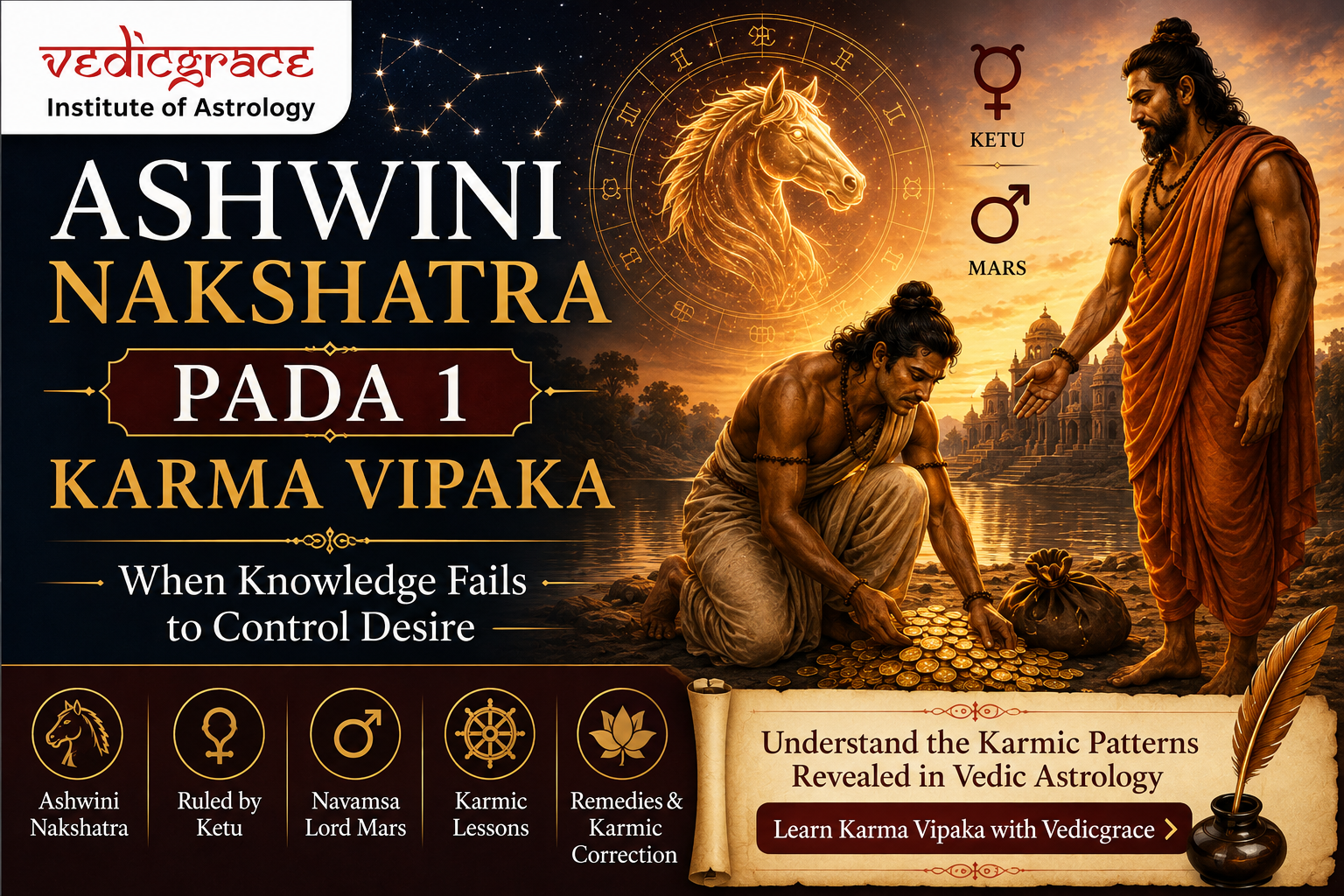
Aśvinī Nakshatra Pada 1 carries a very important teaching about karma, and the lesson is not simply that a person may suffer because of a wrong action done in a previous birth. The deeper lesson is that knowledge alone does not protect a person from creating karma.
A person may know Dharma, may understand right conduct, may perform worship, may come from a respected family and may even carry considerable Puṇya, but if greed becomes stronger than discrimination at one important moment, that single action can create a karmic debt which may return much later.
This is the central teaching hidden in the story of Aśvinī Nakshatra Pada 1 in Karma Vipāka Saṁhitā.
The text begins by describing the previous birth connected with this Pada:
अश्विन्याः प्रथमे पादे यदा जन्म प्रजायते ।
तदा ब्राह्मणवर्णोऽयं मध्यदेशसमुद्भवः ॥
The Saṁhitā says that the previous birth was in a Brahmin family of Madhyadeśa. At first, this sounds like a fortunate birth. The person belonged to a respected social and spiritual background, knew Śāstra, performed Brahminical duties and understood Dharma. He was not an ignorant man acting without any moral training.
His wife was Viśālākṣī and he had a son named Narahari.
He also had a Brahmin friend named Lanja sharma, who was prosperous and possessed wealth and gold.
Then comes the turning point.
When Lanja sharma came to him, the sight of wealth disturbed the mind of this learned man. Lobha, or greed, entered his consciousness, and for the sake of gold he killed his own friend along with the friend’s son and took their wealth.
This one act changes the whole karmic direction of the story. The Real Problem Was Not Ignorance
- The Brahmin already knew what was right.
- He understood Dharma.
- He knew the value of friendship.
- He understood that murder was wrong.
- He knew that taking another person’s wealth through violence was Adharma.
Yet he still acted against what he knew. This is much more serious than making a mistake because of ignorance. If a person does something wrong because he genuinely does not know better, the karma is of one kind. But when a person knows the right conduct, understands the consequences, and still chooses greed, position, money or pleasure over Dharma, the samskāra becomes deeper.
This is one of the most important teachings of Karma Vipāka Saṁhitā.
Knowledge and conduct are not the same thing.
- A person may be very educated and still fail a karmic test.
- A person may quote Śāstra and still act against Śāstra.
- A person may perform Puja and still become dishonest when money is involved.
- A person may teach spirituality and still become greedy when status, wealth or power enters the situation.
So the karmic question is not always, “Did the person know the right path?”
Sometimes the real question is: “Why did knowledge fail at the exact moment when desire became stronger?”
The Karmic Result described in the Saṁhitā, the story does not end with the act itself.
The Karma Vipāka Saṁhitā describes the consequences which followed after death and after passage through other states and births. Eventually, the soul obtained human birth again, but unresolved karma began to appear through important areas of life. The text describes suffering connected with progeny and health. Children did not survive, and illness remained an important part of life.
The Saṁhitā later gives a wider principle that actions such as betraying a friend, killing a child or killing an animal can create karma which returns through loss connected with children and repeated illness. This is important because the result is not random.
- The original action contained three strong elements: betrayal, violence and greed.
- The later result touched: continuity of life, family happiness and physical well-being.
In karmic terms, the person took life and wealth from another family, so later the soul had to experience insecurity in its own continuity and well-being.
Ashwini Nakshatra Pada 1 in Jyotish
Aśvinī Nakshatra is ruled by Ketu.
Its first Pada falls in Aries Navāṁśa, therefore Mars becomes important in the practical interpretation. This gives us a strong karmic combination of Ketu and Mars.
- Ketu can show something already experienced, something carried from before, something unfinished, something remembered without clear reason or a samskāra that has not been fully resolved.
- Mars shows action, impulse, cutting, aggression, taking, immediate response, courage and the urge to act before thinking too much.
When we place these two together, one possible karmic pattern becomes clear: old samskāra + sudden impulse + action + consequence.
This fits the story very well. The man already had knowledge, but at one moment desire became stronger than wisdom, and action followed quickly.
This is why Aśvinī Pada 1 can become important when we are studying how a person reacts when wealth, competition, control or immediate gain enters the situation. Wealth and Loyalty Can Become a Karmic Test
Suppose a Graha is placed in Aśvinī Nakshatra Pada 1. One of the first things I would examine is whether money and relationship become connected in the horoscope.
- Does the native repeatedly face situations where wealth, inheritance, property, business advantage or financial gain tests friendship and loyalty?
- Does money create tension with relatives?
- Does the person have to choose between profit and fairness?
- Does a business relationship become a test of trust?
- Does the native feel tempted to take advantage of someone close?
- Or does the opposite happen, where the native becomes the one who is betrayed financially by a trusted person?
The pending karma may not simply be “money trouble.”
The deeper theme may be: Will this person choose Dharma when money and relationship come into conflict?
This is a much more useful prediction than telling someone a dramatic past-life story.
Friends and Associates May Become the Medium of Karma
The second area to examine is friendship and association. The original story itself is about betrayal of a friend.
So if the Graha in Aśvinī Pada 1 also connects with the 3rd, 7th or 11th-house indications, then friends, business associates, close contacts or people treated like family may become important carriers of the karmic pattern.
- Sometimes such a person may receive great help from friends.
- Sometimes the native may give financial help and later feel cheated.
- Sometimes a business partner becomes very close and then a money issue creates distance.
- Sometimes the person repeatedly meets situations where trust is being tested.
This does not mean every friend becomes an enemy. It means relationship and material interest may become linked strongly enough that the native has to learn how to keep ethics above immediate gain.
Progeny Must Be Judged Carefully.
The third important area is children. The classical story clearly connects the karmic result with progeny, but this must be handled responsibly.
Aśvinī Pada 1 alone cannot be used to predict child loss.
For progeny-related difficulty to become a real prediction, the same theme should repeat through:
- Jupiter
- the 5th lord
- the 5th Bhava
- relevant Karakas
- associated planets
- Daśā
- transit
If these factors also become disturbed, then the Nakshatra story can give a deeper explanation of why children, conception, responsibility towards children or emotional anxiety around progeny becomes a major karmic field. But if the 5th house, Jupiter and the relevant Karakas are strong, then the same story may express in a milder way.
- The native may simply become very protective of children.
- He may feel heavy responsibility towards them.
- He may work in healing, education, childcare or protection.
- He may experience fear around children without actual loss.
The Nakshatra shows the seed. The whole horoscope tells us the level at which that seed will manifest.
Knowledge Before Maturity
Another very strong interpretation of Aśvinī Pada 1 is the possibility of knowledge being present before maturity.
- Such a person may learn very fast.
- He may understand Jyotish, healing, philosophy, spirituality, finance or Śāstra quickly.
- He may even appear more knowledgeable than others.
But life may repeatedly create situations where the real test is not intellectual. The test becomes behavioural.
- The question is not: “What do you know?”
- The question is: “Will you live according to what you know?”
This can become one of the biggest karmic lessons of Aśvinī Pada 1.
A person may know that honesty is important, yet manipulate facts when money is involved. He may know that relationships require loyalty, yet choose convenience over trust. He may understand spiritual teachings, yet become jealous or greedy when competition appears. He may give excellent advice to others but struggle to follow the same advice personally.
This is not hypocrisy in every case. Sometimes it is simply an unfinished samskāra where knowledge has developed faster than self-control. Life then keeps creating situations where the person has to bring behaviour up to the level of knowledge.
Why Ketu and Mars Matter So Much
The Ketu–Mars pattern behind Aśvinī Pada 1 gives a very useful way of understanding this.
Ketu brings something from before. Mars acts. So the native may react quickly because the samskāra is already deep. The person may not even understand why certain situations create such strong reactions.
- Money may trigger fear.
- Competition may trigger aggression.
- Loss may trigger impulsive decisions.
- A friend’s success may trigger insecurity.
- A financial opportunity may create impatience.
This is why awareness becomes important. If Jupiter, Mercury or a strong benefic influence supports the pattern, the native may recognise the old impulse and act differently.
That is the beginning of correction.
The Ashwini Kumāras and the Healing Message
Aśvinī is not only connected with speed, beginning and action. Its Devatās are the Aśvinī Kumāras, the divine physicians. This changes the whole tone of the Nakshatra.
The story may begin with difficult karma, but Aśvinī itself carries the possibility of healing. That is why the final lesson of Aśvinī Pada 1 is not punishment. It is correction. The person is given another opportunity to repair what was damaged.
- The same energy which once acted through greed can later act through protection.
- The same Mars which once harmed can later defend.
- The same Ketu which carries old karma can later give detachment from greed.
- The same intelligence which once failed to control desire can later become wisdom.
This is the deeper beauty of Aśvinī. The Remedy Is Not Mechanical
The Karma Vipāka Saṁhitā prescribes Japa, Dāna, worship, Prāyaścitta and acts of correction.
Gayatrī Japa and Tryambaka Japa are among the important remedies described. But the logic of the remedy is more important than merely counting repetitions.
The original wrong action contained: taking, greed and violence.
So the corrective path moves in the opposite direction: giving instead of taking, restraint instead of greed, protection instead of violence, honesty instead of betrayal and Dharma instead of personal gain.
- That is why Dāna becomes important.
- That is why worship becomes important.
- That is why Prāyaścitta becomes important.
The purpose is not to “cancel” karma mechanically. The purpose is to change the inner direction from which the karma was created.
Never Use the Story Literally. Never look at a person born in Aśvinī Pada 1 and say:
“You killed someone for gold in your previous birth.”
That is not responsible astrology. The story should not be used as an accusation.The classical story gives us a karmic pattern. The horoscope shows how that pattern may operate now.
A proper Jyotishi must examine:
- the Graha placed in Aśvinī Pada 1
- its Karakatwa
- its lordship
- its Bhava
- its association with Ketu and Mars
- connections with wealth
- connections with friends
- connections with progeny
- the operating Daśā
- the transit which activates the pattern
Only after these factors repeat should we speak about a strong karmic theme.
The Real Question of Ashwini Pada 1
The most useful question is not: “What crime did I commit in a previous birth?”
That question may satisfy curiosity, but it does not automatically create growth.
The better question is: “What behaviour has returned in this birth for correction?”
- If money repeatedly creates problems in relationships, the correction may be honesty and restraint.
- If friendship repeatedly breaks over material issues, the correction may be loyalty.
- If the person knows what is right but keeps acting impulsively, the correction may be discipline.
- If children or health become sensitive areas, the lesson may include protection, care, responsibility and respect for life.
This is how the story becomes useful.
Final Teaching of Ashwini Nakshatra Pada 1
Aśvinī Nakshatra Pada 1 teaches that a person can possess knowledge and still create karma if desire becomes stronger than Dharma. The problem is not always lack of wisdom. Sometimes the real problem is failure to apply wisdom at the right moment.
The story of the Brahmin, his friend, the gold, the betrayal and the later karmic result shows us how one act of greed can create a long shadow. But Aśvinī does not leave the story in darkness. Its Devatās are healers. Its energy begins the zodiac. Its deeper message is that life gives another chance.
- Correct what was done wrongly.
- Restore what was damaged.
- Protect what was once harmed.
- Give where once there was taking.
- Choose Dharma where once there was greed.
- And begin again.
That is the deeper meaning of Aśvinī Nakshatra Pada 1 in Karma Vipāka Saṁhitā, the difference between merely reading a karmic story and actually decoding it through Jyotish.
Understand the Deeper Laws of Karma
Curious to understand how past actions, karmic patterns, and planetary influences shape life experiences? Explore the Karma Vipaka Course by Vedicgrace and learn how to interpret karmic patterns through the principles of Vedic astrology.
Explore the Karma Vipaka Course →
Jai Guru Dev
Vinayak Bhatt










![Science of Remedies in Vedic Astrology [English]](https://vedicgrace.com/wp-content/uploads/2025/12/Science-of-Remedies-in-Vedic-Astrology-VG-300x214.png)


Leave a Comment
Comments are closed for this post.
Be the first to comment on this blog!