
The First Horoscope a Jyotishi Must Learn to Read Is His Own Mind – Why Jyotishmati Pragya Meditation Matters to a Jyotishi by Vinayak Bhatt
Jyotishmati Pragya Meditation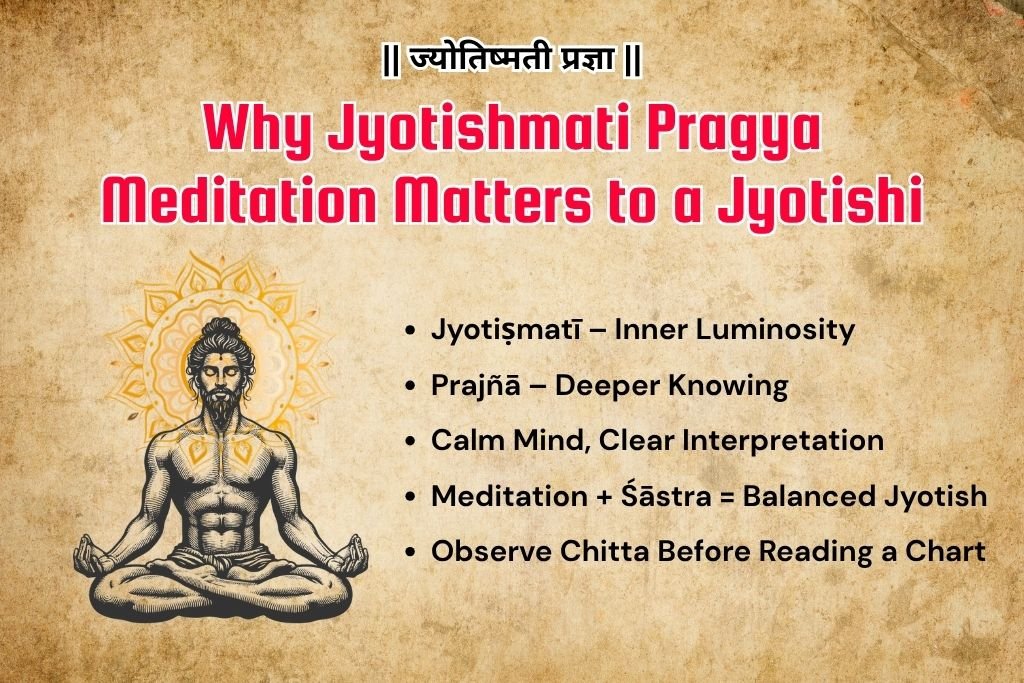
The deeper I go into Jyotish, the more one uncomfortable point keeps returning: sometimes the real error is not in the horoscope at all. It is in the mind of the astrologer who is reading it. Two astrologers may see the same Saturn, same Moon, same Daśā, same Nakṣatra, and still arrive at very different conclusions. One sees only fear, another sees discipline. One sees destruction, another sees restructuring. One sees Ketu and immediately says separation, another sees withdrawal from an exhausted karmic pattern. The Grahas have not changed. The consciousness through which those Grahas are being interpreted has changed.
This is one reason I use the framework I call Jyotishmati Pragya Meditation. And serious students should know the classical distinction properly. The exact expression “Jyotishmati Pragya Meditation” is not the title of a meditation given by Maharishi Patañjali. I draw the framework from two powerful Yoga Sūtra ideas: “विशोका वा ज्योतिष्मती — viśokā vā jyotiṣmatī” in Yoga Sūtra 1.36, describing a sorrowless or luminous condition that can steady the mind, and later “ऋतम्भरा तत्र प्रज्ञा — ṛtambharā tatra prajñā” in 1.48, where Prajñā becomes truth-bearing.
For a Jyotish student, just sit with these two words for a moment: Jyotiṣmatī – luminosity. Prajñā – deeper knowing. Jyotish itself deals with Jyotis, with light, with the celestial indicators through which Kāla is understood. But knowing the mathematical position of light in the heavens is one thing; having enough inner clarity to interpret what that light is showing is another. You can calculate the chart perfectly and still read it badly if fear, attachment, ego, personal prejudice or the need to impress the client enters the reading.
This is why I do not separate meditation from serious Jyotish practice. But I also do not believe meditation gives us permission to ignore Parāśara, Jaimini, Varāhamihira, Daśā, Vargas and classical rules and then say, “My intuition tells me this.” That is simply another trap. Śāstra gives the structure. Meditation helps reduce the distortion through which that structure is applied. A good meditation practice should make the astrologer more careful with Śāstra, not less.
Take Moon first. Every Jyotishi knows Chandra is deeply connected with manas. But suppose my own mind is restless when I open a client’s chart. Maybe I have already had an argument, maybe I desperately want my prediction to sound impressive, maybe I have developed some fixed opinion about marriage, money or spirituality. Then a very serious question arises: am I reading the client’s Moon, or is my Moon reading his Moon?
This is not a small issue.
Patañjali begins Yoga by dealing with citta-vṛtti. The whole discipline recognises that consciousness can become coloured by its own movements. When those movements begin settling, perception changes. So before we become obsessed with “stunning predictions,” perhaps the astrologer should first learn to recognise the noise inside the instrument doing the prediction.
Bhagavad Gītā gives one of the most beautiful images for this: “यथा दीपो निवातस्थो नेङ्गते…” – like a lamp kept in a windless place whose flame does not flicker, such is the mind of the Yogi established in meditation.
Now look at that image like a Jyotishi.
If a lamp is in strong wind, the light is still there. The problem is that everything appears unstable because the flame itself is moving. In exactly the same way, sometimes the horoscope is not confusing; the observer is moving too much.
- Rahu says, “Find something extraordinary.”
- Mercury says, “Keep analysing.”
- Mars says, “Give the prediction quickly.”
- Jupiter says, “I already understand everything.”
- Saturn says, “What if I am wrong?”
- Moon says, “But I feel something else.”
- And Ketu quietly disconnects from half the data.
- Then we proudly call the final mixture “intuition.”
This is why Jyotishmati Pragya Meditation, as I understand it, is not about forcing the mind to become blank, and it is certainly not about visualising planets during meditation. It is about allowing mental activity to settle enough that Buddhi is not constantly contaminated by reaction. That is very different from suppression.
Gītā 6.26 gives a wonderfully practical instruction: whenever the restless and unsteady mind wanders, bring it back again.
This verse removes one common misunderstanding. A wandering thought does not mean the meditation has failed. The returning is itself part of the practice.
And notice how directly this applies to horoscope reading.
A student sees Venus-Rahu and immediately remembers one scandalous chart studied last month. Bring the mind back.
He sees Saturn in the 7th and remembers three divorces. Bring it back.
He sees Ketu in the 10th and immediately thinks renunciation. Bring it back.
- Return to Lagna.
- Return to lordship.
- Return to dignity.
- Return to Nakṣatra.
- Return to Daśā.
- Return to context.
- Return to Śāstra.
This is meditation applied to Jyotish.
The Mahābhārata’s Mokṣadharma gives a similar discipline. It describes the Yogi withdrawing the senses into the mind and repeatedly fixing the unstable mind, which naturally wanders towards objects.
Again, the key word is repeatedly. Meditation is not one dramatic mystical experience. It is training the instrument again and again.
Even Brahma Sūtra 4.1.1 opens an important discussion with “आवृत्तिरसकृदुपदेशात् – āvṛttir asakṛd upadeśāt”, establishing repetition because the teaching of contemplation is repeatedly given. Śaṅkara’s discussion there links this with hearing, reflection and nididhyāsana.
And this is exactly what our modern mind does not enjoy.
We want one initiation.
One workshop.
One advanced method.
One mystical experience.
And preferably enlightenment before Sunday evening because Monday office starts again.
But the classical approach keeps returning to abhyāsa.
The same is true in Jyotish. One hundred charts studied carefully over years will change perception differently from watching one hundred “secret prediction technique” reels.
Another reason I use the word Prajñā is that Patañjali does not stop with concentration. Yoga Sūtra 1.48 speaks of Ṛtambharā Prajñā – consciousness or insight filled with truth, and 1.49 immediately distinguishes this from ordinary knowledge gained merely through testimony and inference because it concerns direct particular knowledge.
But this is exactly where Jyotish students need caution.
I would never say, “Meditate, and whatever comes into your head is Ṛtambharā Prajñā.” That would be spiritual ego wearing Yogic terminology.
Real Prajñā should make us more humble, because we begin noticing how much of what we previously called intuition was actually memory, fear, projection, desire and assumption.
This is where Mercury and Jupiter become interesting to me. Mercury gathers information, compares, calculates and discriminates. Jupiter sees broader meaning and principle. Meditation is not about destroying Budha so Guru can become mystical. It can help create a condition where information and wisdom stop fighting each other.
Then comes Rahu.
Rahu is especially interesting in meditation because Rahu loves experience.
“I saw light.”
“My body vibrated.”
“I saw a deity.”
“I heard something.”
“I felt energy.”
“Which Chakra has opened?”
Maybe something genuine happened. Maybe not. But if the experience immediately increases ego, restlessness and the need to announce it, a Jyotishi should at least ask which Graha is enjoying the experience.
The Yoga tradition is much more sober than this. Patañjali is interested in transformation of Chitta, not in collecting spiritual entertainment.
Saturn gives another test. Can you meditate when nothing happens? Can you sit when yesterday’s meditation felt beautiful and today’s feels completely ordinary? Can you practise for months without demanding a vision? That is where Śani becomes a very important friend of Sādhanā.
Mars also has his place. Mars gives the decision to sit. But too much Mars can even turn meditation into competition: “Yesterday twenty minutes, today forty, next month two hours.” Even spiritual practice can quietly become another achievement project.
Moon wants experience.
- Rahu wants extraordinary experience.
- Mars wants progress.
- Mercury wants explanation.
- Jupiter wants meaning.
- Saturn wants repetition.
- Ketu wants silence.
But perhaps meditation becomes mature when we stop negotiating with every Graha while sitting.
Dharmaśāstra adds something which I feel every astrologer should take seriously. Manusmṛti 2.160 says, “यस्य वाङ्मनसी शुद्धे सम्यग्गुप्ते च सर्वदा…” – one whose speech and mind are pure and properly guarded attains the fruit spoken of in , Notice the combination: Vāk and Manas.
This is especially important for astrologers.
You can meditate for thirty minutes and then spend the rest of the day gossiping, exaggerating predictions, criticising others and frightening clients.
Then what exactly are you purifying?
Meditation that does not gradually touch Vāk, Ācāra and behaviour remains incomplete.
This is why the Rāmāyaṇa’s famous description of Śrī Rāma, रामो विग्रहवान् धर्मः – Rāmo vigrahavān dharmaḥ,” Rama as Dharma embodied, matters here. Dharma is not something you merely know. At its highest, it becomes something you embody.
The same test applies to meditation.
If meditation becomes deeper but anger becomes worse, examine it.
If meditation increases but humility decreases, examine it.
If “intuition” increases while respect for Śāstra decreases, examine it very carefully.
And if Jyotish knowledge increases while compassion towards the client decreases, something is moving in the wrong direction.
This is where Jyotishmati Pragya Meditation becomes deeply connected with Jyotish for me. Its purpose is not to manufacture supernatural predictions. Its purpose is to improve the quality of the instrument through which prediction is made.
- If that instrument becomes less fearful, Saturn will be interpreted differently.
- If it becomes less desirous, Venus and Rahu will be interpreted differently.
- If it becomes less reactive, Mars will be interpreted differently.
- If it becomes less emotionally biased, Moon will be interpreted differently.
- If it becomes less intellectually restless, Mercury will be interpreted differently.
- If it becomes less attached to being “right,” Jupiter will be interpreted differently.
The planets did not change.
The Drashtā changed.
And Gītā 2.64 gives us another important word – Prasāda, serenity or clarity arising when the senses move among their objects without being ruled by Rāga .That is exactly the quality a serious astrologer needs.
When I look at a client’s chart, can I see what is actually there without secretly wanting a particular conclusion?
Can I admit that a Yoga I expected to work may not be strong enough?
Can I say, “I don’t know,” when the chart does not justify certainty?
Can I separate prediction from my personal beliefs?
For me, this is also Jyotishi’s meditation.
And there is one more beautiful connection. Patañjali’s Jyotiṣmatī appears in the context of making the mind steady. The Gītā compares the steady mind to an unflickering light. Jyotish studies celestial lights through which Kāla is interpreted. These are not identical doctrines, and I do not want students mixing texts carelessly, but the imagery gives a very powerful contemplation:
What is the use of studying light outside if the instrument looking at that light remains clouded inside?
That is why the name Jyotishmati Pragya has meaning for me.
Not just “light.”
Not just “knowledge.”
But a movement towards luminous, less distorted understanding.
And there is a very practical predictive principle hidden in this.
Before analysing a client’s difficult Daśā, observe your own state.
- If you are frightened, you may exaggerate danger.
- If you are excited, you may exaggerate promise.
- If you dislike the client, you may unconsciously become harsher.
- If you want to impress him, you may become unnecessarily specific.
- If you desperately want your technique to work, you may ignore evidence that contradicts it.
- Meditation cannot replace Jyotish rules, but it can expose the person who is misusing them.
- So I want Jyotish students to try one simple experiment.
Before opening a horoscope, sit quietly for some time. Do not predict. Do not mentally run planetary combinations. Do not search for Yogas. Allow the mind to settle. Then open the same horoscope you studied earlier and see whether something becomes clearer.
Not a supernatural vision.
Maybe a simple relationship.
A forgotten lordship.
A contradiction.
A subtle Daśā link.
A Nakṣatra clue.
Sometimes clarity looks miraculous only because we are so used to noise.
Now tell me something honestly in the comments:
Which Graha creates the greatest disturbance in YOUR mind while reading a horoscope?
- Moon – emotional bias?
- Mercury – over-analysis?
- Mars – rushing to conclusions?
- Jupiter – overconfidence?
- Saturn – fear of being wrong?
- Rahu – desire to give a sensational prediction?
- Ketu – missing an obvious detail because the mind has disconnected?
Write your Lagna + Moon Nakṣatra + the Graha you feel most affects your judgement.
And one deeper question:
Can an astrologer really read another person’s Karma clearly without first learning to observe the movements of his own Chitta?
For me, that is the point where Jyotishmati Pragya Meditation and Jyotish begin meeting each other.
Vinayak Bhatt
Jai Guru Dev


Leave a Comment
Be the first to comment on this blog!