
Vishnu Sahasranama and Jyotish – Beyond Astrological Remedies by Vinayak Bhatt
Science of Remedies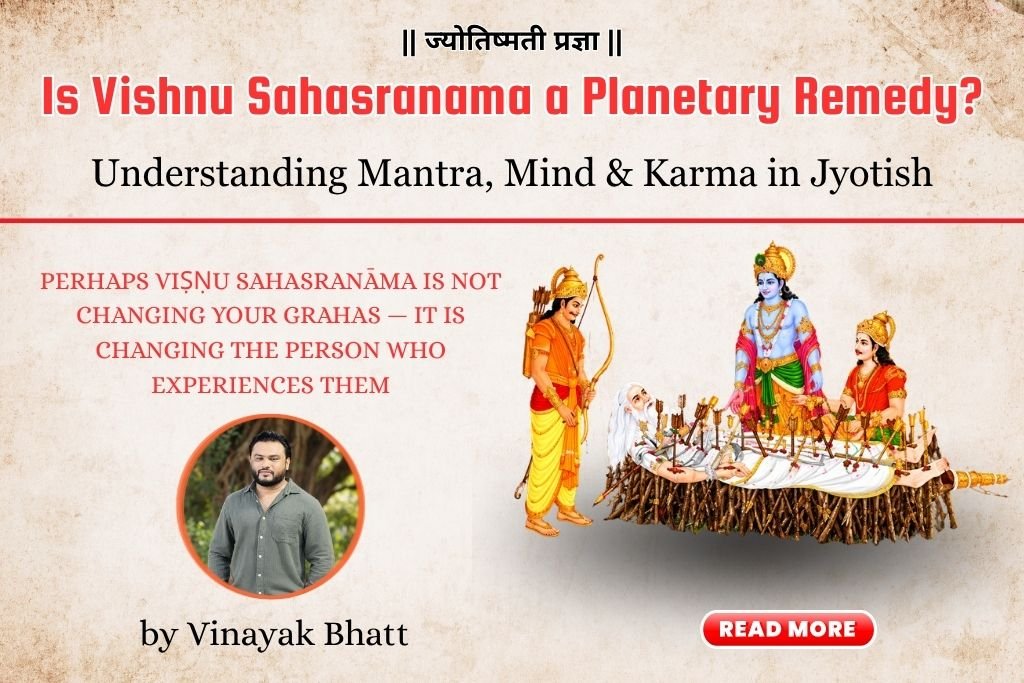
PERHAPS VIṢṆU SAHASRANĀMA IS NOT CHANGING YOUR GRAHAS – IT IS CHANGING THE PERSON WHO EXPERIENCES THEM
The more I study Viṣṇu Sahasranāma with Jyotish, meditation and Mantra Śāstra, the less comfortable I become with calling it simply a “remedy.” A remedy usually means, “I have a problem, please remove it.” But Viṣṇu Sahasranāma begins from a much larger question. Yudhiṣṭhira has already passed through one of the greatest human catastrophes imaginable.
The Mahābhārata war is over. Victory has come, but peace has not necessarily come with victory. He approaches Bhīṣma and asks: Who is the one supreme refuge? What is the highest Dharma? By remembering and praising whom can a human being cross the bondage of birth and saṁsāra? These are not the questions of a man looking for a quick planetary remedy. They are questions arising when worldly success has failed to solve the deeper problem.
And Bhīṣma’s answer eventually becomes Viṣṇu Sahasranāma. This itself is mystical. One thousand Divine Names are being taught by a man lying between life and death, to a king who has won his kingdom but is struggling with the weight of Karma. The setting itself is already a commentary on Jyotish. Sometimes the horoscope can show victory, Rājayoga, wealth and power, and yet the mind may remain disturbed. Therefore the highest question cannot always be, “Will I get the result?” Sometimes the real question is, “Who will I become after I get the result?”
Now look at the first few Names: Viśvam, Viṣṇuḥ, Vaṣaṭkāraḥ, Bhūta-bhavya-bhavat-prabhuḥ. The text begins with the universe itself, the all-pervading principle, Yajña, and immediately the Lord of what has been, what will be and what is. (Sanskrit Documents). For a Jyotish student, Bhūta–Bhavya–Bhavat should immediately catch the eye. Our entire subject is trying to understand Kāla – what has produced the present, what is happening now, and what is ripening next.
But there is a major difference. Jyotish studies time through Graha, Daśā, Nakṣatra, Gochar and Muhūrta. Viṣṇu Sahasranāma repeatedly takes the mind towards the principle within which time itself operates. This is why I would never reduce Viṣṇu Sahasranāma to “chant this for Jupiter” or “chant these names for Saturn.” Such applications may exist in particular remedial traditions, but the Sahasranāma itself is much larger than one Graha.
The first Name itself is Viśvam – the whole universe.
How can Viśvam fit inside one planetary box?
This is where the Brahma Sūtra gives a useful philosophical key. It begins the enquiry into Brahman and immediately states “जन्माद्यस्य यतः – janmādy asya yataḥ,” pointing towards that from which the origin and the rest of the universe proceed. In the introduction to the Sahasranāma, Bhīṣma similarly describes that principle from which beings arise at the beginning and into which they return at dissolution.
So when we chant the Names, we are not merely requesting favours from a deity sitting somewhere outside creation. The text is repeatedly moving attention towards the source, support and inner ground of the whole field in which our horoscope itself exists.
This changes my understanding of a Jyotish remedy.
Suppose Saturn is giving a difficult Daśā. Normally we ask, “How can I reduce Saturn?” But Viṣṇu Sahasranāma produces another question: Can I become internally larger than the experience Saturn is producing?
Suppose Rahu produces obsession. Must the first result of Sādhanā be that the object of obsession disappears, or could the deeper result be that my mind stops being enslaved by it?
Suppose Moon produces emotional instability. Should I only wait for the Gochar to improve, or can the quality of my Chitta itself become different?
Suppose Mars repeatedly produces conflict. What if the environment does not immediately change, but the person who responds to that environment changes?
For me, this is where Mantra and Jyotish meet.
And Bhagavad Gītā gives a remarkable statement: “यज्ञानां जपयज्ञोऽस्मि — yajñānāṁ japa-yajño’smi” — among Yajñas, Śrī Kṛṣṇa identifies Himself with Japa-Yajña. This is important. Japa is not simply repeated speech. In Yajña something is being offered. In external Yajña we immediately understand Āhuti. But in Japa-Yajña, what exactly are we offering?
Perhaps every repetition offers a little distraction.
A little anger.
A little anxiety.
A little ego.
A little uncontrolled Vāk.
A little compulsive thinking.
And slowly the mind which began the Sahasranāma is not exactly the same mind which finishes it.
Dharmaśāstra also gives Japa an extraordinarily high position. Manusmṛti 2.85–87 places mental Japa above lower forms of repetition and strongly elevates Japa-Yajña in relation to external sacrificial forms. Whether one approaches this through ritual hierarchy or meditation psychology, the message is clear: inner repetition is not considered a minor religious activity.
But here is where I feel many people miss something important.
We chant one thousand Names while mentally running one thousand other thoughts.
The tongue is saying Nārāyaṇa, the mind is checking WhatsApp.
The mouth reaches Acyuta, the mind has reached tomorrow’s business meeting.
By Govinda, we are remembering who insulted us three years ago.
Then after completing the Sahasranāma we ask, “Why am I not getting results?”
Patañjali gives a very useful clue. Speaking specifically about Praṇava, Yoga Sūtra 1.28 says “तज्जपस्तदर्थभावनम् — taj-japas tad-artha-bhāvanam” — its Japa should be accompanied by contemplation of its meaning. The following Sūtra connects that practice with inward consciousness and reduction of obstacles. I am not saying Patañjali was commenting on Viṣṇu Sahasranāma; he was not. But the principle is invaluable for Sahasranāma practice: sound and meaning should slowly begin meeting each other.
This is where Viṣṇu Sahasranāma can become meditation rather than merely recitation.
Take only one Name — Sākṣī, the Witness.
Do not rush.
What happens if a Jyotishi sits with this Name?
Saturn is giving something unpleasant — who is witnessing Saturn?
Moon is disturbed — who knows that Moon is disturbed?
Rahu wants something desperately — who is observing that wanting?
A thought has appeared, remained and disappeared — but what knew its arrival and departure?
One Name can become a meditation class.
Take another Name — Kṣetrajña, knower of the field.
Immediately a student of Gītā remembers Kṣetra and Kṣetrajña. A horoscope describes so much about the field — body, relationships, parents, profession, wealth, disease, desire and Karma. But are you merely the field described by the horoscope?
This is where Jyotish can become dangerous if badly understood. A person begins saying, “I am like this because my Moon is like this. I cannot change because my Saturn is like this. My marriage must fail because my Venus is like this.”
The horoscope, which was supposed to increase awareness, becomes another identity prison.
Sahasranāma keeps breaking that prison by repeatedly changing the angle from my limited story to the larger Tattva.
This is also why the Phalaśruti interests me more than many popular claims about Sahasranāma remedies. Yes, it speaks about prosperity, fear, difficulty and well-being. But then it gives something far more revealing: one established in this devotion is associated with inner happiness, patience, steadiness and memory, and the text specifically speaks of anger, jealousy, greed and impure thought falling away.
For me, this is one of the greatest tests of Mantra practice.
You have chanted Viṣṇu Sahasranāma for ten years.
Good.
Has your anger reduced?
Has jealousy reduced?
Has greed reduced?
Has your ability to tolerate delay improved?
Has your memory become steadier?
Has your speech become cleaner?
Have you become less frightened during a difficult Daśā?
If none of these has changed, but we have collected 5,000 chanting counts, perhaps we should examine what exactly we are practising.
This is where Rāmāyaṇa gives another beautiful key. Mārīca, of all people, describes Śrī Rāma as “Rāmo vigrahavān dharmaḥ” — Rama is Dharma embodied. This line tells me something important about Nāma. Divine Name cannot remain permanently separated from Ācāra, from the way we live.
If I chant Satya among the Divine Names and lie throughout the day, what has the Name entered?
If I chant Śānta and nourish anger daily, where is the Sādhanā going?
If I chant Dharmādhyakṣa but behave unfairly with employees, family or students, what exactly is being worshipped?
If I chant Bhūtabhāvana, the nourisher of beings, while deliberately hurting others, sound and conduct are moving in opposite directions.
Perhaps Mantra becomes powerful when Nāma slowly becomes Svabhāva.
And that is deeply relevant to Jyotish because Grahas also operate through behaviour. Saturn does not manifest only as an external delay; Saturn appears in how we respond to responsibility. Mars appears in our manner of action and conflict. Mercury appears through Vāk and decision. Jupiter through judgement, knowledge and values. Venus through relationship and exchange. Moon through response. Rahu through hunger. Ketu through disconnection.
Therefore one of the deepest effects of sustained Sahasranāma practice may not always be that the Graha stops giving its Karma.
It may be that our behavioural channel through which that Karma manifests begins changing.
This is a very important distinction.
A difficult Saturn Daśā plus resentment can produce one life.
The same Saturn Daśā plus patience, discipline and Dharma can produce another.
Mars plus uncontrolled anger produces one result.
Mars plus courage and protection of Dharma produces another.
Rahu plus unconscious craving produces one result.
Rahu plus awareness of craving produces another.
The Graha may be identical.
The consciousness receiving the Graha is not identical.
And perhaps this explains something about Yudhiṣṭhira’s question. He did not ask Bhīṣma for a technique to reverse the Mahābhārata war. That Karma had already ripened.
He asked for Parāyaṇa — the highest refuge.
Sometimes Jyotish tells us what can be changed.
Sometimes it tells us what must be endured.
Sometimes it tells us when action is required.
But spiritual Vidyā teaches something Jyotish alone cannot always give: how to remain internally established while Karma is unfolding.
That is why I increasingly hesitate to describe Viṣṇu Sahasranāma simply as a remedy for “bad planets.”
It is much more radical than that.
A planetary remedy asks: “Can my circumstance change?”
Sahasranāma eventually asks: “Who is this ‘I’ whose peace depends completely upon circumstance?”
Now I want Jyotish students to do a genuine experiment.
For the next few weeks, if you chant Viṣṇu Sahasranāma, do not only observe external events. Observe Moon, Mercury, Saturn, Mars and Rahu inside your behaviour.
Observe your mind before chanting and after chanting.
Observe anger.
Observe anxiety.
Observe speech.
Observe cravings.
Observe your reaction when somebody disagrees with you.
Observe whether you can sit for the complete recitation without reaching for the phone.
That is also Jyotish research.
And I want one serious discussion in the comments:
Which one Name from Viṣṇu Sahasranāma do you feel has the deepest Jyotish meaning?
Viśvam?
Sākṣī?
Kṣetrajña?
Acyuta?
Dhruva?
Kāla-related Names?
Śrīnivāsa?
Govinda?
Nārāyaṇa?
Or some completely different Name?
Write one Name + one Graha or Jyotish principle you connect with it + your logic.
But please don’t give me only, “This Name is for Saturn” or “this one is for wealth.”
Go deeper.
Because perhaps the real secret of Viṣṇu Sahasranāma is not that one thousand Names solve one thousand problems.
Perhaps one thousand Names slowly reveal that behind our thousand changing problems there is one consciousness which was never changing with them.
The Mahābhārata source is especially important here: its own Phalaśruti moves from external benefits toward ātma-sukha, kṣānti, dhṛti, smṛti and reduction of anger, jealousy and greed. That gives a much stronger basis for connecting Sahasranāma with meditation and Jyotish than inventing a planet-to-name remedy table.
Jai Guru Dev
Vinayak Bhatt
![Bhrigu Nandi Nadi Course for Beginners [Hindi]](https://vedicgrace.com/wp-content/uploads/2025/12/Bhrigu-Nandi-Nadi-for-Beginners-Hindi-Recorded-VG-300x214.png)



Leave a Comment
Be the first to comment on this blog!