
Sri Siddha Kunjika Stotram
Spirituality & Vedic Astrology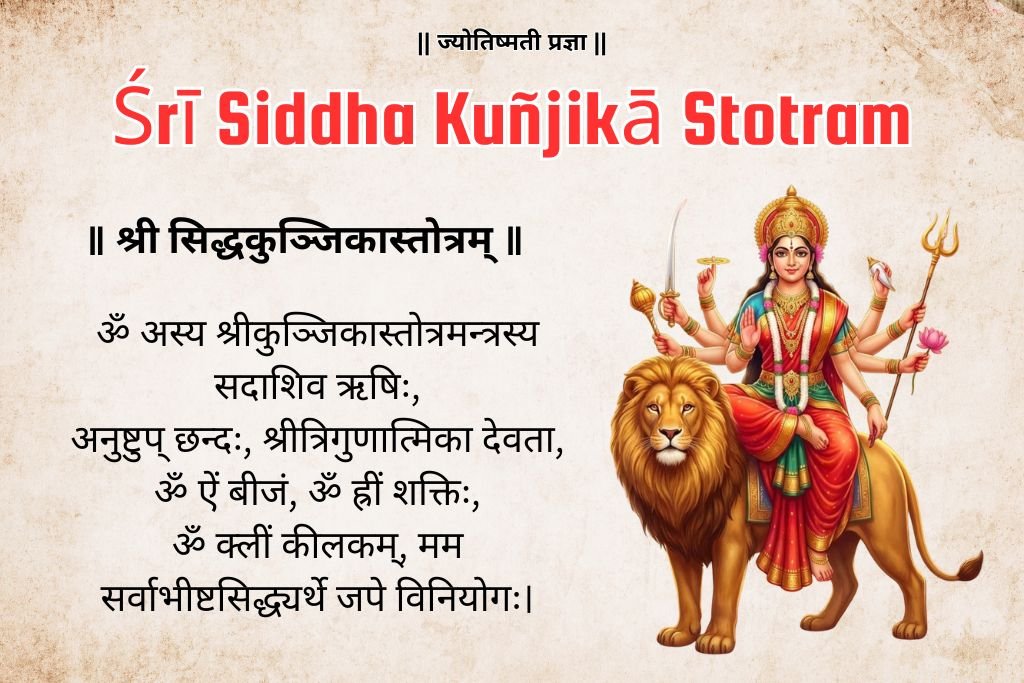
॥ श्री सिद्धकुञ्जिकास्तोत्रम् ॥
Śrī Siddha Kuñjikā Stotram — Complete Sanskrit Text, English Transliteration and Verse-by-Verse Translation
Siddha Kunjika Stotram is a sacred Tantric hymn dedicated to Bhagavatī Durgā and Caṇḍī. It is traditionally presented as a conversation between Lord Śiva and Goddess Pārvatī, and is associated with the Rudrayāmala and Gaurī Tantra traditions.
विनियोगः — Viniyoga
Sanskrit
ॐ अस्य श्रीकुञ्जिकास्तोत्रमन्त्रस्य सदाशिव ऋषिः, अनुष्टुप् छन्दः, श्रीत्रिगुणात्मिका देवता, ॐ ऐं बीजं, ॐ ह्रीं शक्तिः, ॐ क्लीं कीलकम्, मम सर्वाभीष्टसिद्ध्यर्थे जपे विनियोगः।
English Transliteration
Oṃ asya śrīkuñjikāstotramantrasya sadāśiva ṛṣiḥ, anuṣṭup chandaḥ, śrītriguṇātmikā devatā, oṃ aiṃ bījaṃ, oṃ hrīṃ śaktiḥ, oṃ klīṃ kīlakam, mama sarvābhīṣṭasiddhyarthe jape viniyogaḥ.
English Translation
For this sacred Siddha Kunjika Stotram:
- The Rishi is Lord Sadāśiva.
- The metre is Anuṣṭubh.
- The presiding Goddess is Triguṇātmikā, the Divine Mother who governs the three Guṇas — Sattva, Rajas and Tamas.
- The Bīja is Aiṃ.
- The Śakti is Hrīṃ.
- The Kīlaka is Klīṃ.
Part 1 — Śiva Reveals the Secret of Kunjika Stotram
Shloka 1 — The Teaching of Lord Śiva
Sanskrit
शिव उवाच ।
शृणु देवि प्रवक्ष्यामि कुञ्जिकास्तोत्रमुत्तमम् ।
येन मन्त्रप्रभावेण चण्डीजापः शुभो भवेत् ॥ १ ॥
English Transliteration
Śiva uvāca |
Śṛṇu devi pravakṣyāmi kuñjikāstotram uttamam |
Yena mantraprabhāveṇa caṇḍījāpaḥ śubho bhavet || 1 ||
English Translation
Lord Śiva said:
O Devi, listen carefully. I shall now reveal to you the supreme Kunjika Stotram.
Through the power of this sacred mantra, the recitation of Caṇḍī becomes auspicious and spiritually fruitful.
Shloka 2 — The Special Importance of Kunjika Stotram
Sanskrit
न कवचं नार्गलास्तोत्रं कीलकं न रहस्यकम् ।
न सूक्तं नापि ध्यानं च न न्यासो न च वार्चनम् ॥ २ ॥
English Transliteration
Na kavacaṃ nārgalāstotraṃ kīlakaṃ na rahasyakam |
Na sūktaṃ nāpi dhyānaṃ ca na nyāso na ca vārcanam || 2 ||
English Translation
For this special practice, separate recitation of the Kavacha, Argala Stotra, Kīlaka and Rahasya is not required.
Neither is the separate recitation of a Sūkta, formal meditation, Nyāsa or elaborate worship required.
Lord Śiva is explaining the independent importance of Kunjika Stotram. The verse is not a general rejection of these traditional practices.
Shloka 3 — The Hidden Power of the Stotram
Sanskrit
कुञ्जिकापाठमात्रेण दुर्गापाठफलं लभेत् ।
अति गुह्यतरं देवि देवानामपि दुर्लभम् ॥ ३ ॥
English Transliteration
Kuñjikāpāṭhamātreṇa durgāpāṭhaphalaṃ labhet |
Ati guhyataraṃ devi devānām api durlabham || 3 ||
English Translation
O Devi, through the recitation of Kunjika Stotram alone, the devotee receives the spiritual merit associated with the recitation of Durgā Saptashatī.
This knowledge is extremely secret and sacred. Even among the gods, it is considered difficult to obtain.
Shloka 4 — The Secrecy of the Sacred Teaching
Sanskrit
गोपनीयं प्रयत्नेन स्वयोनिरिव पार्वति ।
मारणं मोहनं वश्यं स्तम्भनोच्चाटनादिकम् ।
पाठमात्रेण संसिद्ध्येत् कुञ्जिकास्तोत्रमुत्तमम् ॥ ४ ॥
English Transliteration
Gopanīyaṃ prayatnena svayonir iva pārvati |
Māraṇaṃ mohanaṃ vaśyaṃ stambhanoccāṭanādikam |
Pāṭhamātreṇa saṃsiddhyet kuñjikāstotram uttamam || 4 ||
English Translation
O Pārvatī, protect this sacred knowledge with great care, just as a person protects the most private matters of life.
The text states that this supreme Kunjika Stotram is connected with Tantric powers such as Māraṇa (destruction), Mohana (enchantment), Vaśya (bringing under control), Stambhana (immobilisation) and Uccāṭana (driving away).
Through its recitation, the text traditionally claims that such Tantric accomplishments may be attained.
This verse describes the traditional claims of the text, not a direction to use these practices against others.
Part 2 — The Main Siddha Kunjika Mantra
Mantra 5 — The Navārṇa Mantra and the Awakening of Divine Śakti
Sanskrit
॥ अथ मन्त्रः ॥
ॐ ऐं ह्रीं क्लीं चामुण्डायै विच्चे ।
ॐ ग्लौं हुं क्लीं जूं सः ज्वालय ज्वालय ज्वल ज्वल प्रज्वल प्रज्वल ।
ऐं ह्रीं क्लीं चामुण्डायै विच्चे ज्वल हं सं लं क्षं फट् स्वाहा ॥ ५ ॥
॥ इति मन्त्रः ॥
English Transliteration
Atha mantraḥ |
Oṃ aiṃ hrīṃ klīṃ cāmuṇḍāyai vicce |
Oṃ glauṃ huṃ klīṃ jūṃ saḥ jvālaya jvālaya jvala j
Mantra 6 — Salutations to the Destroyer of Demons
Sanskrit
नमस्ते रुद्ररूपिण्यै नमस्ते मधुमर्दिनि ।
नमः कैटभहारिण्यै नमस्ते महिषार्दिनि ॥ ६ ॥
English Transliteration
Namaste rudrarūpiṇyai namaste madhumardini |
Namaḥ kaiṭabhahāriṇyai namaste mahiṣārdini || 6 ||
English Translation
Salutations to you, O Goddess, who possesses the fierce form of Rudra.
Salutations to you, who destroyed the demon Madhu.
Salutations to you, who destroyed Kaiṭabha.
Salutations to you, who defeated Mahiṣāsura.
You are the divine power that removes destructive forces and restores Dharma.
Mantra 7 — Awakening the Power of the Mantra
Sanskrit
नमस्ते शुम्भहन्त्र्यै च निशुम्भासुरघातिनि ।
जाग्रतं हि महादेवि जपं सिद्धं कुरुष्व मे ॥ ७ ॥
English Transliteration
Namaste śumbhahantryai ca niśumbhāsuraghātini |
Jāgrataṃ hi mahādevi japaṃ siddhaṃ kuruṣva me || 7 ||
English Translation
O Mahādevī, salutations to you, who destroyed Śumbha and Niśumbha.
O Divine Mother, please awaken the spiritual power of my mantra recitation.
May my Japa become successful and spiritually fruitful through your blessings.
Mantra 8 — The Three Bīja Powers of the Goddess
Sanskrit
ऐङ्कारी सृष्टिरूपायै ह्रीङ्कारी प्रतिपालिका ।
क्लीङ्कारी कामरूपिण्यै बीजरूपे नमोऽस्तु ते ॥ ८ ॥
English Transliteration
Aiṅkārī sṛṣṭirūpāyai hrīṅkārī pratipālikā |
Klīṅkārī kāmarūpiṇyai bījarūpe namo’stu te || 8 ||
English Translation
Salutations to the Goddess who manifests as the sacred sound Aiṃ and takes the form of creation.
Through Hrīṃ, she becomes the divine power that protects and sustains the universe.
Through Klīṃ, she becomes the power associated with desire and its manifestation.
O Divine Mother, you exist as the very essence of these sacred Bīja Mantras. I bow before you.
Mantra 9 — The Power of Cāmuṇḍā and the Navārṇa Mantra
Sanskrit
चामुण्डा चण्डघाती च यैकारी वरदायिनी ।
विच्चे चाऽभयदा नित्यं नमस्ते मन्त्ररूपिणि ॥ ९ ॥
English Transliteration
Cāmuṇḍā caṇḍaghātī ca yaikārī varadāyinī |
Vicce cābhayadā nityaṃ namaste mantrarūpiṇi || 9 ||
English Translation
O Cāmuṇḍā, you are the destroyer of the demon Caṇḍa.
Through the sacred sound Yai, you are the giver of blessings and boons.
Through Vicce, you are praised as the Goddess who grants freedom from fear.
O Divine Mother, you are the living form of the sacred mantra itself. I bow before you.
Mantra 10 — The Goddess as Kālikā and Vāgīśvarī
Sanskrit
धां धीं धूं धूर्जटेः पत्नी वां वीं वूं वागधीश्वरी ।
क्रां क्रीं क्रूं कालिका देवि शां शीं शूं मे शुभं कुरु ॥ १० ॥
English Transliteration
Dhāṃ dhīṃ dhūṃ dhūrjaṭeḥ patnī vāṃ vīṃ vūṃ vāgadhīśvarī |
Krāṃ krīṃ krūṃ kālikā devi śāṃ śīṃ śūṃ me śubhaṃ kuru || 10 ||
English Translation
O Goddess, you are the divine consort of Lord Śiva, who wears matted hair.
You are Vāgadhīśvarī, the supreme Goddess of speech and expression.
You are also Goddess Kālikā, the powerful form of the Divine Mother.
O Devi, through your sacred Bīja Mantras, please bring auspiciousness into my life.
Mantra 11 — The Power of Bhairavī and Bhavānī
Sanskrit
हुं हुं हुङ्काररूपिण्यै जं जं जं जम्भनादिनी ।
भ्रां भ्रीं भ्रूं भैरवी भद्रे भवान्यै ते नमो नमः ॥ ११ ॥
English Transliteration
Huṃ huṃ huṅkārarūpiṇyai jaṃ jaṃ jaṃ jambhanādinī |
Bhrāṃ bhrīṃ bhrūṃ bhairavī bhadre bhavānyai te namo namaḥ || 11 ||
English Translation
O Goddess, you are the embodiment of the powerful sacred sound Huṃ.
You possess the power of Jambhana, traditionally understood as the power of arresting or stopping forces.
You are Bhairavī, the fierce divine power.
You are Bhadrā, the auspicious Goddess, and Bhavānī, the Divine Mother.
Again and again, I bow before you.
Mantra 12 — Awakening the Inner Fire of the Mantra
Sanskrit
अं कं चं टं तं पं यं शं वीं दुं ऐं वीं हं क्षम् ।
धिजाग्रं धिजाग्रं त्रोटय त्रोटय दीप्तं कुरु कुरु स्वाहा ॥ १२ ॥
English Transliteration
Aṃ kaṃ caṃ ṭaṃ taṃ paṃ yaṃ śaṃ vīṃ duṃ aiṃ vīṃ haṃ kṣam |
Dhijāgraṃ dhijāgraṃ troṭaya troṭaya dīptaṃ kuru kuru svāhā || 12 ||
English Translation
This mantra begins with a sequence of sacred Bīja sounds.
The repeated expression Dhijāgraṃ is traditionally associated with awakening, while Troṭaya conveys the idea of breaking or cutting through, and Dīptaṃ Kuru means to make something shine or become radiant.
In devotional understanding, the practitioner is calling upon the Goddess to awaken the power of the mantra, remove obstructions and kindle divine radiance.
Because the opening syllables are Tantric Bījas, they should not be given invented literal meanings.
Mantra 13 — Pārvatī, Khecarī and the Power of Saptashatī
Sanskrit
पां पीं पूं पार्वती पूर्णा खां खीं खूं खेचरी तथा ।
सां सीं सूं सप्तशती देव्या मन्त्रसिद्धिं कुरुष्व मे ॥ १३ ॥
English Transliteration
Pāṃ pīṃ pūṃ pārvatī pūrṇā khāṃ khīṃ khūṃ khecarī tathā |
Sāṃ sīṃ sūṃ saptaśatī devyā mantrasiddhiṃ kuruṣva me || 13 ||
English Translation
O Goddess Pārvatī, you are complete and perfect in yourself.
You are Khecarī, the divine power that moves freely through the vast expanse of space.
You are the Goddess whose glory is expressed through the sacred Durgā Saptashatī.
O Divine Mother, please bless my mantra practice with spiritual accomplishment.
Concluding Salutation
कुञ्जिकायै नमो नमः ।
Kuñjikāyai namo namaḥ |
Again and again, I bow before Goddess Kuñjikā.
Mantra 14 — The Secret of Mantra Awakening
Sanskrit
इदं तु कुञ्जिकास्तोत्रं मन्त्रजागर्तिहेतवे ।
अभक्ते नैव दातव्यं गोपितं रक्ष पार्वति ॥ १४ ॥
English Transliteration
Idaṃ tu kuñjikāstotraṃ mantrajāgartihetave |
Abhakte naiva dātavyaṃ gopitaṃ rakṣa pārvati || 14 ||
English Translation
O Pārvatī, this Kunjika Stotram is meant for awakening the spiritual power of the mantra.
This sacred knowledge should not be given to a person who has no devotion or respect for the practice.
Therefore, O Pārvatī, carefully protect and preserve this secret teaching.
Mantra 15 — The Importance of Kunjika in Caṇḍī Pāṭha
Sanskrit
यस्तु कुञ्जिकया देवि हीनां सप्तशतीं पठेत् ।
न तस्य जायते सिद्धिररण्ये रोदनं यथा ॥ १५ ॥
English Transliteration
Yas tu kuñjikayā devi hīnāṃ saptaśatīṃ paṭhet |
Na tasya jāyate siddhir araṇye rodanaṃ yathā || 15 ||
English Translation
O Devi, the person who recites Durgā Saptashatī without Kunjika Stotram does not attain the spiritual accomplishment described here.
Such a recitation is compared to crying in an empty forest, where no one is present to hear.
Lord Śiva uses this comparison to emphasise the special importance of Kunjika Stotram in this tradition.
॥ इति श्री सिद्धकुञ्जिकास्तोत्रम् ॥
Traditional Closing
इति श्रीरुद्रयामले गौरीतन्त्रे शिवपार्वतीसंवादे कुञ्जिकास्तोत्रम् ।
English Transliteration
Iti śrīrudrayāmale gaurītantre śivapārvatīsaṃvāde kuñjikāstotram |
English Translation
Thus concludes Kunjika Stotram, traditionally attributed to the Gaurī Tantra within the Rudrayāmala tradition, presented as a sacred conversation between Lord Śiva and Goddess Pārvatī.



![Shri H. N. Katwe: Secrets of Sun [Predictive Techniques Related to Sun]](https://vedicgrace.com/wp-content/uploads/2025/11/Shri-H.-N.-Katwe-Secrets-of-Sun-300x214.png)

Leave a Comment
Be the first to comment on this blog!