
Bharani Nakshatra Pada 1: Pending Karma and Predictions from Karma Vipaka Samhita By Vinayak Bhatt
Karma Vipaka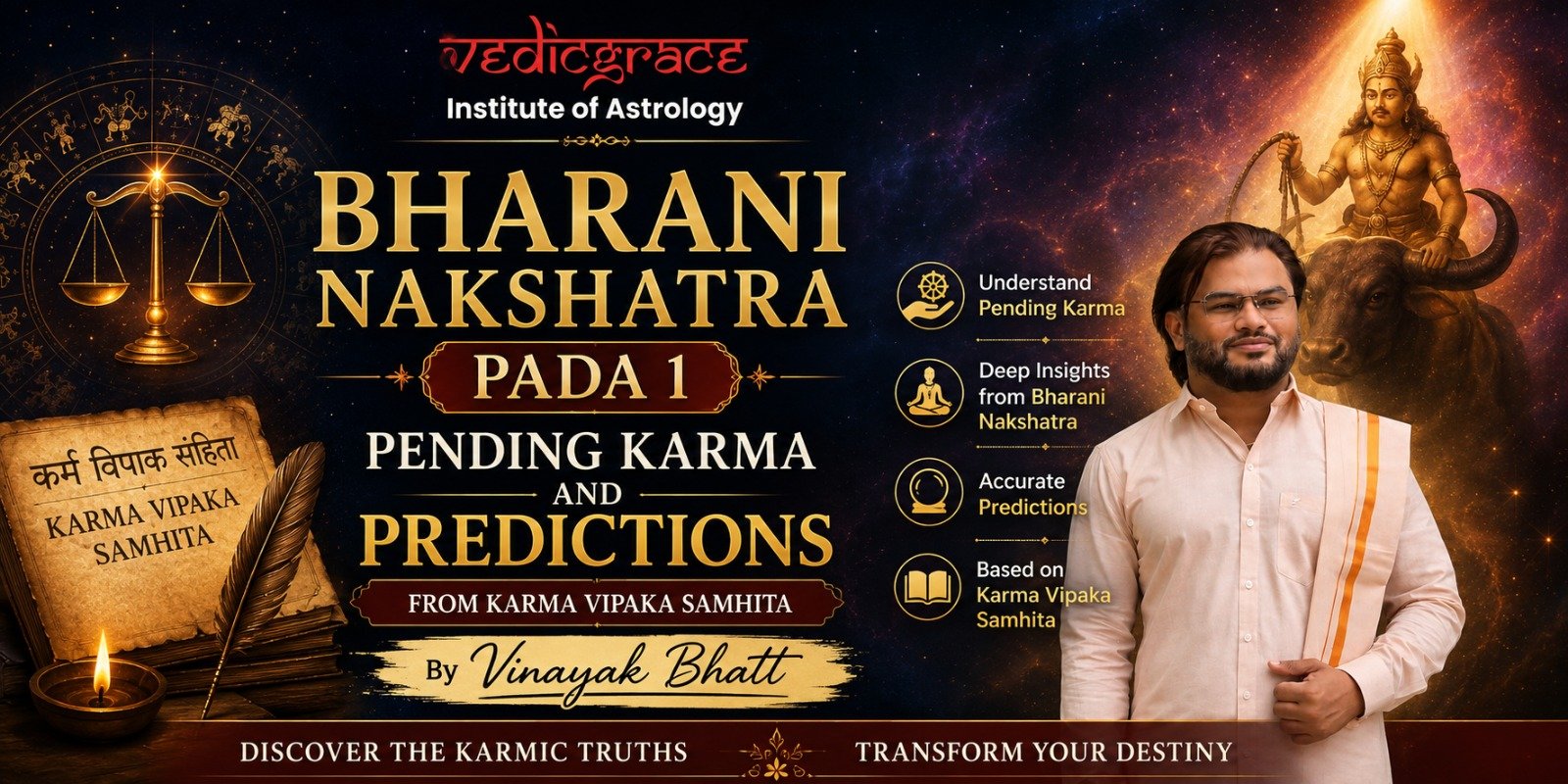
Most students first understand Bharani Nakshatra through Venus, Yama, birth, death, sexuality, restraint, suffering, responsibility and the ability to carry something difficult until its natural conclusion. These are useful meanings, but Bharani Nakshatra Pada 1 becomes much more practical when we study it through Karma Vipaka Samhita because the text gives us a very specific karmic situation: a financial obligation was created, the money was not returned, the creditor later entered the debtor’s own family, and the old financial account turned into an emotional account. This is one of the clearest examples in Karma Vipaka Samhita of what Jyotish traditionally understands through Rinanubandha, the bond created through debt.
A debt does not always return only as another financial demand. Sometimes the person to whom we owe something returns as somebody we deeply love. Then money is no longer the real issue. Attachment becomes the method of repayment.
Bharani Nakshatra occupies 13°20′ to 26°40′ Aries. Its first pada covers 13°20′ to 16°40′ Aries and falls in Leo Navamsha, ruled by the Sun. The Nakshatra itself is ruled by Venus and its Devata is Yama, the divine authority connected with order, consequence, restraint and the unavoidable result of actions.
So Bharani Pada 1 brings together Mars, Venus, Yama and the Sun.
- Mars gives personal action.
- Venus governs value, exchange, money, agreements, relationships and what we consider desirable.
- Yama keeps the account and establishes the boundary between what is permitted and what must eventually be answered for.
- And the Leo Navamsha brings the Sun, which introduces honour, responsibility, Dharma, authority and the question of whether one’s conduct is worthy of the role one occupies.
This combination fits the Karma Vipaka story remarkably well because the central person in the story was born into a position which carried responsibility, but his actual conduct moved away from that responsibility. That is where the story begins.
The Karma Vipaka Story of Bharani Pada 1
Lord Shiva explains the Karma Vipaka connected with Bharani Nakshatra first pada through the story of a Brahmin named Neelakantha, who lived in a beautiful place called Kakutstha or Kakustha Nagar.
The text describes Neelakantha as Brahma-Karma-Bhrashta. This expression is important. It does not simply mean that he was born into a Brahmin family. It says that he had moved away from the work and conduct expected from that position.
A Brahmin’s traditional field involved learning, teaching, Yajna, religious work, guiding others and maintaining a life directed towards knowledge and Dharma. Neelakantha, however, had moved into trade and commercial dealings.
The problem should not be misunderstood as saying that business itself is wrong for a Brahmin in modern life. That would miss the real point. The text is showing a person whose outer position and inner conduct had separated. He possessed one kind of responsibility but lived according to another motivation.
Neelakantha had a Vaishya friend with whom he conducted business and from whom goods were obtained for trade. In the same area lived an elderly Brahmin woman who had neither husband nor son. She was therefore socially and financially vulnerable.
At this stage the available translations differ slightly.
One version says that Neelakantha borrowed money directly from this elderly woman to use in his business. Another translation says that the financial arrangement passed through the Vaishya merchant. Another commentary says more directly that Neelakantha took the Brahmin woman’s gold or wealth as a business loan and failed to return it even after a long time had passed.
Whichever reading we follow, the karmic centre remains the same: money belonging to a vulnerable woman was taken for commercial use and was never properly returned.
Neelakantha later died, and the text says that because of his corrupted conduct he underwent suffering after death. He then passed through a serpent birth and a donkey birth before again obtaining human birth.
In the next human incarnation he was born in Madhyadesha. The translations vary on whether he possessed substantial wealth or was deprived of wealth, but they agree on the more important result: he had no children.
Then something remarkable happened. After a long period, a daughter was born. The Karma Vipaka tradition identifies this daughter with the same elderly Brahmin woman whose money had remained unpaid. This is the key to the whole story. The creditor had entered the debtor’s family. The person whose material security had been disturbed was no longer standing outside asking for repayment. She was now inside the house as somebody the native loved more than money.
The girl grew up and became extremely dear to her parents. When she reached marriageable age, her parents arranged her marriage with affection and expectation. But soon after marriage she became a widow. Her widowhood brought great sorrow to her parents, and the text again connects the native with the pain of interrupted lineage and unfulfilled hopes concerning descendants.
This is not merely a story about money. It is a story about how financial debt can become emotional debt when it remains unresolved.
What Is the Pending Karma of Bharani Pada 1?
The pending karma of Bharani Pada 1 is not simply “failure to repay a loan.”
The deeper issue is what happens when somebody else’s trust, need and resources are used for one’s own progress while their rightful claim is postponed or ignored.
Neelakantha did not rob an unknown person on the road. He accepted wealth in a relationship. That distinction matters. The elderly woman gave because some level of trust existed. Neelakantha received because he had a use for the money. Time passed. His business purpose continued. But her claim did not receive the same importance as his own need.
This gives us the real karmic sutra of Bharani Pada 1: A debt which is convenient for us to forget may become a relationship which life does not allow us to forget.
This is where Bharani becomes very different from a simple financial Nakshatra.
Bharani is ruled by Yama. Yama represents order and consequence. An unpaid account does not disappear simply because the creditor stops asking. And Venus, as Nakshatra lord, connects the whole event with value and exchange. If the exchange becomes unequal, Yama eventually restores the balance.
The Leo Navamsha gives another layer. The Sun represents integrity. So the karmic test is not merely whether one has money available to repay. The test is whether one honours an obligation even when nobody has the power to force repayment.
That is a much higher examination.
How Bharani Pada 1 Can Manifest in Present Life
When Bharani Nakshatra Pada 1 becomes prominent through the Moon, Lagna, Atmakaraka or another important planet, I would pay close attention to the person’s relationship with loans, delayed payments, informal borrowing, business credit, money taken from relatives, investments received through trust and obligations which remain technically open for a long time.
This does not mean every Bharani Pada 1 native will become a debtor. The karmic pattern can work from either direction.
- Some people with this pada may repeatedly lend money and then struggle to recover it.
- They may help relatives financially and discover years later that nobody intends to repay them.
- They may invest in somebody’s business because of trust rather than proper paperwork.
- They may become emotionally involved with somebody who already owes them money.
In another chart, the native may be the person who repeatedly lives through debt.
- Money comes easily when required, but repayment keeps getting postponed.
- A friend pays a bill.
- A relative provides business capital.
- An elderly family member lends money.
- A partner temporarily covers an expense.
- The native sincerely intends to return it, but something always becomes more urgent.
This is exactly the kind of situation which should be watched carefully. The amount does not have to be enormous. The karmic issue is not decided only by the number of rupees. The important question is whether another person’s rightful share has been held back because returning it is inconvenient.
There can also be a strong connection between business and personal relationships.
Someone may borrow from a friend and later avoid the friend because the debt has become uncomfortable.
- A sibling relationship may deteriorate because of an unpaid family loan.
- A person may accept investment from a relative and later begin treating the investment as a gift.
- A client may pay in advance and the promised work may remain incomplete.
- An employer may delay salaries even while spending comfortably elsewhere.
All of these examples carry the same structure.
- Value was received.
- An obligation was created.
- The obligation was not completed.
Bharani says the matter must eventually reach completion.
The Strong Prediction: Unfinished Financial Accounts Can Return Through Relationships
If a strong planet occupies Bharani Nakshatra Pada 1 and the 2nd, 5th, 6th, 8th or 11th houses repeat the pattern, one prediction can become very useful:
An important relationship in the native’s life may carry an old financial or obligation-based Rinanubandha.
I would not tell the client, “Your daughter was your creditor in a previous birth.” That is far too literal unless extraordinary supporting factors exist.
Instead, I may say: “There is a pattern in your chart where money and emotional relationships become connected. Be careful about borrowing from people you love because the financial account can later affect the relationship much more than you expect.”
In another chart: “You may find that somebody who costs you money, demands a lot from you or creates repeated financial responsibility is also somebody you cannot emotionally walk away from. This relationship may be functioning like a karmic repayment.”
Or: “You should close old debts even when the lender has stopped asking. Delayed money can become delayed peace.”
Another variation can be especially important for business people: “Do not use another person’s capital indefinitely simply because the person trusts you. Give regular accounts and establish a clear repayment or profit-sharing structure.”
- When the 5th house is involved, the relationship may come through children.
- When the 7th is involved, spouse or business partner may carry the account.
- When the 3rd is involved, siblings may become connected with the debt.
- When the 6th becomes dominant, loans and repayment disputes can become a major life theme.
The Nakshatra gives the story. The horoscope tells us who is playing each role.
Rinanubandha: Why the Creditor Returns as the Daughter
The most valuable teaching hidden in Bharani Pada 1 is the idea that the old Brahmin woman returns as the daughter of the same person who failed to repay her. This gives students a very useful way of understanding Rinanubandha in Jyotish.
- Rina means debt.
- Anubandha means bond or connection.
So a Rinanubandha is not simply an outstanding bank balance. It is a relationship created because something remains to be exchanged, repaid, completed, experienced or balanced between two beings. This is why some relationships feel far heavier than their visible history can explain.
- One child may require unusual financial sacrifice.
- Another may cause enormous emotional worry.
- A relative may repeatedly come to the native whenever money is involved.
- A person may meet someone and almost immediately become responsible for them.
From ordinary logic, the bond looks disproportionate. From the viewpoint of Karma Vipaka, the relationship may be carrying an older account. The Bharani Pada 1 narrative makes this principle extremely clear because the repayment is no longer financial in the second human birth. Neelakantha does not simply hand the woman back her gold.
- He receives her as his daughter.
- He feeds her.
- He clothes her.
- He raises her.
- He becomes attached to her.
- He spends on her marriage.
And when she suffers, he suffers. The old monetary value has been converted into care, time, attachment, responsibility and pain.
This is why karmic repayment cannot always be measured in money.
Why Progeny Appears in Bharani Pada 1
The Bharani Pada 1 story repeatedly returns to progeny. Initially, the reborn native is without children. Later a daughter is born. That daughter becomes deeply loved.
Her early widowhood creates suffering and again disturbs the native’s hope for continuation through the next generation.
For a Jyotish student, this is important because the 5th house is the house of Purva Punya. It shows what comes forward from the past. And here the past literally enters the native’s life through a child.
This gives us a useful predictive principle: When the 5th house carries debt-related karma, children may become the channel through which an old obligation is repaid. This does not mean the child is “bad karma.” That would be a serious misunderstanding. The child may be the most loved person in the native’s life. Precisely because of that love, the relationship becomes powerful enough to settle an old account.
- One child may require very expensive education.
- Another may need long-term financial support.
- One may remain dependent much longer than expected.
- Another may create a business liability.
- Another may require the parent to give up property, wealth, career or personal comfort.
The prediction should not be that the child is a punishment. The better understanding is that responsibility itself may be the repayment. And this should only be predicted when the 5th house, fifth lord, Jupiter, Putrakaraka, Saptamsha and relevant Dashas confirm the theme.
Without confirmation, do not force the literal story.
Bharani Pada 1 and the Karma of Debt
Debt is normally seen through the 6th house in Jyotish. But Bharani Pada 1 shows that the meaning of Rina is much larger.
A bank loan has clear paperwork. Karmic debt often does not.
- You may owe somebody gratitude.
- You may owe an employee money.
- You may owe a student knowledge you promised to teach.
- You may owe a business partner their share.
- You may owe your parents support.
- You may have borrowed jewellery and never returned it.
- You may have accepted help during difficulty and disappeared once your situation improved.
These are all accounts. Yama does not care only about legal enforceability. The deeper question is whether the exchange was completed fairly. This is why a strong Bharani Pada 1 native should develop a habit of closing accounts properly. Do not allow small unpaid obligations to remain open for years. If somebody lent money, return it. If full repayment is not possible, communicate. If somebody invested, give accounts. If you promised a share, honour the share. If a service was received, pay fairly. If someone helped you when you were helpless, remember them after you become strong. These acts look ordinary. For this pada, they are spiritual practice.
Bharani Pada 1 and Health
The detailed Bharani Pada 1 chapter is primarily concerned with debt, childlessness, the daughter and interruption of lineage. It does not give the same strong disease narrative seen in some other Nakshatra padas. That distinction should be respected. We should not invent a disease prediction merely because Bharani as a Nakshatra has wider medical significations.
Bharani ia also associated with Pitta tendencies and mentions possible concerns involving reproductive organs, mucus or catarrhal conditions, dysentery, eyes and related areas, but his own method clearly says such indications have to be synchronised with planets, houses and affliction. Therefore, an astrologer should keep the hierarchy clear.
Bharani Pada 1 by itself does not justify a medical diagnosis.
If Bharani Pada 1 is tied strongly to Lagna, Moon, 6th house, 8th house, Venus, Mars and afflicted health factors, then the general Bharani health indications may become more relevant. But in the Karma Vipaka narrative, the stronger predictive field is financial and progeny karma. That should remain the main interpretation.
The Child as an Instrument of Karma
The daughter is not a side character in this story. She is the centre of the karmic return. The old creditor could have returned as an enemy. She could have returned as another lender. She could have returned as a business partner demanding repayment. But Karma Vipaka places her inside the native’s heart. That is important. There are certain debts which can be settled only when we develop the feeling which was absent when the original action happened.
When Neelakantha retained the woman’s money, her insecurity apparently did not move him enough to return it. In another birth, when she becomes his daughter, her security becomes his own concern. Now her happiness matters. Her marriage matters. Her future matters. Her suffering hurts him. This is a very deep karmic reversal. The soul is being made to experience the value of the person whose needs it once ignored.
So one of the most useful sutras from Bharani Nakshatra Pada 1 is: What we once treated as somebody else’s problem can return as somebody we cannot stop caring about.
This is why relationships can educate the soul in ways that punishment cannot.
Why One Unpaid Debt Can Become Expensive
An unpaid debt looks small when viewed only from the debtor’s side. The debtor thinks in numbers.
- “I only owe this much.”
- “I will pay later.”
- “They have enough money.”
- “They are not asking.”
But the creditor experiences something else. They may experience insecurity, betrayal, loss of trust, humiliation and fear. The inability to use their own money when they need it. This is especially important in the Karma Vipaka story because the creditor is not described as a wealthy merchant who could easily absorb the loss.
She is an elderly woman without husband or son. That means her vulnerability is part of the karmic weight.
This gives us another predictive rule: The karmic weight of a financial action is not decided only by the amount taken; it is also affected by what that amount means to the person who loses it.
Taking ₹10,000 from somebody who owns crores and withholding ₹10,000 from somebody who needs medicine are not emotionally identical actions. This is why Dharma requires context. Bharani is the Nakshatra of Yama. Yama measures consequence. And consequence includes the suffering created by our action.
The Higher Side of Bharani Pada 1
The lower expression of Bharani Pada 1 can delay repayment. The higher expression becomes extremely careful about responsibility. Such a person can become somebody who never forgets a promise.
- They may maintain clear accounts.
- They may repay earlier than expected.
- They may become very protective of elderly people, widows or those who have no financial support.
- They may help people escape debt.
- They may work in finance, banking, taxation, law, administration, collections, compliance, trusteeship, accounting, social welfare or professions where one person’s resources must be handled responsibly.
This is where Yama becomes a strength. Yama is not merely punishment. Yama is order. Without boundaries, there can be no fair exchange. Without consequence, trust has no value. Without repayment, commerce cannot continue.
The Sun as Navamsha lord also becomes important here. The higher expression of Leo Navamsha says: “My word has value because I honour it.”
Venus says: “Exchange should be fair.”
Mars says: “Do what is required.”
And Yama says: “Complete what you started.”
When these four principles work together, Bharani Pada 1 can produce somebody people trust precisely because the person understands the seriousness of obligation.
Traditional Remedies and the Logic Behind Them
The Karma Vipaka Samhita gives a clear Prayaschitta for Bharani Nakshatra Pada 1. The source prescribes one lakh repetitions of a Surya mantra. Hemant Bhatt notes Surya Gayatri or a Vedic Surya mantra as possible readings in his commentary. This is particularly meaningful because Bharani Pada 1 falls in Leo Navamsha, ruled by the Sun. The remedy therefore restores the Sun principle: truth, honour, responsibility and clean conduct.
The text then prescribes worship of a Parthiva Shivlinga, a Shiva Linga made from earth, together with repetition of the Tryambaka or Mahamrityunjaya Mantra. After this, Homa is to be performed under proper guidance and one hundred Brahmins are to be fed, with food including Payasa or Kheer.
The most striking remedy comes next.
The native is told to establish wells, step-wells, ponds, reservoirs or other water sources, particularly where travellers can benefit from them. And the text explicitly says that by doing this the lineage continues; if the required correction is not made, continuity remains obstructed. This remedy gives us the deepest clue to the karmic logic of the whole chapter.
The original act withheld a resource. The remedy creates a resource. The original money served one person’s business. The remedial water serves everybody. The original creditor was vulnerable. The remedy supports unknown people, travellers and communities who may have no personal power over the donor. The original act says: “I will keep what came to me.” The remedy says: “I will create something from which others can freely take.”
This is a complete reversal of the karmic direction.
Why the Water Remedy Is So Important
Students should not pass quickly over the instruction to build wells and ponds because it contains a major rule of remedial astrology.
Water is life. A well does not ask whether the traveller is rich or poor. A pond does not ask whether the animal can repay. The donor provides something essential without expecting a return from the receiver.
Compare this with Neelakantha’s action. He received value and failed to return it. The remedy teaches him to give value without demanding repayment. This is why the remedy is psychologically and karmically exact.
In modern life, this principle may be expressed through restoring village ponds, contributing towards drinking-water facilities, installing water systems in schools, Dharmashalas or pilgrimage routes, supporting clean-water projects or helping maintain traditional wells and water bodies.
These should be understood as practical expressions of the principle, not as replacements for formal classical Prayaschitta when a person wishes to follow the ritual text exactly.
A Practical Remedy for Modern Life
The strongest daily remedy for Bharani Pada 1 is to stop carrying unnecessary debt. This does not mean a person should never take a legitimate bank loan or business finance. Debt itself is not the sin in the story. Failure to honour the obligation is the problem. Keep a written record of money borrowed from friends and relatives. Do not wait for the other person to ask repeatedly. If repayment becomes difficult, tell them before the due date rather than disappearing. Return borrowed objects. Pay pending professional fees. Clear old employee dues. Pay commissions honestly.
Complete work for which advance payment has already been received. If you discover that you owe somebody money from years ago, contact them and settle it. And pay special attention when the person who helped you was vulnerable, elderly, dependent or acting purely out of trust.
Another powerful practical remedy is to support somebody who cannot easily recover what is owed to them. Help an elderly person manage finances. Support a widow in distress. Help a deserving person become free of exploitative debt. Pay for a child’s education where the family cannot afford it. Create drinking-water facilities. In other words, reverse the old pattern consciously.
Do not merely ask: “How do I remove my karma?”
Ask: “What action today is the exact opposite of the old pattern?”
That question produces much better remedies.
How to Confirm Bharani Pada 1 in a Horoscope
Karma Vipaka gives the story, but the complete horoscope tells us how literally the story should be applied.
For Bharani Nakshatra Pada 1, four factors deserve immediate attention: Venus, Mars, Sun and the 5th and 6th house axis.
Venus rules Bharani and therefore shows how exchange, value, relationships and money operate. Mars rules Aries and tells us how the person acts when personal need becomes strong. The Sun rules Leo Navamsha and becomes important for honour, fatherhood, responsibility, promises, authority and repayment through Dharma. Yama is not a Graha, but his principle should be read through houses and planets connected with debt, consequence and accountability.
- The 2nd house shows accumulated wealth and what the person considers their own.
- The 6th house is crucial because it rules Rina, debt, obligations and repayment.
- The 8th house becomes important for other people’s money, shared resources and unresolved financial entanglement.
- The 11th house can show friends, business networks, gains and people through whom resources arrive.
- The 5th house tells us whether the old debt is returning through children, Purva Punya, education, students or legacy.
- The 7th house should be examined if the account enters through marriage or business partnership.
Then Dasha tells us when the old account becomes active.
- A Venus Dasha can activate money, relationships, contracts and the Bharani Nakshatra itself.
- A Sun Dasha may bring repayment, authority, reputation, fatherhood or a situation where the native’s integrity is tested.
- A Mars Dasha can force quick financial decisions or produce conflict over money.
- A 6th lord Dasha can bring loans, creditors and old obligations to the surface.
- A 5th lord or Jupiter period can activate the same karma through children or descendants.
- If Mercury occupies Bharani Pada 1, business agreements, contracts, accounts and documentation may become the field.
- If Venus occupies it, money, relationship and pleasure can become strongly interconnected.
- If Jupiter occupies the pada, children, teachers, knowledge and Dharma may become the route of repayment.
- If Saturn occupies it, an old debt may remain for years and repayment may become a long-term responsibility.
- If Moon occupies Bharani Pada 1, the emotional part of Rinanubandha can become much stronger and family relationships may carry the account.
This is how the story should be converted into predictive Jyotish. Do not announce a past-life story merely because one planet is in Bharani Pada 1.
Find the repetition. Then predict.
The Real Teaching of Bharani Pada 1
Bharani Nakshatra Pada 1 gives one of the finest teachings on Rinanubandha in Karma Vipaka Samhita.
Neelakantha took money. He did not return it. The creditor disappeared from his visible life. But the account did not disappear. She returned as his daughter. Now he could no longer ignore her. He had to care for her. He had to spend upon her. He had to become attached to her. And when she suffered, he experienced her suffering as his own.
This tells us something very important about karma: Life does not always collect a debt in the same currency in which it was created.
Money can return as responsibility. Neglect can return as attachment. Another person’s insecurity can return as our own anxiety. A forgotten promise can return as a relationship we cannot escape.
This is why Bharani is ruled by Yama. Yama does not forget the account. But Yama is not merely standing there to punish. He restores balance. And Bharani itself carries something through a difficult passage until the process is complete. That is the soul lesson of Bharani Pada 1.
- Do not leave exchanges incomplete.
- Do not use trust as free capital.
- Do not assume that silence means forgiveness of debt.
- Do not wait until somebody becomes your enemy before you recognise their rightful claim.
- And most importantly, do not imagine that money and relationships belong to two different worlds.
A financial act can create a relationship. A relationship can become repayment.
At the lower level, Bharani Pada 1 postpones what must be paid. At the middle level, life repeatedly places the native inside complicated financial relationships until the principle becomes clear. At the higher level, the same person becomes extremely trustworthy because they understand the sacred nature of obligation.
- Venus teaches the value of exchange.
- Mars gives the strength to act.
- The Sun restores integrity.
- Yama ensures completion.
And when the native learns to close every account with fairness, an old Rina stops becoming a new Bandhana. That is the deeper meaning of Bharani Nakshatra Pada 1, pending karma, Rinanubandha and predictions from Karma Vipaka Samhita.
Related Articles
Bharani Nakshatra Pada 1
Bharani Nakshatra Pada 2
Bharani Nakshatra Pada 3
Bharani Nakshatra Pada 4


















Leave a Comment
Comments are closed for this post.
Be the first to comment on this blog!