
Ardra Nakshatra Pada 2: Pending Karma, Debt, Business Loss, Financial Responsibility and Predictions from Karma Vipaka Samhita By Vinayak Bhatt
Karma Vipaka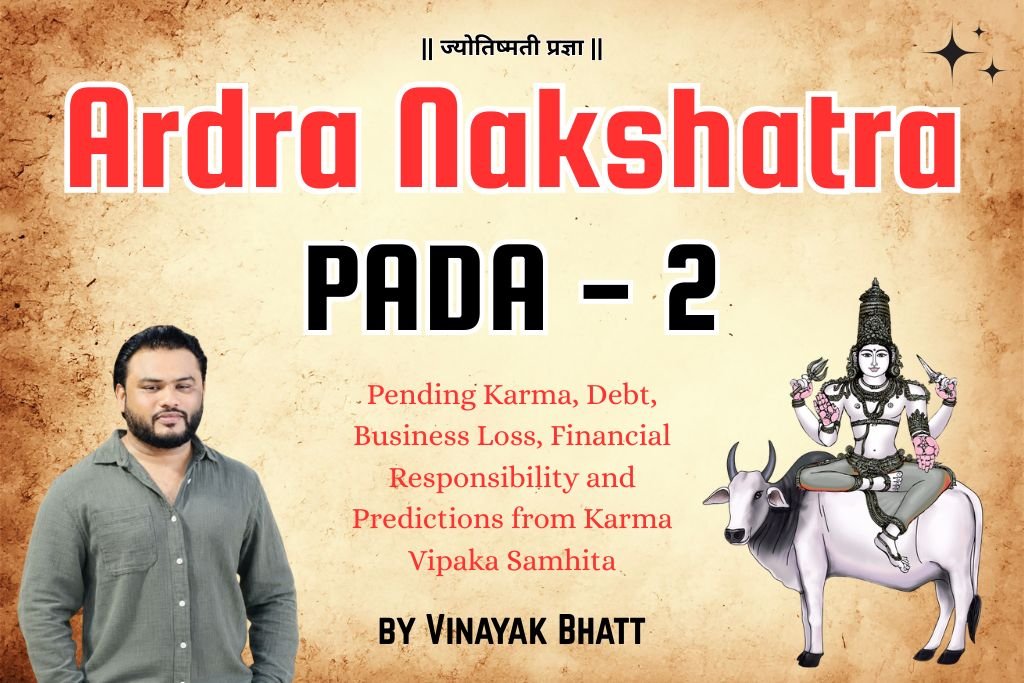
Ardra Nakshatra Pada 2 and Its Deeper Karmic Meaning
Ardra Nakshatra Pada 2 gives a very specific Karma Vipaka lesson about financial responsibility, business borrowing, decline after prosperity, unpaid obligation and the way an unresolved debt can return through one’s own family. The source story is particularly valuable because the previous-life person is not presented as dishonest from the beginning.
He is a prosperous Vaishya, possesses wealth and grain, follows his occupational Dharma and appears materially established during the first part of life. The problem begins later, when prosperity declines, poverty arrives and he borrows gold from a Brahmin in order to continue business and maintain the household. The borrowed wealth is spent, but repayment never takes place. After death, the Punya connected with a sacred place gives its own result, yet the unpaid debt remains unresolved and later returns through a son who consumes wealth corresponding to the old debt.
This makes Ardra Nakshatra Pada 2 fundamentally different from a simple story about poverty or borrowing. The source does not condemn business loss, financial difficulty or taking assistance during crisis. Its deeper question is what happens after another person has carried us through a difficult period. The immediate emergency may disappear, the business may close, the borrower may die and even a long period of Punya may intervene, but the text treats the unfinished obligation as something that remains alive until balance is restored.
Ardra Pada 2 occupies approximately 10°00′ to 13°20′ Gemini and falls in Capricorn Navamsha. Ardra is ruled by Rahu, its Devata is Rudra, Gemini is ruled by Mercury and Capricorn Navamsha is ruled by Saturn. This combination fits the source narrative remarkably well.
Mercury governs trade, money movement, calculation, agreements and commercial intelligence; Rahu expands desire, risk and the search for another solution; Rudra represents breakdown of an existing structure; and Saturn represents time, scarcity, obligation, repayment, consequences and the reality that some accounts can be postponed but not permanently escaped.
The second Pada therefore moves Ardra’s storm into the field of material responsibility. When prosperity collapses, does the native create a disciplined structure to face the problem, or does one temporary solution simply become another future liability?
The Karma Vipaka Story of Ardra Nakshatra Pada 2
The Karma Vipaka account places the previous-life story near the western gate of Ujjain, where there lived a prosperous Vaishya or merchant. He is described as fortunate, endowed with wealth and grain and engaged in his own Dharma. This is important because the source does not begin with an irresponsible or unsuccessful man; the native initially understands business and possesses resources. As approximately half of his life passes, however, his circumstances change and poverty arrives.
In order to continue business and support his household, he borrows gold from a Brahmin. The exact old measure is rendered differently in the surviving translations: one version gives twenty Palas, while another modern rendering expresses the quantity differently. It is therefore safer to understand it simply as a substantial amount of gold taken as business and household capital rather than forcing an uncertain modern conversion.
The merchant spends the borrowed wealth in trade and maintaining the family. He and his wife later die in connection with the sacred Narmada region, and because of the Punya of the sacred place the couple enjoys heavenly pleasure for sixty thousand years. When that merit is exhausted, they return to human birth. This sequence is extremely important because once again Karma Vipaka clearly separates different karmic streams: pilgrimage-related Punya gives heaven, while the financial obligation remains unresolved. A sacred death does not mechanically erase an unpaid debt.
In the later human birth the couple is described as weak, diseased and initially deprived of stable progeny. The old Brahmin creditor then becomes connected with them through the birth of a son because of the unpaid debt. The son eventually consumes wealth corresponding to the amount which had been taken in the earlier birth and then dies; after this, the couple again remains without a son for a long period, described in one translation as twenty years.
The old son-centred language should not be carried literally into modern Jyotish. The important principle is disturbance of progeny and continuity, not preference for a male child.
The karmic structure of the story is therefore very precise. In the earlier life a Brahmin gives wealth which supports the merchant and his household. The merchant uses that wealth but does not restore it. In the later life the creditor enters the debtor’s household itself and takes the value back through filial relationship. The financial account has changed its outer form, but according to the logic of the text it has not disappeared.
The Real Pending Karma: Business Failure Is Not the Sin
The first thing students should understand is that financial failure itself is not the karmic fault described here. The merchant becomes poor after once being wealthy. Businesses fail, markets change, age reduces capacity, illness can destroy savings and circumstances can turn against even a competent person. Karma Vipaka does not say that becoming poor is sinful.
Likewise, borrowing money during genuine need is not presented as the central fault. Credit is part of economic life. A merchant may require working capital, a family may require emergency support and a temporarily distressed person may need help. The karmic weakness arises when value is received under an obligation and, after that value has performed its purpose, the obligation is left unresolved.
This distinction is essential in consultation. Ardra Pada 2 should not be interpreted as “you should never borrow.” A much more useful question is: “When circumstances collapse and somebody helps you financially, how seriously do you preserve the memory of that obligation after the immediate crisis has passed?”
The story is therefore really about accountability after crisis.
Capricorn Navamsha: Time Eventually Presents the Bill
The Capricorn Navamsha is one of the strongest keys for understanding this Pada. Saturn rules Capricorn, and Saturn deals with time, debt, duty, scarcity, delayed results and the necessity of accepting consequences. Rahu and Mercury may find an immediate financial solution, but Saturn asks what that solution will cost over the longer period.
This creates an important Ardra Pada 2 pattern: the native can be very intelligent at handling emergencies, yet the real test comes later when the excitement of solving the crisis has passed and a disciplined repayment structure is required. Mercury knows how to arrange the money; Rahu can find unconventional sources; Saturn wants a schedule, record, reserve and consistent instalment.
The lower expression therefore lives from crisis to crisis. A new loan solves an old shortage, another transaction covers the first repayment and future earnings are repeatedly committed before they arrive. The higher expression uses exactly the same intelligence differently: it calculates what can realistically be borrowed, how long repayment will take, what happens if income falls and whether the household can survive the obligation under less favourable conditions.
The deeper Saturnian teaching is that time does not necessarily erase a financial account; often it strengthens the consequences of an account that has been neglected.
Rudra and the Collapse of an Earlier Financial Structure
Rudra, the Devata of Ardra, gives another layer to the story. The merchant begins prosperous and later loses that prosperity. Ardra therefore introduces its typical pattern of breakdown before reconstruction. Something which once appeared stable becomes unstable, and the native is forced into a reality that was not expected earlier.
This can be very important predictively. Ardra Nakshatra Pada 2 does not necessarily show lifelong poverty; it can show a sharp financial change after a period of stability. A person may begin with a successful business and later face disruption, or may lose an income source that had previously appeared secure. The crisis itself may not be the real karmic problem. The important karma is created by how the person responds to that crisis.
Rudra destroys the illusion that the previous arrangement will continue forever. Saturn then asks whether the person can rebuild with discipline. If Rahu dominates without Saturnian maturity, the native may become desperate for rapid recovery and take financial risks that create a longer burden. If Saturn is strong and supported, the same crisis can produce a far more mature relationship with money than existed during the earlier prosperous period.
The Story Shows Why Prosperity Should Be Used to Prepare for Adversity
A subtle but very practical lesson lies in the sequence of the story. The merchant was wealthy before becoming poor. This means the real financial lesson begins before the borrowing ever occurs.
Prosperous periods should create reserves. High-income years should not be treated as though they will continue permanently. A business which is doing well should build emergency liquidity. Household expenditure should not expand so completely that any interruption in earnings immediately requires borrowing.
This is an important Capricorn principle because Saturn thinks in longer cycles rather than immediate comfort. The native who understands Ardra Pada 2 does not become pessimistic during good times; they simply respect impermanence.
A useful predictive statement can therefore be that the native’s financial life may have pronounced cycles rather than a straight upward line, and stability improves substantially once reserves, insurance, debt limits and long-term planning become more important than simply increasing income.
The Debt Was Used for Both Business and Household
The source says that the borrowed gold was used in business and family maintenance, which adds another layer. Business capital and household expenses belong to different financial categories, and mixing them can create serious problems even today.
A person may take business finance intending to generate returns, but part of it gradually gets used for rent, lifestyle, family ceremonies, school expenses or daily household needs. Once productive capital becomes consumption capital, repayment becomes much harder because the money no longer has the possibility of generating the income from which it was supposed to be returned.
This is a valuable modern decoding of the story. Ardra Pada 2 can require especially clear separation between business accounts and personal household accounts. When Mercury, Saturn and the 2nd, 6th, 10th or 11th houses repeat the theme, financial discipline becomes essential.
The higher Pada knows how much money belongs to business, how much belongs to family maintenance and when the business has reached a point where further borrowing is no longer productive.
Rahu and the Temptation to Keep the Business Alive at Any Cost
Rahu ruling Ardra can create another psychological pattern. Once a person has experienced prosperity or built an identity around business success, accepting decline can become extremely difficult. The native may keep searching for one more investment, one more lender or one more opportunity that will restore the old level.
This can become dangerous because the financial decision is no longer being made only from commercial logic. It is also trying to protect identity.
The merchant who was once prosperous may find poverty psychologically unacceptable. Rather than reduce the scale of life, he borrows to preserve the earlier structure. In modern charts this can show as keeping a failing business alive long after its economics have stopped working, or maintaining a lifestyle through credit because downsizing feels like humiliation.
The higher Rahu remains innovative but allows Saturn to define limits. It asks whether the new capital is actually capable of changing the business, or whether it only postpones recognition that the old model has ended.
This is an important Ardra lesson: sometimes Rudra’s work should not be reversed. Sometimes the correct response to collapse is not restoration but restructuring.
The Brahmin Creditor Is More Than a Financial Detail
The lender in the story is specifically described as a Brahmin, and this should be handled carefully. It would be wrong to literalise caste and claim that borrowing from a Brahmin creates a different universal karmic rule in modern life. The more useful principle is that the creditor belongs to a category associated in the text with learning, Dharma and a respected social role.
The debt therefore carries not merely an economic dimension but a moral one. Somebody trusted the merchant sufficiently to provide resources during decline. That act of trust becomes part of the karmic relationship.
The source’s later remedy again directs resources towards a learned Brahmin and ritual charity, symbolically reversing the original imbalance. The modern principle is broader: when somebody carries you through a period of weakness, the obligation should not be treated as disposable merely because your circumstances remain difficult.
If payment cannot happen immediately, communication, acknowledgement and a genuine plan matter. Saturn respects honest effort more than avoidance.
Punya Did Not Cancel the Debt
One of the strongest philosophical lessons of this story is the sixty-thousand-year heavenly result after death in the sacred Narmada region. The couple receives Punya, enjoys that Punya fully and only afterwards returns to the unresolved financial account.
This shows very clearly that different karmas can mature independently. A person may perform pilgrimage, charity, mantra, worship and other Punya Karma while still carrying an unresolved financial obligation. Spiritual practice does not automatically transfer money back to the creditor.
This has an important modern implication. If the native owes somebody a genuine amount and has the capacity to repay, donating elsewhere while deliberately avoiding the creditor does not represent full correction of the original relationship. Dana may create its own Punya, but the unpaid account remains another matter.
The story therefore gives a very mature understanding of Prayaschitta: general goodness does not replace specific responsibility.
The Creditor Returning as the Son
The transformation of the creditor into the son is the central karmic reversal of Ardra Nakshatra Pada 2. The person who once gave resources to support the merchant later enters the merchant’s own family and consumes wealth corresponding to the old obligation.
This should not be converted into the simplistic claim that an expensive child is necessarily a past-life creditor. Children naturally require money, education, healthcare and support. The source gives a symbolic karmic model, and the full horoscope must confirm whether a strong Rina Anubandha theme is actually present.
Still, the story gives a valuable Jyotish idea: financial accounts can return through emotional relationships. The repayment no longer feels like repayment because it appears as parental responsibility. The native gives willingly or compulsorily because the relationship itself carries attachment.
This is why the 5th house becomes especially relevant when applying Ardra Pada 2. If the planet in this Pada strongly connects with the 5th, 6th, 8th or 11th houses and Jupiter is similarly involved, the astrologer may investigate whether children, students or younger dependents become major channels through which accumulated wealth flows outward.
The correct approach is not to resent the relationship but to understand the pattern and manage it responsibly.
The Amount Being Consumed Again Gives the Idea of Karmic Accounting
The source says that the son consumes wealth corresponding to what the Brahmin had previously given. This resembles the exact financial balancing seen in several Karma Vipaka stories. The text repeatedly treats money as though it creates a relational ledger when one side of an exchange is left incomplete.
The important lesson is not that karma functions like a modern spreadsheet with exact currency conversion across births. The deeper principle is that value received from another person creates a relationship until the exchange has properly concluded.
This is particularly useful when a native complains that one person repeatedly consumes a disproportionate amount of money. Rather than declaring a previous-life debt, the astrologer should first examine the present-life reality: What is the relationship? Is there dependency? Was money promised? Is guilt involved? Does the native repeatedly rescue the same person? Are financial boundaries clear?
Only when the horoscope repeats the Rina pattern should the Karma Vipaka story be used as an additional interpretive layer.
Twenty Years Without a Son: Time Becomes Part of the Result
One translation states that after the debt-related son consumes the corresponding wealth and dies, twenty years pass without another son. The literal son-centred wording belongs to the cultural environment of the old text and should not be repeated as a prediction of male-child denial. What is important is the long delay in restoration of continuity.
This is highly appropriate to Capricorn Navamsha. Saturn rarely gives immediate correction. Even after the obvious financial account appears to have been settled, the consequences of a long-unresolved pattern may take time to stabilise.
In modern interpretation, this can become delayed recovery after a financial collapse. The loan may be cleared, but savings take years to rebuild. A business may close, but creditworthiness takes time to recover. A family may settle a dispute, yet trust returns slowly. A project may survive, but continuity must be reconstructed gradually.
Ardra Pada 2 therefore teaches that settlement and recovery are not always the same date.
The Difference Between Immediate Repayment and Responsible Settlement
Saturnian karma must be interpreted realistically. Sometimes a person genuinely cannot repay an entire obligation immediately. Karma Vipaka should not be used to create shame or impossible demands.
Responsible settlement can include a transparent repayment schedule, partial payments, restructuring mutually accepted by both sides or a formally agreed settlement. What matters is that the creditor is not deliberately kept in darkness while the borrower behaves as though the account no longer exists.
- Higher Mercury communicates.
- Higher Saturn continues paying.
- Higher Rahu searches for workable restructuring rather than escape.
The lower pattern combines silence with postponement.
For Ardra Pada 2, communication during difficulty itself becomes part of the remedy.
Ardra Pada 2 and the Psychology of Scarcity
Capricorn Navamsha can create a strong sensitivity to scarcity. A person who has once fallen from wealth into poverty may develop a deep fear of ever becoming financially vulnerable again. Even after prosperity returns, the mind may remain prepared for collapse.
This can produce two opposite expressions. One native may become extremely disciplined, save carefully and avoid unnecessary debt because earlier instability taught responsibility. Another may become excessively anxious about money, accumulate beyond reasonable need or take aggressive opportunities because the fear of returning to poverty remains active.
The higher Saturn transforms scarcity into structure rather than fear. The native does not need to become miserly. They need systems.
Budgeting, reserves, insurance, documentation, predictable repayment and diversification become Saturnian forms of psychological healing.
Ardra Pada 2 Can Be Strong for Difficult Financial Work
The combination of Mercury, Rahu and Saturn should not be regarded only negatively. At its higher level it can produce excellent ability to deal with complexity, crisis, systems, restructuring and difficult commercial environments.
Such natives may be good at accounting, audit, taxation, banking, credit, risk management, insolvency, restructuring, operations, technology, compliance, business analysis, debt recovery or any profession where disorder has to be converted into a workable structure.
Rahu can understand unconventional systems, Mercury can calculate and negotiate, while Saturn has patience with tedious details and long processes. Ardra’s Rudra quality is particularly useful where an old system has failed and must be rebuilt.
The lower expression gets trapped in financial complexity.
The higher expression becomes the person who can untangle financial complexity.
House Logic for Ardra Nakshatra Pada 2
The 2nd house becomes important for accumulated wealth, family resources and the loss of earlier prosperity. The 5th house matters because the creditor returns through the son and because continuity becomes disturbed. The 6th house is fundamental for Rina, loans, repayment, disputes and obligations.
The 7th house can show the contractual party or commercial relationship, while the 8th house becomes important for another person’s money, liabilities and consequences continuing beyond the original agreement. The 10th house relates to business and occupation, the 11th house to gains and capital inflow and the 12th house to expenditure and financial depletion.
A 2nd–6th connection can make debt and savings directly compete with each other. A 5th–6th connection can channel financial obligation through children, education or dependents. A 6th–10th connection may bring business loans, professional liabilities or work connected with credit and recovery. A 6th–8th connection can create complicated liabilities or long-running debt structures, while the involvement of the 12th can increase financial leakage.
If Saturn strongly influences the same houses, the debt may be long-term but manageable through disciplined repayment. Rahu can increase leverage, complexity or unconventional finance. Jupiter’s protection can improve judgement and allow ethical settlement.
The Pada should never be read independently. The story provides the karmic pattern; the horoscope tells us where and how strongly the pattern manifests.
Dasha Activation
A Rahu Dasha or Antardasha can activate the Ardra field through sudden financial changes, unconventional opportunities, expansion, borrowing or a breakdown of the previous economic structure. Rahu’s dispositor Mercury and its house position become extremely important because they determine whether the response is intelligent adaptation or chaotic multiplication of obligations.
A Mercury period can activate contracts, accounts, business negotiations, documentation and commercial decisions because Ardra Pada 2 lies in Gemini.
A Saturn period can bring repayment, austerity, restructuring, delayed recovery or the consequences of earlier financial commitments because Saturn rules the Navamsha.
Periods of the 2nd lord can activate savings, the 6th lord debt and repayment, the 5th lord or Jupiter children and continuity, and the 8th lord old liabilities or another person’s money. The strongest reading comes when Nakshatra, house connection and Dasha repeat the same financial theme.
Consultation-Level Predictions
When Mercury, Saturn or the 6th lord occupies Ardra Pada 2 and connects with the 2nd, 10th or 11th houses, a useful consultation statement would be: “You can have phases of strong earnings followed by periods where cash flow becomes unexpectedly tight. Your protection lies in reserves and careful borrowing because your chart can find money during crisis, but it also requires you to build a clear structure for repayment before taking it.”
When the 5th house and Jupiter become involved, the astrologer may say that children, education, students or younger dependents can become significant channels of expenditure and that financial planning for them should begin early. This should not become a frightening prediction regarding progeny unless Saptamsha and the complete fifth-house picture independently support difficulty.
When the chart shows a strong reverse expression through the 6th, 7th and 11th houses, the native may become the lender, business owner or professional whose money is delayed by others. In that situation the lesson shifts towards careful credit policies, documentation and not allowing sympathy or friendship to replace proper commercial boundaries.
If Saturn dominates the entire pattern, one financial problem may take considerable time to resolve, but the native can often emerge much stronger because Saturn gives the ability to rebuild patiently once reality is accepted.
Planetary Applications of Ardra Nakshatra Pada 2
When the Sun occupies Ardra Pada 2, financial decline or responsibility can become connected with father, authority, status or the native’s self-image. Pride may make it difficult to reduce lifestyle or admit business difficulty, while the higher expression allows the person to take responsibility publicly and rebuild reputation through disciplined conduct.
When the Moon occupies this Pada, money and emotional security can become strongly connected. Financial instability may disturb mental peace deeply, and the person may borrow primarily to protect family or home. A strong Moon can develop excellent awareness of household needs, while an afflicted Moon may make financial decisions from anxiety rather than calculation.
When Mars occupies Ardra Pada 2, financial action can be rapid. The native may take decisive business risks, borrow quickly during crisis or become aggressive about recovery. At the higher level Mars gives the courage to confront financial problems directly rather than postponing them.
When Mercury occupies the Pada, commercial intelligence becomes very strong. Business, accounts, contracts, trading, lending and communication may become central to life. A strong Mercury can create an excellent analyst or negotiator, while an afflicted Mercury can produce complicated accounts, repeated refinancing or misunderstandings regarding repayment.
When Jupiter occupies Ardra Pada 2, financial judgement, children, ethics and advice become important. A strong Jupiter can help the native recognise the Dharmic dimension of repayment and may bring teachers or advisers who help during crisis. An afflicted Jupiter can create excessive optimism that future prosperity will solve present liabilities without disciplined action.
When Venus occupies the Pada, lifestyle, comforts, spouse and money can become interlinked. Borrowing may sometimes be used to maintain a standard of living or family expectations. At the higher level Venus understands real value and helps the native reduce unnecessary expenditure without destroying quality of life.
When Saturn occupies Ardra Pada 2, the Navamsha lord becomes especially important. Debt, responsibility, delayed reward, business pressure and long-term rebuilding can become major themes. Yet a well-placed Saturn can make this one of the strongest placements for disciplined financial recovery because the native eventually learns patience, accounting and endurance.
When Rahu occupies Ardra Pada 2, the desire to recover or expand quickly can become powerful. Leverage, technology, unusual investments or unconventional finance may attract the native. Strong Mercury and Saturn become essential because without them Rahu may keep multiplying the complexity of the financial structure.
When Ketu occupies the Pada, the native may detach abruptly from business or material obligations and therefore leave practical accounts unfinished. At the higher level Ketu can help the person abandon an unsustainable business model without ego and accept a simpler financial structure.
These planetary applications are Jyotish interpretations derived from Ardra, Gemini and Capricorn Navamsha, not literal statements of the Karma Vipaka chapter, and they should always be modified by house ownership, dignity, conjunctions, aspects and Dasha.
Progeny and Continuity Must Be Judged Carefully
The source connects the earlier unpaid debt with later progeny disturbance and the birth of a debt-related son. This is an important part of the classical narrative, but it should not be used mechanically to predict infertility or child loss.
For literal progeny judgement, the astrologer must examine the 5th house, fifth lord, Jupiter, Putrakaraka, Saptamsha and relevant Dasha. If these are strong, Ardra Pada 2 alone cannot deny children.
The wider symbolism of continuity is more useful. A business owner may carry liabilities which later burden successors. A parent may leave debt rather than assets. A company may continually use future revenue to pay old obligations. A teacher may create an institution whose next generation spends years correcting financial disorder inherited from the founder.
The higher Ardra Nakshtra Pada 2 therefore learns not to transfer today’s crisis into somebody else’s future.
Health Indications Must Be Confirmed Through the Horoscope
The source describes the later couple as diseased and weak, and the classical remedy concludes with claims of relief from disease. These statements belong to the Karma Vipaka narrative and should not be converted into a specific medical diagnosis from the Nakshatra Pada alone.
Health judgement requires Lagna, Lagnesha, Moon, Mercury, Saturn, Rahu, the 6th and 8th houses, relevant Vargas and Dasha. At an interpretive level, prolonged financial insecurity can create chronic mental and physical stress, but that should remain a lifestyle observation rather than a medical prediction.
The safer Jyotish principle is that the native may suffer more from long unresolved pressure than from one sudden event. This again fits Saturn’s role in Capricorn Navamsha.
Traditional Prayaschitta for Ardra Nakshatra Pada 2
The traditional remedy begins with Dana from accumulated wealth, and one translation specifically instructs the native to give one-eighth of household income or saved wealth as part of the expiation. The text further prescribes making a golden lotus, with one version describing five Palas of gold, and donating it to a Veda-knowing Brahmin.
The remedial procedure also prescribes one lakh Gayatri Mantra Japa, followed by the traditional Dashamsha Homa and corresponding Tarpana and Marjana. A properly decorated cow is then to be donated to a qualified Brahmin; the translation describes the cow as adorned with gold and ornaments or anklets and suitable cloth.
The classical text associates completion of this Prayaschitta with restoration of progeny and purification of the old karmic fault. Exact old measures, ritual procedure, Mantra Sankalpa and the form of Dana should be checked through a competent traditional practitioner before literal performance rather than reconstructed solely from an English translation.
Why the Golden Lotus Is Important
The source does not provide a detailed philosophical explanation of the golden lotus, so its deeper interpretation should remain clearly separate from the classical instruction. Still, the lotus is a powerful symbol of purity arising from difficult conditions. Ardra Pada 2 begins with material collapse, debt and weakness, yet the remedy asks the native to transform wealth into a sacred object and release it through Dana.
Gold which had once been borrowed and consumed now becomes gold consciously offered. The direction of wealth changes. Earlier, another person’s wealth entered the household. In the remedy, wealth leaves the household voluntarily. This creates a coherent Karma Vipaka reversal: taking without completing the return becomes deliberate release through Dana.
The lotus also fits the higher Capricorn lesson because mature Saturn does not merely suffer consequence; it produces something valuable through disciplined purification.
Why Gayatri Fits the Karmic Problem
Gayatri centres upon illumination of Buddhi, and Ardra Pada 2 needs exactly this because financial trouble can easily produce short-term thinking. When pressure becomes severe, the mind asks only how to survive the immediate problem. Gayatri symbolically restores clarity so that the person can see the entire chain of consequence rather than merely the next transaction.
Rahu generates possibilities, Mercury calculates them and Saturn evaluates whether they are sustainable. Gayatri strengthens the discrimination required to decide which solution is genuinely Dharmic and which only postpones the problem.
Yet mantra should never become a substitute for actual financial responsibility. Where a real present-life creditor exists, the behavioural correction remains communication, repayment or mutually agreed settlement.
Practical Modern Remedy
The strongest living remedy for Ardra Pada 2 is to close unresolved debt systematically. The native should clearly identify personal loans, family borrowings, business credit, vendor dues, client advances, taxes and other outstanding obligations, then distinguish productive debt from debt merely supporting consumption. Genuine liabilities should be given realistic repayment schedules rather than being allowed to remain vague.
The second correction is to separate household spending from business capital. Borrowed funds intended for enterprise should not slowly disappear into lifestyle without recognising that the repayment source has simultaneously been weakened. If a business cannot support itself even after repeated capital infusion, Saturnian wisdom may require restructuring or closure rather than endless borrowing.
The third correction is to build reserves during profitable periods. This directly addresses one of the deepest patterns in the source story: the native once possessed prosperity but entered old age without sufficient financial security. Savings, retirement planning and emergency reserves are therefore not merely economic techniques; within the symbolic logic of this Pada they are forms of karmic maturity.
Regular Dana according to capacity can complement the traditional remedy, but charity should not be funded by avoiding legitimate creditors. The first ethical priority is to complete existing responsibilities.
The Difference Between Ardra Pada 1 and Pada 2
Ardra Pada 1 and Pada 2 both contain disruption, but the object of disruption changes considerably. Pada 1, falling in Sagittarius Navamsha, dealt mainly with relationship responsibility, desire, abandonment and the tension between Rahu’s attraction and Jupiter’s Dharma.
Ardra Pada 2 falls in Capricorn Navamsha and moves the storm into money, livelihood, debt and material responsibility. Here the central question is not whether the native properly concludes an emotional relationship but whether they properly conclude a financial one.
Pada 1 asks whether a new desire destroys an old responsibility.
Pada 2 asks whether a financial solution creates an obligation that remains after the crisis has passed.
Sagittarius seeks meaning after disruption; Capricorn demands accountability after disruption.
This makes the progression between the first two Ardra padas very clear.
The Higher Expression of Ardra Nakshatra Pada 2
The higher expression of Ardra Pada 2 can be extremely capable because this combination understands crisis better than stability. Rahu sees unconventional possibilities, Mercury analyses, Rudra is not afraid to dismantle what has failed and Saturn rebuilds through discipline.
Such a native can become excellent at rescuing distressed businesses, reorganising financial systems, dealing with debt, building controls, analysing risk, designing repayment structures or handling situations where other people become overwhelmed by complexity.
The same person who at the lower level keeps postponing an account can, at the higher level, become exceptionally serious about never leaving accounts open. The person who once depended upon another person’s capital can later become a disciplined manager of capital. The person who once experienced financial collapse can become the one who teaches others how to prepare for it.
This is the mature form of Ardra: the storm produces expertise rather than merely damage.
The Real Teaching of Ardra Nakshatra Pada 2
Ardra Nakshatra Pada 2 ultimately teaches that a financial crisis may explain why an obligation was created, but it does not automatically erase the obligation after the crisis has passed. The merchant in the source was once prosperous, later became poor, borrowed in genuine difficulty and used the money for trade and family support. His circumstances make the borrowing understandable, yet the debt remained unresolved. Sacred Punya gave its own result, but the unfinished financial relationship later returned through the family itself.
The story therefore carries much more wisdom than a simple warning against debt. It teaches that prosperity is temporary, crisis must be handled without abandoning accountability, Punya and financial responsibility belong to different karmic fields, and a solution which helps us today should be judged partly by the responsibility it creates for tomorrow.
Rahu searches for another possibility, Mercury finds the transaction, Rudra breaks the old financial structure and Saturn eventually asks for the final account. At the lower level, the native uses intelligence to postpone reality. At the higher level, intelligence is used to restructure reality.
The main predictive principle for Ardra Nakshatra Pada 2 is that when this Pada strongly connects with wealth, debt, business or continuity houses, the astrologer should examine whether the native experiences sharp changes between prosperity and scarcity, whether borrowing becomes the bridge through those periods, and whether obligations are being systematically closed or simply moved forward into another relationship or another generation.
The deeper Karma Vipaka principle is that Punya can give its own reward without cancelling an unpaid obligation, because goodness in one part of life does not mechanically settle a specific responsibility owed to another person. The higher principle of Ardra Pada 2 is therefore to prepare during prosperity, borrow intelligently during necessity, communicate honestly during difficulty, repay with discipline and allow the storm to teach a better financial structure rather than forcing life to repeat the same crisis in another form.




![Science of Remedies in Vedic Astrology [Hindi]](https://vedicgrace.com/wp-content/uploads/2025/12/Science-of-Remedies-in-Vedic-Astrology-Hindi-VG-300x214.png)




Leave a Comment
Be the first to comment on this blog!