
Mrigashira Nakshatra Pada 2: Pending Karma, Dependency, Ancestral Duty and Predictions from Karma Vipaka Samhita By Vinayak Bhatt
Nakshatra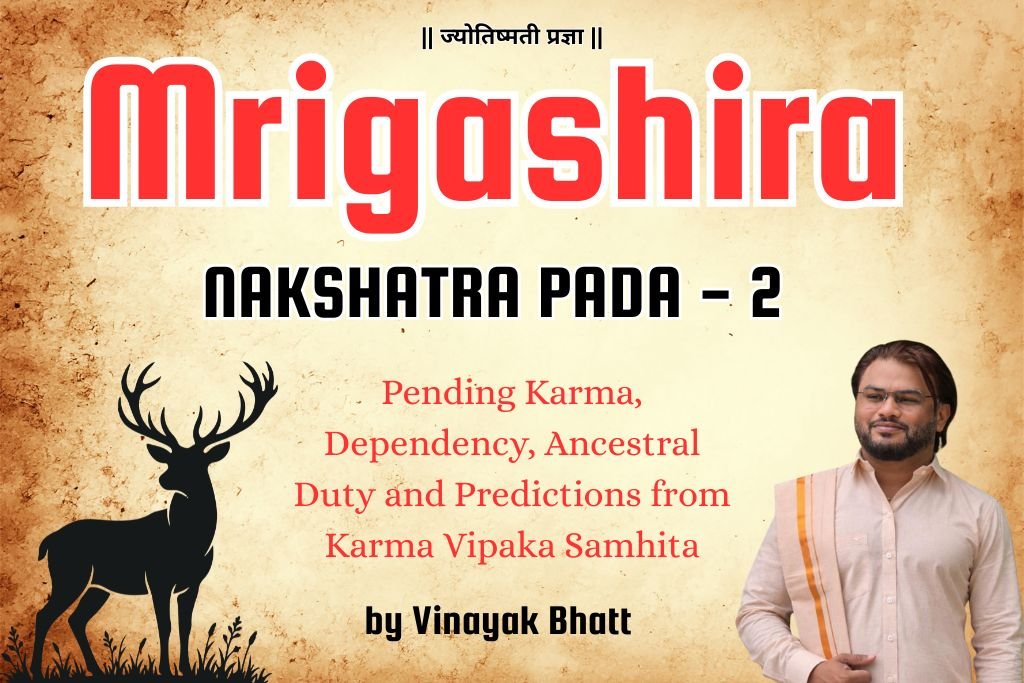
Mrigashira Nakshatra Pada 2 and Its Deeper Karmic Meaning
Mrigashira Nakshatra Pada 2 gives a very different karmic lesson from Pada 1. The first Pada dealt with custody, another person’s wealth and the betrayal of trust, whereas the second Pada turns towards a quieter but equally serious subject: what happens when a person spends an entire life receiving nourishment and support from others without properly completing the duties, reciprocal responsibilities and ancestral obligations attached to that life.
The Karma Vipaka story describes a poor Brahmin named Bodha Sharma who continuously lived upon food received from others, while the versions also describe him as doing servant or messenger-type work. The source then makes an important second statement: he did not perform Shraddha for the departed elders, and in the later human incarnation his own lineage became obstructed.
This means that Mrigashira Pada 2 should not be reduced to a moral judgement such as “depending upon others is sinful.” Such an interpretation would be both crude and impractical. Human beings depend upon one another throughout life. A child depends upon parents, an elderly person may depend upon children, a student depends upon a teacher, a Sannyasi may depend upon Bhiksha, and a person going through genuine hardship may temporarily require the help of family or society. The deeper issue in the source is one-sided receiving combined with neglected duty. Something keeps entering the person’s life—food, support and maintenance—but the stream does not appear to move properly backwards towards the ancestors or forwards towards the continuation of the lineage.
This is why I would understand the second Pada through the karmic law of circulation. Food is received. Service should answer it. Life is received from ancestors. Remembrance and duty should answer it. Knowledge is received. It should become useful to somebody else. Support is received during weakness. Once strength returns, some form of contribution should begin. The problem is not receiving; the problem is when receiving becomes permanent without the corresponding movement of gratitude, work, Seva or responsibility.
Mrigashira Pada 2 occupies approximately 26°40′ to 30°00′ Taurus and falls in Virgo Navamsha. Mrigashira is ruled by Mars, its Devata is Soma, Taurus is ruled by Venus, and the Navamsha is ruled by Mercury. This creates an unusually meaningful combination for the Karma Vipaka story. Taurus governs food, resources, accumulation and material sustenance; Virgo deals with work, service, practical duty, purification, detail and the need to make oneself useful; Mercury handles messages, movement, transactions and service through skill; Mars gives the impulse to act; and Soma represents nourishment, rasa and the search for satisfaction. The story itself combines food received from others, messenger or servant-like work, neglected ritual duty and eventual disruption of the family line. The Jyotish symbolism and source narrative therefore fit each other very closely.
The Karma Vipaka Story of Mrigashira Nakshatra Pada 2
The twenty-first chapter of the available Karma Vipaka material places the earlier-life account in the country of Kanyakubja, in a city called Nandanapura. There lived a poor Brahmin whose name is given as Bodha Sharma or Bhodha Sharma. His wife’s name appears as Badhma, Bhaadhania or Vadhma in different English renderings. The central account is stable even though these names vary slightly between translations.
There is a small difference in how the sources describe Bodha Sharma’s livelihood. One translation says that he did not properly work and continuously obtained his daily food from other people, while another translation describes him as eating other people’s food and carrying out messenger-type work, comparing it to modern courier service. The Shivgovind Dikshit rendering says that he lived on donated food and worked as a servant for others. Because the exact occupational wording varies, it would be wrong to build the whole interpretation around the claim that he was literally unemployed. The point on which the versions agree is much stronger: throughout his life he depended heavily upon food or maintenance received from others.
The source then says that after death both husband and wife entered a difficult post-death state and remained in hell for several thousand years. After emerging, the man passed through a sequence of non-human births. Other translated versions describe a crow, then deer and then sheep or goat, while the Shivgovind rendering gives crow, deer and then buffalo before the human incarnation. Because the third animal differs between translations, it is safer to preserve the broad point rather than forcing one reading: the text describes several intermediate animal births before the soul returns to human life.
When Bodha Sharma finally returned to human birth in Madhyadesha, the text says that he was afflicted by disease and remained without sons and daughters. One translation reading additionally describes him as skilled in dancing, while another translation gives the uncertain wording “expert liar, expert dancer”; because that expression is textually uncertain, it should not be used as a major predictive rule. The important line follows immediately: he continued to be associated with eating food received from others and, in the previous life, had not performed Shraddha for the departed elders. The text directly connects these actions with destruction or interruption of the family lineage.
This final detail changes the entire understanding of Mrigashira Pada 2. The story is not merely about food. It is about receiving nourishment without properly maintaining the chain of nourishment from which one’s own life came.
The Most Important Karmic Principle: What You Receive Must Enter a Cycle
The deeper teaching of Mrigashira Pada 2 is that resources should move through a proper cycle. Bodha Sharma continuously receives food, yet the source simultaneously says that he neglects Shraddha, the ritual through which food, remembrance and gratitude are symbolically offered towards the Pitrs. Later his own line becomes obstructed.
The symbolism is extremely precise. He receives from others in the present. He does not properly honour those through whom his own life came from the past. Then continuity towards the future becomes disturbed.
This creates a powerful three-generation principle: Ancestors- the native- descendants.
A human being does not stand alone in the middle. We inherit life, body, language, family culture, property, knowledge, Samskaras and countless advantages and difficulties from those who came before us. We then use those resources and eventually pass something forward through children, students, institutions, books, knowledge or social contribution.
Mrigashira Pada 2 becomes difficult when the middle person becomes primarily a consumer rather than a transmitter. The source expresses this through food and Shraddha. Modern life may express the same principle through many other forms.
The astrologer’s question should therefore not merely be, “Are you dependent upon others?” A much deeper question is: “What has come to you through your family, teachers and society, and what are you doing with what you received?”
That is the living karmic question of this Pada.
Taurus and Virgo: The Difference Between Consuming and Serving
The combination of Taurus Rashi and Virgo Navamsha gives us perhaps the clearest Jyotish explanation of the story. Taurus is connected with food, resources, material security, nourishment and possession, while Virgo is connected with work, usefulness, service, duty, practical skill and purification. The second Pada therefore sits at the meeting point between what we consume and what we contribute.
If Taurus becomes dominant without the corrective intelligence of Virgo, the person can become highly focused on receiving comfort, food, financial support and security. If Virgo functions properly, the native asks another question: “What useful work am I doing in return?”
This is not an argument that every relationship must be commercially equal. A mother does not keep an invoice for feeding a child. A Guru may teach somebody without demanding immediate return. Society may help a person during crisis without expecting repayment to the same individual. Dharma is not accountancy in that mechanical sense.
But the principle of reciprocity still exists. The child eventually matures. The student eventually becomes capable. The person receiving assistance may later become able to help another. The debt does not always have to be returned to the same human being. But receiving should eventually awaken contribution. That is the higher Virgo Navamsha.
The Messenger or Servant Detail Is Important
Although the exact wording varies, One rendering understands Bodha Sharma as performing messenger work, while the Shivgovind version describes service to others. This detail is remarkably compatible with Virgo Navamsha and Mercury.
A messenger does not necessarily create the message. He carries something from one person to another. This itself gives a subtle metaphor for the Pada.
The native is meant to carry something forward-
- Food comes to him.
- Knowledge comes to him.
- Family Samskara comes to him.
- Life itself comes to him.
The question is whether he becomes merely the destination of the flow or a channel through which something continues moving.
At the higher level, Mrigashira Pada 2 can therefore become excellent for people who transmit value: teachers, messengers, coordinators, writers, accountants, healers, assistants, administrators, service professionals, translators, researchers, couriers, technicians, advisers and people whose work connects one person with another.
- Mercury distributes.
- Virgo makes useful.
- Taurus gives substance.
Mrigashira searches for what is needed.
The higher Pada says: “I may not create everything I receive, but I can make sure it reaches where it is needed.”
This is almost the exact opposite of stagnant dependency.
Soma and the Karma of Nourishment
Mrigashira’s Devata Soma becomes especially meaningful in this Pada because the source repeatedly speaks about food. Soma is connected with nourishment, rasa, refreshment and satisfaction, and Mrigashira itself represents the search for that which may fulfil the mind.
The problem is that the search for nourishment can become endless if satisfaction is always expected to come from outside.
- Someone else must feed me.
- Someone else must support me.
- Someone else must solve the problem.
- Someone else must provide emotional security.
- Someone else must recognise me.
- Someone else must give me opportunity.
The object changes, but the inner movement remains the same.
At the lower level, Soma becomes the search for the next source of comfort.
At the higher level, Soma becomes the capacity to nourish and be nourished within a reciprocal system.
This is why the practical correction for the Pada is not extreme independence. Human beings need one another. The correction is mature interdependence.
The native should be capable of saying: “I can receive without shame when I genuinely need help, but I will not make helplessness my identity.”
And equally: “I can give without superiority because I also know what it is to receive.”
That is a much higher Soma.
The Real Issue Is Not Poverty
Bodha Sharma is specifically described as poor, but poverty itself cannot be the karmic offence. Dharmic literature repeatedly honours poor people, ascetics, students and householders who live with very little. Therefore the story should never be used to imply that somebody suffers because they are poor or that receiving food in hardship creates sin.
The problem lies in the combination of dependency, lack of proper duty and neglected ancestral obligation. This distinction is essential for responsible teaching. A person may need food because illness prevents work. Another may be elderly. Another may be studying. A Sannyasi may deliberately renounce ordinary earning and live upon Bhiksha while giving spiritual teaching. A child is naturally dependent. These are completely different from a life in which a capable person repeatedly consumes what others provide while making no serious effort towards their own Swadharma or reciprocal responsibility.
Mrigashira Pada 2 therefore does not condemn dependence. It asks whether dependence is appropriate to the person’s stage, condition and Dharma.
Shraddha Is the Hidden Centre of the Story
The most important additional content for understanding Mrigashira Pada 2 comes from the line regarding Shraddha. The source specifically says that Bodha Sharma had not performed Shraddha for his departed elders, and immediately connects this karmic pattern with interruption of his lineage.
This creates a direct axis between Pitru and Putra—ancestor and descendant.
- A person stands between the two.
- The ancestors represent where life came from.
- Children represent where life is going.
The traditional Shraddha system is built around remembrance, gratitude and the continuity of family obligation. Whether someone interprets the ritual literally, spiritually or symbolically, the Karma Vipaka logic is unmistakable: one cannot endlessly expect continuity forward while remaining completely disconnected from continuity behind.
In Jyotish this immediately brings the 9th house, Sun and Pitru factors into the analysis along with the 5th house and Jupiter.
If Mrigashira Pada 2 is strongly activated and the horoscope simultaneously shows affliction to the 5th and 9th axis, Sun, Jupiter or relevant family Karakas, I would examine whether the native has a deeper issue concerning ancestry, father, family traditions, inheritance, ancestral rituals, unresolved disputes among elders or a complete break from the family lineage.
This does not mean that every person must mechanically perform one particular ritual regardless of belief or circumstance. It means that the past has to be acknowledged rather than denied.
Ancestral Karma Is Not the Same as Blind Obedience to Family
This point needs clarity. Honouring ancestors does not mean copying every belief of one’s parents or tolerating harmful family behaviour. Dharma does not require a person to remain in an abusive environment merely because elders are involved. Ancestral respect can coexist with strong boundaries. A person can disagree with a father and still perform the duties which are genuinely theirs. One can leave an unhealthy family system without denying that one’s body, language, education or opportunities came partly through that lineage. One can correct ancestral mistakes instead of repeating them. In fact, sometimes the highest form of Pitru Dharma is to end an Adharmic family pattern rather than continue it.
Mrigashira is a searching Nakshatra. It does not have to accept everything blindly. Its higher function is to discover what deserves continuation and what deserves correction. Virgo Navamsha helps this because Virgo discriminates.
Therefore the karmic principle is not “obey the past.”
It is: “Know what you inherited, fulfil what is truly owed, purify what is unhealthy, and pass forward something better.”
The Destruction of Lineage Has a Wider Meaning
The source gives a direct result of being without sons and daughters and says the lineage becomes cut off. This should never be converted mechanically into a prediction of infertility merely because Moon, Lagna or another planet occupies Mrigashira Pada 2. For literal progeny judgement, the astrologer must examine the 5th house, fifth lord, Jupiter, Putrakaraka, Saptamsha and Dasha.
But lineage is broader than biological children.
- A teacher’s students continue the intellectual line.
- A priest’s disciples continue ritual knowledge.
- A business successor continues an institution.
- A book carries an author’s thought into another generation.
- A research archive preserves knowledge.
- A social service project can continue after the founder’s death.
Therefore the “lineage destroyed” result can sometimes appear as an inability to create continuity. The person may begin many projects but nobody carries them forward. They may possess knowledge but fail to teach. They may inherit a family business but allow it to disappear. They may receive a tradition without producing any capable successor. This interpretation is especially appropriate for Mrigashira because the Nakshatra searches and gathers information, while Virgo Navamsha should organise and transmit it.
The deeper question becomes: “What have you received that should not end with you?”
Mrigashira Pada 2 and the Karma of Food
Food deserves its own discussion because the chapter repeats the idea of eating food provided by others. Taurus is one of the strongest signs for food, material sustenance and the physical experience of value, while Soma is also deeply connected with nourishment.
Food is not merely calories in traditional thought. To feed somebody is to sustain their Prana. To accept food creates a relationship with the giver. This is why traditional culture placed so much importance upon who cooked, who served, for what purpose the food was offered and what state of mind surrounded the meal. The modern world need not reproduce every ancient social rule to understand the underlying principle. The deeper teaching is gratitude.
- If somebody feeds you during difficulty, remember it.
- If parents fed and educated you for years, do not later treat their contribution as though it never existed.
- If a spouse supports the household while you are struggling, recognise the support.
- If society gives scholarship, charity or opportunity, use it intelligently.
Food becomes the symbol for all forms of sustenance received from outside oneself. The karmic fault begins when support is consumed while the relationship behind the support is forgotten.
The Strong Prediction: Dependence and Service May Alternate in Life
One interesting present-life manifestation of Mrigashira Pada 2 can be an alternation between periods of dependence and service. The native may experience phases where they need significant help from family, spouse, employer or community, followed by phases where other people become heavily dependent upon them. This is especially likely when the 6th, 10th, 2nd or 4th houses become involved.
- A person may spend early life dependent upon parents and later become the main caretaker of those same parents.
- Someone may receive help during unemployment and later employ or support others.
- A student may depend greatly upon a teacher and eventually become a teacher themselves.
- A person may receive charity during illness and later spend part of life serving sick people.
This reversal should not automatically be called punishment. It may be the mechanism through which the soul learns the full cycle of nourishment. The higher expression is not to resent either side.
Learn how to receive properly. Then learn how to give properly.
Virgo Navamsha and the Need to Become Useful
Virgo Navamsha adds a very practical solution to the karmic story: become useful. Virgo does not necessarily require fame or great wealth. It asks whether the person can contribute something precise and needed. A small service performed consistently can be more Dharmic than a grand intention never acted upon.
This can make Mrigashira Pada 2 excellent for technical work, healing support, administration, research assistance, editing, accounting, logistics, data management, health services, translation, communication, writing, analysis, teaching support and other roles where attention to detail allows something larger to function properly.
The lower expression may keep searching for the ideal opportunity while depending upon others in the meantime.
The higher expression says: “I will begin with the work that is actually in front of me.” This is an important Mars-Mercury correction.
- Mars wants movement.
- Mercury develops skill.
- Virgo applies it.
- Taurus then creates stability.
The karmic progression becomes very practical: Skill- Service- Earned Stability-Responsible Nourishment.
That is the healthy expression of this Pada.
Searching Without Settling Can Create Dependency
Mrigashira naturally searches, and sometimes this itself can create a modern version of the source pattern. A person may continuously search for the perfect career, perfect teacher, perfect place, perfect business opportunity or perfect relationship and therefore fail to commit to the practical work necessary to become stable.
This is not directly stated in Karma Vipaka Samhita, so it should be treated as Jyotish inference from Mrigashira’s searching nature combined with Taurus and Virgo. But it can be highly relevant when Mercury and Mars are unstable or heavily afflicted.
The lesson becomes: Searching is valuable only when the search eventually becomes skill and contribution.
Otherwise Mrigashira keeps moving while Taurus never develops genuine self-sufficiency.
A Strong Consultation-Level Prediction
When an important planet occupies Mrigashira Pada 2 and the 2nd, 6th, 9th or 5th houses repeat the source themes, one useful prediction is: “Your life has a strong lesson around receiving and giving support. There can be a period when family or other people support you more than expected, but your prosperity becomes stronger once you convert that support into skill, service and contribution rather than remaining permanently dependent upon it.”
If the 9th and 5th houses are involved, I would add: “Ancestral and lineage matters are important in your chart. There may be some unfinished family responsibility, ritual, property matter or emotional issue connected with elders which should not simply be ignored. At the same time, you have to consciously preserve what is valuable in the family line for the generation after you.”
If the 6th and 10th houses dominate, the prediction can become: “Your success comes through service, technical work, practical problem-solving or a role where people rely upon your usefulness rather than only your status. The more employable and skilful you become, the less life allows you to remain dependent.”
If the 2nd house and Moon are involved, I would examine food, family support and financial dependency more closely. These are recognisable, present-life predictions without claiming that a literal past-life story can be proven.
Mrigashira Pada 2 and Family Resources
Because Taurus remains the Rashi, family resources can become important. The native may grow up inside a household where food, housing, education, property or money comes relatively easily from parents or relatives, yet the real karmic test is what happens after adulthood.
Does the native expand what they received? Preserve it? Use it for education? Support the next generation? Or simply consumes it? Inherited wealth itself is not negative, inherited support is not negative. The important question is whether the person becomes merely the final consumer of the family resource.
When the 2nd and 8th houses join Mrigashira Pada 2, this issue can become particularly strong. The native may receive inheritance, family property or substantial assistance, but Virgo Navamsha asks for proper management, documentation and responsibility. The higher Pada converts inheritance into stewardship.
The Pitru–Putra Axis in Prediction
The strongest technical extension of the Karma Vipaka story is the connection between the 9th house and 5th house. The 9th carries father, Guru, Dharma and ancestral continuity in a broad Jyotish sense; the 5th carries children, Purva Punya, students and what the native generates forward.
The source itself links neglected Shraddha with destruction of lineage, making this axis particularly relevant.
If the 5th lord and 9th lord are mutually afflicted, if Jupiter and Sun are badly affected, or if the planet in Mrigashira Pada 2 connects strongly with both houses, the native may experience a life where the relationship with what came before and what comes after becomes one continuous karmic subject.
A person may have serious disagreement with the father and later experience difficulty with their own child. They may reject the family business and later struggle to establish continuity in their own work. They may inherit religious knowledge but refuse to teach and later feel that students never remain. These are inferential applications, not literal promises from the text, but the logic is much stronger when multiple chart factors repeat it. The remedy is not blind obedience to the past. It is conscious continuity.
Health Indications in Mrigashira Pada 2
The source describes the later human incarnation as diseased and concludes that the prescribed Prayaschitta can remove disease, but it does not give one reliable modern diagnosis. Therefore a planet in Mrigashira Pada 2 cannot by itself be used to predict a specific illness.
The full horoscope must be examined through Lagna, Lagnesha, Mars, Mercury, Venus, the 6th and 8th houses, appropriate Karakas, Vargas and Dasha.
Virgo Navamsha may increase the relevance of digestion, routine, health management, service and practical bodily discipline at an interpretive level, while Taurus gives food and nourishment. This makes lifestyle particularly worth examining when the chart repeats the pattern, but these are Jyotish extensions rather than medical statements from the source.
The stronger karmic health principle is consistency. A Virgo-type correction generally works through routine: proper food, disciplined work, cleanliness, regularity and not allowing dependency or disorder to become permanent.
The Higher Expression of Mrigashira Pada 2
The higher expression of this Pada is beautiful because the person can move from being primarily a receiver of nourishment to a distributor of nourishment. This does not necessarily mean becoming wealthy. It means becoming useful.
- A person who once needed support can become the one who feeds others.
- A student can become the teacher.
- A person who depended upon family can later care for elderly family members.
- Someone who received a scholarship can fund another student’s education.
- A person who inherited a tradition can preserve it through writing or teaching.
- A messenger can become a bridge between people.
- A service worker can become indispensable through skill.
This is where Mrigashira’s search finally finds its purpose. The person no longer searches only for what can satisfy them. They begin searching for what is needed and how they can provide it.
Traditional Prayaschitta for Mrigashira Nakshatra Pada 2
The source gives a comparatively compact but meaningful Prayaschitta. It prescribes two lakh total mantra repetitions: one lakh Gayatri Mantra and one lakh Jatavedase Mantra, followed by Homa using one-tenth of the Japa count. Tarpana and Marjana are then prescribed, together with feeding one hundred Brahmin householders, specifically in connection with Shraddha. Finally, a Shyama-varna or dark blue/blackish-blue bull, properly decorated with clothes, is to be donated to a qualified Brahmin. The text associates these acts with removal of disease, correction of Vandhya Dosha and restoration of progeny.
The Shivgovind rendering gives essentially the same structure: Gayatri and Jataveda Japa, Dashamsha Homa, Tarpana, Marjana, feeding Brahmins and donation of a blue-coloured bull.
These formal procedures should be undertaken through competent ritual guidance. The exact Sanskrit Mantra, Sankalpa, Homa method, Tarpana and Shraddha procedure should not be reconstructed casually from an English article.
Why Gayatri and Jatavedase Are Meaningful Here
The source does not give a long philosophical explanation of why these two Mantras are prescribed, so the deeper interpretation should be presented as Jyotish and ritual reasoning rather than as a direct textual statement.
Gayatri brings illumination, discrimination and alignment of intelligence. This is important in a story where a person lives without sufficient self-directed Dharma.
Jatavedas is a name of Agni, and Agni transforms what is offered. A life centred upon consumption needs the corrective principle of offering.
- Food was taken inward. Homa sends an offering outward.
- Support was received. Dana releases resources.
- Ancestors were neglected. Tarpana and Shraddha restore the backward connection.
- Lineage was interrupted. The remedy consciously restores the Pitru–Putra cycle.
The remedial architecture is therefore remarkably coherent.
Why Tarpana and Shraddha Are the Real Heart of the Remedy
Although mantra and bull donation attract attention, the most structurally important remedy may be the ancestral component, because neglected Shraddha is explicitly named in the karmic narrative.
The text prescribes Tarpana and feeding household Brahmins after Shraddha, which directly reverses the earlier omission.
This is an important general principle in Karma Vipaka: The remedy often restores the exact relationship that the earlier karma neglected. If the karmic fault involves ancestors, the remedy does not only prescribe unrelated charity. It restores ancestral remembrance. If the karma involves failure to nourish, the remedy includes feeding. If lineage becomes obstructed, the remedial act reconnects the native with lineage. This is why Prayaschitta becomes meaningful when we study its symbolic logic instead of treating it as a collection of random ritual items.
The Symbolism of the Bull
The text prescribes donation of a Shyama-coloured bull. It does not explicitly explain the symbolism, so one should avoid claiming a single definitive reason. Yet the bull naturally represents labour, strength, agriculture, carrying responsibility and the productive capacity through which food is generated.
This makes the bull highly appropriate to the deeper Karma Vipaka lesson. Bodha Sharma’s life is characterised by receiving food from others; the bull represents the opposite movement—strength used to produce, carry and support. Again, this is interpretive rather than direct commentary from the Samhita, but it fits the larger structure extremely well. The bull does not merely consume. It works within the productive order.
For a modern practitioner who cannot literally perform such Dana, the principle may be honoured through genuine support of cattle care or agricultural welfare under appropriate traditional guidance, though such modern adaptations should be distinguished from the exact classical prescription.
A Practical Modern Remedy
The strongest living remedy for Mrigashira Pada 2 is to examine where the native is currently receiving more than they are contributing and gradually restore balance. If parents are still providing significant support, use that support to become capable rather than remaining permanently dependent. If a spouse carries most of the financial burden, recognise the contribution and increase one’s own practical responsibility where possible. If society, teachers or institutions have supported one’s education, eventually allow some benefit from that education to move outward.
Regular Anna Dana becomes particularly meaningful because the source karma itself centres upon food. But the deeper correction is not simply feeding somebody once while continuing the same dependency pattern. The person should become part of a living cycle of nourishment.
Ancestral remembrance also deserves attention. Where the family tradition follows Shraddha and Tarpana, the classical ritual should be performed properly under guidance. Where circumstances are different, at minimum the native should avoid complete indifference towards deceased elders and unresolved ancestral responsibilities. Family property disputes, unperformed last duties, disrespect towards deceased parents or ignored obligations among siblings may deserve attention when the chart strongly repeats the Pitru theme.
Another practical remedy is skill-building. Virgo Navamsha improves when the person becomes useful. Learning accounting, teaching, communication, administration, technical work, healing support, research, translation or another practical skill can transform dependency into contribution.
The karmic correction can be stated very simply: Do not be ashamed to receive when you need help, but do not remain only a receiver once you become capable of giving.
How to Confirm Mrigashira Pada 2 in the Horoscope
For practical Jyotish, begin with Mars, Venus and Mercury. Mars rules Mrigashira and shows the drive to search and act. Venus rules Taurus and shows food, money, comfort and resources. Mercury rules the Virgo Navamsha and shows whether the native converts available resources into skill, service, communication and practical usefulness. Moon also deserves attention because Soma is the Devata and the source story revolves around nourishment.
The 2nd house is extremely important because it signifies food, accumulated resources and family continuity. The 3rd house can become relevant through messenger work, communication and practical movement. The 5th house shows children, students and future continuity. The 6th house is important for service, work, dependency, debt and the obligation to become useful. The 9th house becomes exceptionally important because of Pitru, Shraddha, Dharma and the ancestral dimension. The 10th house shows whether the native develops productive Karma rather than remaining dependent upon others. The 12th house may become relevant through charity, consumption and what continuously leaves the native’s resources.
The strongest technical pattern may be the 2nd–5th–9th axis: food and family resources, descendants, and ancestors. If Mrigashira Pada 2 links these houses and Sun, Jupiter or Mercury are also afflicted, the Karma Vipaka theme becomes much more meaningful.
Another important pattern is the 2nd–6th–10th connection, where receiving resources has to be corrected through skill, service and work.
Dasha finally shows when the issue becomes active. Mars periods can push the native into action or employment. Mercury periods can activate work, service, documentation, skills and practical responsibilities. Venus periods may bring questions of comfort, money, food and dependency. Jupiter or 5th-lord periods can activate children and lineage, while Sun or 9th-lord periods may awaken father, ancestral duty or Dharma.
Planetary Applications of Mrigashira Nakshatra Pada 2
When the Sun occupies Mrigashira Pada 2, the native may have a strong lesson involving father, self-respect and the transition from dependence towards self-directed responsibility. If the Sun is strong, the person may become determined to stand independently after an early period of support. If afflicted, conflict with father or difficulty accepting authority may complicate the ancestral side of the Pada.
When the Moon occupies the Pada, food, emotional security and the need to feel cared for can become very strong. Such a native may be deeply nourished by family and familiar surroundings, but if the Moon is afflicted, they may remain emotionally dependent upon other people’s attention or support for longer than is healthy. The higher expression is an exceptional ability to feed, care for and emotionally support others.
When Mars occupies Mrigashira Pada 2, the Nakshatra lord becomes strong and the search for practical independence can become intense. The person may dislike dependence yet repeatedly enter situations where they must fight their way towards financial or professional stability. A mature Mars gives the energy to learn a skill and become productive.
When Mercury occupies this Pada, Virgo Navamsha becomes especially active and the native can be excellent in communication, logistics, accounting, technical analysis, writing, administration, research or messenger-type work. If afflicted, the person may scatter effort among too many small tasks without creating stable livelihood.
When Jupiter occupies Mrigashira Pada 2, Guru, children, education, ancestors and Dharma become important. A strong Jupiter can transform received knowledge into teaching and lineage. An afflicted Jupiter may show a person who receives knowledge and support but struggles to transmit it, or who has unfinished family or progeny concerns when the relevant houses also agree.
When Venus occupies the Pada, food, comfort, money, family support and material security become powerful. The person may receive considerable help through family or spouse, and the karmic test is to turn comfort into productivity rather than allowing it to weaken initiative.
When Saturn occupies Mrigashira Pada 2, dependency may arise through genuine hardship, delay, poverty, family burden or health responsibility. The native may have to serve for years before becoming stable. A strong Saturn can eventually create enormous humility and reliability because the person understands both receiving and labour.
When Rahu occupies the Pada, dissatisfaction can make the search for support, opportunity or better circumstances endless. The native may move repeatedly between jobs or systems, always believing the next arrangement will finally provide security. Strong Mercury and Saturn become particularly important for grounding the search in actual skill.
When Ketu occupies the Pada, the person may feel detached from ordinary work or material ambition, which can become spiritually productive in a genuine renunciatory context but problematic if practical responsibilities are simply neglected. The full chart must distinguish real Vairagya from avoidance of Karma.
These are Jyotish applications derived from the Nakshatra, Rashi and Navamsha structure, not literal statements made by Karma Vipaka Samhita, and they should always be modified by house lordship, dignity, aspects, conjunctions and Dasha.
The Difference Between Mrigashira Pada 1 and Pada 2
The distinction between the first two padas is important because both remain in Taurus but their Navamshas completely change the karmic emphasis.
Mrigashira Pada 1 falls in Leo Navamsha and asks: “Can you remain honourable when somebody places something valuable in your hands?”
Its story revolves around entrusted gold, friendship and custodianship.
Mrigashira Pada 2 falls in Virgo Navamsha and asks: “Can you turn what you receive into useful work, reciprocal service and continuity rather than living permanently through other people’s nourishment?”
Pada 1 is primarily about the boundary between possession and ownership.
Pada 2 is primarily about the boundary between support and dependency.
Pada 1 says: “Protect what is entrusted.”
Pada 2 says: “Complete the cycle of what nourishes you.”
This distinction makes both padas much easier to apply in consultation.
The Real Teaching of Mrigashira Nakshatra Pada 2
Mrigashira Nakshatra Pada 2 ultimately teaches that receiving is not weakness, but receiving creates a responsibility to remain part of the cycle of life. Bodha Sharma received food throughout his life. The source also says that Shraddha was neglected. Then his own lineage became interrupted. This sequence should not be read as a simplistic threat that anybody who misses a ritual will become childless. Its deeper structure is much more meaningful.
- Life came from somewhere.
- Nourishment came from somewhere.
- Food came from somewhere.
- Culture came from somewhere.
- Knowledge came from somewhere.
If everything is taken inward and nothing is remembered, served, offered or transmitted, the flow becomes stagnant.
The higher Pada brings these principles together: the person searches for what is needed, develops the skill to provide it, receives nourishment without shame, gives nourishment without pride, honours what came before and makes sure something worthwhile continues afterwards.
At the lower level, the native continuously searches for another source of support.
At the middle level, life repeatedly moves the person between receiving and serving until reciprocity is understood.
At the higher level, the same person becomes a bridge through which resources, food, knowledge, care and family continuity move from one generation to another.
The main predictive sutra for Mrigashira Nakshatra Pada 2 can therefore be stated as: “When Mrigashira Pada 2 is strongly activated, examine where the native depends upon other people’s food, money, care, knowledge or support, and whether that support is gradually being transformed into skill, service, gratitude and continuity.”
The ancestral sutra is: “If you want the line to continue forward, do not become completely disconnected from the line that stands behind you.”
And the shortest Karma Vipaka sutra is: “What nourishes you should not end with you.” That is the deeper meaning of Mrigashira Nakshatra Pada 2, pending karma, ancestral responsibility and predictions from Karma Vipaka Samhita.





![Bhrigu Nandi Nadi Course [Hindi]](https://vedicgrace.com/wp-content/uploads/2025/12/Bhrigu-Nandi-Nadi-Astrology-VG-Hindi-300x214.png)

Leave a Comment
Be the first to comment on this blog!