
When Surya Becomes Shani – The Hidden Jyotish Secret in the Story of Harishchandra by Vinayak Bhatt
Planets / Graha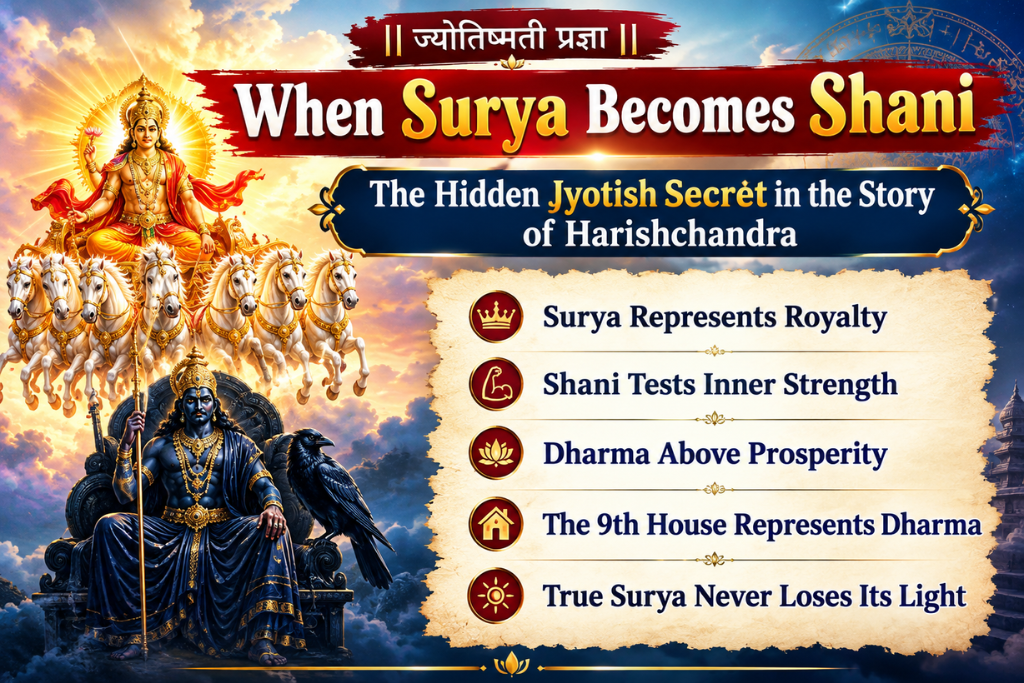
There is one scene from the story of King Harishchandra which, for me, can become an entire Jyotish class. A king belonging to the Surya Vamsha loses his kingdom, wealth, wife, son, royal clothes and social position. Finally, the same man who once commanded an entire kingdom is working as a servant at a cremation ground. Think about this through Jyotish symbolism. Surya has apparently fallen from the throne and entered the world of Shani. The Raja becomes Sevaka. Status disappears. Wealth disappears. Family disappears. Comfort disappears. But one thing still remains — Satya and Dharma.
Before going deeper, one textual correction is important. The detailed version in which Vishwamitra takes away Harishchandra’s kingdom, demands Dakshina, Harishchandra sells his wife and son, sells himself to a Chandala and finally works in the cremation ground is found prominently in the Markandeya Purana and related later Puranic traditions. In the Markandeya version his wife is called Shaivya and his son Rohitasya; Dharma himself ultimately reveals that he had assumed the form of the Chandala.
The Bhagavata Purana does contain Harishchandra, but its main story in Skandha 9 is different. There Harishchandra promises his future son to Varuna, repeatedly postpones the sacrifice, Rohita leaves, and eventually Shunahshepa becomes central to the story. The Bhagavata ends the episode by praising Harishchandra and his wife’s truthfulness and fortitude, and Vishwamitra gives them higher spiritual knowledge.
The Bhagavata gives this beautiful verse:
“सत्यं सारं धृतिं दृष्ट्वा सभार्यस्य च भूपतेः ।
विश्वामित्रो भृशं प्रीतो ददावविहतां गतिम् ॥”
Vishwamitra sees Satya, firmness and Dhriti in the king and his wife, becomes deeply pleased, and grants them an unobstructed spiritual attainment or knowledge. Notice what the text praises. Not his throne. Not his money. Not his royal power. Satya and Dhriti.
And the Mahabharata gives yet another angle. In Sabha Parva, Yudhishthira is surprised that among earthly kings Harishchandra has such an exalted place in Indra’s Sabha. Narada explains his greatness through his Rajasuya, sovereignty and extraordinary generosity. So in the Mahabharata we meet the successful emperor; in the Bhagavata we meet the king tested around vow, sacrifice and truth; and in the Markandeya Purana we meet the king stripped of practically everything.
These are not useless contradictions. They create a much deeper philosophical question: what exactly makes Harishchandra great? His Raja Yoga? His wealth? His Yajna? His generosity? Or the fact that when all those things disappear, his inner principle still survives?
Now Jyotish becomes fascinating.
Brihat Jataka and the Parashari planetary cabinet give Surya and Chandra royal status, while Saturn occupies the position of servant. Surya also carries the principle of Atma, while Saturn carries sorrow, labour, limitation and service in the classical planetary symbolism.
Now look at Harishchandra’s story again. He begins in the external world of Surya — king, authority, kingdom, recognition and command. Then life takes him towards the external world of Shani — slavery, labour, humiliation, suffering, death, cremation ground and service under another person.
But here is the secret: his outer Surya is removed, but his inner Surya is being tested.
This is a very important distinction for Jyotish students.
A strong Sun does not merely mean government job, authority, fame or sitting on a high chair. The deeper question is: what remains of the person when the chair is removed?
Anybody can behave like a king when everybody is obeying him.
Can you remain royal when nobody recognises you?
That is a completely different Surya.
This is why difficult Dashas are often misunderstood. Suppose somebody loses a senior position during Saturn Dasha. We immediately say Saturn destroyed the career. Maybe externally that is correct. But psychologically something else may also be happening. Perhaps Saturn is asking: “Were you powerful because you had authority, or did you possess authority because something powerful existed inside you?”
This is where Harishchandra becomes a Jyotish lesson rather than merely a moral story.
The 10th house is Karma, public status, profession and visible action. The 9th is Dharma, higher principle and the Guru-field. The 2nd includes wealth, family and speech. Classical house doctrine distinguishes these fields clearly.
Now imagine the symbolic horoscope of Harishchandra’s ordeal. His 10th-house world collapses — kingship disappears. His 2nd-house world collapses — wealth and family security disappear. His relationship with wife and child is torn apart. Eventually even his social identity collapses when the king works among corpses at the cremation ground.
What is left?
The 9th-house question.
Dharma.
This gives us one of the most important predictive principles I feel students should understand: a person’s prosperity and a person’s Dharma are not always the same thing.
Sometimes a person is prospering while moving away from Dharma.
Sometimes a person is suffering while holding Dharma.
Therefore never tell a client, “Everything is going badly, so your karma must be bad.”
That is childish astrology.
A difficult period can certainly be the Vipaka of previous Karma, but suffering itself is not proof that the person is Adharmic. If it were, Harishchandra’s story would make no sense.
The Markandeya Purana makes this point almost brutally. When Vishwamitra demands his promised fee, the text says that truth outweighs even a hundred Ashvamedha sacrifices. Harishchandra’s wife herself urges him to preserve truth when everything else is collapsing.
Now ask a difficult question.
Why would Dharma test a Dharmic person?
Perhaps because Dharma that survives only favourable circumstances is not yet fully tested.
It is very easy to speak truth when truth is profitable.
What happens when truth costs you money?
Easy to remain ethical when business is doing well.
What happens when one dishonest transaction can save the company?
Easy to speak about Guru and Dharma when Jupiter Dasha is giving respect.
What happens when Saturn humiliates you publicly?
Easy to preach detachment when nothing precious is being taken away.
Ketu becomes understandable only when separation reaches something you actually love.
This is why great stories are useful for Jyotish. They prevent us from reducing planets to “good” and “bad.”
Sun can give kingship, but kingship can produce ego.
Saturn can give humiliation, but humiliation can reveal character.
Jupiter can give knowledge, but knowledge can remain theoretical.
Mars can give courage, but courage is tested only when there is something to fear.
Venus can give relationships, but love becomes visible when relationship enters difficulty.
So what exactly is a benefic result?
This is a much harder question than “Is Jupiter good?”
Another part of the Markandeya story is even more fascinating. The Chandala who purchases Harishchandra is ultimately revealed to be Dharma himself. Harishchandra believed he had become the servant of the lowest social condition imaginable, but the being to whom he had actually submitted was Dharma.
What a powerful symbolism.
Sometimes the person we think is humiliating us may become the instrument through which our Dharma is being tested.
Sometimes the job beneath our status teaches more than the prestigious job.
Sometimes the failure which destroys ego becomes more valuable than the success which was feeding it.
This does not mean every humiliation is spiritually necessary, and it certainly does not mean an astrologer should romanticise suffering. But it means we should hesitate before deciding the meaning of an event only from its outer appearance.
And then comes the cremation ground.
For a Jyotishi, the symbolism immediately brings the 8th house into the discussion — death, vulnerability, what is hidden, what cannot be controlled, and radical transformation. But again, we should not say Harishchandra’s story is literally an 8th-house astrology lesson. This is a philosophical comparison.
A king entering the cremation ground is entering the one place where kingship has absolutely no value.
The corpse of a king and the corpse of a servant finally ask the same question.
Who are you when every worldly designation is removed?
This is why the cremation ground appears again and again in Indian spiritual imagery. It destroys false continuity.
And perhaps that is exactly what a powerful 8th-house period sometimes does psychologically. The native says, “I am this profession.” Life removes the profession. “I am this marriage.” Life transforms the relationship. “I am this status.” Status disappears.
The astrologer usually asks, “When will the old thing come back?”
Sometimes the deeper question is: “Why must the old identity come back at all?”
Harishchandra reaches an even greater point at the end. Indra offers him heaven, but he refuses to abandon his people. He says, in effect, that the people through whose support he performed his duties and merits cannot simply be discarded now that heaven is available. The Markandeya Purana eventually has him share his merit with them.
This changes the entire definition of a king.
A king is not the person sitting above people.
A king is someone who refuses to abandon responsibility even when he personally has nothing left to gain.
That is real Surya.
And perhaps this gives us a beautiful rule for reading leadership in Jyotish: do not judge leadership only through the promise of authority. Also judge what the native does with responsibility.
A powerful 10th house can make somebody visible.
It cannot automatically make him ethical.
A powerful Sun can give authority.
It cannot automatically guarantee Dharma.
A strong 9th can indicate Dharma, Guru, fortune and principles, but its actual expression must still be seen through the complete horoscope and through conduct.
This is why Dharma-Karma relationship is much deeper than “9th lord + 10th lord = Raja Yoga.”
The real question is whether Karma is serving Dharma.
Harishchandra’s Karma changes completely. King, debtor, seller of his own freedom, servant, cremation-ground worker. But the Dharmic axis is what the story refuses to let collapse.
That is far more interesting than his profession.
And one small critical point about the popular version of the story: later retellings often include the dramatic scene where Harishchandra demands the cremation fee from his own wife and she begins removing her garment to pay. In the Markandeya Purana version I checked, the central cremation-ground episode is slightly different: Shaivya arrives with their snake-bitten son, husband and wife recognise each other, they grieve and prepare to enter the funeral fire, after which Dharma, Indra and the gods appear. So when teaching these stories, it is useful to distinguish the classical textual version from later popular dramatic expansions.
This does not reduce the story. For me it makes it stronger.
Because Harishchandra’s final test is not simply whether he can collect one funeral fee.
The test is whether every external definition of himself can collapse without destroying the principle by which he lives.
Now apply this practically to a horoscope.
When somebody enters a difficult Saturn Dasha, do not ask only what will be taken away. Ask what remains after the taking.
When the 10th house is disturbed, ask whether profession is changing or identity itself is being reorganised.
When the 2nd house suffers, examine money and family, but also examine Vani and values.
When the 8th becomes active, do not predict only crisis. Ask what old identity can no longer continue.
And when the 9th is strong, do not simply predict luck. Ask: what principle will this person refuse to betray even when betraying it becomes profitable?
That last question may tell you more about Dharma than a hundred generic 9th-house predictions.
Now I want Jyotish students to think about their own chart.
Which Graha has tested you by taking away something you once believed was essential?
Saturn through delay or loss of status?
Ketu through separation?
Mars through conflict?
Rahu through desire and disappointment?
Sun through ego and authority?
And after that event, did you become weaker — or did you discover something in yourself which would never have appeared during an easy Dasha?
Write your Lagna + the Graha + one major test in the comments.
But don’t tell me only what you lost.
Tell me what remained.
And one final question for serious students: who is the real Harishchandra — the emperor sitting on the throne, or the man covered in cremation-ground ash who has no kingdom left but still refuses to abandon Dharma?
If Surya represents the king and Saturn represents the servant, perhaps the story is telling us something extraordinary:
the highest Sun is not proved when life makes you a king.
The highest Sun is proved when life temporarily makes you Saturn — and you still do not lose your light.
Jai Guru Dev,
Vinayak Bhatt

![Shri H. N. Katwe: Secrets of Sun [Predictive Techniques Related to Sun]](https://vedicgrace.com/wp-content/uploads/2025/11/Shri-H.-N.-Katwe-Secrets-of-Sun-300x214.png)
![Bhrigu Nandi Nadi Course for Beginners [Hindi]](https://vedicgrace.com/wp-content/uploads/2025/12/Bhrigu-Nandi-Nadi-for-Beginners-Hindi-Recorded-VG-300x214.png)

Leave a Comment
Be the first to comment on this blog!