
Ardra Nakshatra Pada 1: Pending Karma, Marriage, Desire, Hidden Wealth and Predictions from Karma Vipaka Samhita By Vinayak Bhatt
Nakshatra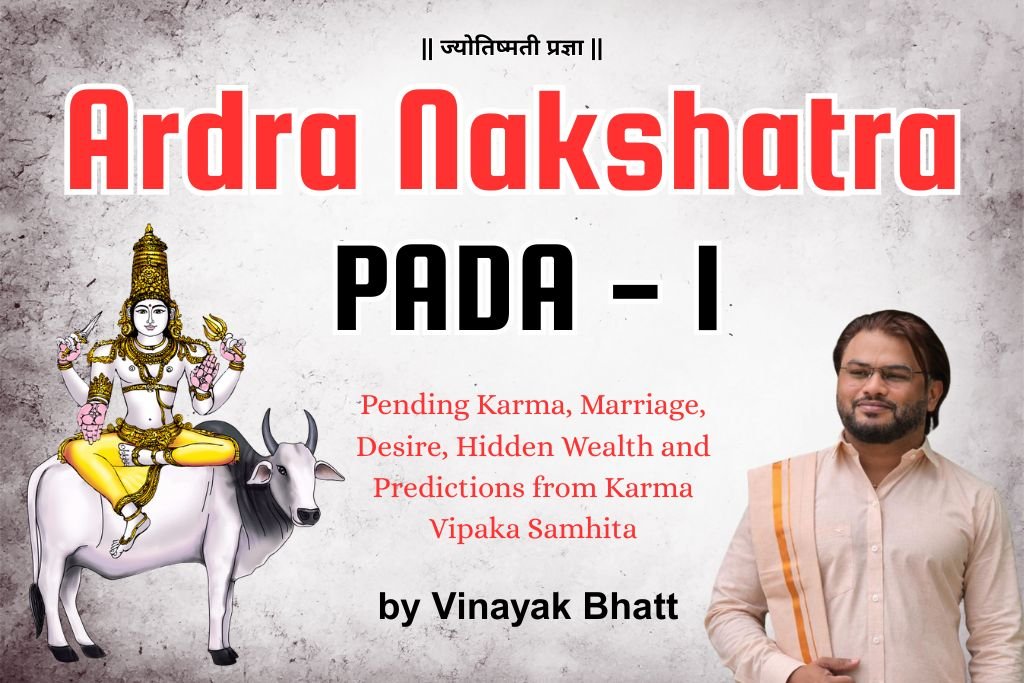
Ardra Nakshatra Pada 1 and Its Deeper Karmic Meaning
Ardra Nakshatra Pada 1 gives a powerful Karma Vipaka lesson about desire, abandonment of an established relationship, wealth, hidden attachments and the difference between performing some Punya while leaving another important area of Dharma unresolved. The central person in the source story is not presented as completely irreligious or incapable of good action. He earns through his profession, accumulates considerable wealth, performs charity at the sacred confluence of the Ganga and Yamuna, and in some versions is described as observing his occupational Dharma.
Yet in the most intimate part of his life he abandons his loyal wife and forms another relationship. The later birth therefore contains an interesting mixture: wealth and social standing remain, showing that earlier Punya has not disappeared, but progeny and bodily well-being become disturbed, showing that the unresolved relationship karma has also not disappeared.
This mixed result is one of the most important things to understand about Ardra Nakshatra Pada 1. The story does not support the simplistic idea that a person is either entirely Dharmic or entirely Adharmic. One area of life can produce Punya while another creates a difficult Samskara. Sacred charity may give its own result, professional skill may give another result, while betrayal or abandonment within marriage can continue as a separate karmic account.
This is exactly why Karma Vipaka becomes useful for Jyotish: the horoscope itself often contains strong Dhana Yogas, intelligence and public recognition together with difficult combinations involving spouse, children, home or health.
Ardra occupies 6°40′ to 20°00′ Gemini, and its first Pada extends from 6°40′ to 10°00′ Gemini, falling in Sagittarius Navamsha. Ardra is ruled by Rahu, its Devata is Rudra, Gemini is ruled by Mercury and Sagittarius Navamsha is ruled by Jupiter. This creates a very meaningful combination for the source story.
Mercury gives skill, trade, movement, communication and multiplicity; Rahu intensifies appetite, fascination and crossing of established boundaries; Rudra brings disruption and the destruction of a previous order; while Jupiter in the Navamsha introduces Dharma, conscience, pilgrimage, charity and the possibility of understanding the consequences of one’s choices. At the lower level, desire destroys an existing structure before wisdom has decided what should replace it. At the higher level, the disruption becomes a genuine purification through which life is rebuilt on a more truthful foundation.
The Karma Vipaka Story of Ardra Nakshatra Pada 1
The source places the earlier-life account in Avantipura or Ujjain, where there lived a cloth-dyer or colour-maker named Kubera. His work consisted of colouring different kinds of cloth, and one translation describes him as following his occupational duties properly. His wife was named Leela, who is presented as devoted and loyal to her husband.
Despite having such a wife, Kubera abandoned her and became attached to another woman described in the text as a Brahmin woman. Some translations describe this as a love relationship followed by living together, while another uses more condemnatory language. The stable point across the versions is that Kubera left his existing loyal wife and established another intimate relationship.
Kubera had also accumulated a large quantity of wealth and buried or concealed it beneath the earth. At some stage he performed charity at the sacred confluence of the Ganga and Yamuna. He later died, and the woman with whom he had formed the later relationship also died. Leela, the abandoned wife, is then described in the old narrative as performing Sati.
This is a historical feature of the source story and should not be understood as approval or recommendation of that practice. The text attributes great Punya to Leela’s devotion and says that because of this virtuous association Kubera experienced a heavenly state for a very long period, given in one translation as two lakh years.
After the exhaustion of that Punya, Kubera returned to human birth and was again wealthy, famous and socially important. Yet the text says that although sons were born to him, they did not survive, and he suffered from recurring fever and a physical difficulty described as lameness or weakness in the leg. The chapter explicitly connects the disturbance of progeny with the earlier marital transgression. The traditional result should not be converted mechanically into a prediction of child loss for every Ardra Pada 1 placement, but the source clearly identifies marital breach and disturbed continuity of progeny as the central karmic connection of this chapter.
The Real Pending Karma: Desire Was Allowed to Destroy an Existing Responsibility
The deeper karma of Ardra Pada 1 is not simply “having another relationship.” Such a statement would be too crude for modern Jyotish. Relationships end, people separate, marriages sometimes become unhealthy and remarriage itself cannot automatically be treated as Adharma. The source story becomes relevant because Kubera is presented as abandoning a wife who had remained loyal while he pursued another attachment. The karmic issue is therefore desire overriding an already accepted responsibility without proper closure.
This distinction is extremely important. Ardra is a Nakshatra of storm, disruption and radical change. Sometimes a structure genuinely needs to end. A marriage may be harmful, a business partnership may become dishonest or an old life may no longer be sustainable. Rudra does not preserve everything merely because it already exists. But destruction carries responsibility. The higher Ardra ends what must end truthfully and then accepts the consequences. The lower Ardra becomes fascinated by the new situation and simply leaves the old one carrying the damage.
A useful consultation question for Ardra Pada 1 is therefore not, “Will you have an affair?” A much deeper question is: “When you become strongly attracted towards a new person, opportunity or life direction, do you complete your responsibility towards what you are leaving behind?” This question can apply to marriage, business, family or even professional commitments.
Rudra: Destruction Is Not the Problem, Unconscious Destruction Is
Ardra’s Devata is Rudra, and this changes the entire way the story should be understood. Rudra is associated with fierce transformation, storm, pain, purification and the breaking of conditions which can no longer remain as they are. Ardra therefore cannot be interpreted only as suffering; it is the stage where something accumulated finally breaks open.
The karmic problem begins when destruction is driven only by appetite, anger, fascination or restlessness. Kubera’s first household is broken, but the source does not show that he consciously completes the old relationship before beginning the new one. In that sense the storm destroys, but it does not purify.
The higher Rudra principle is very different. It may still end a marriage or relationship where that is genuinely necessary, but it does so with truth, responsibility, proper provision, respect and as little unnecessary cruelty as possible. Ardra therefore teaches that ending something is not automatically Adharma; the karmic quality depends greatly upon how and why it is ended. This is one of the most useful distinctions when interpreting Ardra for modern clients.
Rahu and the Attraction Towards What Lies Outside the Existing Boundary
Rahu rules Ardra and gives the Nakshatra its intense searching, experimental and boundary-crossing quality. Rahu is naturally fascinated by what lies outside the familiar structure. In the source story, Kubera has an established wife and household, yet his attention moves outside that structure towards another woman.
The important point is not the woman’s social identity; old translations use caste-based language which should not be literalised today. The astrological principle is that desire becomes attracted towards something outside the already established boundary.
This Rahu tendency can appear in many ways. In relationship matters it may produce attraction towards someone very different from the spouse, unconventional relationships or fascination with what is forbidden, unavailable or socially complicated. In career it may produce an urge to leave a stable profession suddenly for something experimental. In finance it can produce attraction towards hidden or unconventional opportunities. None of these is automatically wrong. Rahu often creates progress precisely by forcing a person beyond familiar limits.
The real question is whether Rahu is guided by intelligence and Dharma or merely by appetite. Ardra Pada 1 becomes constructive when Jupiter, the Navamsha lord, is strong enough to give meaning and ethical direction to Rahu’s desire for change.
Sagittarius Navamsha: The Pada Has a Built-In Possibility of Correction
The first Pada falls in Sagittarius Navamsha, ruled by Jupiter, and this is extremely significant because the source story itself contains both transgression and Punya. Kubera performs charity at a sacred confluence even while his relationship karma remains unresolved. This shows that Dharma has not disappeared from his life; it is simply not governing every area equally.
Sagittarius Navamsha gives the Pada the possibility of correction through higher understanding, pilgrimage, Guru, Shastra, truth and ethical reorientation. The native may go through an Ardra-like disruption first and understand the real meaning only later. Some of the most important wisdom in such lives may come after a crisis, when the person is forced to examine why something broke and what their own role was in that destruction.
The lower Rahu-Jupiter pattern rationalises desire using philosophy: “I deserve happiness, therefore anything I want must be right.” The higher expression uses Jupiter to question desire: “Even if I want this deeply, what is the Dharmic way to proceed?” That difference can completely change the karmic outcome.
The Cloth-Dyer Gives a Powerful Symbol of Changing Appearance
Kubera’s profession as a cloth-dyer or colour-maker is one of the most interesting details in the chapter. The text itself does not explain its symbolic meaning, so this should be understood as interpretive Jyotish rather than literal commentary. A dyer takes an existing cloth and changes its colour. The material remains, but the outer appearance is transformed.
This image fits Ardra remarkably well. Ardra changes the colour of life. After its storm, the same person may appear completely different: a marriage ends, a new relationship begins, career changes, location changes or social identity changes. Yet changing outer colour does not necessarily change the inner Samskara. A person can leave one marriage and repeat the same pattern in the next. They can change cities, professions or partners while carrying exactly the same unresolved emotional habit.
The deeper lesson of the cloth-dyer is therefore that transformation of appearance is not the same as transformation of character. Higher Ardra does not merely repaint life; it transforms the pattern underneath.
Hidden Wealth and the Psychology of Private Security
The source says that Kubera accumulated considerable wealth and buried it beneath the earth. This detail deserves attention because the story simultaneously contains a visible relationship disturbance and hidden material security.
Buried wealth can be read literally as an ancient method of storing valuables, so it should not automatically be treated as proof of secretive or dishonest money. Yet as a symbolic Jyotish layer it fits the Ardra-Rahu theme of things kept below the surface. The native may have a public life and another private life, visible relationships and hidden attachments, declared finances and undisclosed reserves, or an outward decision whose true motive remains concealed.
When Ardra Nakshatra Pada 1 connects strongly with the 2nd, 8th or 12th houses, I would examine whether the native has a tendency to keep important financial or emotional realities hidden until a crisis forces disclosure. This can concern secret savings, unspoken relationship dissatisfaction, private debts, unregistered agreements or information deliberately withheld from the spouse.
The higher use of the same pattern is strategic privacy rather than deception. Not every private matter needs to be public, but anything which materially affects the rights and security of a spouse or partner should not remain hidden indefinitely.
Punya and Papa Can Operate at the Same Time
One of the strongest philosophical lessons of Ardra Pada 1 is that Kubera performs charity at the Ganga-Yamuna confluence and receives a long heavenly result, yet his marital karma still returns separately. The virtue associated with Leela is also shown as contributing to his heavenly enjoyment in the traditional narrative.
This gives a crucial Karma Vipaka principle: Punya does not automatically erase every unresolved Papa, and difficult karma does not mean that a person possesses no Punya. Different actions can give their fruits independently.
This principle is essential when reading real horoscopes. A native may have excellent Dhana Yoga and a difficult 7th house. Another may have strong spiritual combinations but disturbed progeny. A person may be generous, respected and successful while one private relationship remains deeply complicated. There is no contradiction. Different parts of the chart carry different karmic histories.
Therefore, one of the worst mistakes an astrologer can make is to conclude that material success proves that all earlier actions were good, or that one painful area proves the person is fundamentally sinful. Karma Vipaka itself presents a much more nuanced model.
The Abandoned Wife and the Karma of Unfinished Emotional Responsibility
Leela’s role is central because she is not described as hostile or harmful towards Kubera. She is presented as loyal, yet she is left behind when Kubera forms another attachment. This makes abandonment more important than sexuality alone.
In modern life, abandonment can occur even without physical separation. A person may remain married but emotionally withdraw completely while investing all attention elsewhere. Another may leave physically but refuse to settle finances, property or parenting responsibilities. Someone may begin a new relationship while forcing the previous partner to live indefinitely without clarity.
Ardra Pada 1 therefore needs clean endings. If a relationship truly cannot continue, the higher path is to acknowledge that reality, communicate honestly, settle practical responsibilities and allow both people to rebuild. The lower path is to disappear emotionally or financially while continuing to enjoy the benefits of a new life.
The deeper karmic principle is that freedom obtained by leaving another person carrying all the consequences is not complete freedom.
Progeny Karma and the Meaning of Continuity
The classical source says that Kubera’s sons did not survive and explicitly links this with the earlier relationship transgression. This should not be applied literally to every Ardra Pada 1 native. For any serious judgement concerning children, the astrologer must examine the 5th house, fifth lord, Jupiter, Putrakaraka, Saptamsha and operative Dasha.
The wider symbolic principle, however, is valuable. The 5th house represents not only children but what continues after us—students, creative works, institutions, teachings and legacy. Kubera abandons one relationship for immediate desire, while later continuity becomes unstable. The story therefore creates a contrast between short-term gratification and long-term continuation.
In charts where biological progeny is perfectly healthy, the same pattern may manifest through projects which repeatedly fail to continue, businesses which are not successfully handed to the next generation or students who do not remain connected with the teacher. The astrologer should then ask whether the native has a pattern of beginning intensely under Rahu but losing sustained commitment once fascination changes.
The deeper lesson is that what we want intensely today should not destroy what we hope will continue tomorrow.
Fever and the Ardra-Rudra Principle of Inner Heat
The source mentions recurring fever and a physical difficulty affecting the leg in the later birth. These are source-derived results, but they should never be converted into automatic medical predictions from Ardra Pada 1 alone. Health judgement requires the Lagna, Lagnesha, Sun, Moon, Rahu, Mercury, Jupiter, 6th and 8th houses, relevant Vargas and Dasha.
At an interpretive level, fever is an interesting image for Ardra because Rudra is intense, agitated and storm-like. A person can remain internally heated by conflict, desire, guilt or unresolved relationship tension. Yet this should remain symbolic unless the medical factors of the chart independently confirm illness.
The practical correction is not to frighten the native with disease predictions but to recognise that prolonged secrecy, emotional conflict and disrupted relationships can keep life in a continuous state of agitation.
Relationship Karma: Ardra Does Not Like False Stability
Ardra often becomes difficult when a person maintains an outward structure long after the inner relationship has already collapsed. Because Rahu seeks another experience and Mercury creates multiple mental possibilities, the native can live between two realities for too long: one formal, one private.
This is why the higher expression of Ardra Pada 1 needs radical honesty. The person should not pretend that everything is fine merely to avoid disruption, but they should also not destroy an existing structure impulsively simply because something new feels exciting.
A consultation-level prediction can therefore be framed as: “Your chart can bring major transformation through relationships. The danger is not change itself; the danger is beginning the new chapter before the previous chapter has been truthfully closed. Whenever attraction and responsibility point in different directions, the quality of your decision becomes karmically important.”
If the 7th, 8th and 12th houses are heavily involved, secrecy, intimacy, hidden relationships or private financial arrangements may become important. If Jupiter protects the combination, the native may ultimately choose a more principled path after an initial period of confusion.
Wealth, Recognition and the Strange Combination of Success With Private Disturbance
The later Kubera is described as wealthy and famous despite difficulties concerning children and health. This provides an important prediction for Ardra Pada 1: external success and private disturbance can coexist.
When the 10th and 11th houses are strong but the 5th, 7th or 8th houses are afflicted, the person may appear extremely successful publicly while experiencing considerable emotional turbulence privately. Career may rise during the same period that marriage undergoes major transformation. Wealth can increase while family continuity or domestic happiness becomes uncertain.
This is not hypocrisy by itself. It simply shows that different karmic streams are ripening simultaneously. The astrologer should therefore avoid telling a successful client that their difficulties are impossible because the rest of life looks fortunate. Ardra can produce exactly this contrast: a strong outer profile and a storm occurring in the private field.
The First Pada Can Give Powerful Transformative Intelligence
Ardra should not be reduced to destruction or suffering. Its first Pada can possess extraordinary intelligence because Rahu, Mercury and Jupiter together can create the ability to question accepted structures, research deeply and understand something after passing through complexity.
Mercury gives mental agility, Rahu refuses superficial answers and Sagittarius Navamsha eventually wants the larger truth. Such natives can do well in research, technology, analytics, investigation, psychology, crisis management, consulting, unconventional knowledge, media, communication, healing systems or subjects where hidden causes must be discovered beneath visible symptoms.
The danger is intellectual rationalisation. A very intelligent person can construct excellent arguments for whatever they already want to do. Therefore Jupiter becomes essential. The higher question is not simply, “Can I justify this?” but “Would I still call this Dharmic if another person did the same thing to me?” That one question can regulate Rahu remarkably well.
House Logic for Ardra Nakshatra Pada 1
The 2nd house becomes important for family, wealth and resources kept within the household, especially because Kubera accumulated and concealed wealth. The 4th house shows the home and emotional security which may be disrupted when the original marriage breaks. The 5th house is essential because the source specifically gives disturbed progeny. The 7th house is one of the primary houses for the story because marriage, spouse and the breaking of partnership are central.
The 8th house becomes relevant for secrecy, sexual intimacy, hidden resources and consequences which continue beneath the visible surface. The 9th house connects strongly with the Sagittarius Navamsha and the source’s charity at the sacred confluence, bringing Dharma, pilgrimage and corrective wisdom. The 12th house can show separation, private relationships, bed pleasures, secrecy and the cost of choices made outside the established household.
When the 5th and 7th houses both connect with an afflicted Ardra Pada 1, relationship decisions and children may strongly influence each other. A 7th–8th–12th connection can make hidden intimacy, separation or private relationships more relevant. A 2nd–8th connection can bring secret family finances or resources which are not fully disclosed. A strong 9th-house or Jupiter influence can become a major protection because it gives the native the capacity to recognise the Dharmic dimension of a difficult choice.
The Pada should therefore never be read separately from the horoscope. The Karma Vipaka story gives the pattern; the Bhavas show where that pattern actually enters life.
Dasha Activation
Rahu Dasha or Antardasha can strongly activate Ardra themes because Rahu rules the Nakshatra. Such periods may bring sudden attraction towards a different life, unconventional relationships, abrupt professional changes, foreign influence, intense ambition or events which break an old pattern. Whether this becomes constructive or destructive depends greatly upon Rahu’s dispositor, Jupiter’s condition and the houses involved.
Mercury periods can activate the Gemini side of the Pada through communication, contracts, dual choices, business, travel and the need to speak clearly about what is changing. Jupiter periods can bring the Sagittarius Navamsha to the foreground and often make questions of Dharma, Guru, truth, children or consequences more visible. Venus periods can strongly activate relationship and pleasure themes, while periods of the 5th or 7th lords may directly bring progeny and marriage into focus.
The strongest prediction should be made only when Nakshatra, house connection and Dasha repeat the same subject. Ardra Pada 1 by itself is not enough to declare an affair, divorce or progeny difficulty.
Planetary Applications of Ardra Nakshatra Pada 1
When the Sun occupies Ardra Pada 1, identity, status and personal will can become involved in major life transformations. The native may find it difficult to accept a relationship or career structure that no longer fits their sense of self. If afflicted, ego may justify abrupt abandonment, while a strong Jupiterian influence can help the native take responsibility for the consequences of change. Public recognition may remain strong even when private life goes through storms.
When the Moon occupies Ardra Pada 1, emotional life becomes much more intense because the mind itself sits in Rudra’s Nakshatra. The person may experience powerful emotional shifts, deep attachment followed by sudden disillusionment, or a strong need to understand why relationships change. At the higher level, such a Moon can develop unusual emotional intelligence after passing through difficult experiences; at the lower level, temporary emotional storms can lead to irreversible decisions.
When Mars occupies the Pada, change can be swift because Mars acts before everything has been intellectually processed. Relationship conflict, anger and decisive breaks may become more likely if the 7th or 8th houses are involved. Yet the same Mars gives the courage required to end genuinely harmful situations and rebuild life honestly.
When Mercury occupies Ardra Pada 1, the Gemini field becomes highly active and the native can be exceptionally intelligent, adaptable, persuasive and commercially capable. The danger lies in rationalising contradictory behaviour or maintaining two narratives simultaneously. Higher Mercury communicates difficult truths early rather than allowing secrecy to become a larger problem.
When Jupiter occupies this Pada, the Sagittarius Navamsha lord becomes strongly involved and the life may contain a major tension between desire and Dharma. A strong Jupiter can give eventual wisdom, repentance, teaching ability and the capacity to convert crisis into philosophy, while an afflicted Jupiter can make the person intellectually justify conduct that their deeper conscience already questions.
When Venus occupies Ardra Pada 1, relationship, pleasure, attraction and lifestyle become particularly important. Unusual or intense relationships may transform the native’s life, especially if Rahu and the 7th or 12th houses are also involved. The higher Venus learns that love and honesty must develop together; attraction without responsibility creates instability.
When Saturn occupies the Pada, the native may remain in a difficult structure for a long time before the eventual break occurs. Relationship responsibilities, guilt or fear of social consequences can make change slow, but once the structure ends it may not easily return to its previous form. A strong Saturn helps the native settle obligations carefully rather than disappearing from them.
When Rahu occupies its own Nakshatra Pada, the Ardra quality becomes highly intensified. The person may be strongly attracted towards unconventional experiences, foreign influences, technology, research or relationships which challenge social expectations. This placement can produce remarkable intelligence and worldly reach, but desire needs strong ethical direction because ordinary boundaries may feel less compelling.
When Ketu occupies Ardra Pada 1, detachment may follow intense experience. The native may suddenly lose interest in relationships, possessions or identities which once seemed extremely important. At the higher level this can produce deep inquiry and spiritual transformation, while at the lower level the person may sever connections before practical responsibilities have been completed.
These planetary applications are Jyotish interpretations derived from Ardra, Gemini and Sagittarius Navamsha, not literal statements made by the Karma Vipaka chapter. Lordship, dignity, aspects, conjunctions and Dasha must always modify them.
Consultation-Level Predictions
When Venus, Rahu or the 7th lord occupies Ardra Pada 1 and connects with the 8th or 12th house, one useful consultation statement is: “Relationships can become a major field of transformation in your life. Strong attraction towards a new direction may arise suddenly, but your protection lies in not beginning the new arrangement by leaving the old one unresolved. Financial, emotional and family responsibilities should be settled clearly before life moves forward.”
When the 2nd and 8th houses are involved, the astrologer may add that some money or family resources may be kept privately and that financial transparency becomes important in marriage. When the 5th house and Jupiter are involved, children or continuity of family may become especially sensitive to relationship decisions, though no literal prediction of child loss should be made unless the full progeny factors independently support it.
When the 9th house or Jupiter strongly protects the Pada, a different prediction becomes possible: “A major crisis can eventually become the reason you move towards deeper Dharma, pilgrimage, teaching or spiritual understanding. The storm may not be the end of the story; it may become the event that forces you to live more truthfully afterward.”
This is one of the highest possibilities of Sagittarius Navamsha.
Traditional Prayaschitta for Ardra Nakshatra Pada 1
The traditional Prayaschitta given in the chapter centres on Gayatri Japa, Homa, Tarpana, Marjana, Dana and feeding Brahmins. The source prescribes one lakh repetitions of the Gayatri Mantra, followed by Dashamsha Homa and the corresponding Tarpana and Marjana. It further instructs the native to use one-sixth of household wealth or income for Punya or charity, and to feed ninety Brahmins with Payasa, a rice-and-milk preparation.
A copper-red or tawny cow, properly decorated, is then prescribed for donation according to the ritual procedure. The text associates completion of these acts with restoration of progeny and relief from disease.
Another translation gives the same basic structure: Gayatri Japa, Homa, Tarpana and purification rites, one-sixth of wealth in donation, feeding Brahmins with rice-and-milk preparations and cow donation. The numerical and descriptive details should therefore be followed from a reliable Sanskrit edition if someone intends to perform the exact classical ritual, rather than reconstructing a Purashcharana solely from English translations.
Why Gayatri Is an Appropriate Remedy for Ardra Pada 1
The source itself does not provide a philosophical explanation for every remedial element, so this is interpretive reasoning rather than direct textual commentary. Gayatri is centred on the purification and illumination of Buddhi, and Ardra Pada 1 needs precisely this because the central difficulty is not lack of intelligence. Kubera is productive, capable of wealth and able to perform charity. The problem is that intelligence does not govern desire consistently.
Rahu can make the mind intensely convinced by what it currently wants. Mercury can provide excellent arguments. Gayatri symbolically restores a higher discrimination so that desire is examined rather than automatically obeyed.
The correction is therefore not suppression of desire but clarity about consequence.
Why One-Sixth of Wealth Is Directed Toward Punya
The source’s instruction to redirect one-sixth of wealth is especially meaningful because Kubera accumulated substantial resources and concealed them under the earth. The old pattern therefore contains retention and private possession, while the remedy makes wealth consciously move outward through Dana and feeding.
This reverses the direction of the Samskara. Hidden wealth becomes visible charity, private enjoyment becomes nourishment for others and accumulation becomes circulation. The remedy does not condemn prosperity; the later incarnation is itself described as wealthy. Instead, it teaches that wealth should not become completely disconnected from Dharma.
For modern practice the exact one-sixth prescription belongs to the traditional ritual and should not be casually imposed upon every client as a financial rule. The deeper principle is to make a meaningful part of one’s resources serve something beyond private appetite.
Why Feeding Is Important
The chapter prescribes feeding ninety Brahmins with Payasa. The ritual number belongs to the classical remedy, but the broader symbolism is important. Ardra’s storm can make the individual highly self-absorbed during crisis. Relationship breakdown often narrows attention to personal hurt, personal desire and personal justification.
Feeding others moves awareness outward.
Soma, closely associated with nourishment and rasa, becomes constructive when the native becomes a source of nourishment rather than remaining absorbed only in what they themselves want.
The traditional remedy therefore combines mental purification through Mantra, transformation through Agni, release through Dana and nourishment through feeding.
Practical Modern Remedy
The strongest practical remedy for Ardra Pada 1 is truthful closure of unresolved relationships. If there is an existing spouse or partner, the person should not maintain a secret parallel relationship while avoiding the consequences of a decision. If separation is necessary, financial obligations, property, children and practical responsibilities should be settled as cleanly as possible. Where harm has already been caused, acknowledgement and reasonable restitution are more meaningful than spiritual ritual performed without behavioural change.
Financial transparency is the second major correction because the source includes buried wealth. Shared family resources should not be hidden where secrecy directly affects the rights of spouse or children. Personal privacy can remain, but material deception should not become part of the relationship.
A third correction is to create regular Punya through Dana, food support, education, medical assistance or other genuine service according to capacity. This reflects the direction of the traditional remedy without claiming that a modern charitable act is identical to the classical Prayaschitta.
The deeper behavioural principle is simple: do not use a new desire as permission to disappear from an old responsibility.
The Higher Expression of Ardra Nakshatra Pada 1
The higher Ardra Pada 1 is not a person who never experiences storm. In fact, major transformation may be part of the life. Relationships, career, belief systems or identity can change dramatically, and the native may pass through periods where the old structure genuinely cannot continue.
The higher expression lies in what happens after truth becomes unavoidable. Rahu gives the courage to cross boundaries which genuinely need to be crossed, Mercury gives the intelligence to understand the situation, Rudra destroys what has become false and Jupiter rebuilds life according to a larger principle. Such a person can emerge from crisis far wiser than they were before it.
This Pada can therefore produce excellent researchers, reformers, crisis managers, therapists, investigators, technologists and teachers who understand human complexity because they have personally experienced the difference between outer stability and inner truth. Their power grows when they stop using intelligence to defend desire and begin using intelligence to understand consequence.
The Real Teaching of Ardra Nakshatra Pada 1
Ardra Nakshatra Pada 1 ultimately teaches that transformation is not complete merely because the old life has been destroyed. Kubera changed his relationship, accumulated wealth, performed charity and eventually enjoyed great Punya, yet the unresolved pain of the abandoned bond remained as another karmic stream. The later incarnation gave wealth and recognition, but family continuity and bodily peace were disturbed. The chapter therefore presents a life in which achievement and unresolved karma exist side by side.
Rudra breaks structures, but Jupiter asks whether anything wiser has been built after the breaking. Rahu searches beyond boundaries, but Dharma asks whether the search has become an excuse to ignore responsibility. Mercury can explain every choice, but the soul eventually has to live with the result of the choice.
The main predictive principle for Ardra Nakshatra Pada 1 is that when this Pada strongly connects with marriage, progeny, hidden resources or private-life houses, the astrologer should examine whether a powerful new desire, relationship or direction has entered life before the previous responsibility has been properly concluded, and whether public success is coexisting with an unresolved private storm.
The deeper Karma Vipaka teaching is that one field of Punya does not automatically erase another field of unfinished karma. Charity may give its result, professional skill may give its result and relationship conduct may give its own result separately. The higher principle of Ardra Pada 1 is therefore to allow Rudra to destroy what is genuinely false, but never allow Rahu’s fascination with the new to make you careless about the people and responsibilities left behind. Real transformation is not simply changing the colour of life; it is changing the Samskara underneath it.







![Shri H. N. Katwe: Secrets of Moon [Predictive Techniques Related to Moon]](https://vedicgrace.com/wp-content/uploads/2025/11/Secrets-of-Moon-Webinar-300x300.jpg)

Leave a Comment
Be the first to comment on this blog!