
Shri Suktam is Not Just a Prayer For Money by Vinayak Bhatt
Astrology/ Spirituality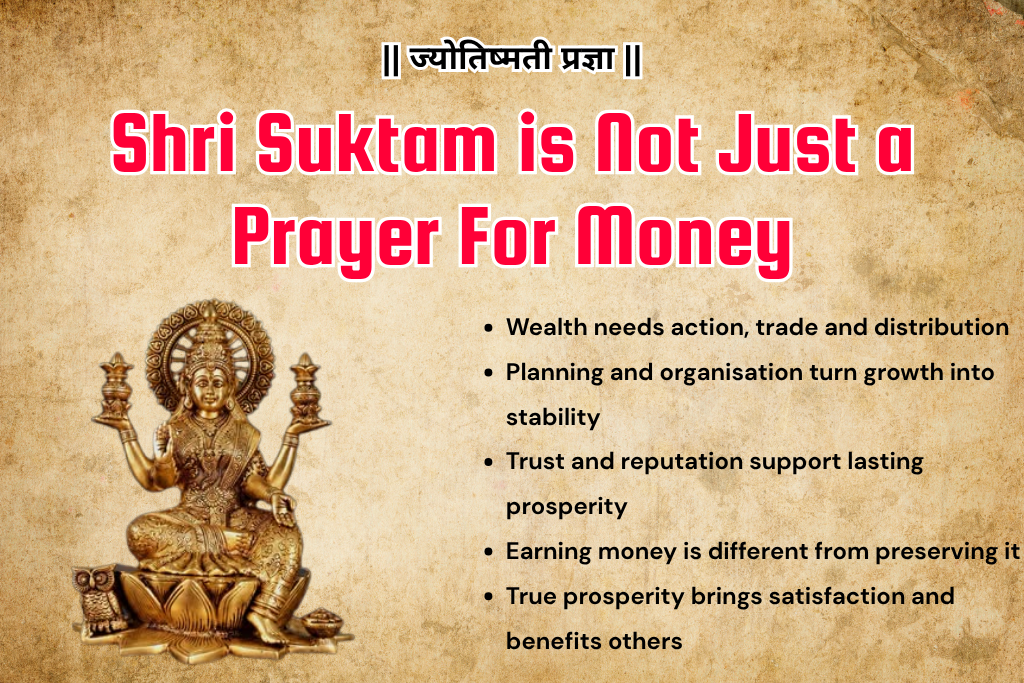
Whenever I study Shri Suktam, one question keeps returning to my mind: Why does the Vedic Rishi describe Goddess Lakshmi arriving with horses, chariots and elephants? If the purpose were simply to obtain money, why not ask for gold directly? Why introduce an entire procession? Perhaps the Rishi is showing us something much deeper about prosperity. Wealth is not merely the amount sitting in your bank account. Wealth is also the capacity to produce, organise, preserve and distribute resources. And this is where Shri Suktam becomes extraordinarily interesting for students of Jyotish, business, economics and spiritual science.
Let us take the third mantra of Shri Suktam:
“अश्वपूर्वां रथमध्यां हस्तिनादप्रबोधिनीम् ।
श्रियं देवीमुपह्वये श्रीर्मा देवी जुषताम् ॥”
In simple language, I invoke Goddess Shri, whose procession is preceded by horses, who is positioned amidst chariots, and whose presence is announced by the trumpeting of elephants. May that Divine Shri be pleased with me.
Now notice the arrangement. First come horses, then the chariot, and then the sound of elephants. This is not an image of Lakshmi sitting alone on a mountain of currency. It is an image of organised prosperity, movement and royal abundance. Traditional explanations primarily understand these as signs of royal wealth and splendour. But some devotional interpretations go deeper, connecting the chariot with the Divine abode and the elephant’s call with the appeal of Gajendra to Bhagavan. The physical procession and the devotional meaning are two different ways of approaching the same mantra.
There is even an interesting textual variation. Some recensions read “हस्तिनादप्रबोधिनीम्”, suggesting one awakened or heralded by the sound of elephants, while another transmitted reading is “हस्तिनादप्रमोदिनीम्”, suggesting one delighted by their sound. This is exactly why studying the original mantra and its different recensions matters. A small change in Sanskrit can change the shade of meaning.
But now I want to read this mantra through a different lens. What if we apply its imagery to modern economics and management? I am not claiming that the Vedic Rishi literally wrote a modern business-management textbook. The following is a practical interpretation of the mantra’s symbolism, not its literal translation.
Ashva represents movement, energy and the ability to reach a destination. In today’s economy, what produces movement? Sales, marketing, transportation, distribution, communication and the ability to bring a product or service to people. You may have the finest product in the world, but if nobody knows about it, if nobody can access it, and if you cannot deliver it properly, your business will struggle. A beautiful product without distribution is like owning a magnificent chariot without horses.
Now comes Ratha, the chariot. A horse provides movement, but the chariot gives that movement structure and direction. This is where management enters. Operations, planning, accounting, employees, systems, inventory and coordination form the chariot of an organisation. You may have tremendous demand, but without proper systems, growth itself can become destructive. More customers bring more complaints, more sales create more unpaid bills, and greater revenue produces greater operational confusion. The horses are running, but the chariot is breaking.
Then comes Hasti, the elephant. In the traditional royal setting, elephants were associated with power, prestige and authority. In our modern interpretation, this can represent institutional strength, reputation, credibility and the capacity to sustain large responsibilities. A business may generate sales through Ashva and execute them through Ratha, but without trust, governance and credibility, it may never develop lasting authority.
So one possible management lesson from this mantra is that movement, organisation and institutional strength must work together. Having only one of these is not the same as possessing complete prosperity.
Now look at the same concept through Jyotish. Mars can contribute initiative and execution. Mercury represents trade, calculation, communication and commercial intelligence. Saturn brings labour, systems, discipline and the ability to repeat a process. Jupiter brings judgement, knowledge, finance and a larger understanding of responsibility. Venus represents value, comfort, refinement and the quality of what we offer. Sun becomes relevant to authority, leadership and recognition. These are interpretive connections with planetary Karakatwas, not a claim that the mantra assigns a particular Graha to each animal.
This is why I tell students not to predict wealth merely by looking at Jupiter or Venus. The 2nd house may indicate accumulated resources, the 11th gains, the 10th professional activity, the 7th business relationships and exchange, and the 9th Dharma and fortune. But the real question is whether these factors work together. A strong promise of gain does not automatically guarantee sound financial management.
Imagine two businessmen. One generates ₹10 lakh in monthly revenue but spends almost everything on unnecessary expansion, maintains poor accounts and repeatedly struggles to pay employees. Another generates ₹5 lakh, preserves healthy margins, pays obligations on time, builds reserves and slowly develops a trustworthy organisation. Which one is actually moving towards more sustainable Shri? The first person may have impressive income, but his financial structure is weak. The second is building the conditions under which prosperity can remain.
This is where the previous mantra of Shri Suktam becomes important. It invokes “लक्ष्मीमनपगामिनीम्” — Lakshmi who does not depart. The concern is not only the arrival of prosperity but its continuity.
This is a profound economic principle. Earning money and retaining money require different abilities. Creating wealth and managing wealth are not identical. And acquiring wealth without learning how to use it responsibly can make a person financially richer but internally poorer.
The fourth mantra then adds another extraordinary dimension through the words “तृप्तां तर्पयन्तीम्” — the Goddess who is herself fulfilled and who nourishes or satisfies others. The traditional spiritual meaning concerns Divine fullness and Her capacity to bestow satisfaction. As a modern management interpretation, it raises a beautiful question: Can prosperity be considered complete when it satisfies only the owner but leaves everyone connected with the enterprise dissatisfied?
Think about a business where the owner becomes wealthy but employees remain unpaid, customers feel cheated, suppliers are constantly pressured and the environment is damaged. Is that Shri, or merely accumulation? True prosperity has an element of nourishment. The same principle can be applied to family wealth. A person may accumulate crores but destroy relationships through greed, control and insecurity. What exactly has he gained?
This also gives Shri Suktam an important spiritual meaning. Lakshmi is not simply a reward for desire. Her worship can become a contemplation on our relationship with abundance. Do we want wealth because we can use it meaningfully, or because we are frightened of being ordinary? Do we seek money for security, or has the search for security itself become endless? Can we enjoy prosperity without becoming enslaved by comparison?
And this brings me back to Jyotish. Sometimes a strong wealth combination produces enormous income but little contentment. Sometimes a difficult financial period forces a person to understand budgeting, savings, discipline and responsibility for the first time. We must distinguish the promise of wealth from the wisdom required to handle wealth.
A horoscope may show when a financial opportunity becomes active. It may indicate the fields through which income is generated. But no planetary combination gives us permission to ignore accounting, business ethics, customer trust or financial discipline.
This is the beauty of combining Shri Suktam with practical Jyotish. We move from merely asking, “When will I become rich?” to asking, “What kind of wealth am I capable of creating, preserving and using?”
And perhaps the greatest secret of this mantra is that Shri arrives in an organised procession. Wealth is not presented as an isolated object. It comes with movement, structure, resources and authority.
For me, this is a fascinating way to understand the relationship between Artha and Dharma. Money is necessary, but the ability to handle money correctly is a separate Vidya. Wealth without direction creates waste. Wealth without discipline creates instability. Wealth without values can destroy the very happiness for which it was accumulated.
Now I want serious Jyotish students to answer one question. If Ashva represents movement, Ratha represents organised execution and Hasti represents institutional strength, which planetary combination would you examine for a person who earns very well but cannot build a stable business?
Would you examine Mercury and Saturn? The 2nd and 11th lords? Jupiter and Venus? The 10th house? Or something else?
Give your logic in the comments. I want to see how many students can move beyond “Jupiter gives wealth” and actually analyse the process through which wealth is created.
And one more question: If Lakshmi is invoked as Anapagāminī, the one who does not depart, should our Jyotish predictions distinguish between earning wealth, accumulating wealth and preserving wealth across generations?
These are the kinds of questions we are going to explore in our upcoming lecture series, SECRETS OF SHRI SUKTAM, where we will study its mantras through their Sanskrit meanings, spiritual philosophy, Jyotish, money management, economics and practical application in daily life.
We will examine how the Vedic imagery can help us think about income, business, wealth creation, financial discipline, leadership, customer satisfaction, prosperity and the deeper meaning of Shri.
Because perhaps Shri Suktam is not merely teaching us how to invite Lakshmi into our lives. It is also asking whether we have developed the capacity to receive, preserve and honour Her presence.
Our new lecture series SECRETS OF SHRI SUKTAM is starting soon.
And before commenting, think about one final question: Is a person wealthy because Lakshmi has given him money, or does the true test of Shri begin with what he does after receiving that money?
Jai Guru Dev
Vinayak Bhatt

![Bhrigu Nandi Nadi Course [English]](https://vedicgrace.com/wp-content/uploads/2025/11/Bhrigu-Nandi-Nadi-Astrology-VG-English-300x214.png)


Leave a Comment
Be the first to comment on this blog!