
Siddha Kunjika Stotra Is Not Just a Shortcut to Durga Saptashati – Its Real Secret May Be “Mantra Jagriti,” the Awakening of the Mantra by Vinayak Bhatt
Astrology/ Spirituality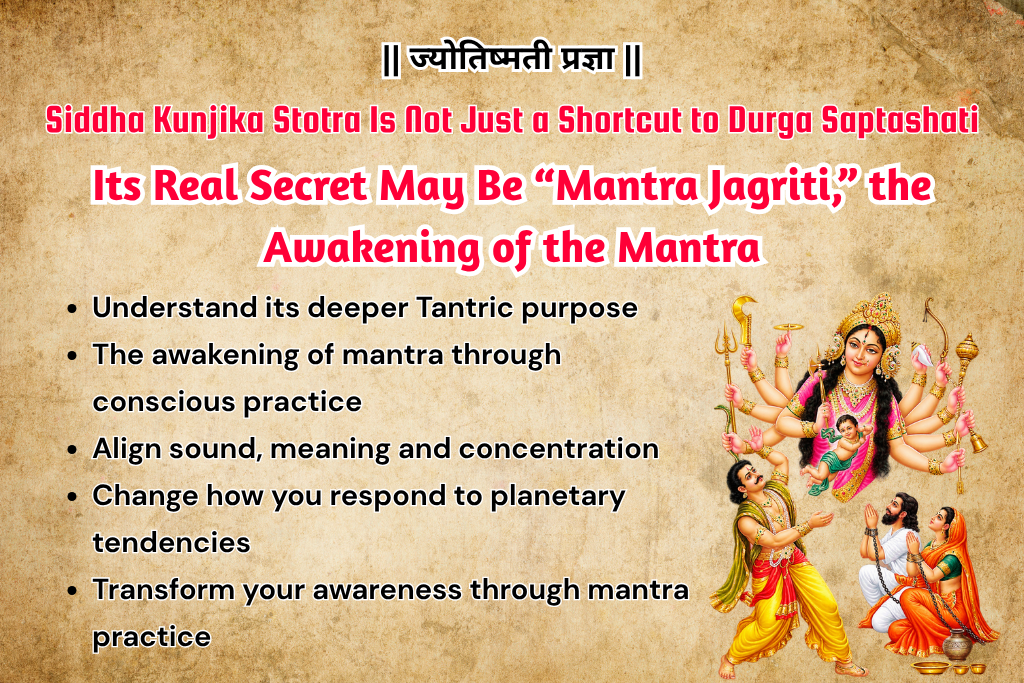
Whenever I hear Siddha Kunjika Stotra being described simply as “a shortcut to Durga Saptashati,” I feel we are missing the most interesting part of the text. Yes, the Stotra itself makes an extraordinary statement: “न कवचं नार्गलास्तोत्रं कीलकं न रहस्यकम् । न सूक्तं नापि ध्यानं च न न्यासो न च वार्चनम् ॥” and then, “कुञ्जिकापाठमात्रेण दुर्गापाठफलं लभेत् ।” In simple words, it says that through Kunjika recitation one can obtain the fruit associated with Durga Path without separately performing Kavacha, Argala, Kilaka, Sukta, Dhyana and Nyasa.
But students should immediately notice something. Siddha Kunjika Stotra is not one of the original thirteen chapters of Devi Mahatmya in the Markandeya Purana. The Devi Mahatmya itself is the famous thirteen-chapter section corresponding to chapters 81–93 of the Markandeya Purana. The transmitted Kunjika text identifies itself instead with the Rudrayamala/Gauri Tantra tradition, while another colophon gives Damara Tantra. This means the Kunjika belongs to the later Tantric ritual world that developed around Chandi worship, rather than being simply another original chapter of the Markandeya Purana.
For me, this difference is important. It does not make Kunjika less sacred. It makes its purpose clearer. Devi Mahatmya gives us the great narrative and theological body of the Goddess tradition; Kunjika represents a much more concentrated Tantric approach to activating the mantra-current around Chandi. Modern scholarship also shows how Devi Mahatmya later developed a vast ritual and Tantric life around itself through its Angas, commentaries and recitation traditions.
And then comes the line which I personally find more interesting than the famous “shortcut” statement: “इदं तु कुञ्जिकास्तोत्रं मन्त्रजागर्तिहेतवे ।” The text itself says that Kunjika Stotra is for “Mantra-Jagarti” – for the awakening, enlivening or bringing-to-consciousness of the mantra.
That changes the entire discussion.
Perhaps Kunjika is not merely asking, “How can I recite fewer pages?” Perhaps it is asking, “When does sound stop being ordinary sound and become living Mantra in the consciousness of the practitioner?”
This is why the word Kunjika itself is fascinating. Sanskrit dictionaries record Kuñcikā in the sense of a “key.” So the popular understanding of Siddha Kunjika as a “key” to Chandi is not meaningless. But a key is useful only when we understand what it is opening. The deeper question is: what exactly is locked?
Is Devi locked?
Is the mantra locked?
Or is our own attention locked?
We may chant the most powerful mantra while the mind is planning dinner, remembering an argument, checking the phone and thinking about tomorrow’s consultation. Then the mantra is moving, but is consciousness moving with it?
This is where Patanjali gives us a beautiful parallel, although he is speaking specifically about Pranava and not commenting on Kunjika. Yoga Sutra 1.28 says: “तज्जपस्तदर्थभावनम्” – repetition should be accompanied by contemplation of its meaning. The following Sutra connects this practice with inward awareness and the weakening of obstacles.
This one principle can transform mantra practice. Japa is not only repetition of sound. Sound, attention and Bhavana slowly have to start meeting each other.
Bhagavad Gita gives Japa an equally high place. Shri Krishna says: “यज्ञानां जपयज्ञोऽस्मि” – among Yajnas, I am Japa-Yajna. Why call Japa a Yajna? Because something is being offered. Perhaps in every conscious repetition, distraction is being offered, ego is being offered, restlessness is being offered, and slowly the practitioner is no longer exactly the same person who started the recitation.
Even Brahma Sutra begins its final contemplative section with “आवृत्तिरसकृदुपदेशात्” – repetition is required because the teaching is repeatedly enjoined. Different Shastra, different subject, but again the same deep Indian principle appears: transformation rarely comes from touching something once. It comes through Avritti – conscious repetition.
And this brings me to Jyotish.
Parashara says very simply: Sun is Atma, Moon is Manas, Mercury gives Vani, and Jupiter gives Jnana. Now think about mantra chanting. What is involved? Vani is involved. Manas is involved. Knowledge of meaning is involved. Sankalpa and inner centre are involved. This is why I would be very careful before saying, “Siddha Kunjika is a remedy for this one planet.”
The text is much larger than that.
Mercury becomes relevant because pronunciation, sequence and sound require precision. Moon becomes relevant because the mind must remain with the mantra. Jupiter becomes relevant because sound without understanding can remain mechanical. Sun becomes relevant because intention needs a centre. Saturn becomes relevant through disciplined repetition. But these are Jyotish reflections upon the practice; Siddha Kunjika Stotra itself does not give a chart saying AIM = Mercury, HRIM = Moon, KLIM = Venus and so on.
This distinction is extremely important.
Today we have developed a habit of converting every sacred text into a planetary remedy table. One bija for Saturn, one bija for Rahu, one Stotra for Ketu. It makes teaching easy, but sometimes destroys the original depth of the text.
Look at Kunjika itself. Its Vinayoga gives Aim as Bija, Hrim as Shakti and Klim as Kilaka, and the Stotra later explicitly speaks of Devi as Mantrarupini. These syllables belong to Mantra Shastra and Shakta Tantra. Their first job is not to fit neatly into our nine-planet spreadsheet.
And there is another reason for caution. The available Kunjika text itself openly preserves textual variations. The Sanskrit Documents edition gives alternate readings in the central mantra and later Bija passages, and explicitly notes that different books contain variations in both wording and verse numbering.
This is a very important lesson for modern practitioners.
Do not take one reel, one WhatsApp forward or one random website and confidently declare, “This is the only original Kunjika Mantra.”
There are transmitted variants.
That is exactly why Guru, Paddhati and Sampradaya matter in Mantra practice.
The Stotra itself also uses very strong Tantric language and mentions applications such as Marana, Mohana, Vashya, Stambhana and Ucchatana. I do not read this as an invitation for everybody to start experimenting with occult control techniques after downloading a PDF. I read it as a warning that we are dealing with a Mantra tradition which historically considered itself potent, guarded and not casual. The same text immediately says it should be protected and not given indiscriminately.
This makes the modern approach almost funny. The text says “Gopaniyam” – guard it carefully. We put it on Instagram with “CHANT 21 TIMES AND CONTROL YOUR ENEMIES.”
Something has obviously been lost between Shastra and social media.
Now come to meditation. Siddha Kunjika becomes very interesting when we stop asking only, “What will I get from chanting?” and start asking, “What happens to my mind while chanting?”
Can you remain with every syllable?
Can you hear your own pronunciation?
Can you notice when the tongue continues but the mind has left?
Can you maintain the same attention on the 21st repetition that you had on the first?
That is meditation hidden inside Mantra.
And this gives us a very practical Jyotish application. Suppose somebody has a disturbed Moon. The horoscope may certainly show emotional sensitivity, anxiety or instability. But should we conclude that this person is permanently helpless because Moon is placed in a difficult combination? Or can disciplined Japa change the quality of the Manas through which that Moon expresses itself?
The Moon in the chart remains at the same degree.
But the person experiencing the Moon can change.
This distinction is one of the most important bridges between Sadhana and Jyotish.
The same Mercury can produce scattered thinking in one person and extraordinary mantra discipline in another. The same Mars can become anger or Tapas. The same Saturn can become frustration or long-term Sadhana. The same Rahu can become obsession with worldly stimulation or intense research into the hidden dimensions of Shastra.
Graha may describe the tendency. Sadhana influences how consciously that tendency is lived.
This is also why I find the story of Devi Mahatmya itself relevant. King Suratha and the Vaishya Samadhi approach the sage because they cannot understand why their minds remain attached to people and situations that have already caused them suffering. The text begins with a psychological mystery: “I know this hurts me, so why am I still attached?”
That is exactly the kind of question we should ask in Jyotish.
Why does the same relationship pattern repeat?
Why do I know I should remain silent but still react?
Why do I know the financial decision is unwise but still make it?
Why does the mind return to the same fear?
We normally say Moon, Rahu, Saturn, Mars.
Correct.
But Mantra Sadhana asks the second question: what are you doing with that planetary tendency every day?
Perhaps this is where “Mantra-Jagarti” becomes psychologically meaningful. When mantra awakens, maybe only the mantra is not becoming alive. Perhaps the practitioner also becomes more awake to his own patterns.
And then Kunjika begins to look less like a shortcut.
A shortcut means doing less.
A key means opening something.
There is a big difference.
If I recite five minutes carelessly instead of forty minutes carelessly, I have merely found a shorter way to remain distracted.
But if one short Stotra brings sound, attention, meaning and Devi-Bhava together, then compression becomes power.
This may be the real genius of Siddha Kunjika.
It compresses.
It does not necessarily simplify.
Now I want Jyotish students who regularly chant Siddha Kunjika Stotra to observe something different. Do not only tell me that your problem disappeared. Tell me what changed first inside you.
Did your fear reduce?
Did your speech become more controlled?
Did anger reduce?
Did concentration improve?
Did you become more decisive?
Did you notice old emotional patterns more clearly?
Did your response to a difficult Dasha change even before the external event changed?
Write your Lagna + Moon sign or Nakshatra + the Graha you feel is most difficult in your chart, and then one actual change you noticed after regular mantra practice.
And one deeper question for discussion: when Siddha Kunjika calls itself “Mantra-Jagarti-Hetave”, what exactly is being awakened — the mantra, the Devi within the mantra, or the consciousness of the person chanting it?
Perhaps all three cannot really be separated.
And maybe that is why Siddha Kunjika Stotra should not be studied merely as a shorter replacement for Durga Saptashati.
It may be teaching something much more subtle: before asking Mantra to change your destiny, allow Mantra to change the consciousness through which you are living that destiny.
One research point worth retaining when you teach this: the received Kunjika text itself acknowledges variant readings and gives alternate colophons pointing to Rudrayamala/Gauri Tantra or Damara Tantra. So for serious Mantra practice, it is better to follow one recognised Paddhati or Guru-parampara consistently rather than mixing syllables from several internet versions.
Jai Guru Dev
Vinayak Bhatt


![Bhrigu Nandi Nadi Course [Hindi]](https://vedicgrace.com/wp-content/uploads/2025/12/Bhrigu-Nandi-Nadi-Astrology-VG-Hindi-300x214.png)



Leave a Comment
Be the first to comment on this blog!