
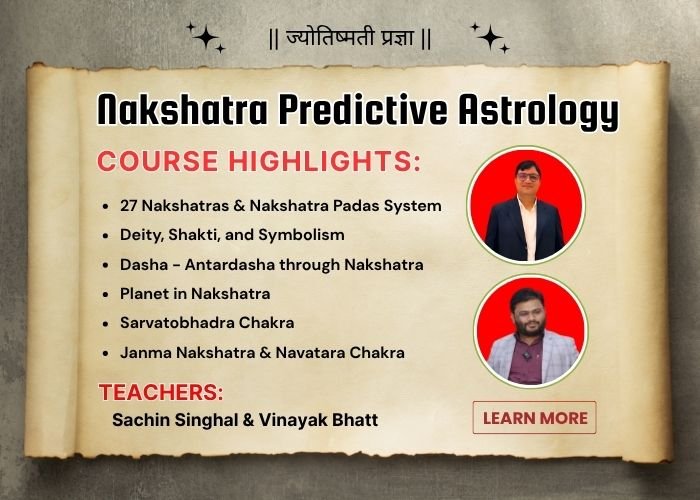
Why This Course?
The course is designed to help you move beyond simply memorizing Nakshatra characteristics and develop a structured, practical and predictive approach to Nakshatra Astrology.
Understand the Nakshatra. Refine it through the Pada. Connect it with the planet, Tara, Dasha and life event — and develop a deeper approach to Jyotish prediction.
MODULE 1 — Foundations of Nakshatra Shastra
1. Understanding the Nakshatra Framework
Concept and significance of Nakshatras.
The 27 Nakshatra system.
Nakshatra Mandala and placement through the zodiac.
Relationship between Rashi and Nakshatra.
Importance of Nakshatras in predictive astrology.
Role of the Moon and Janma Nakshatra.
Introduction to Abhijit and the 28-Nakshatra framework.
2. Anatomy of a Nakshatra
Understanding each Nakshatra through:
Zodiacal span.
Nakshatra Lord.
Presiding Deity.
Shakti.
Symbol.
Core meaning and theme.
Four Padas.
Nakshatra sounds.
Principal significations.
MODULE 2 — The Predictive Language of Nakshatras
1. Deity, Shakti and Symbolism
Understanding the presiding Deity of each Nakshatra.
Understanding the Shakti or inherent power of the Nakshatra.
Interpreting Nakshatra symbols.
Connecting symbolism with practical interpretation.
2. Multi-Layered Nakshatra Classification
Understanding classifications such as:
Gana.
Guna.
Caste.
Yoni.
Dharma, Artha, Kama and Moksha.
Element.
Direction.
Orientation.
Activity.
Functional nature.
Body-part association.
Dosha and other relevant classifications.
MODULE 3 — Detailed Study of the 27 Nakshatras
Each Nakshatra will be studied through:
Core nature and meaning.
Deity.
Shakti.
Symbol.
Nakshatra Lord.
Four Padas.
Gana, Guna and Yoni.
Motivation.
Element and orientation.
Behavioural tendencies.
Constructive and challenging expressions.
Practical predictive observations.
Nakshatras Covered
Ashwini, Bharani, Krittika, Rohini, Mrigashira, Ardra, Punarvasu, Pushya, Ashlesha, Magha, Purva Phalguni, Uttara Phalguni, Hasta, Chitra, Swati, Vishakha, Anuradha, Jyeshtha, Mula, Purva Ashadha, Uttara Ashadha, Shravana, Dhanishtha, Shatabhisha, Purva Bhadrapada, Uttara Bhadrapada and Revati.
MODULE 4 — Nakshatra Pada
1. Understanding the Four Padas
Fourfold division of every Nakshatra.
Pada and Navamsha relationship.
How each Pada changes the expression of the Nakshatra.
Pada-level refinement in interpretation.
Pushkara Navamsha and Pushkara Bhaga where applicable.
MODULE 5 — How Planets Behave in Different Nakshatras
2. Planet in Nakshatra
A simple and practical understanding of:
How each planet behaves when placed in different Nakshatras.
How the Nakshatra changes the expression of a planet.
Why the same planet can give different results in different Nakshatras.
How the four Padas further modify planetary behaviour.
Practical interpretation through examples and charts.
The purpose is simple:
To understand not only the planet, but how that planet behaves in the specific Nakshatra in which it is placed.
MODULE 6 — Janma Nakshatra and Navatara Chakra
1. Janma Nakshatra
Importance of the Moon's birth Nakshatra.
Janma Nakshatra as a reference point.
Behavioural tendencies.
Life patterns.
Predictive application.
2. Navatara Chakra
Detailed study of:
Janma
Sampat
Vipat
Kshema
Pratyari
Sadhana
Naidhana / Vadha
Mitra
Paramamitra
Application
Calculating Tara relationships.
Favourable and challenging Tara positions.
Application in prediction.
Application in timing.
Application in Dasha–Antardasha.
Application in relationships.
MODULE 7 — Nakshatra Nexus in Dasha–Antardasha
1. Dasha–Antardasha through Nakshatra
Nakshatra of the Dasha Lord.
Nakshatra of the Antardasha Lord.
Relationship between Dasha and Antardasha Nakshatras.
Tara relationship of activated Nakshatras.
Understanding favourable and challenging periods.
Practical case studies.
The focus is to understand the Nakshatra connection operating behind Dasha–Antardasha results.
MODULE 8 — Nakshatra Tattva and Special Nakshatras
1. Nakshatra Tattva
Elemental grouping of Nakshatras.
Tattva relationships.
Practical interpretation through Nakshatra groups.
2. Special Nakshatra Conditions
Pushkara Nakshatra.
Gandanta Nakshatra.
Panchaka Nakshatra.
Abhijit.
Special Nakshatra groups and sensitive positions.
MODULE 9 — Nakshatra Sight, Direction and Orientation
1. Mukha and Nakshatra Orientation
Adhomukha Nakshatra.
Urdhva Mukha Nakshatra.
Tiryanga Mukha Nakshatra.
Directional qualities.
Nakshatra sight.
Practical application.
MODULE 10 — Namakaran Shastra through Nakshatra
1. Nakshatra-Based Naming
Janma Nakshatra and naming.
Four Padas and syllables.
Namakshara.
Selection of name sounds.
Practical Namakaran exercises.
MODULE 11 — Nakshatra in Muhurta
2. Nakshatra-Based Muhurta Selection
Role of Nakshatra in Muhurta.
Understanding the inherent quality of each Nakshatra.
Matching the nature of an activity with the appropriate Nakshatra.
Fixed and movable Nakshatras.
Light, swift, sharp and mixed Nakshatras.
Suitable and unsuitable activities.
Practical Muhurta assessment.
MODULE 12 — Sarvatobhadra Chakra
1. Sarvatobhadra Chakra
Introduction to Sarvatobhadra Chakra.
Structure and Nakshatra arrangement.
27/28 Nakshatra framework.
Nakshatra-based application.
Practical interpretation.
MODULE 13 — Kurma Chakra
2. Kurma Chakra
Introduction to Kurma Chakra.
Structure and Nakshatra arrangement.
Directional and spatial understanding.
Practical Nakshatra-based application.
MODULE 14 — Nakshatra Remedies
1. Remedial Application
Nakshatra-specific remedial principles.
Remedies related to difficult Tara positions.
Deity-oriented remedies.
Remedies during Dasha–Antardasha.
Practical application of remedies.
MODULE 15 — Nakshatra Compatibility and Relationships
2. Relationship Application
Gana-based compatibility.
Yoni-based compatibility.
Tara compatibility.
Nakshatra relationship between two individuals.
Marriage and relationship assessment.
Supportive and challenging Nakshatra combinations.