Why We Are Conducting This Special Ganesh Chaturthi Anuṣṭhāna
Most people have heard the Gaṇapati Atharvaśīrṣa.
Many can even chant parts of it.
But very few students have been taught to stop and ask:
What is this text actually teaching?
Why does it call Gaṇapati Tattva?
Why does it call him Vāṅmaya — the very embodiment of speech?
Why does it call him Cinmaya — consciousness itself?
Why does the text speak about the five Mahābhūtas?
Why does it speak of the three Guṇas?
Why does it speak of the three states of consciousness?
Why does it specifically say:
त्वं मूलाधारस्थितोऽसि नित्यम् ॥
“You are eternally established in Mūlādhāra.”
Why does the text reveal the construction of the Gaṇapati Bīja?
And what is the meaning of these teachings for somebody studying Jyotish, mantra, karma, remedies and Vedic sciences?
These are the questions we will study during this programme.
Because the purpose is not simply to make you repeat Atharvaśīrṣa for seven days.
The purpose is that by the time you sit for the Mahā-Abhiṣeka on Ganesh Chaturthi, you should know what you are chanting.
Program Stages
From Pāṭha to Tattva
There are three stages in this programme:
- Pāṭha — Learn to Chant
During seven guided sessions, participants will become familiar with the complete flow of the Gaṇapati Atharvaśīrṣa.
We will work with the text slowly so that students can understand its divisions, pronunciation, important words and sequence.
The objective is simple:
On Ganesh Chaturthi, nobody should feel like a passive spectator.
You should be able to participate in the collective chanting with awareness.
- Artha — Understand What You Are Chanting
After the chanting preparation, we will conduct two special commentary sessions.
Here we move beyond pronunciation.
We begin opening the philosophy hidden inside the mantra.
For example:
त्वं वाङ्मयस्त्वं चिन्मयः ।
त्वमानन्दमयस्त्वं ब्रह्ममयः ॥
Gaṇapati is described as Vāṅmaya and Cinmaya.
Vāk is not merely ordinary speech.
For a Jyotishi, this becomes very important.
A horoscope may show a combination.
Your intellect has to recognise the pattern.
But finally, your Vāk has to convert that pattern into a prediction.
This is why knowledge alone does not make a great Jyotishi.
There must be clarity between Darśana, Buddhi and Vāk.
A person may know one hundred combinations and still speak without precision.
Another astrologer may see three factors and speak one sentence that enters directly into the life of the client.
That difference is worth studying.
- Anuṣṭhāna — Bring Knowledge into Worship
Finally comes Ganesh Chaturthi.
The learning of the previous nine sessions culminates in the Śrī Mahāgaṇapati Atharvaśīrṣa Abhiṣeka.
Every registered participant will join with Sankalpa.
And together we will chant the sacred Atharvaśīrṣa during the Abhiṣeka.
This gives a completely different quality to participation.
You are no longer merely watching somebody perform a Puja for you.
You have prepared.
You have studied.
You know the mantra.
You understand something of its Tattva.
And now your own voice becomes part of the collective Upāsanā.
That is the real intention behind this programme.
Gaṇapati, Vāk and Prediction
One of the statements we will examine is:
त्वं वाङ्मयस्त्वं चिन्मयः
“You are the essence of speech; you are the essence of consciousness.”
For an astrologer this deserves meditation.
A prediction exists first as an internal recognition.
Then it becomes thought.
Then language.
Then sound.
And finally that sound enters another person's consciousness.
So Vāk carries responsibility.
This is why traditional Jyotish was never separated completely from Sādhana.
The quality of the astrologer's consciousness affects the quality of the judgement.
The quality of judgement affects the quality of speech.
And the quality of speech affects the person receiving the prediction.
This relationship between Mantra, Vāk and Jyotish will be one of the important themes of our commentary.
Gaṇapati and the Five Mahābhūtas
The Atharvaśīrṣa says that Gaṇapati is present as:
Bhūmi — Earth
Āpa — Water
Anala — Fire
Anila — Air
Nabha — Space
For the student of Jyotish this opens another door.
Grahas and Rāśis do not operate in an abstract world.
Their results finally manifest through the field of the elements.
Body.
Environment.
Food.
Speech.
Action.
Direction.
Objects.
Relationships.
Profession.
Disease.
Residence.
All manifestation requires a field.
Understanding Pañca Mahābhūta therefore changes the way we understand both Jyotish and remedial measures.
We will discuss this connection during the Atharva Vidyā sessions.
Gaṇapati and Mūlādhāra
Another remarkable declaration is:
त्वं मूलाधारस्थितोऽसि नित्यम्
Gaṇapati is eternally established in Mūlādhāra.
Mūla means root.
Before something can rise, its root must hold.
This principle can also be understood astrologically.
When the foundation of life becomes unstable, everything built on it begins demanding attention.
Family.
Security.
Health.
Money.
Confidence.
Place of residence.
Direction in life.
Even spiritual practice can become scattered when the foundation is disturbed.
So Gaṇapati Sādhana is not only about asking:
“Remove my obstacle.”
The deeper question is:
“Where has my inner order been disturbed?”
That is a much more useful question for a student of karma and Jyotish.
Special Jyotish Commentary: Gaṇapati and Ketu
Students of Jyotish will also recognise the traditional relationship often made between Śrī Gaṇapati Upāsanā and Ketu.
But this will not be taught as the usual one-line rule:
“Ketu problem = worship Gaṇeśa.”
We will examine the logic.
Ketu cuts.
Ketu separates.
Ketu can remove attachment to form.
Ketu can produce discontinuity, strange breaks, invisible causes and experiences which ordinary logic cannot completely organise.
But the same Ketu is deeply connected with inwardness, discrimination beyond appearances and spiritualisation when properly directed.
Now consider Gaṇapati.
He stands at the threshold.
He establishes order before movement.
He gives discrimination before undertaking.
This gives us a much richer way of understanding why Gaṇapati Upāsanā has an important place in the remedial and spiritual language used by many Jyotish traditions.
We will discuss how this principle may be observed rather than blindly turning it into another mechanical astrological remedy.
What Is Atharva Vidyā?
The two special commentary sessions will introduce students to Atharva Vidyā in its wider Vedic sense.
This should not be confused with sensational ideas about “secret magic.”
Atharva traditions contain an important applied dimension of Vedic knowledge — dealing with human life, Śānti, protection, restoration of order, mantra, Sankalpa and the relationship between subtle intention and practical life.
During these sessions our focus will remain on principles useful to a serious student:
Mantra and Sankalpa
Why the same mantra recited mechanically and the same mantra approached with understanding are not psychologically the same practice.
Vāk Śakti
How sacred sound, pronunciation, repetition, attention and meaning are related.
Mantra Devatā
Why mantra cannot be reduced merely to syllables.
Bīja
What a Bīja represents and why the Atharvaśīrṣa itself explains the formation of Gaṇapati's mantra.
Śānti
Why Vedic recitation begins by creating a field of order rather than immediately asking for material results.
Pañca Mahābhūta
How the five elements provide the field through which manifestation takes place.
Mūlādhāra
Why Gaṇapati is placed at the root and what the symbolism teaches us about beginning any serious undertaking.
Vāk and Jyotish
Why the astrologer's speech itself should become a subject of Sādhana.
Mantra and Karma
Can mantra erase karma?
Or does Upāsanā change our relationship with karma, strengthen appropriate action and create the inner condition through which karma may be handled differently?
We will examine these questions carefully without reducing Vedic remedies to superstition or instant promises.
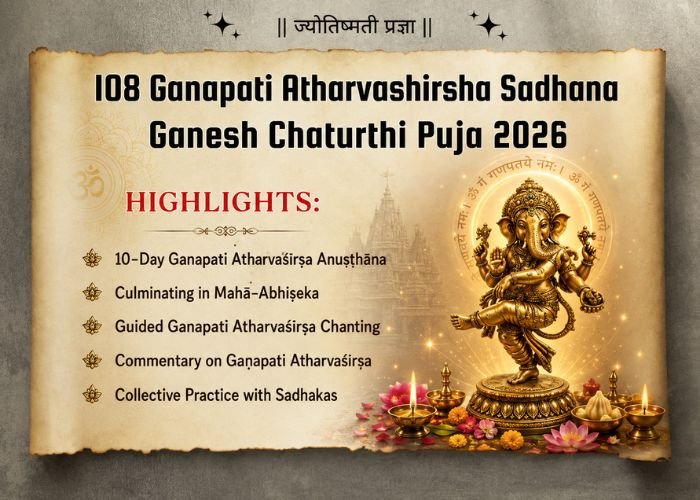
The 10-Day Sacred Journey
DAYS 1–7
Guided Gaṇapati Atharvaśīrṣa Chanting Sādhana
For seven days we prepare together.
Participants will work with:
- Śānti Pāṭha
- structure of Gaṇapati Atharvaśīrṣa
- guided pronunciation
- important Sanskrit words
- correct flow of the recitation
- Gaṇapati Tattva
- important mantra portions
- understanding the intention behind chanting
- developing continuity in daily recitation
- preparing for collective chanting on Ganesh Chaturthi
The purpose is not to judge who is an expert Sanskrit chanter.
The purpose is to help every sincere participant chant with greater confidence, understanding and Bhāva.
DAYS 8–9
Special Commentary on Gaṇapati Atharvaśīrṣa & Atharva Vidyā
These two sessions are the intellectual and spiritual heart of the programme.
We will take important statements from the Atharvaśīrṣa and decode their meaning.
Topics will include:
Gaṇapati as Pratyakṣa Tattva
Kartā – Dhartā – Hartā
Creation, sustenance and dissolution.
Vāṅmaya and Cinmaya
Speech and consciousness.
Jñāna and Vijñāna
Knowledge and realised or applied understanding.
Pañca Mahābhūta
Earth, Water, Fire, Air and Space.
Four levels of Vāk
Their significance in mantra and sacred speech.
Guṇa-traya
Sattva, Rajas and Tamas.
Avasthā-traya
Different states of consciousness.
Deha-traya
The deeper understanding of embodiment.
Kāla-traya
Past, present and future.
A fascinating subject for every student of Jyotish.
Mūlādhāra and Śakti
Why Gaṇapati is placed at the root.
Gaṇapati Bīja
The mantra construction given within the text.
Gaṇapati Gāyatrī
एकदन्ताय विद्महे वक्रतुण्डाय धीमहि
तन्नो दन्तिः प्रचोदयात् ॥
Gaṇapati and Jyotish
Vāk, Buddhi, Ketu, Karma, Sankalpa and the responsibility of prediction.
Atharva Vidyā
How applied Vedic knowledge approaches Śānti, protection, order, intention and mantra.
DAY 10 — GANESH CHATURTHI
Grand Śrī Mahāgaṇapati Atharvaśīrṣa Abhiṣeka
Monday, 14 September 2026
This is where the nine days of preparation culminate.
A sacred Sankalpa will be taken for registered participants.
Śrī Gaṇapati will be worshipped traditionally.
The Mahā-Abhiṣeka will be performed with the recitation of the Gaṇapati Atharvaśīrṣa.
And all participating students will chant together.
One mantra.
One rhythm.
One Sankalpa.
Many voices.
Before beginning a new cycle of study, work and life, we place our Buddhi and Vāk at the feet of Gaṇapati.
Your Personal Sankalpa in the Mahā-Abhiṣeka
Every registered Puja participant will be included through a formal Sankalpa.
Participants will be asked to submit the required traditional details before the event, such as:
Name
Gotra, where known
Janma Rāśi
Janma Nakṣatra
Further instructions regarding Sankalpa and participation will be provided after registration.
This is not simply registration for a lecture.
Your primary registration is for participation in the Ganesh Chaturthi Puja and Śrī Mahāgaṇapati Atharvaśīrṣa Abhiṣeka.
The learning programme prepares you for that worship.
What Is Included in Your ₹5,000 Participation
Śrī Gaṇapati Puja & Mahā-Abhiṣeka Sankalpa
Your Sankalpa is included in the Ganesh Chaturthi worship and Atharvaśīrṣa Abhiṣeka.
7 Guided Atharvaśīrṣa Chanting Sessions
Learn and practise before the festival so that you can participate actively in the final collective recitation.
2 Detailed Commentary Sessions
Study the inner meaning of Gaṇapati Atharvaśīrṣa and an introduction to Atharva Vidyā.
Special Jyotish Connections
Understand Gaṇapati through Vāk, Buddhi, Ketu, Pañca Mahābhūta, Mūlādhāra, Kāla and the discipline required of a Jyotishi.
Collective Ganesh Chaturthi Chanting
On the final day all students participate together in Gaṇapati Atharvaśīrṣa Pāṭha during the sacred observance.
No Additional Teaching Fee
The chanting preparation and two commentary sessions are offered without any separate course fee to registered Puja participants.
Your contribution is for your Puja, Sankalpa and Mahā-Abhiṣeka participation: ₹5,000.
Why Gaṇapati Atharvaśīrṣa Is Important for a Student of Jyotish
There is a beautiful mistake we make in Jyotish.
We think astrology begins with the first horoscope.
It does not.
Jyotish begins with the mind that is going to read the horoscope.
Before interpreting somebody else's karma, the instrument of interpretation must become clear.
A Jyotishi requires:
Smṛti — ability to retain knowledge.
Buddhi — ability to discriminate.
Vāk — ability to express what has been seen.
Dhāraṇā — ability to hold several astrological factors together.
Sankalpa — clarity of intention.
Viveka — knowing which indication is primary and which is secondary.
And above everything, the humility to understand that a chart is the language of Kāla and not merely an intellectual puzzle.
The Atharvaśīrṣa gives us a profound framework for this inner preparation.
Who Should Join Ganapati Atharvashirsha Sadhana?
This Programme Is Especially Suitable for You If…
You are a student or practitioner of Jyotish and want to connect your astrological study with traditional Sādhana.
You regularly chant Gaṇapati Atharvaśīrṣa but have never properly studied its meaning.
You want to understand why Gaṇapati is connected with Buddhi, Vāk, Tattva and Mūlādhāra.
You want to understand the deeper reasoning behind Gaṇapati remedies used in Jyotish.
You are interested in Mantra Śāstra, Atharva Vidyā and traditional Vedic practices.
You want to participate in Ganesh Chaturthi as a practitioner rather than merely as an observer.
Or you simply have Śraddhā towards Śrī Gaṇapati and want to dedicate these sacred days to disciplined chanting and worship.
No advanced knowledge of Sanskrit or Jyotish is required for sincere participation.
This Is Not Just a “Remedy for Obstacles”
Gaṇapati is commonly called Vighneśvara, Lord of obstacles.
But if we stop there, we miss much of the teaching.
Sometimes the greatest obstacle is not outside.
It is confusion.
Wrong judgement.
Scattered attention.
Poor discrimination.
Speaking before understanding.
Beginning without preparation.
Repeatedly choosing the wrong direction.
Failing to recognise what must first be corrected at the root.
This is why Gaṇapati stands at the beginning.
Not simply because he makes every difficulty disappear.
But because a correct beginning itself prevents many future difficulties.
For a Jyotishi, this is an important teaching.
Prediction also requires us to find the root before describing the result.
Remedy also requires us to understand the cause before prescribing an action.
And spiritual practice requires us to establish the foundation before seeking higher experiences.
This is the Gaṇapati principle we want students to understand.
Your Personal Sankalpa in the Mahā-Abhiṣeka
Every registered Puja participant will be included through a formal Sankalpa.
Participants will be asked to submit the required traditional details before the event, such as:
Name
Gotra, where known
Janma Rāśi
Janma Nakṣatra
Further instructions regarding Sankalpa and participation will be provided after registration.
This is not simply registration for a lecture.
Your primary registration is for participation in the Ganesh Chaturthi Puja and Śrī Mahāgaṇapati Atharvaśīrṣa Abhiṣeka.
The learning programme prepares you for that worship.
Exam Details & Certification
Certification details will be provided during the course.
Your Instructor
Instructor information will be updated soon.