
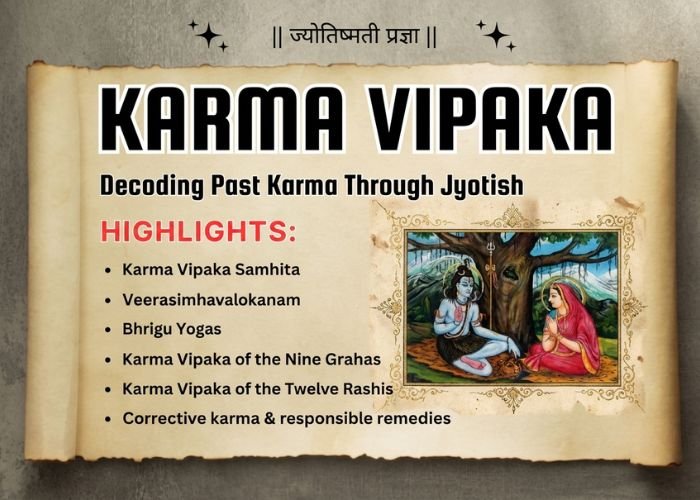
Why This Course?
What You Will Learn
1. Foundations of Karma Vipaka
We will begin by understanding the meaning of Karma and Vipaka from the Jyotish point of view.
You will learn:
- The difference between past action and present result
- How unfinished karma becomes a repeated life pattern
- How a karmic promise becomes active through Graha and Dasha
- Why every difficult placement should not be called bad karma
- The difference between punishment, repayment, responsibility and correction
- How good karma also appears as protection, knowledge, support and opportunity
The purpose is not to create fear.
The purpose is to understand the cause behind a pattern and the correct way to work with it.
2. How to Decode Karma Vipaka Samhita
Karma Vipaka Samhita cannot be understood by reading its stories only in a literal manner.
Every story contains several layers.
A place may indicate a direction or Rashi.
A person may indicate a Graha or relationship.
An action may indicate a Bhava, Karaka or planetary association.
An object may indicate wealth, land, food, marriage, lineage, duty or spiritual merit.
In this section, you will learn how to separate the different parts of a Karma Vipaka description and convert them into usable Jyotish rules.
We will study:
- How to identify the central karma in a story
- How to identify the person who created the karma
- How to identify the person through whom the karma returns
- The role of Nakshatra and Nakshatra Pada
- How to connect the story with Graha Karakatwa
- How to connect the result with Bhava and Rashi
- How to understand the stated suffering or blessing
- How to identify the corrective action or Prayaschitta
- How to test the principle in actual horoscopes
Students will learn why the same story cannot be applied mechanically to every person born in the same Nakshatra Pada.
The complete horoscope must support the result.
3. Veerasimhavalokanam and the Karmic Cause of Suffering
Veerasimhavalokanam gives an important approach to understanding the connection between karma, health, suffering and corrective measures.
In this section, we will examine how a physical or emotional difficulty may be connected with a deeper karmic pattern shown in the horoscope.
We will discuss:
- How Grahas become carriers of karmic consequences
- The connection between conduct, disease and planetary affliction
- How Bhava and Karaka show the area of suffering
- How repeated behaviour strengthens a difficult planetary result
- Why a disease combination should not be judged from one planet
- How karmic interpretation must be separated from medical diagnosis
- How corrective conduct can become part of a Jyotish remedy
This section will help students understand that Karma Vipaka is not only about finding a past-life story.
It is also about recognising which behaviour must be corrected in the present life.
4. Bhrigu Yogas and Past-Life Patterns
Bhrigu Yogas often carry direct information about relationships, duties, debts, blessings, betrayals, family karma, wealth and suffering.
But these Yogas must be understood through planetary Karakatwa and the sequence of planets.
We will study selected Bhrigu Yogas connected with:
- Unpaid debts
- Broken promises
- Family responsibilities
- Marriage and relationship karma
- Children and lineage
- Property and inheritance
- Wealth gained through previous merit
- Wealth lost due to previous misuse
- Disease and physical suffering
- Service, sacrifice and repayment
- Protection received from previous good karma
- Spiritual knowledge carried from earlier births
Students will learn how to understand the action, its karmic result and the people involved through the participating Grahas.
5. Karma Vipaka of the Nine Grahas
Every Graha carries a particular type of responsibility.
The placement and association of a Graha show where its karma may mature.
We will examine the Karma Vipaka of:
Surya
Karma connected with father, authority, pride, honour, government, leadership and misuse of power.
Chandra
Karma connected with mother, emotional care, nourishment, family memory, public response and mental peace.
Mangala
Karma connected with land, brothers, violence, courage, protection, conflict, injury and misuse of physical strength.
Budha
Karma connected with speech, promises, business, calculation, documents, education, communication and intellectual dishonesty.
Guru
Karma connected with teachers, children, knowledge, wealth, Dharma, guidance, blessings and misuse of wisdom.
Shukra
Karma connected with marriage, women, pleasure, comfort, beauty, sexuality, agreements and material enjoyment.
Shani
Karma connected with labour, servants, poverty, duty, delay, neglect, elderly people and social responsibility.
Rahu
Karma connected with desire, manipulation, deception, foreign influence, obsession, social image and crossing boundaries.
Ketu
Karma connected with separation, abandonment, spiritual memory, rejection, hidden guilt and unfinished detachment.
The predictions will not be based on Graha Karakatwa alone. We will study how conjunction, house lordship, Rashi, Nakshatra and supporting Yogas modify the result.
6. Karma Vipaka of the Twelve Rashis
A Graha shows the living force of karma.
A Rashi shows the field and environment where that karma operates.
We will study how every Rashi carries a particular karmic lesson.
This will include:
- Aries and the karma of action, aggression and initiative
- Taurus and the karma of possessions, food, family values and attachment
- Gemini and the karma of speech, information and dual conduct
- Cancer and the karma of family, protection, homeland and emotional memory
- Leo and the karma of authority, recognition, children and personal pride
- Virgo and the karma of service, correction, criticism, health and repayment
- Libra and the karma of agreements, marriage, balance and justice
- Scorpio and the karma of secrecy, betrayal, shared resources and transformation
- Sagittarius and the karma of Dharma, teachers, belief and judgement
- Capricorn and the karma of work, hierarchy, duty and social structure
- Aquarius and the karma of society, groups, reform and collective responsibility
- Pisces and the karma of sacrifice, escape, surrender, faith and liberation
Students will learn how the Rashi changes the way a Graha delivers its karmic result.
7. Combining Graha, Rashi, Nakshatra and Pada
The real judgement begins when we combine all the layers.
For example, it is not enough to say that Shani shows old karma.
We must ask:
- Which Rashi contains Shani?
- Which Bhava is affected?
- Which Nakshatra carries Shani?
- What is the Pada?
- Which Graha rules that Nakshatra?
- Which planets join or influence Shani?
- What relationship or event does Shani represent in that horoscope?
- Which Dasha or transit activates the result?
This method will help students move from general statements to chart-specific predictions.
8. Original Research and Unpublished Techniques
During the webinar, I will share my original research developed through the study of classical texts and practical horoscope testing.
This will include techniques that have not been taught in my earlier public classes.
The research section will cover:
- How to recognise the main karmic planet in a chart
- How to identify whether a Graha is giving debt, repayment or reward
- How to find the person through whom past karma returns
- How to separate inherited family karma from personal karma
- How to identify repeating karmic patterns
- How to connect Nakshatra stories with Graha Karakatwa
- How to judge whether a Karma Vipaka indication will manifest strongly or remain mild
- How to understand the difference between karmic suffering and ordinary life difficulty
- How present conduct can reduce or strengthen a planetary pattern
- How to test a classical statement without applying it blindly
Several horoscope examples will be discussed to explain the working of these principles.
9. Corrective Karma and Remedies
A remedy should not become a method of escaping responsibility.
The first remedy is to understand the mistake shown by the Graha.
The second remedy is to correct the behaviour connected with that Graha.
The third remedy is the appropriate act of Seva, Dana, Mantra, worship or Prayaschitta.
We will discuss:
- Why remedies fail when behaviour remains unchanged
- How to identify the correct Graha for a remedy
- The difference between strengthening a Graha and correcting its karma
- Why a strong planet can still produce difficult Karma Vipaka
- How Seva and Dana should be selected
- Why fear-based remedies should be avoided
- How to recommend remedies responsibly