
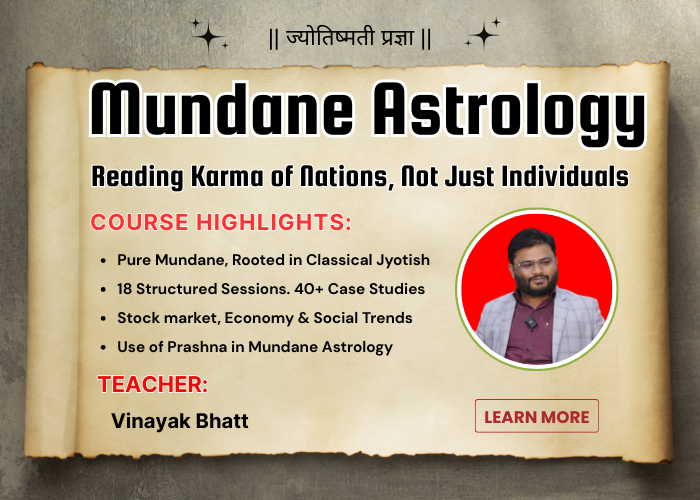
Why This Course?
Most astrology teaching stops at the individual level:
birth chart, marriage, job, health, property.
But the Rishis also gave a complete branch where the “native” is a country, a king, a government, a city, or even a stock market index. That branch is Mundane Astrology.
In this course you learn to read:
- charts of nations,
- ingress charts,
- yearly (Varshphal-type) charts for countries,
- eclipse charts,
- event charts,
- and Prashna charts for collective questions.
You begin to see how signs, planets and Nakshatras behave when the canvas is a whole nation, not a single family.
For example:
- A fiery sign activated in the 4th house of a nation’s chart can show internal unrest, agitation, civil disturbances.
- A strongly benefic Jupiter transiting key national points may show policy reforms, prosperity, or major spiritual/religious movements.
- Eclipses across the Lagna or 10th house of a country can mark turning points in leadership or economic shock.
The course takes you steadily from basic symbolic understanding to timed predictions of events such as:
- elections,
- policy changes,
- social movements,
- economic booms and slowdowns,
- natural disasters like earthquakes,
- and other collective shifts.
The first five classes build a solid base: significations of signs, planets, houses, Nakshatras and chart types in Mundane context. After that, the tools of transits, eclipses, yearly charts and Prashna are layered on top, and you spend many hours on case studies.
The tone of teaching is traditional, but language stays simple and direct, like a senior astrologer explaining to students in a small group.

Curriculum Overview
1. Significations of Signs in Mundane Astrology – 1 Session
- How each zodiac sign represents parts of the world, types of countries, climates, crops, industries, public moods.
- For example, watery signs and flood-prone regions, fiery signs and drought or fire-related events, airy signs and movements of ideas, rumours, and media.
- Which signs are more prone to war, trade, spirituality, disease, revolution when triggered.
2. Significations of Planets in Mundane Astrology – 1 Session
- Role of each planet as minister in the cosmic cabinet:
– Sun for rulers, heads of state, national ego,
– Moon for public mood, masses, water, food, women,
– Mars for armed forces, conflict, accidents,
– Mercury for trade, communication, markets,
– Jupiter for law, religion, education, banking,
– Venus for arts, luxury, peace treaties,
– Saturn for labour, mining, poverty, discipline,
– Rahu–Ketu for unusual events, epidemics, sudden surges and crashes. - How planetary strengths and combustions reflect world conditions.
3. Significations of Houses in Mundane Astrology – 1 Session
- Interpretation of 12 houses when the native is a nation:
– 1st: national identity and health,
– 2nd: economy, treasury, banking, food supply,
– 4th: land, agriculture, internal peace, opposition parties,
– 7th: treaties, foreign partners and rivals,
– 10th: government, leadership, reputation, public decisions,
– and so on. - How house interlinks show tension between government vs opposition, people vs policy, army vs state, etc.
4. Significations of Nakshatras in Mundane Astrology – 1 Session
- How Nakshatras act as fine-tuning layer on signs in Mundane charts.
- Important Nakshatras linked with:
– earthquakes,
– maritime issues,
– stock market turbulence,
– religious events,
– scientific breakthroughs. - How to observe Nakshatra cycles for recurring national patterns.
5. Types of Mundane Charts – 1 Session
- National charts (independence, constitution, coronation).
- Foundation charts of cities, states, important institutions.
- Ingress charts: Sun ingress, Jupiter/Saturn ingress into signs.
- Event charts: treaties, wars, market opening, disasters.
- How to decide which chart to use for which kind of prediction.
6. Basic Principles of Judgment – 1 Session
- Disentangling multiple charts: D1 of nation, ingress charts, Varsh charts.
- Priority rules: when to go by transits, when by annual chart, when by eclipse, when by Prashna.
- Simple step-wise method for analysing any Mundane situation.
7. Basics of Transits – 1 Session
- Role of slow-moving planets (Saturn, Jupiter, Rahu–Ketu) in shaping national destiny.
- Basic transit rules for growth, tension, crisis, recovery.
- How transit to key national points (Lagna, 4th, 10th, 2nd) reflects collective events.
8. Advanced Transit Principles & Application in Mundane Astrology – 2 Sessions
- Special transit combinations for:
– war-like conditions,
– financial crashes or booms,
– change of leadership,
– social unrest, mass protests. - Layering transit on:
– national chart,
– yearly chart,
– and important event charts. - Saturn–Jupiter cycles, nodal movements, retrograde periods and their impact on the rhythm of history.
9. Eclipses – 1 Session
- Solar and lunar eclipses as trigger points.
- Eclipses falling over key national houses and planets.
- How eclipses often mark turning points:
– policy change,
– scandals,
– leadership shifts,
– natural events. - Examples from known years where eclipses coincided with major world events.
10. Earthquakes – 1 Session
- Astrological methods traditionally used to see earthquake potential.
- Sign, Nakshatra, and planetary patterns linked to seismic events.
- Use of ingress and eclipse charts for shortlisting vulnerable periods.
- Discussion of selected historical earthquakes and the charts around them.
11. Using Yearly Charts to Make Predictions – 2 Sessions
- Concept of annual charts for nations: Varsh chart style.
- How to set, read, and interpret these yearly charts:
– which houses become prominent,
– how year-lord behaves,
– what is promised about politics, economy, weather, security. - Linking yearly charts with transits for month-wise forecasting.
12. Detailed Case Studies: Elections & Major Events – 4 Sessions
- Study of at least 40 case studies:
– national elections,
– government changes,
– major economic reforms or crashes,
– wars and ceasefires,
– large-scale movements or protests. - You see step-by-step:
– which charts were used,
– which rules were applied,
– which transits and eclipses acted as triggers,
– what was clear, what was subtle.
This is the heart of the course where theory becomes real.
13. Prashna Methods in Mundane Astrology – 2 Sessions
- Using Prashna for collective questions:
– “Will this government stay?”,
– “Is war likely in the coming months?”,
– “Will this policy be withdrawn?”,
– “Will this alliance hold?” - How Prashna interacts with national and annual charts.
- Sample Prashna charts related to national and global questions.
Learning Outcome
By the end of the course, a sincere student should be able to:
- Understand how signs, planets, houses and Nakshatras operate in Mundane charts, not only in personal charts.
- Read and interpret national, ingress, and yearly charts for countries and institutions.
- Use transits and eclipses to anticipate periods of tension, growth or change in a nation.
- Analyse and discuss elections, economic events, wars, social movements, earthquakes and other major events using Mundane principles.
- Use Prashna for specific questions related to national and global affairs.
- Build a simple forecasting framework for the next month / quarter / year for a country, based on charts and transits.
- Connect Mundane signals with stock market and economic trends at a conceptual level (if you already know financial astrology, this course will deepen your macro view).
Who Should Join This Course
- Astrology students who want to move from individual charts to collective charts.
- Practising astrologers who wish to comment responsibly on elections, markets, disasters, or world events.
- Students of Stock Market & Trading Astrology who want a Mundane backbone for their market work.
- Anyone who feels curious when big events happen and wants to see the astrological logic behind history.
Pre-Requisites
- You should already know basic Vedic astrology:
– 9 planets, 12 signs, 12 houses,
– basic dignity concepts (exaltation, debility, own sign),
– some experience reading D1 charts. - Basic understanding of transit and dashā helps, but transit will be taught in the course as well.
- Comfort with simple English and regular attendance for 5–6 months.
Exam Details & Certification
To bring discipline and clarity in Mundane work:
- Assignments:
– written analysis of given national charts,
– simple transit-based forecasts for a defined period,
– interpretation of a yearly chart for one country,
– short Prashna-based judgements for collective questions. - Format:
– online written submissions,
– may include one live presentation or discussion-based assessment towards the end. - Evaluation:
Focus is on:
– correctness of astrological logic,
– sobriety and responsibility in prediction,
– ability to connect different tools (chart + transit + eclipse + Varsh chart). - Certification:
Students who complete the course and required assessments receive a Certificate of Completion – Complete Course on Mundane Astrology (2025) from the institute.
Your Instructor
Vinayak Bhatt
- Known for detailed work in:
– Stock Market & Trading Astrology,
– Prashna and Horary methods,
– Advanced Vedic and Nadi astrology,
– Bhrigu Nandi Nadi. - Has applied Mundane principles to:
– market cycles,
– political events,
– economic changes,
– social disturbances. - Teaching style is paramparā-based but practical: shastra is respected, but every rule is shown working through real charts and events.
This course brings together his experience in predictive work on larger scales, beyond individual lives.